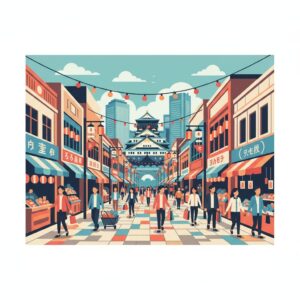
You’ve just moved to Osaka. You’re standing at a tiny takoyaki stand tucked into a side street in Tenma, the sizzling sound and savory smell of batter and octopus filling the air. The old man behind the grill, a master of his craft, flips the octopus balls with lightning speed. Suddenly, one rogue takoyaki flies out of its cast-iron divot and lands on the counter with a soft thud. Without missing a beat, the man points at it with his pick and announces to the small crowd, “Ah, this one’s a feisty one! Trying to make a run for it.” The woman next to you immediately shoots back, “Let him go, he’s probably late for a date!” The chef retorts, “With his looks? He needs more sauce and a prayer.” Everyone, including you, bursts out laughing. In that moment, a simple transaction for a snack becomes a shared piece of micro-theater. This isn’t a special occasion. This is Tuesday.
Welcome to Osaka, where comedy isn’t just a performance you watch on a stage in Namba; it’s the city’s unofficial language, the very rhythm of daily life. It’s a social lubricant, a business tool, and the quickest way to turn a stranger into a temporary friend. While other Japanese cities might prioritize politeness, formality, and reserved distance, Osaka operates on a different frequency, one that’s tuned to the beat of a comedic duo. Understanding this is fundamental to understanding how this city ticks. It’s the key to unlocking why interactions here feel so different, so direct, and so incredibly alive. At the heart of this comedic pulse are two concepts you’ll hear and see constantly: ‘boke’ and ‘tsukkomi’. Forget your textbook Japanese for a moment. This is your crash course in the real Osakan dialect of connection.
If the playful social interplay you just experienced has piqued your interest in the local dining scene, explore Osaka neighborhood snack bars to uncover more of the city’s intimate culinary traditions.
The Unspoken Language of Laughter
In most places, conversations follow a logical progression: a question is answered, and a statement receives a response. In Osaka, however, conversations often take on a comedic form. It’s a real-time game of setup and punchline, played by everyone from grandmothers buying daikon to salarymen waiting for the train. This system is designed to establish rapport quickly.
More Than Just Jokes: Comedy as Connection
Consider a typical interaction in Tokyo, which is built on a foundation of politeness and subtle boundaries. There’s a careful exchange of honorifics and an effort to avoid crossing lines. It’s smooth, efficient, and professional. Osaka, by contrast, discards that rulebook. Here, the quickest way to connect is not through formal greetings but by sharing a laugh, often at one another’s expense. This isn’t rudeness; it’s authenticity. It signals, “Let’s drop the pretense. We’re just people.” A shopkeeper might joke self-deprecatingly about the quality of his goods, or a stranger might playfully tease your brightly colored jacket. It’s not an insult—it’s an invitation. It opens the door to a more genuine, human interaction. They’re testing if you’re willing to join in the game. If you are, you’ve instantly built a bridge that might otherwise take weeks to create in a more formal setting.
The Anatomy of a Conversation: Boke and Tsukkomi
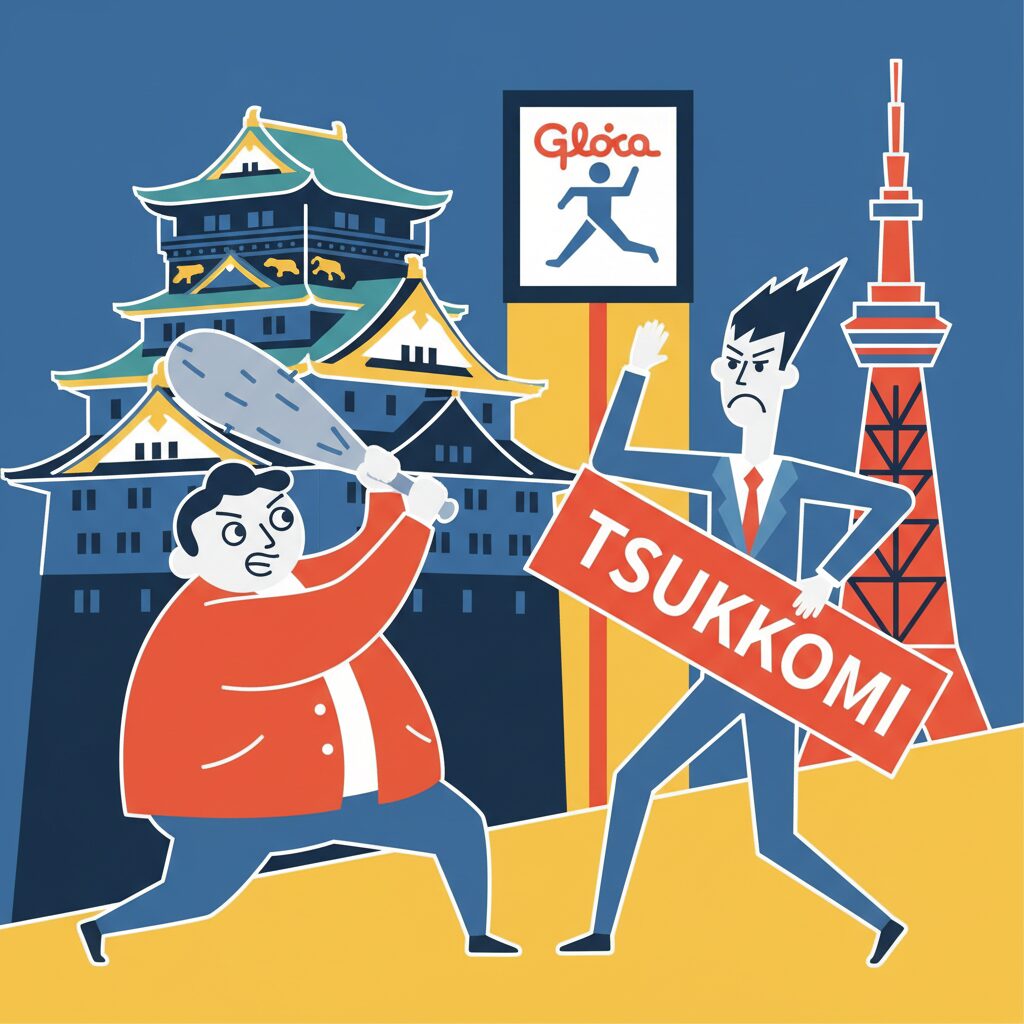
To grasp this dynamic, you need to know its participants. Every great comedic duo features a funny man and a straight man. In Osaka’s everyday life, these roles are known as ‘boke’ and ‘tsukkomi’.
The Boke: The Agent of Chaos
The ‘boke’ (ボケ) derives from the verb ‘bokeru’, meaning to act senile, dazed, or foolish. The ‘boke’ says or does something absurd, illogical, or silly. They provide the setup. They deliberately miss the point, wildly exaggerate, or present the obvious as if it were a groundbreaking discovery. Importantly, being the ‘boke’ isn’t about genuine stupidity—it’s a performance of foolishness, a deliberate act of vulnerability, tossing a comedic ball in the air with the trust that someone will catch it. Without a ‘tsukkomi’, a ‘boke’s’ comment hangs awkwardly in silence, an incomplete exchange.
The Tsukkomi: The Voice of Reason
The ‘tsukkomi’ (ツッコミ) comes from the verb ‘tsukkomu’, meaning to thrust or poke into. The ‘tsukkomi’ acts as the straight man who grounds the ‘boke’ in reality. They deliver the punchline with sharp, witty, and often lightning-fast retorts. The ‘tsukkomi’ anchors the joke by providing context that turns the ‘boke’s’ remark from strange to funny. A classic ‘tsukkomi’ line is “Nande ya nen!” (often translated as “Why?!” or “What the heck?!”), a verbal slap pointing out the absurdity. The ‘tsukkomi’ completes the circuit, delivering the spark of laughter that energizes the conversation.
This dynamic is like a dance—a rapid-fire exchange where people fluidly switch roles or where one person plays ‘boke’ to their friend’s ‘tsukkomi’. It’s the fundamental, unspoken rhythm of communication in Osaka.
Spotting Boke and Tsukkomi in the Wild
Once you learn what to notice, you’ll start spotting it everywhere. It’s the city’s background music, playing out in supermarkets, train stations, and local bars. It turns everyday errands into chances for spontaneous amusement.
The Supermarket Aisle Spectacle
Picture yourself in a bustling supermarket in Namba. A woman reaches for a carton of milk on the top shelf, and as she pulls it down, she accidentally knocks over a bottle of soy sauce, which luckily doesn’t break. In Tokyo, the typical response might be quiet concern. Someone would probably rush over with a soft “Daijoubu desu ka?” (Are you okay?), help her clean up, and the moment would pass amid polite murmurs. In Osaka, however, the scene unfolds differently. An old man nearby might glance over and deadpan, “Starting a new abstract painting? I like the brown theme.” That’s the ‘boke’ — a deliberately silly remark. Rather than feeling embarrassed, the woman might shoot back without hesitation, “Yeah, I’m selling it to a museum later. This one’s called ‘Aisle Five Tragedy.’” She’s joining in, adding another layer to the ‘boke’. Then a store employee might arrive and sigh dramatically, saying, “Nande ya nen! Clean up your masterpiece before someone slips!” That’s the ‘tsukkomi’. The tension breaks, everyone chuckles, and the minor mishap becomes a shared, lighthearted moment.
The Art of the Deal: Haggling with Humor
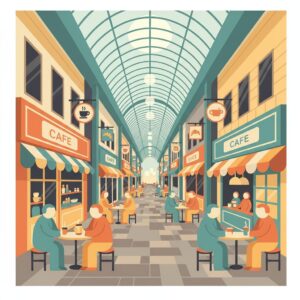
This interplay is most visible in Osaka’s famous shotengai, or covered shopping arcades, like Shinsaibashi-suji or Tenjinbashi-suji. Here, commerce is a contact sport, and humor is your best tool. The back-and-forth between shopkeepers and customers is a classic boke-tsukkomi. A customer might pick up a flashy shirt and ask the owner, “If I wear this, will I become instantly popular?” The shop owner, an ‘obachan’ (older lady) with a permanent twinkle in her eye, might lean in confidentially and whisper, “This shirt can only do so much. The rest is up to God.” It’s a perfect ‘boke’ — a gentle poke wrapped in a sales pitch. The customer, knowing the game, replies with playful outrage, “Hey! You’re supposed to tell me it’ll change my life! What kind of salesperson are you?” This exchange isn’t really about haggling, although that might happen as well. It’s about building rapport. The customer leaves not just with a shirt but also a story and a sense of connection. That’s why shopping in Osaka feels less like a transaction and more like a conversation.
Navigating Train Station Banter
Even the famously stressful rush-hour crush on a train at Umeda Station can become a stage. Imagine this: the doors are closing, and one last salaryman makes a frantic dash, squeezing himself into a packed car. He bumps into another man, who nearly stumbles. In many cities, this would be met with a cold glare or a quick apology. In Osaka, you’re just as likely to hear the bumped man say, loud enough for others to hear, “Whoa there, buy me dinner first if you wanna get that close.” It’s an unexpected ‘boke’ that completely diffuses the tension. The man who just squeezed in, catching his breath, might reply, “Sorry, you’re not my type.” Everyone nearby smiles. The awkwardness melts away, replaced by a shared, silent recognition of their sardine-can predicament. This is Osaka’s charm: the knack for finding humor in even the most ordinary and stressful moments of city life.
Why Osaka? The Roots of a Comedic Culture
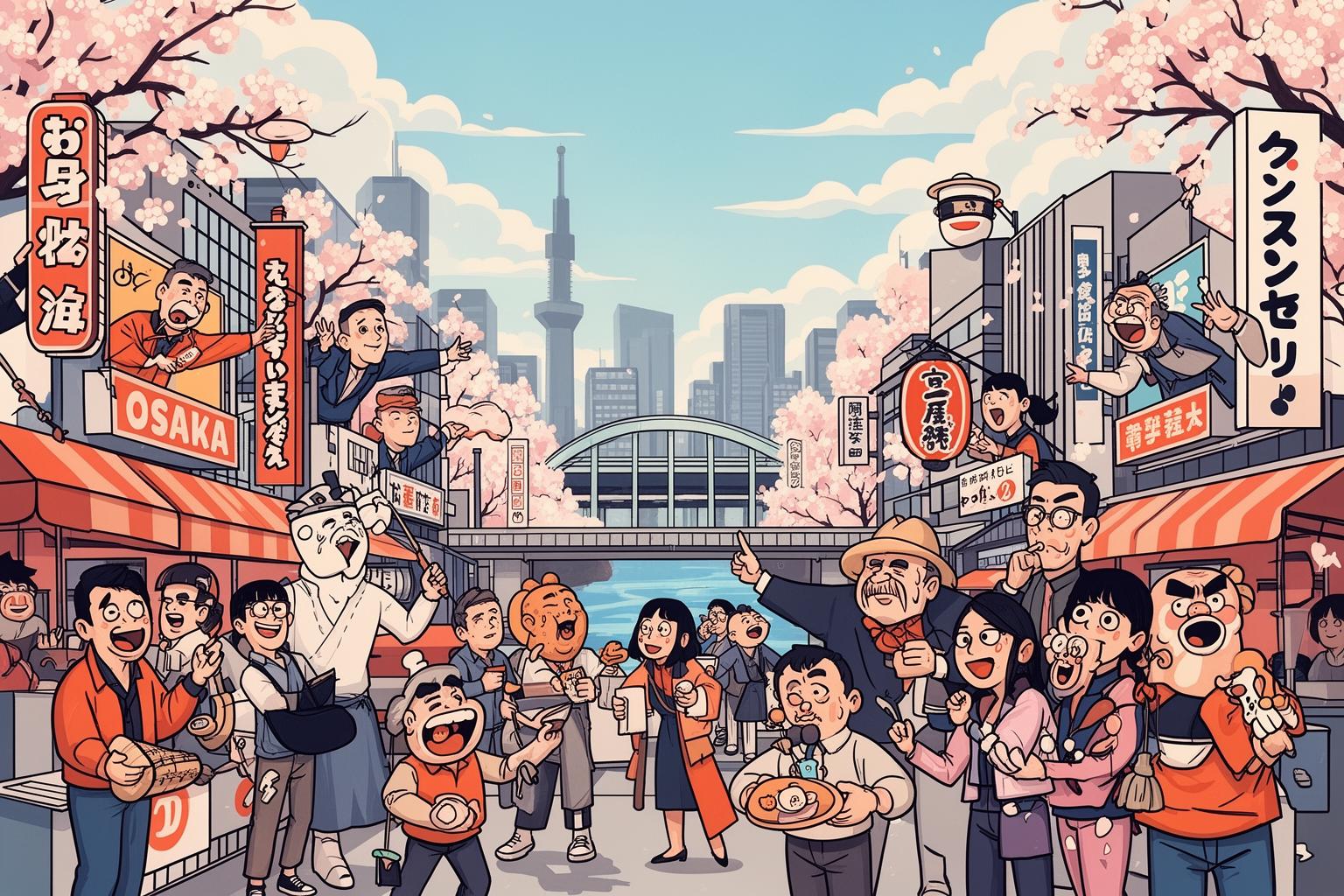
This distinctive conversational style didn’t emerge spontaneously. It is deeply embedded in the city’s history, economy, and core identity. Osaka’s humor reflects its unique past and its enduring role as Japan’s “other” major city.
The Merchant City Mindset
For centuries, while Tokyo (then Edo) served as the center of samurai and government bureaucracy, Osaka was known as the nation’s kitchen—the vibrant hub of commerce and trade. It was a city of merchants rather than warriors. In the competitive world of business, success required more than just a good product. It demanded sharp intelligence, the ability to read others, and the skill to quickly build trust and rapport. Humor became an essential tool for merchants. A clever joke could ease tension during difficult negotiations. A witty retort demonstrated quick thinking. Banter was not merely for entertainment; it served as a way to assess potential partners and smooth the path for deals. This ethos of “service with a punchline” has been passed down through generations and remains alive in the lively exchanges found in any Osakan marketplace today.
Yoshimoto Kogyo and the Media Influence
Osaka comedy cannot be discussed without mentioning Yoshimoto Kogyo. Established in Osaka in 1912, this entertainment giant reigns supreme in Japanese comedy. For over a century, Yoshimoto has nurtured and promoted countless manzai (stand-up comedy) duos, whose acts hinge entirely on the boke-tsukkomi dynamic. Their comedians are omnipresent on Japanese television, spreading Osaka-style humor into homes across the country, especially within the Kansai region. Generations of Osakans have grown up with this as a staple of their daily entertainment. The catchphrases, timing, and playful aggression of the ‘tsukkomi’ have become woven into the local dialect and cultural identity. When children imitate their favorite comedians on playgrounds, they aren’t merely playing; they are practicing a fundamental mode of social interaction.
A Healthy Dose of Anti-Establishment Spirit
Osaka has always taken pride in defining itself in contrast to the capital. It is the pragmatic, straightforward, and somewhat rebellious counterpart to Tokyo’s formal, polished, and bureaucratic image. This ingrained underdog mentality cultivates a culture that values directness and freely mocks authority and convention. Humor acts as a form of rebellion—a means to break through the hierarchical rigidity characteristic of other parts of Japanese society. Making a joke communicates, “Let’s not take ourselves too seriously.” This mindset fosters an atmosphere where people are more open, more willing to engage with strangers, and quicker to shed formalities for genuine, if occasionally boisterous, interactions.
A Foreigner’s Guide to Playing Along
Grasping the theory is one thing, but actively taking part is another. For a non-native speaker, jumping into a rapid-fire boke-tsukkomi exchange can seem intimidating. However, it’s not impossible, and even small efforts can earn you considerable social credit. The key is to start slowly and be a keen observer.
To Boke or to Tsukkomi? That Is the Question.
For beginners, the ‘tsukkomi’ role is generally the safer and easier way in. The ‘boke’ demands a more subtle understanding of language and context to be funny rather than just confusing. But everyone knows a ‘boke’ when they see one. When an Osakan friend or shopkeeper says something playfully absurd, you can join in by simply replying with a ‘tsukkomi’. You don’t need a perfectly crafted zinger. Simple phrases delivered with a playful, slightly exasperated tone work wonders:
- “Ehhh, honto ni?” (Ehh, really?)
- “Uso ya!” (No way! / You’re lying!)
- A simple, drawn-out “Nande?!” (Why?!)
Even just laughing and shaking your head shows you understand the joke and appreciate the effort. It signals that you’re on their wavelength. Once you’re more comfortable, you can try more advanced moves, but starting as an appreciative ‘tsukkomi’ is the perfect first step.
Common Misunderstandings: Is It Rude?
One of the biggest culture shocks for foreigners in Osaka can be the nature of the ‘tsukkomi’. It can sound sharp, critical, or even aggressive. Sometimes it’s accompanied by a light tap on the arm or head, a classic manzai move. To outsiders, this can look like a real argument or even physical assault. It’s important to understand that in 99% of these daily interactions, this is a sign of affection and familiarity. If someone feels comfortable enough to deliver a sharp ‘tsukkomi’ to you, it’s a compliment. It means they see you as part of the group, someone who understands the local rules of engagement. They’re not angry; they’re playing. The key is to read the context: is everyone else laughing? Is the tone light and fast? If so, you’re in the middle of friendly banter, not a fight. This directness is often mistaken for rudeness, but it comes from a desire for an honest and unpretentious connection.
The Ultimate Compliment: Being Called “Omoroi”
In your journey to understand Osaka, you will come across the word “omoroi.” It’s the Osaka-ben (dialect) version of “omoshiroi,” typically translated as “interesting” or “funny.” But in Osaka, “omoroi” carries a much deeper meaning. It is the city’s highest social currency. Being called “kakkoii” (cool) or “kirei” (pretty) is nice, but being called “omoroi” shows true social acceptance. It means more than just telling a good joke. It means you are quick-witted, engaging, and have a playful spirit. It means you contribute positively to the energy of a conversation. It means you ‘get’ it. Striving to be “omoroi” is a worthy goal for any foreigner hoping to truly integrate. It’s not about becoming a comedian; it’s about learning to engage in the joyful, energetic, and collaborative dance of Osakan conversation.
Beyond the Laughs: What Boke-Tsukkomi Reveals About Osaka
This ongoing comedic exchange is more than just an endearing habit; it offers insight into the fundamental values of the city and its residents. It embodies a culture that highly values directness, community, and resilience.
A Culture of Directness and Efficiency
The rapid rhythm of boke-tsukkomi reflects a preference for clear, straightforward communication. Although humor serves as the medium, the core message is often quite explicit. This approach is a refreshing contrast to the more indirect, nuanced styles common elsewhere in Japan, where one might need to infer meaning from subtle cues. In Osaka, what you see is largely what you get. This directness, rooted in a merchant culture that prioritizes time and clarity, makes social interactions surprisingly simple once you understand the comedic language in which it is expressed.
Valuing Community and Shared Experience
By its very nature, the boke-tsukkomi exchange is collaborative and cannot be executed alone. It demands active listening and engagement, transforming an ordinary conversation into a collective creation. This builds a strong sense of community, even among strangers. When you laugh with the person beside you at a ramen counter, for a fleeting moment, you become part of the same team. This constant interplay of shared comedic moments weaves a social fabric that is warmly welcoming and resilient. It’s a city that invites—and indeed expects—you to be involved, not just an onlooker.
Resilience Through Humor
Life isn’t always easy, and like any major city, Osaka faces its challenges. Yet the local attitude often responds to difficulties with a shrug and a joke. The capacity to laugh at oneself, at tough situations, or at the sheer absurdity of life serves as a powerful coping strategy. This resilience is deeply embedded in the culture. This doesn’t mean Osakans are frivolous or indifferent; rather, they recognize the healing power of laughter. Finding humor in adversity diminishes its impact and helps people move forward. This persistent thread of hopeful, tough-minded humor is perhaps the most lasting and admirable aspect of the Osakan spirit.
Final Thoughts: It’s Not a Performance, It’s a Conversation
Navigating Osaka’s social scene can feel like learning an entirely new set of rules, with humor being the most essential chapter in the handbook. The boke-tsukkomi dynamic isn’t just for comedians; it’s the core way people interact daily. It’s the city’s method for breaking down barriers, forging instant connections, and making everyday life more enjoyable.
Don’t be put off by the quick pace or sharp comebacks. Begin by listening closely. Observe the rhythm and exchange in the conversations around you. Smile and laugh when a joke lands, showing you’re engaged. And when the moment feels right, such as when a friendly shopkeeper throws you a gentle ‘boke’, don’t hesitate to respond with a simple ‘tsukkomi’. You might be surprised by how warmly it’s welcomed. Embracing this approach is the quickest way to stop feeling like an outsider and start feeling at home. Because in Osaka, sharing a laugh is the same as saying, “Welcome home.”