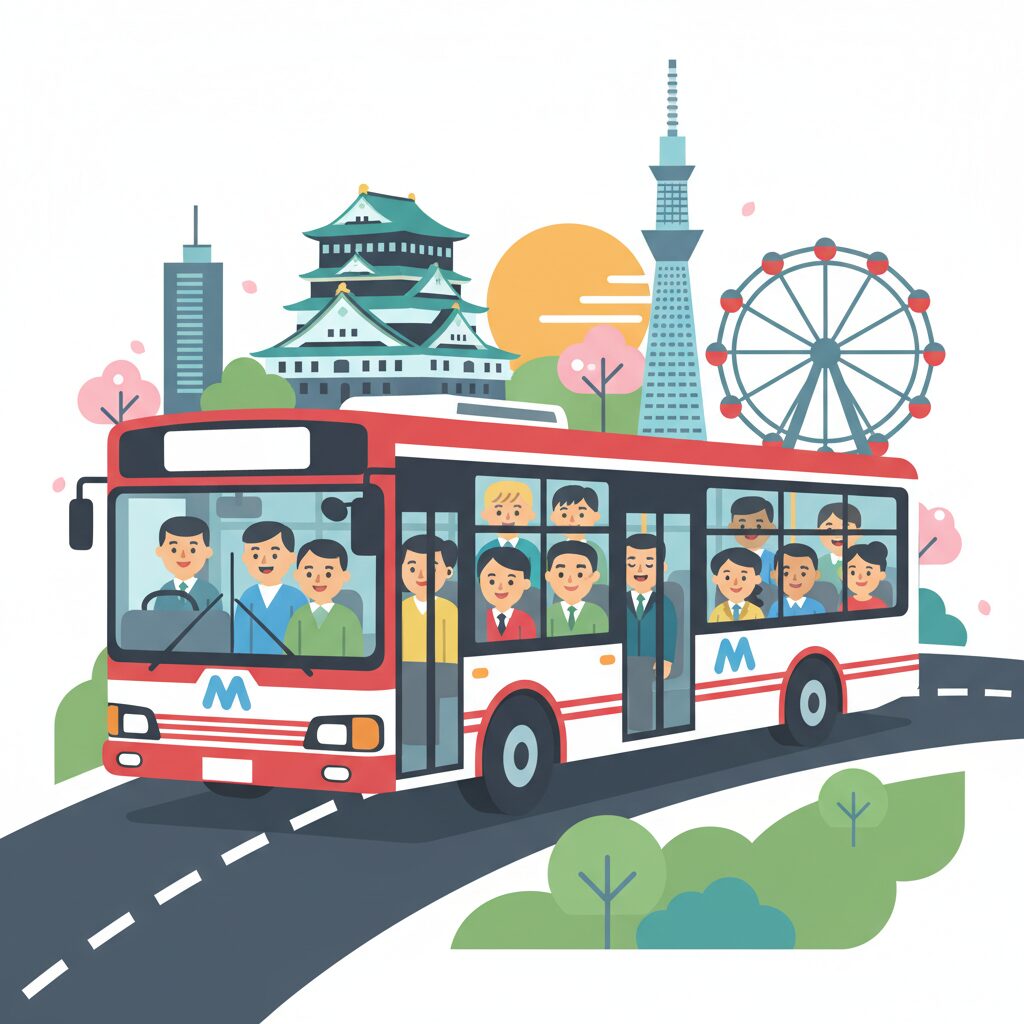
You’re standing at a bus stop in Tennoji, maybe somewhere in the quiet residential maze of Abeno. The summer air is thick and heavy, the cicadas are screaming their electric song, and you’re just trying to mentally prepare for the crush of people on the bus. It’s just you and an older woman, an ‘obachan’ with a classic perm and a brightly patterned blouse, fanning herself with a flyer. You give a slight, polite nod, the kind you’ve perfected in Japan, the one that says, “I acknowledge your existence, but let’s maintain a comfortable cushion of silence.” It’s a signal universally understood in Tokyo. But this isn’t Tokyo. The silence doesn’t last. She catches your eye, her fan stills, and she leans in conspiratorially. “Atsui ne,” she says. “So hot.” You agree, of course. “Honto ni.” But it’s not just a comment. It’s an opening. A door pushed ajar. Before you know it, she’s asking where you’re from, what you’re doing in Osaka, what’s in your shopping bag, and whether you’ve tried the takoyaki from the little shop around the corner, because the one run by the Sato family is good, but the new one that just opened is using cheaper octopus, you know. You find yourself in a full-blown conversation, a whirlwind of personal questions and unsolicited advice, all before the bus has even crested the hill. As a foreigner, especially one accustomed to the reserved politeness of other Japanese cities, this experience can be jarring. Is this genuine, heartwarming friendliness? Or is it an intrusive, slightly bewildering form of nosiness? The truth, like most things in this vibrant, chaotic city, is that it’s a beautiful, complicated, and often hilarious mix of both. This isn’t just small talk. It’s a cultural performance, a social currency, and the very heartbeat of daily life in Osaka. To understand this city, you have to understand the philosophy behind the bus stop interrogation. It’s the key to unlocking what makes Osaka tick, and what sets it so profoundly apart from its eastern rival, Tokyo. Forget the tourist guides for a moment; this is about the real, everyday texture of living here, a world away from the silent, orderly queues of the capital. It’s about navigating the fine line between community and curiosity, and learning to love the city not just for its food and castles, but for the irrepressible, talkative spirit of its people.
This vibrant, talkative spirit is also the engine behind the spontaneous connections you can make in Osaka’s standing bars.
The Anatomy of a Bus Stop Conversation
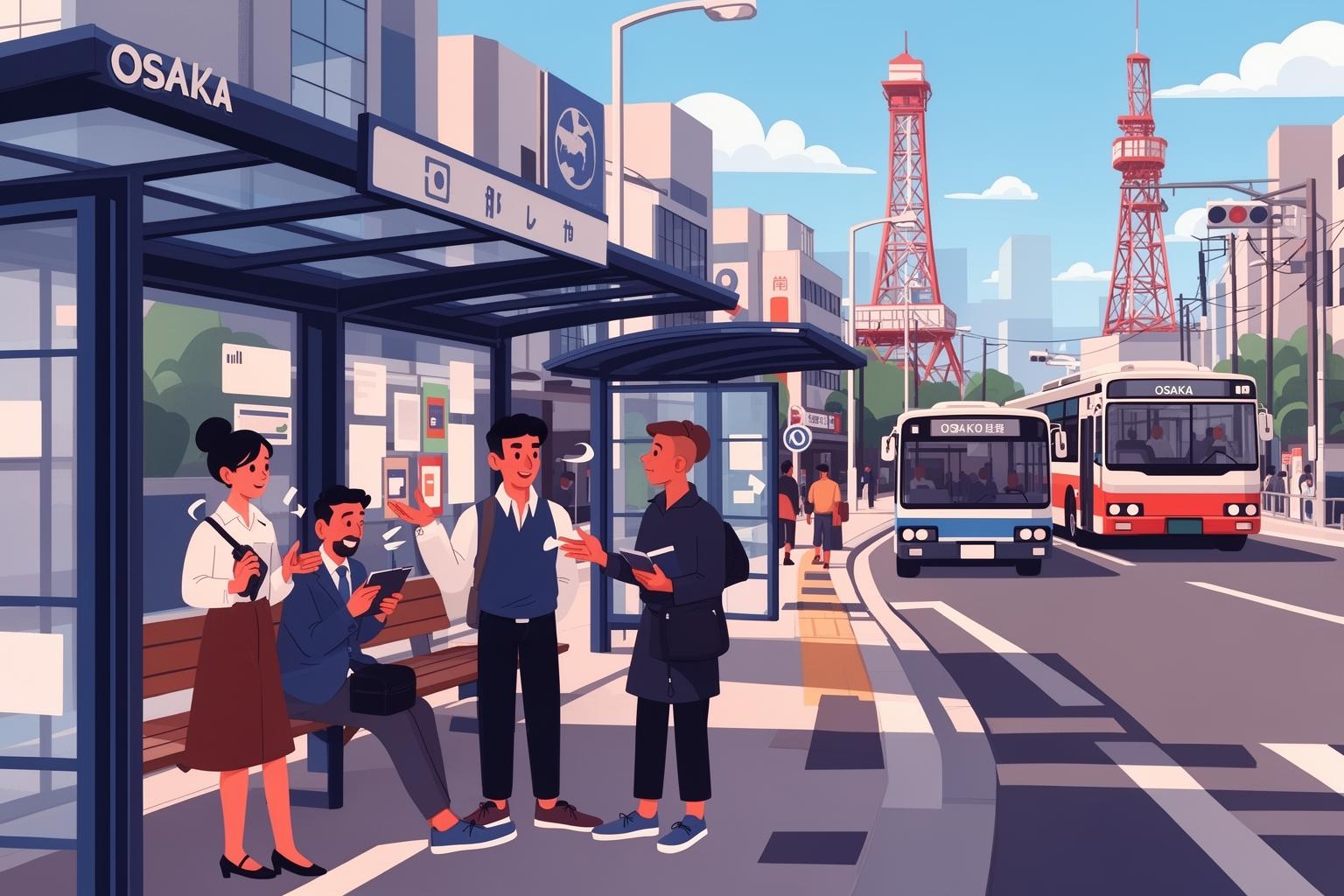
To someone unfamiliar, these spontaneous encounters might seem like random bursts of chatter. However, there is an underlying structure—a recognizable rhythm—that soon becomes apparent. It resembles a social dance, and once you’ve learned the steps, you can decide whether to join in or gracefully decline the invitation. This interaction reflects Osaka’s entire social philosophy, a system rooted in engagement rather than avoidance. It stands in stark contrast to the invisible barriers people build around themselves in other major cities. Here, connection is the default, and silence is often viewed not as peaceful but as a missed chance for a good story, a shared laugh, or valuable local insight.
The Opening Gambit: “Where You Headed?”
Conversations rarely begin with deep or philosophical questions. Instead, they start with the mundane, the observable, the shared experience of the moment. Weather remarks are a global classic, but in Osaka, they come with dramatic flair. It’s not just “It’s hot,” but a drawn-out “Atsui naa, mou iya ni naru wa~” (“It’s so hot, I’m getting sick of it~”), inviting empathy. Common openers often involve direct observations about you. If you’re carrying a distinctive bag, reading a book, or wearing a unique jacket, that becomes the entry point. “That’s a nice bag, where did you get it?” is more than a compliment; it’s a hook. Questions about your destination—“Are you going to Namba?”—are standard. In Tokyo, a stranger asking where you’re headed might feel threatening, a potential precursor to being followed or scammed, triggering all the usual big-city stranger-danger alarms. But in Osaka, it’s often a sincere attempt to connect or help. They might add, “Oh, if you’re going to Namba, you should get off at this stop, not the next one; it’s a shorter walk to the shotengai.” This opening serves as a social test. Your reply signals your openness to engagement. A brief, clipped answer with little eye contact—“Hai”—universally means “Leave me alone.” A more open, friendly response, possibly with a question in return, indicates your willingness to engage. This subtle, unspoken negotiation usually unfolds within the first ten seconds.
The Escalation: From Groceries to Your Life Story
If you pass the initial test and show you’re open to conversation, be prepared for it to quickly deepen, often touching on personal topics. The ideas of personal space and privacy, though recognized, are much more flexible here. In the West, and even in much of Japan, asking a near-stranger about their job, salary, or marital status is a major misstep. In Osaka, it’s frequently the natural next step in getting to know someone. The conversation can shift rapidly. One moment you’re commenting on a cloud’s unusual shape; the next, you’re asked, “So, are you married? Do you have kids? Why not? You’re not getting any younger!” This can feel intrusive. As a woman, being questioned about my relationship status or family plans by a stranger can be jarring. Such personal inquiries are typically reserved for close friends or nosy relatives at home. But here, the intent is seldom hostile. It originates from a different cultural perspective, where individuals see themselves as part of a larger community. Your life isn’t solely your own business; it’s a story that, when shared, enriches the community. They’re not usually trying to judge you but to place you within their social map. They want to understand your story. Questions like “How much is your rent?” aren’t meant to assess you financially but often serve as a way to gauge the local real estate market and offer advice: “Wow, that’s expensive! My nephew pays much less for a bigger place in Nagai; you should check it out.” This mix of curiosity and a strong desire to help guide you, even uninvited, is part of the culture.
The Payoff: A Shared Laugh and a Piece of Candy
So, what’s the point of all this? If you stay with the conversation through personal questions and unexpected turns, you often reach the payoff: a moment of genuine human connection. The ultimate aim usually is to have a pleasant interaction, share a laugh, and make the wait for a bus less dull. Osakans love a good story and a sharp punchline. If you reply to personal questions with humor or self-deprecation, you’ll likely earn their respect and affection. The interaction often concludes with a classic Osaka gesture: the offering of “ame-chan.” This small, individually wrapped hard candy seems to be carried in endless supply by nearly every Osaka obachan. Receiving an ame-chan is more than just getting candy; it’s a symbol—a gesture of goodwill, a thank-you for the chat, a sign that you’re, however briefly, accepted into their circle. It’s a sweet, tangible reward for participating in the city’s social fabric. You’ve shared a moment, entertained each other, and part ways a little richer for the experience. The bus arrives, you say your goodbyes, and you’ll likely never see that person again. But for a few minutes, you weren’t strangers; you were two people sharing space and story. And that, in essence, captures the magic and madness of Osaka.
The Historical and Economic Roots of Osaka’s Chattiness
This distinctive communication style didn’t emerge spontaneously. It’s not a mere idiosyncrasy. It’s deeply rooted in Osaka’s history, its economy, and its centuries-long function as a counterbalance to Tokyo’s political and cultural dominance. To understand why someone strikes up a conversation with you at the bus stop, you need to look back at how this city was shaped—not by samurai and shoguns, but by merchants and artisans.
The Merchant City: Business as Conversation
For centuries, while Edo (modern-day Tokyo) served as the hub of samurai governance—with its rigid hierarchies, formal ceremonies, and stoic warriors—Osaka was Japan’s commercial powerhouse, famously known as “tenka no daidokoro,” or “the nation’s kitchen.” It was a city of rice brokers, moneylenders, and traders. In this environment, success depended not on ancestry but on building relationships, negotiating deals, and quick thinking. Business wasn’t conducted in silent, formal chambers; it took place in bustling markets and crowded streets. The primary tool of trade was conversation. Haggling was expected, and banter helped build rapport. A quick wit and sharp tongue were as valuable as a well-stocked warehouse. This culture of commercial talk became embedded in the city’s very fabric. People learned to communicate directly, efficiently, and persuasively. There was no room for the subtle, indirect communication preferred by the aristocratic courtiers in Kyoto or the samurai bureaucrats in Edo. In Osaka, you said what you meant, asked for what you wanted, and used humor to smooth the wheels of commerce. This mercantile spirit fostered a pragmatic and egalitarian attitude. Everyone was a potential customer or business partner, so social barriers were low. You would talk to anyone because you never knew where the next deal or great tip might come from. That legacy persists today. The person standing beside you at the bus stop might not be trying to sell you anything, but they operate with the same social mindset that has driven this city for generations: open, direct, and always ready for a transaction—even if it’s just an exchange of stories.
The Culture of “Manzai” and Comedy
It’s impossible to discuss Osaka without mentioning comedy. The city is the undeniable home of Japanese stand-up, especially the two-person comic routine known as “manzai.” Yoshimoto Kogyo, the entertainment giant based in Osaka, has been the dominant force in Japanese comedy for over a century. For Osakans, comedy isn’t just something they watch on TV; it’s woven into daily conversation. The structure of a manzai act—with its “boke” (the silly, air-headed character who says absurd things) and “tsukkomi” (the sharp, straight-man who corrects or reacts, often with a light slap)—reflects the rhythm of everyday talk. A chat with an Osakan often becomes a collaborative performance. They might say something slightly outrageous (playing the boke) to see how you respond. Your role is to provide the tsukkomi—to highlight the absurdity, play along, and complete the comedic exchange. For example, if you mention you’re from New York, an Osakan might exclaim, “Wow, a real celebrity! Can I have your autograph?” They don’t actually believe you’re famous; they’re playing the boke. The expected tsukkomi reply isn’t a serious denial like “No, I’m not famous,” but something playful such as, “Sure, that’ll be 1,000 yen.” This back-and-forth, the search for a punchline (“ochi”), is a central part of the local dialect and mindset. A conversation isn’t just for exchanging information; it’s for shared entertainment. When a stranger talks to you, they’re, in a way, inviting you to be their manzai partner for a moment. It’s a test of your “nori,” or your ability to get on the same wavelength and join in the fun.
A Community of Shared Struggles and Triumphs
Osaka has always been a city of the common people. It has been built and rebuilt through fires, wartime bombings, and economic setbacks. This history has forged a strong sense of community and mutual support. This is most evident in the city’s many “shotengai,” covered shopping arcades that aren’t just collections of shops but the social and economic heart of their neighborhoods. For generations, families have lived and worked in these arcades. Shop owners know everyone, and everyone knows them. Your personal matters—your health, family, and finances—are common knowledge, not as gossip, but as part of a tight-knit community looking out for its members. This is where the line between caring and nosiness becomes blurred. The local butcher might ask why you look tired because he’s genuinely concerned you’re overworking yourself. The old woman at the fruit stand might comment on your weight because, in her mind, she’s looking after your health. This mindset, born in the dense, interconnected world of the shotengai, spreads across the city. There’s an underlying belief that everyone is in this together. This creates a culture of shared information and mutual aid. The “nosiness” often arises from a system designed to keep the community healthy, safe, and informed. They’re not simply prying; they’re maintaining the invisible bonds that hold the neighborhood together.
Decoding the “Nosiness”: Is It Rude or Is It Care?
For many foreigners, the greatest cultural challenge in Osaka lies in learning to reinterpret behaviors that would be deemed rude in their home countries. The direct questions, unsolicited advice, and casual remarks about your appearance can easily make you feel judged or as if your privacy has been invaded. However, to truly grasp Osaka’s culture, it’s essential to view these interactions through a different cultural lens. What might feel like an interrogation is often an expression of care, and what seems like nosiness can be an invitation into the community’s information-sharing network.
The Information Exchange Network
Think of Osaka as having a vast, hyper-local, analog social network that has operated for centuries. A conversation with a stranger acts as a login. When someone asks where you bought your shoes and what they cost, it’s not mere idle curiosity—they are collecting valuable information. If you found a good deal, that information can be shared and used by others. By participating, you gain access to the network’s collective knowledge. For example, if you casually mention you’re looking for a good bike repair shop, within minutes a stranger might give you a detailed rundown of the three best places nearby, including which is cheapest, which is fastest, and which is run by a curmudgeonly but skilled old man. This is crowdsourcing, Osaka style. Questions that seem personal are often just data points; “How much is your rent?” helps assess neighborhood rates, while “Where do you work?” maps the local economy. It’s a pragmatic, information-driven method of community building focused on solving problems—both yours and theirs. To outsiders, this might feel intrusive, but to insiders, it is a vital, living system for sharing wisdom and resources, with the price of admission being a small share of your personal information.
The “Osekkai” Mentality: Meddling as a Form of Affection
To understand Osaka, you need to know the important Japanese term “osekkai,” which roughly means meddler, busybody, or nosy. In much of Japan, especially Tokyo, “osekkai” carries a strongly negative connotation, implying someone who crosses boundaries and interferes unnecessarily. But in Osaka, it is often seen as a form of love and care, a core part of the local character. “Osekkai” is the stranger on the train platform who notices you looking at a map and not only offers help but escorts you to your destination. It’s the restaurant owner who insists you eat more because you look too thin. It’s the woman at the bus stop who points out that your shirt is inside out. This meddling stems from a sense of responsibility—a belief that if you see someone struggling or in need of help, you have a duty to intervene. It’s a proactive, sometimes assertive, kind of kindness. From a Western, individualistic viewpoint, it may seem patronizing: “I’m independent, thank you.” But within Osaka’s communal mindset, allowing someone to make a mistake without intervening is the truly unkind act. They’re not trying to control you but looking out for you as a family member would. It’s a tough-love approach that can take some adjustment but is almost always well-intentioned.
Gauging Your “Nori”: Are You Playing the Game?
Ultimately, Osakans are adept at reading social cues and possess high social intelligence. Though forward, they are far from oblivious. The beginning of any conversation is often about gauging your “nori,” a versatile word meaning vibe, rhythm, or atmosphere. Someone who is “nori ga ii” is on the same wavelength—fun, easygoing, and ready to play along. Conversely, someone who is “nori ga warui” is a wet blanket—you don’t get the joke, and you kill the mood. When an Osakan initiates conversation, they’re sizing up your “nori.” Your response signals everything they need to know. If you give brief, polite, but lukewarm answers, you indicate that your “nori” is off, and most will take the hint, wrap up quickly, and leave you be. They may be a bit disappointed not to find a good conversational partner but won’t be offended. However, if you reply with energy, a smile, a joke, or a witty comeback, you signal that your “nori ga ii.” This acts as a green light, inviting them to keep the interaction going enthusiastically. Understanding this can be incredibly empowering for foreigners—it means you’re in control. You decide how much to engage; you’re not a passive target of a conversational onslaught but an active participant who sets the pace and tone of the exchange.
Practical Survival Guide for the Osaka Bus Stop (and Beyond)
Living in Osaka is like playing a participatory sport. While you can choose to remain on the sidelines, the true joy of this city comes from actively joining in. Learning to navigate these spontaneous interactions will not only make your daily life smoother but also unlock genuine friendships and a deeper bond with the city. It’s a skill, and like any skill, it can be learned.
How to Engage: The Art of the “Tsukkomi”
You don’t need to be a professional comedian to have a successful conversation in Osaka, but understanding the basics of the local humor can make a huge difference. The easiest role for a foreigner to take on is the “tsukkomi,” or straight man. The Osakan you’re speaking with will often naturally act as the “boke,” saying something a bit silly or exaggerated. Your role is to respond to it. For example, if an obachan looks at your large backpack and says, “What have you got in there, all your worldly possessions? Are you running away from home?” A serious, non-Osaka reply would be, “No, it’s just my laptop and some books.” That kills the mood. The “tsukkomi” response, however, is to play along and highlight the absurdity with a laugh: “Yes! Don’t tell my mom, it’s a secret!” Or, “Of course not, there’s no room for my cat in here.” This shows that you get the joke, that you’re fun, and that you’re on their wavelength. Self-deprecation is also a powerful tool. If someone comments on your poor Japanese, instead of getting defensive, you can smile and say, “I know, it’s a disaster! My teacher cries every day.” This kind of response is endearing and immediately breaks down barriers. It shows you don’t take yourself too seriously, a trait highly valued in Osaka.
How to Disengage Politely
There will be days when you’re tired, stressed, or just not in the mood for a full conversational performance—and that’s completely fine. The key is to disengage politely but clearly. The silent treatment or a hostile look is considered rude. Instead, try a few gentle techniques. A simple apologetic smile combined with a slight bow is a good start. You might say, “Sumimasen, chotto isoidemasu node” (“Sorry, I’m in a bit of a hurry”). This gives a clear reason for your brevity. Another effective way is to use your phone or headphones as a social shield. Putting your headphones in after the initial greeting sends a clear but polite signal that you’re in your own world. If you’re already on your phone when someone attempts to start a conversation, you can offer an apologetic “Ah, sumimasen” and gesture to your phone, indicating you’re busy. Osakans are direct but not insensitive; they understand social cues. As long as you disengage politely, you won’t offend anyone. They’ll simply move on to their next conversational partner.
From the Bus Stop to the Bar: Where This Skill Matters
The bus stop is just the training ground. This communication style is the key to the entire city. It’s how you build a relationship with the owner of your local vegetable stand, which might earn you some extra freebies. It’s how you become a regular at a tiny, ten-seat izakaya, where the master will start saving your favorite sake for you. It’s even how you can succeed in business. In Osaka, a business meeting might begin with ten minutes of friendly banter about the Hanshin Tigers baseball team before anyone even looks at a spreadsheet. Being able to chat, joke, and connect on a human level often matters more than the presentation itself. People here prefer to do business with those they like and have good rapport with. By mastering the art of casual conversation, you’re not just making your commute more interesting; you’re building social capital that will benefit every aspect of your life in this city. You demonstrate that you’re not just a temporary visitor but someone who understands and respects the local culture.
The Modern Osaka: Is This Culture Fading?
It’s a valid question to ask: in a hyper-modern, globalized Japan, is this old-school, chatty culture fading away? Walk through the sleek, modern shopping malls of Umeda or converse with a group of stylish twenty-somethings, and you might not immediately encounter the classic Osaka obachan archetype. Younger generations, raised on the internet and influenced by the more reserved, standardized culture emanating from Tokyo, are often less openly talkative than their parents and grandparents. There is a clear trend toward a more apathetic, Tokyo-style politeness among some youth. And yet, the spirit of Osaka endures. It may be a bit more subtle now, but it remains, bubbling just beneath the surface. You’ll notice it in the way a convenience store clerk chats with you while scanning your items. You’ll hear it in the laughter bursting from a group of friends on the Midosuji subway line, who are far less concerned with maintaining public silence than their Tokyo counterparts. You’ll sense it in the way strangers still offer to help if you look lost, their advice more direct and detailed than elsewhere. This culture is also a powerful magnet. For many Japanese from other regions, and for foreigners alike, this open, engaging atmosphere is a major part of Osaka’s charm. In a country that can often feel isolating, Osaka provides an antidote to loneliness. It’s a city where human connection is easy to find, where you can feel part of a community even if you’ve just arrived. It might be overwhelming at times, but it’s rarely cold. That fundamental difference is why this culture, even if it evolves, will likely never disappear entirely. It is the city’s identity, its brand, and its greatest strength.
The next time you’re at a bus stop and a stranger starts talking to you, take a deep breath. You’re not just being approached; you’re being given an invitation. An invitation to join a living, breathing cultural tradition that stretches back centuries. You’re standing on the fine line between friendliness and nosiness, a line drawn differently here. In Osaka, that line is a blurry, shifting, and wonderfully porous boundary. It’s a place where a question about the weather can lead to life advice, shared laughter, and a sweet piece of candy. It’s the essence of a city built on the belief that a good conversation is one of life’s great pleasures, and that a stranger is just a friend you haven’t had a good chat with yet. You always have the right to decline the invitation, to retreat into the quiet comfort of your own thoughts. But every now and then, try accepting. You might be surprised by what you discover, about this city, and about yourself.