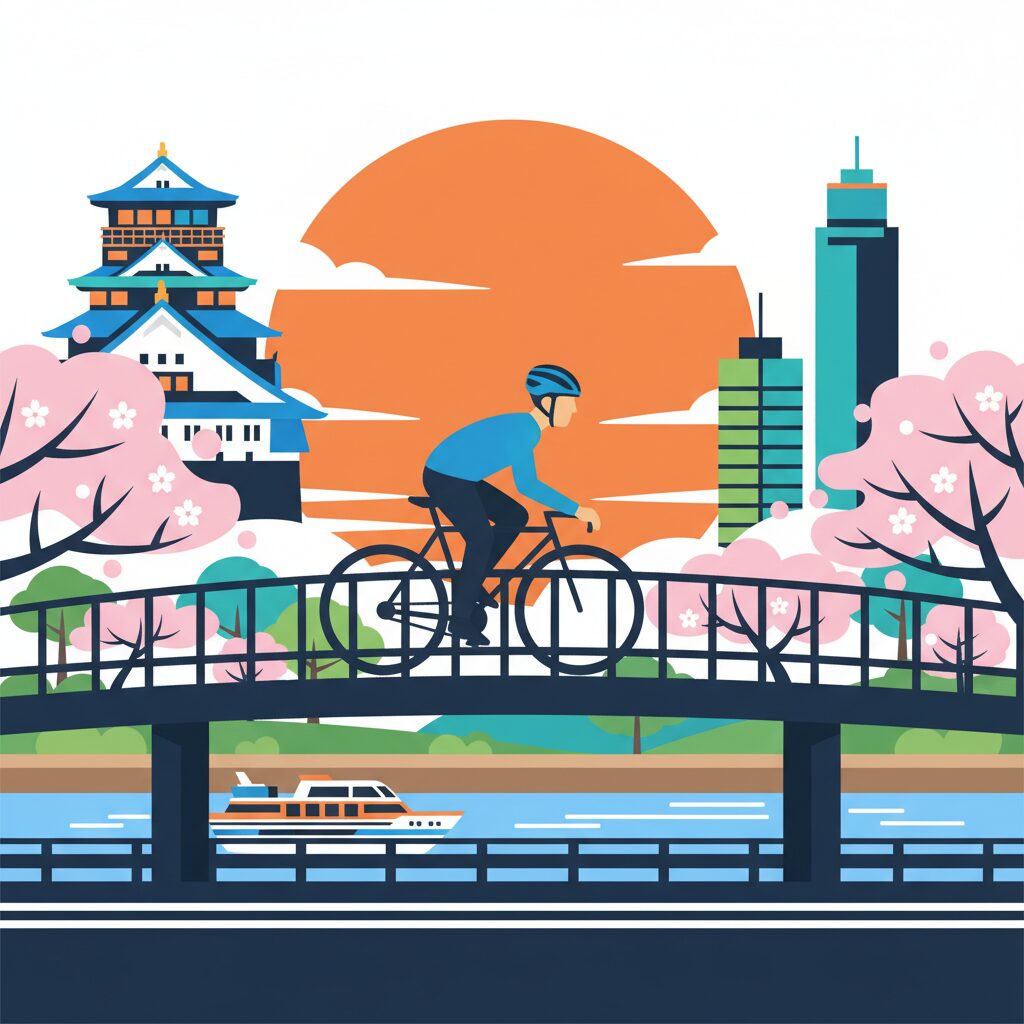
Welcome to Osaka. You’ve probably just stepped out of your new apartment, ready to explore, and the first thing you notice isn’t the towering Umeda Sky Building or the scent of takoyaki grilling on a street corner. It’s the bikes. They’re everywhere. A silent, swerving, chaotic river of steel and rubber flowing down sidewalks, through shopping arcades, and against the tide of pedestrian traffic. This isn’t just transportation; it’s a city-wide ballet, and you don’t know any of the steps. You see a mother with two kids strapped into seats, a basket overflowing with groceries, holding an umbrella while navigating a crowded pavement, and you think, “How?” This, my friend, is your introduction to the world of the ‘chari,’ Osaka’s beloved and indispensable slang for a bicycle. Coming from Tokyo, where life feels like a meticulously planned symphony of rules and regulations, Osaka’s ‘chari’ culture was a shock to my system. It felt like stepping into an improvisational jazz session where everyone knew the rhythm but me. Here, the bicycle isn’t just a way to get from the station to your home; it’s a vital limb, an extension of the self, a tool for living a life of pragmatic efficiency. Understanding the unwritten rules of the ‘chari’ isn’t just about avoiding collisions. It’s about understanding the very soul of Osaka—a city that values common sense over rigid doctrine, efficiency over formal etiquette, and a shared, fluid understanding of public space. This guide is your sheet music to that jazz session. Forget the official traffic laws for a moment; we’re diving into the real, unspoken code of the Osaka streets. This is how you survive, thrive, and ultimately, ride like a local.
Just as mastering the ‘chari’ unlocks the city’s pragmatic soul, understanding the unspoken rules of Osaka’s standing bars reveals another layer of its unique social contract.
The ‘Chari’ is King: Understanding Osaka’s Bicycle Supremacy
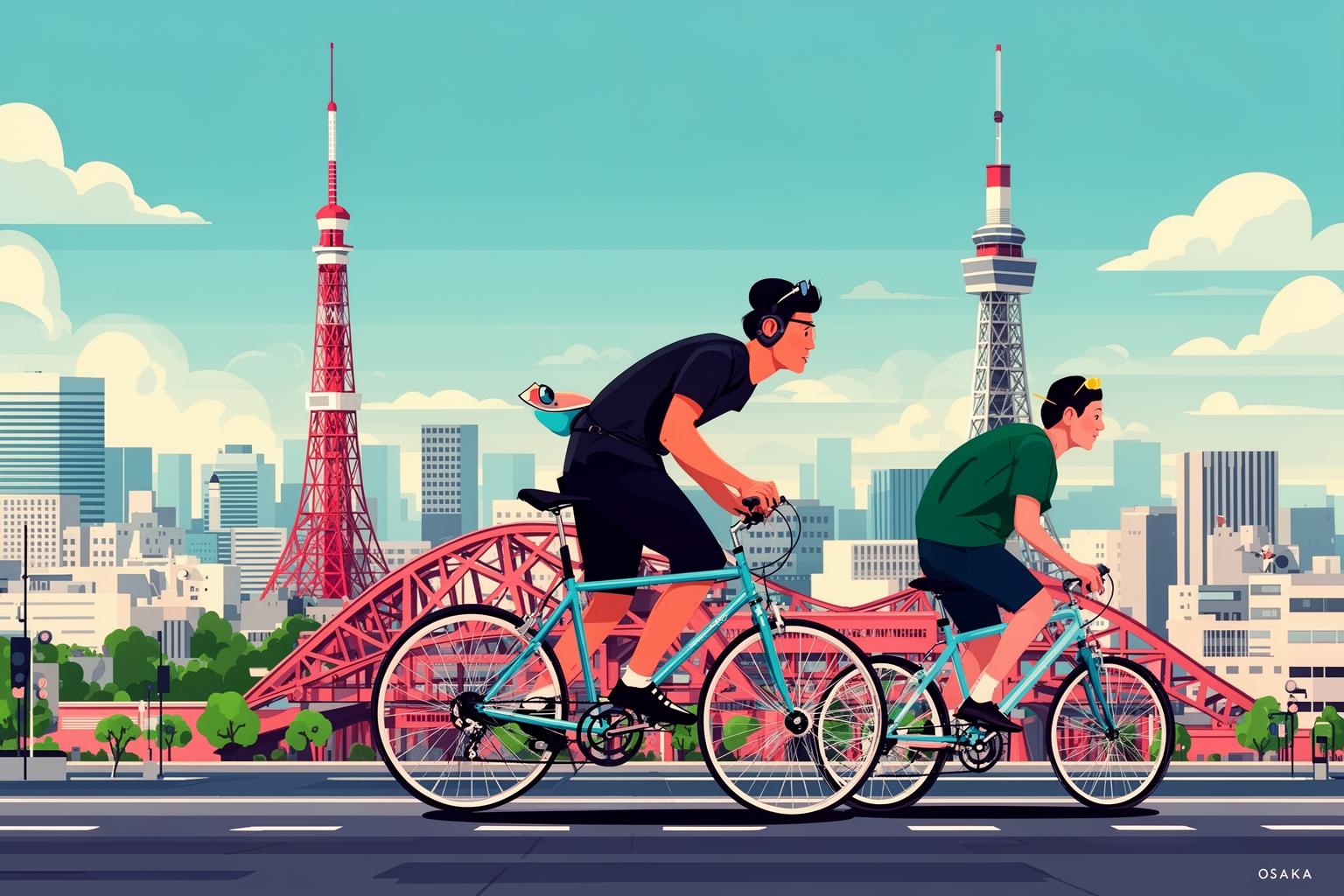
In Osaka, bicycling isn’t a hobby. It’s neither a choice driven by environmental concerns nor a leisurely weekend activity. The ‘chari’ serves as the backbone of everyday transportation. The city’s predominantly flat terrain—a wide plain nestled between mountains and the sea—makes it ideally suited for two-wheeled travel. Neighborhoods are densely packed with supermarkets, clinics, schools, and train stations all within a convenient cycling distance. Owning a car is costly and cumbersome due to limited space. While trains are efficient for long-distance travel, they don’t offer door-to-door service. The ‘chari’ fills that gap perfectly, acting as the ultimate tool for a life centered on speed and convenience—a mindset deeply ingrained in this merchant city’s culture.
More Than Transportation, It’s a Way of Life
The iconic bike in Osaka isn’t a sleek road bike but the ‘mamachari,’ or “mom’s bike.” These reliable machines prioritize practicality over aesthetics. They typically feature a low, step-through frame for easy mounting, a wide and comfortable seat, an upright riding position, and most importantly, a large front basket. But that’s only the basic model. An Osaka ‘mamachari’ is often an extensively customized workhorse. You’ll spot models fitted with a child seat on the back, sometimes another on the front, and handlebar clips designed to hold an umbrella, leaving one hand free to steer. The baskets are frequently overloaded with groceries—daikon radishes jutting out at odd angles, bags of rice teetering precariously—making it almost unbelievable how riders maintain their balance. This goes beyond mere cycling; it’s a finely tuned act of domestic engineering. In Tokyo, bicycles are often seen as an accessory to a life centered around trains, used mainly for the final few minutes of a commute. In Osaka, the ‘chari’ often serves as the entire commute. It’s how parents take their children to daycare, run errands at the ward office, buy groceries, and return home—all without ever using a train card. It symbolizes a strong independence and pragmatic approach. Why wait for a bus or walk ten minutes when you can simply ride your bike and arrive in three? This philosophy shapes every aspect of life here.
The Sidewalk is the Highway: Navigating the Pavement Culture
This brings us to one of the most puzzling and daunting aspects for newcomers: nearly everyone rides their bike on the sidewalk. According to Japanese law, bicycles are vehicles and should share the road with cars; sidewalk riding is only permitted where signs explicitly allow it or for very young or elderly riders. In Tokyo, these rules are mostly respected, especially on major thoroughfares. In Osaka, however, the rulebook might as well be written in a lost language. Here, the sidewalk is the default bike lane. This practice stems from the city’s same pragmatic spirit. Osaka’s streets—especially the narrow, twisting neighborhood roads—often lack shoulders, and traffic is notoriously aggressive with taxis, trucks, and cars vying for space. For the typical Osakan, say a parent with a child on the back of their bike, competing with a delivery truck is unthinkable. The sidewalk, though crowded with pedestrians, is simply the path of least resistance and the safer, more sensible option. This leads to a fascinating, adaptable social contract. The sidewalk is not a lawless free-for-all; it’s a shared space governed by a complex, unspoken code. Pedestrians technically have the right of way, but this is not absolute. It’s an ongoing negotiation of space, a dance of mutual awareness. Cyclists are expected to be the more agile participants, weaving and adjusting speed to accommodate foot traffic. This is the first major mindset shift for foreigners: the sidewalk is not strictly a pedestrian-only zone, but a multi-use corridor where everyone must stay alert. The Tokyo approach—rigidly defined spaces and strict adherence to pavement markings—gives way here to a more organic, if initially chaotic, system of shared responsibility.
The Unspoken Choreography of the Osaka Sidewalk
Once you accept that the sidewalk is the main stage, you need to learn the choreography. Riding a bike in Osaka is less about pushing forward and more about navigating. It’s a game of inches, predicting movement, and communicating without words. It’s a skill, and like any skill, it takes time to master. Locals have been doing it since they first balanced on two wheels, and their fluidity of motion is impressive. They glide through crowds with an ease that seems impossible, making tiny adjustments in speed and direction that keep the whole system moving smoothly. To a newcomer, it appears as a series of near-misses. To an Osakan, it’s simply the natural rhythm of the street.
The ‘Sumimasen’ Weave and the Silent Negotiation
The main technique for navigating a crowded sidewalk is what I call the ‘Sumimasen’ Weave. ‘Sumimasen’ means ‘excuse me,’ but it’s rarely spoken aloud in this context. The sentiment is conveyed through movement. You don’t push straight through a group of people. Instead, you slow down, gauge the gaps, and anticipate how the crowd will shift. You read the body language of pedestrians ahead. Someone looking at their phone is likely to keep going straight. A couple window-shopping will be unpredictable. A group of students expands and contracts like an accordion. Your role as a cyclist is to be like water, finding the path of least resistance and flowing through it. The bell highlights a critical cultural difference. In many Western countries, and even somewhat in Tokyo, ringing a bell politely signals: “Excuse me, I’m coming through.” In Osaka, however, ringing your bell can come off as aggressive and impatient, almost shouting, “Get out of my way!” It brands you as an outsider who doesn’t understand the flow. The preferred approach is proximity and presence. As you get closer, people naturally notice you, and a path often opens organically. If a gentle prompt is needed, a softly spoken “sumimasen” works far better than the sharp clang of a bell. The masters of the weave don’t even need that. They use subtle shifts in momentum or a slight wobble of the handlebars to announce their presence, a non-verbal cue everyone understands. It’s a communication system based on shared assumptions and heightened awareness—a stark contrast to Tokyo’s preference for clear signals and well-defined lanes.
The Art of the ‘Futari-nori’ and Other Local ‘Crimes’
The longer you spend in Osaka, the more you’ll notice behaviors that are technically illegal. These minor infractions offer insight into the local mindset, which often favors practicality over strict rule-following. ‘Futari-nori,’ or two people riding on a single bike, is a classic example. It’s officially banned, but commonly seen, especially among young people. One pedals while the other rides on the rear luggage rack. Why? Because it’s the quickest way to get a friend from the bar to the train station after missing the last train. It’s a convenience-driven solution. Likewise, the remarkable sight of ‘kasa-sashi unten,’ or cycling while holding an umbrella, is also illegal and clearly risky. It demands exceptional one-handed balance and control, especially in gusty weather. Yet, during Osaka’s rainy season, the sidewalks fill with these wobbly, umbrella-holding cyclists. The alternative—getting soaked or staying indoors—is simply unacceptable. So locals adapt. They hone the skill or use handlebar-mounted umbrella holders. The rule takes a backseat to immediate need. This isn’t to say Osaka is lawless. People don’t run red lights into oncoming traffic. There is a boundary. But for minor infractions that mainly risk the rider, there’s a collective shrug. If a rule is widely seen as inconvenient or pointless, it’s often quietly disregarded. This can jar those used to strict obedience, like in Tokyo, where the attitude is that a rule is a rule, no matter its efficiency. In Osaka, there’s an unspoken clause: a rule applies unless there’s a better way to get things done.
Parking Pandemonium: The Battle for a Spot
Your journey on the ‘chari’ doesn’t end once you reach your destination. In fact, one of the toughest challenges begins there: parking. The sheer volume of bicycles in Osaka means parking is a constant, city-wide struggle. This daily conflict reveals the gap between the official system and how things actually function—an ongoing theme in Osaka life. The city offers designated bicycle parking lots, or ‘churinjo,’ especially near train stations and major commercial areas. Yet, these are often insufficient for the overwhelming demand.
The ‘Churinjo’ System vs. Guerrilla Parking
Official ‘churinjo’ come in different forms. Some are large, multi-level garages where you slot your bike into a rack. Others are automated wonders that whisk your bike away into an underground silo. Many require a monthly contract, with waiting lists for prime locations stretching months long. For short-term parking, you might find metered spaces where you lock your bike into a metal clamp for about a hundred yen per hour. These systems are orderly and efficient. The problem is, there are never enough of them. Thus, guerrilla parking emerges. Osakans have perfected the skill of finding and creating parking spots in the urban landscape. Bikes are lined up with military precision against a convenience store wall, tucked into narrow gaps between vending machines and buildings, chained to guardrails, signposts, and fences. Any piece of urban furniture fastened down can serve as an anchor. This isn’t random chaos—there’s an etiquette. An unspoken rule dictates you must not block store entrances or building access, nor obstruct paths for wheelchairs or strollers. As long as you park reasonably out of the way, your spot is generally accepted by the silent consensus of the street. This sharply contrasts with Tokyo, where parking outside designated areas is far less common. In Tokyo, a lack of parking usually means you can’t bring your bike at all. In Osaka, it means you just have to get more creative.
The Dreaded Silver Sticker: The Consequences of Miscalculation
That creativity has limits, and crossing them brings consequences. The city deploys teams that patrol busy areas to identify and tag illegally parked bicycles. If you park in a no-parking zone—usually marked with signs—you might return to find a brightly colored warning sticker wrapped around your handlebars or seat. This is your first warning. Ignoring it, or parking in a blatantly prohibited spot, can lead to your bike disappearing entirely. It has been impounded, or ‘tekkyo-sareta.’ This is the harshest penalty in the world of ‘chari’ parking. Retrieving your bike is a real ordeal. You must discover which impound lot took it—often a bleak, industrial location on the city outskirts. Then you have to travel there during limited business hours, present your ID and bicycle registration, and pay a fine, usually a few thousand yen. It’s an inconvenient and costly lesson. Locals know the limits. They understand which areas are heavily patrolled and when. They can discern risky spots from safe ones. A long line of neatly parked bikes signals a tacitly approved zone. An empty stretch of guardrail outside a busy station is a glaring red flag—it’s empty for a reason. Learning to read these cues is a vital survival skill. It’s a constant game of risk assessment that embodies the Osaka spirit: push boundaries for convenience, but be savvy enough to avoid getting caught.
Osaka vs. Tokyo: A Tale of Two Cycling Cities
The differences in cycling culture between Japan’s two largest cities perfectly illustrate their broader cultural contrasts. Riding a bike in Tokyo and then in Osaka exposes two fundamentally distinct attitudes towards public space, social contracts, and the balance between personal convenience and collective order. It’s more than just bicycles; it reflects the underlying philosophy of how a city and its inhabitants should operate. Both systems function effectively in their own ways, yet they run on entirely different principles.
Efficiency Over Etiquette: The Osaka Approach
If Osaka’s cycling philosophy were summed up in one word, it would be ‘kouritsusei’—efficiency. The main aim for every cyclist is to travel from their starting point to their destination in the most direct and practical manner. All rules, written or unwritten, serve this primary goal. Riding on sidewalks is chosen over competing with cars for efficiency. Weaving through pedestrians is preferred to stopping and waiting. Parking in ambiguous spots takes precedence over searching for official spaces. This creates an environment that can seem aggressive and chaotic to outsiders, yet it remains highly functional in its own right. The system assumes everyone acts rationally in pursuit of their own efficiency, with a functional order emerging from these competing actions. In contrast, Tokyo’s cycling culture centers around the principle of ‘wa,’ harmony. It emphasizes predictability, order, and minimizing inconvenience to others. Cyclists tend to stay on roads or designated bike lanes, stop at red lights even when no cars are present, and use bells as polite signals. The whole system is crafted to reduce friction as much as possible, reflecting a broader social focus on adherence to established procedures for smooth collective operation. One might liken Tokyo’s streets to a meticulously choreographed ballet, where every dancer knows their steps and position to avoid collisions. Meanwhile, Osaka’s streets resemble a sprawling, improvisational jazz ensemble, where each musician plays their own tune while listening and adapting to others in real time, creating a wild, noisy yet ultimately coherent performance.
What Foreigners Often Misinterpret
A common misunderstanding of Osaka’s ‘chari’ culture is that its riders are rude. When a cyclist darts past you on the sidewalk with inches to spare, it can feel like a personal insult, a blatant disregard for your safety and personal space. But within the local context, it’s often quite the opposite. The cyclist isn’t being rude; they’re showing a high level of trust in you. They trust that you will continue on your predictable path, that you are aware of your surroundings, and that you will play your part in the street’s choreography. Their close pass is a demonstration of their skill and their confidence in yours. This system operates on a basis of high trust and skill. The social contract isn’t “I will keep my distance out of politeness,” but rather “We will both be experts at navigating this shared space and trust each other not to make sudden, careless moves.” This mindset is a significant mental adjustment for many foreigners, who are often brought up with strong notions of personal bubbles and clearly defined right-of-way. Osaka’s sidewalks collapse those bubbles and require a continuous, shared awareness that can be tiring at first. It’s not about rudeness; it’s a fundamentally different and far more fluid way of sharing public space.
Your Guide to Surviving and Thriving as an Osaka ‘Chari’ Rider
Alright, you grasp the philosophy, the chaos, and the unspoken rules. Now, it’s time to get practical. How do you go from a terrified pedestrian to a confident ‘chari’ rider? It’s about having the right gear, internalizing the real rules of the road, and, most importantly, adopting the right mindset. You’re not just learning to ride a bike; you’re learning a new dialect of urban movement.
The Essential Gear: Beyond the Bike
First, your ‘chari’ itself. A simple, single-speed ‘mamachari’ with a basket is the classic choice, ideal for city navigation. Don’t stress over fancy gears or lightweight frames; durability and utility matter most. Once you have your bike, the first step is to get it registered. This is called ‘bouhan touroku’ (crime prevention registration). It’s a mandatory one-time process done at the bike shop when you buy it. You’ll receive a small orange sticker with a registration number—your proof of ownership. This rule is non-negotiable. Police conduct random checks, and riding an unregistered bike will lead to a long, awkward conversation. Next, invest in a good lock. A flimsy cable lock is just an open invitation. Bicycle theft is common, so a sturdy U-lock or heavy-duty chain is a smart purchase. A basket is essential; it will serve as your trunk, shopping cart, and briefcase. You’ll wonder how you ever managed without one. Finally, though not necessary for everyone, consider rain gear. Whether it’s a full waterproof suit or a simple poncho, being able to cycle in the rain turns your ‘chari’ into a true all-weather vehicle, putting you on the path to becoming a genuine Osaka local.
The Unwritten Rules, Written Down
Let’s break the philosophy into a practical code of conduct—these are the rules to ride by.
First, go with the flow. This is the golden rule. Don’t be a salmon swimming upstream. Match your speed to those around you. On crowded streets like Tenjinbashisuji, move at a walking pace. On wider sidewalks like Midosuji, you can pick up speed. Watch the locals and imitate their rhythm. Their pace is the city’s rhythm.
Second, assume nothing. Practice defensive cycling. Don’t assume a pedestrian has seen you. Don’t assume a car turning left will wait. Don’t assume the person ahead won’t stop suddenly to look in a shop window. Keep your head up, eyes moving, and be ready to react. Your safety is your responsibility.
Third, the bell is your last resort. Before ringing it, try other ways: slow down, signal your presence by your position, or quietly say “sumimasen” to clear a path. A soft apology is far more effective if you need space. Reserve the bell for emergencies, like when a child is about to dart in front of you.
Fourth, master the slow weave. Speed is not your friend in Osaka’s tight spaces. Control is key. Practice riding as slowly as possible without wobbling. This skill lets you navigate dense crowds with precision and grace—it’s the essence of the ‘Sumimasen’ Weave.
Finally, learn to read parking zones. Notice where bikes cluster and where they don’t. The wisdom of thousands of riders is your best guide. If a spot seems too good to be true, it probably is. Follow the herd—they know where patrols avoid.
Embracing the Chaos: The Final Word
Living in Osaka and learning to navigate its streets by ‘chari’ is a journey. At first, it will be frustrating. You’ll feel clumsy, slow, and maybe even unsafe. You’ll curse the erratic movements of pedestrians and the cyclists who effortlessly glide past you. But then, one day, it will click. You’ll find yourself weaving through the crowd at Umeda Station without a second thought. You’ll instinctively balance three grocery bags in your basket while steering with one hand. You’ll spot the perfect, slightly-illegal—but totally fine—parking spot outside your favorite ramen shop. In that moment, you’ll realize you’re not just following the music; you’re part of the band. The ‘chari’ is more than a bike—it’s your key to unlocking the city. It grants you freedom to explore hidden backstreets, discover secret temples, and stumble upon local festivals. It connects you to the true pulse of Osaka, a city always in motion, always adapting, always finding the most practical way to get things done. So don’t fear the chaos. Get a helmet, hop on a ‘mamachari,’ and ride straight into it. It’s the best way to understand—and ultimately to love—this wonderfully pragmatic and vibrant city.