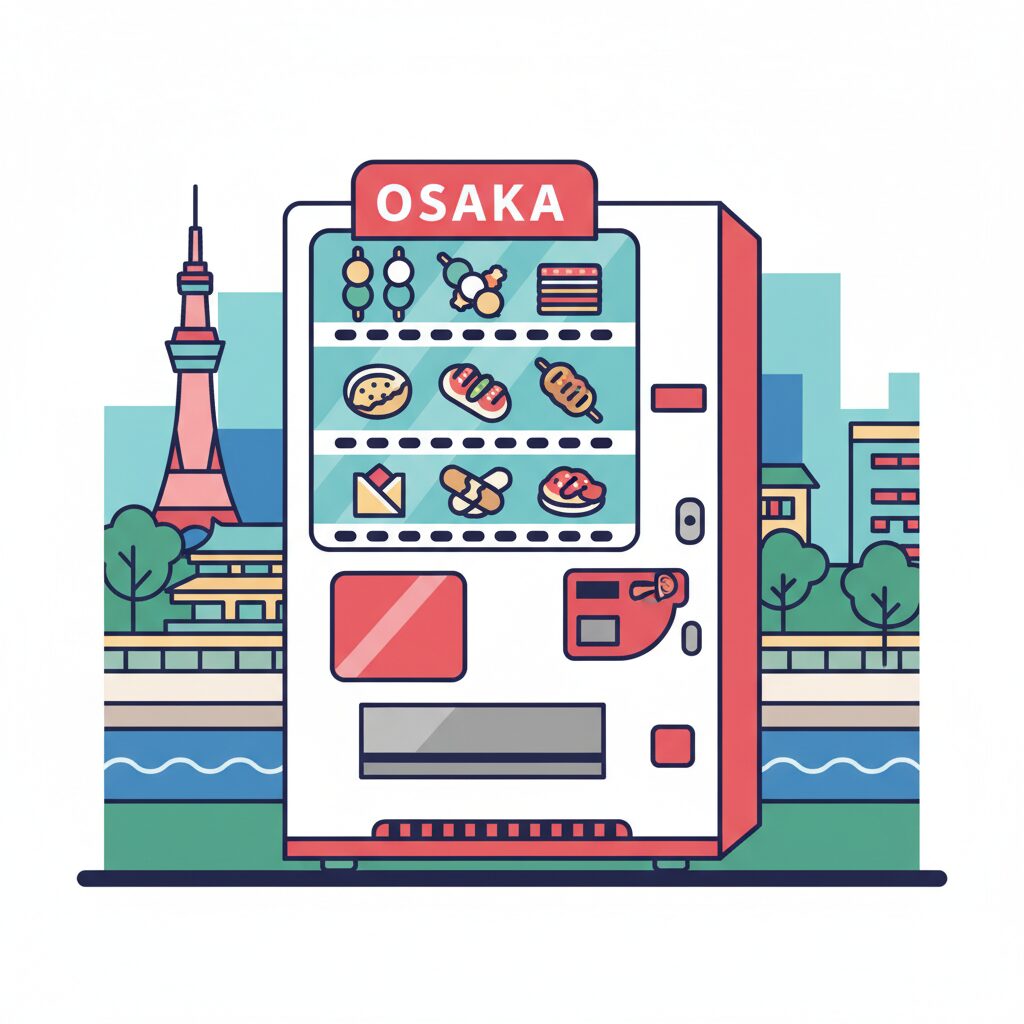
Welcome to Osaka. You’re hungry. It’s 12:15 PM, and the city’s stomach is rumbling in unison. You duck into a promising-looking ramen joint in the labyrinthine backstreets of Umeda. The air is thick with the savory promise of tonkotsu broth. But before you can even think about noodles, you’re stopped by it: the machine. A monolithic block of plastic and metal, covered in a chaotic mosaic of buttons with pictures of food and cascading Japanese characters. This is the kenshoku-ki, the meal ticket vending machine, and it is the stoic gatekeeper to your lunch. A line is already forming behind you. You can feel the collective, impatient energy of a dozen Osaka salarymen willing you to just make a decision. You hesitate, fumbling for your wallet, trying to decipher the difference between `濃厚` (rich) and `あっさり` (light). The pressure mounts. This isn’t just ordering food; it feels like a high-stakes cultural performance, and you’ve forgotten all your lines.
This moment of panic is a rite of passage for almost every non-Japanese person living in Osaka. It’s easy to dismiss the kenshoku-ki as a quirky, slightly inconvenient piece of Japanese automation. But here in Osaka, it’s much more than that. It’s a window into the city’s soul. This machine is the physical embodiment of the Osakan trinity: ruthless efficiency, unwavering practicality, and a deep, abiding love for good value. Understanding the silent, unwritten rules of this mechanical gatekeeper is one of the first and most important steps to truly grasping the rhythm of daily life in this city. It’s about more than just getting your ramen fast. It’s about participating in a social contract that prioritizes speed, minimizes fuss, and allows hundreds of people to get a hot, delicious, and cheap meal in the shortest amount of time humanly possible. Forget what you read in guidebooks; your real education in Osaka culture starts right here, in front of this glowing wall of buttons.
Once you’ve mastered this mechanical gatekeeper, you’ll be ready to explore other unique dining customs, like the social etiquette found in Osaka’s standing bars.
Why the Machine? Osaka’s Obsession with Efficiency and `Kospa`

To grasp why these seemingly impersonal machines dominate the quick meal scene in Osaka, you need to understand two concepts that are almost sacred here: `kospa` (cost performance) and the `sekkachi` (impatient) mindset. The kenshoku-ki isn’t a gimmick; it’s a solution—an intentionally designed outcome of a culture that prioritizes the best possible food at the lowest price, served in the shortest time. It embodies a lifestyle philosophy, packaged into a box that dispenses tickets.
The Gospel of `Kospa` (Cost Performance)
In Tokyo, you might pay for ambiance, elaborate service, or a prestigious brand. In Osaka, you pay for the core offering itself. The idea of `kospa`, short for “cost performance,” is the ultimate gauge of value. An Osakan will enthusiastically describe the amazing 500-yen lunch they discovered, praising the rice’s quality and fish’s freshness with the zeal of a true connoisseur. The meal ticket machine plays a vital role in relentlessly pursuing peak `kospa`. For the shop owner, it’s a stroke of brilliance: it removes the need for at least one front-of-house staff member. There’s no cashier to settle with or waiter to place your order. This reduction in labor costs is directly passed on to customers, making it possible for a tiny, 10-seat ramen bar to serve a world-class bowl for 800 yen instead of 1,200. The machine needs no breaks, doesn’t call in sick, and processes payments flawlessly. It is the silent, tireless engine behind affordability. For customers, the advantage is equally obvious. The transaction is straightforward—you pay upfront, eliminating the awkwardness of catching a busy staff member for the bill later. There’s no fumbling with credit cards or change while others wait. The financial aspect is handled before you even sit down, letting you concentrate fully on your meal. This system benefits both sides, reducing the dining experience to its essentials: payment and consumption. This is Osaka’s `akindo` (merchant) spirit in action—a smart, pragmatic deal where everyone wins.
The `Sekkachi` Mindset: Why Osaka Hates Wasting Time
If `kospa` is the strategy, then the `sekkachi` nature of Osakans is the driving force. Often translated as “impatient” or “hasty,” `sekkachi` actually conveys a deep-seated, energetic restlessness and a cultural aversion to wasted time and inefficiency. People in Osaka walk faster, speak faster, and expect things to happen immediately. The escalators provide a famous example: in Osaka, you stand on the right and walk on the left, while in most other parts of Japan, including Tokyo, it’s reversed. The popular story is that this was to allow busy merchants to rush past on the left. True or not, it perfectly illustrates the local mindset: traffic flow must be optimized for speed. The meal ticket machine is the culinary parallel to the Osaka escalator rule—it eliminates unnecessary conversation. There’s no “Hello, welcome. A table for one? Please look at the menu. Are you ready to order?” Instead, the process is reduced to a few mechanical button presses. This may seem abrupt to outsiders, but to an Osakan, it’s perfectly logical. Why waste words on pleasantries when there’s a line of hungry people waiting and a chef ready to cook? This is a key distinction from Tokyo. While Tokyo is undoubtedly fast, its speed is often wrapped in layers of formal procedure and politeness. There’s a proper way to do things and a certain rhythm to service interactions. Osaka’s speed is rawer and more direct—about cutting through the process to get from A to B as quickly as possible. A Tokyoite might wait patiently in line, while an Osakan is mentally counting the seconds each person spends at the machine, tapping their foot impatiently, their ¥1000 bill ready for instant insertion. The kenshoku-ki is the ideal tool for a `sekkachi` city, respecting the most precious commodity of all: time.
The Unspoken Rules: The Silent Dance of the Solo Diner
Interacting with the kenshoku-ki is a performance with its own unwritten choreography. Success isn’t just about getting the food you want; it’s about carrying out the process smoothly, without disturbing the delicate, fast-paced ecosystem of the solo lunch. Mastering these steps shows you’re in tune with the local rhythm.
Step Zero: Decide Before You Approach
This is the cardinal rule—the single most important etiquette to follow. Never, under any circumstances, start deciding what to order while standing right in front of the machine with a line behind you. This is a serious breach of the social contract of efficiency. The exasperated sighs and sharp stares you’ll get aren’t personal attacks; they’re the collective immune response of a system trying to clear a blockage. You’re expected to use your time in line to prepare. Check out the plastic food models (`shokuhin sanpuru`) in the window. Study the laminated, poster-sized menu on the wall. If there are pictures on the machine, scan them from a distance. If you’re truly unsure, show a gesture of social grace: step aside and wave the person behind you forward. This small gesture demonstrates your awareness of the system and respect for others’ time. It instantly shifts you from obstacle to considerate participant. The locals have their order memorized. They walk in, reach for their wallet, and hit the correct button in one smooth motion. They decided their lunch two blocks away. You don’t need to be that quick, but you must have a plan at least. Approaching the machine should be about execution, not contemplation.
The Transaction: Money First, Then Button
Many newcomers stumble here. You’ve made your choice, see the button for your `kitsune udon`, and start pressing it repeatedly, wondering why nothing happens. The machine stays stubbornly unresponsive because, in the world of the kenshoku-ki, you must signal your intent to pay first. The proper sequence is inviolable: insert your cash or coins before pressing any button. Once the machine accepts your money, the buttons for the items you can afford will light up. Only then can you make your selection. This small detail often causes confused panic among foreigners, resulting in frantic button-mashing as the line behind you grows restless. The machine’s layout can be bewildering. It isn’t a neat, linear menu you might expect. It’s a grid, a visual overload of options. But there’s usually a hidden logic. The shop’s main, signature dishes are nearly always the biggest buttons, located in prime spots at the top row or top-left corner. Variations, like extra pork (`chashu`) or flavored egg (`ajitama`), are nearby in the same column or row. Side dishes like `gyoza` or rice, and toppings like green onions or bamboo shoots, are generally smaller buttons placed at the bottom or sides. Look for the crucial kanji: `大盛` (oomori) meaning a large portion. After selecting, the machine whirs to life, spits out a small ticket—or sometimes two, one for you and one for the kitchen—and returns your change. Take them both. Your ticket is your currency, your proof of purchase, your order confirmation, and your key to being served.
The Hand-Off and the Seating Shuffle
Holding your precious ticket, you might hesitate. What now? This next step is another silent, essential part of the ritual. Don’t just stand there waiting for directions. The system is already moving. As you turn away from the machine, one of two things will happen. In some shops, a staff member will promptly approach, take your ticket with a quick nod, and direct you to an empty stool. More often, especially in small counter-only spots, you’re expected to find the next available seat yourself. This isn’t a time for leisurely choice. You don’t get to pick the “best” seat by the window. You fill the next open space in line, like a piece in a game of human Tetris. This keeps the flow orderly and maximizes seating. Once seated, place your ticket on the raised counter in front of you. The chef, without missing a beat in straining noodles or ladling broth, will swiftly retrieve it. Often, not a single word passes. You might hear a gruff `Hai, domo` (“Yes, thanks”) as they take the ticket, but that’s it. The transaction is complete. Your ticket on the counter was the signal. Their taking it was confirmation. This non-verbal communication exemplifies peak Osaka efficiency. It’s a beautifully streamlined process relying on everyone understanding their part.
What the Machine Reveals About Osaka Culture
The modest meal ticket machine is more than mere restaurant equipment; it stands as a cultural artifact. Its widespread use and the social customs it entails reveal core principles underlying life in Osaka, ranging from a distinct form of urban individualism to a merchant’s philosophy that values substance over style.
Individualism Within a System
The solo lunch is a staple of everyday life throughout Japan, but the kenshoku-ki elevates it to a smooth art form. This machine serves as the perfect interface for the solitary diner, enabling a fully self-contained, anonymous experience. You can enter, interact solely with a machine, enjoy an excellent meal, and leave, all without engaging in meaningful social interaction. To a Westerner, this might seem lonely or cold. Yet, within the context of a densely packed city, it represents a profound form of urban respect. It honors your time, autonomy, and personal space. It grants the freedom to be alone amid a crowd. The system isn’t meant to be unfriendly but to be frictionless. The shared understanding of the rules—choose first, pay first, hand over your ticket—fosters collective harmony. Everyone acts as an efficient individual within a clear system, which in turn simplifies life for the group. This is a brand of individualism that supports, rather than disrupts, communal flow.
The `Akindo` (Merchant) Spirit: Practicality Over Politeness
Osaka has served as Japan’s commercial center for centuries, shaped by merchants (`akindo`). This heritage has instilled a strong pragmatism in the local character. The emphasis is on the deal’s substance rather than its ornate packaging. The kenshoku-ki is the ultimate merchant’s instrument: it standardizes the product, speeds up payment, and maximizes customer turnover. It’s pure, straightforward business logic applied to lunch. This often contrasts with the more formal service culture typical of Tokyo, where `omotenashi`—a style of anticipatory, detailed hospitality—dominates. At a Tokyo eatery of similar price, one might encounter more bows, polite phrases, and a ceremonial presentation of the bill. In Osaka, good service is defined differently: by the speed of food delivery, the heat of the broth, the generous noodle portions, and unbeatable price. The shop owner demonstrates respect and care through product quality, not through small talk or formalities. Customers reciprocate by being efficient, no-nonsense patrons. It’s a distinct form of politeness that conveys, “I respect your time and money, so I’ve removed everything that would delay you from enjoying this excellent bowl of ramen.” An Osakan may not want frills; they want the straightforward deal. The machine delivers exactly that.
A Common Misunderstanding: Is It Unfriendly?
Newcomers may easily misread this highly efficient, low-interaction system as cold, rude, or unfriendly. There’s no warm greeting. The chef may grunt instead of smile. The people in line may seem impatient. But this interpretation comes from the wrong cultural viewpoint. It’s not unfriendly; it is impersonal by design, intended to prioritize collective efficiency. The friendliness doesn’t lie in explicit words but in the smooth operation of the shared system. It’s evident in the shopkeeper’s ability to serve a delicious meal at a low price by streamlining operations. It’s in the unspoken agreement among customers to move quickly so the next person can get their lunch and return to work on time. The social warmth is not in the interaction itself but in the steaming, delicious bowl of udon placed before you mere minutes after you arrived. That bowl is the conversation. It says, “Welcome. We’re glad you’re here. We’ve worked hard to make this for you. Now, please eat and enjoy.” You are partaking in a system founded on mutual, unspoken respect for time and value.
Pro-Tips for Navigating the `Kenshoku-ki` Like a Local
Equipped with this cultural insight, you’re ready to master the machine. Here are some practical tips to ensure your next solo lunch goes smoothly and stress-free, turning you from a tentative tourist into a confident local.
Mastering the Visuals
What should you do when you can’t read a single button? Don’t worry. Rely on your eyes. First, look for pictures. Most machines, especially in busy areas, will display small photos of the dishes. Next, trust the layout. As noted, the button in the top-left corner almost always represents the shop’s main specialty, the `kanban menu` (signature dish). If you’re overwhelmed and the line is growing, you can rarely go wrong by choosing this option—it’s the dish the shop takes the most pride in. To improve, try learning a few essential food-related kanji. Even recognizing a few will help unlock the menu for you. Key characters include: `ラーメン` (ramen), `うどん` (udon), `そば` (soba), `味玉` (ajitama—the delicious marinated soft-boiled egg), `替玉` (kaedama—a common, important word in ramen shops meaning an extra serving of noodles), `大` (dai—large), `並` (nami—regular), and `小` (sho—small). Spotting these can mean the difference between a standard bowl and a supersized version with all the best toppings.
The Cash Situation
Many kenshoku-ki are remnants of a simpler, pre-digital era. They’re cash-focused machines. While some newer models might accept IC cards like Icoca, the vast majority operate on physical currency and are picky about what they accept. These machines favor ¥1000 bills and coins but absolutely reject ¥10,000 and ¥5,000 bills. Trying to insert a ¥10,000 note during the busy lunch rush is a guaranteed way to cause a jam and earn the eternal disdain of those waiting behind you. It’s the ultimate breach of efficiency etiquette. Always try to have smaller bills and some coins ready before you enter the shop. Being prepared with the right currency reflects your respect for the unspoken social contract and shows you’re a considerate participant, not someone who disrupts the lunch flow.
The `Kaedama` Conundrum
In the world of Hakata-style tonkotsu ramen, `kaedama` reigns supreme. It means an extra portion of noodles added to your remaining broth. But ordering it can be tricky. Some shops require you to buy the `kaedama` ticket from the vending machine at the start, along with your main ramen ticket. You keep this second ticket and hand it to the chef when you want your refill. Other shops prefer a simpler system where you order `kaedama` from your seat by placing ¥100 or ¥150 in cash directly on the counter and calling out `Kaedama, onegai shimasu!` (“A noodle refill, please!”). There’s often no clear sign indicating which method the shop uses. This is an advanced challenge where the key is observation. Before finishing your first bowl, take a discreet look at what your neighbors do. Do they hand over a ticket? Or do they put coins on the counter? This is how you learn the local language of the shop. Quiet observation is your best tool for navigating these subtle, unwritten rules.
The Ticket to Understanding
The meal ticket vending machine, in all its mechanical, impersonal glory, is much more than merely a convenience. It serves as a microcosm of life in Osaka. It stands as a tangible representation of a social contract founded on speed, practical value, and a profound, shared understanding that enables this vast city to operate with surprisingly smooth efficiency. It teaches that in Osaka, efficiency is a form of courtesy, and good value is an expression of respect. It reveals a culture where substance consistently outweighs style, and where community is conveyed not through warm greetings but through a collective dedication to a system that benefits everyone.
Learning to use the kenshoku-ki with confidence—to step forward, insert your money, press your selection, and take your seat in one fluid, practiced motion—is a quiet triumph. It signals, both to yourself and others, that you are no longer a mere outsider looking in. You have become a participant. You have begun to grasp the city’s unique rhythm, its unspoken language, and its fundamental logic. So next time you face that glowing wall of buttons, don’t feel the least bit intimidated. See it for what it truly is: your entry ticket into the authentic, unfiltered, and wonderfully efficient flow of everyday Osaka. It is the silent handshake welcoming you to the table.