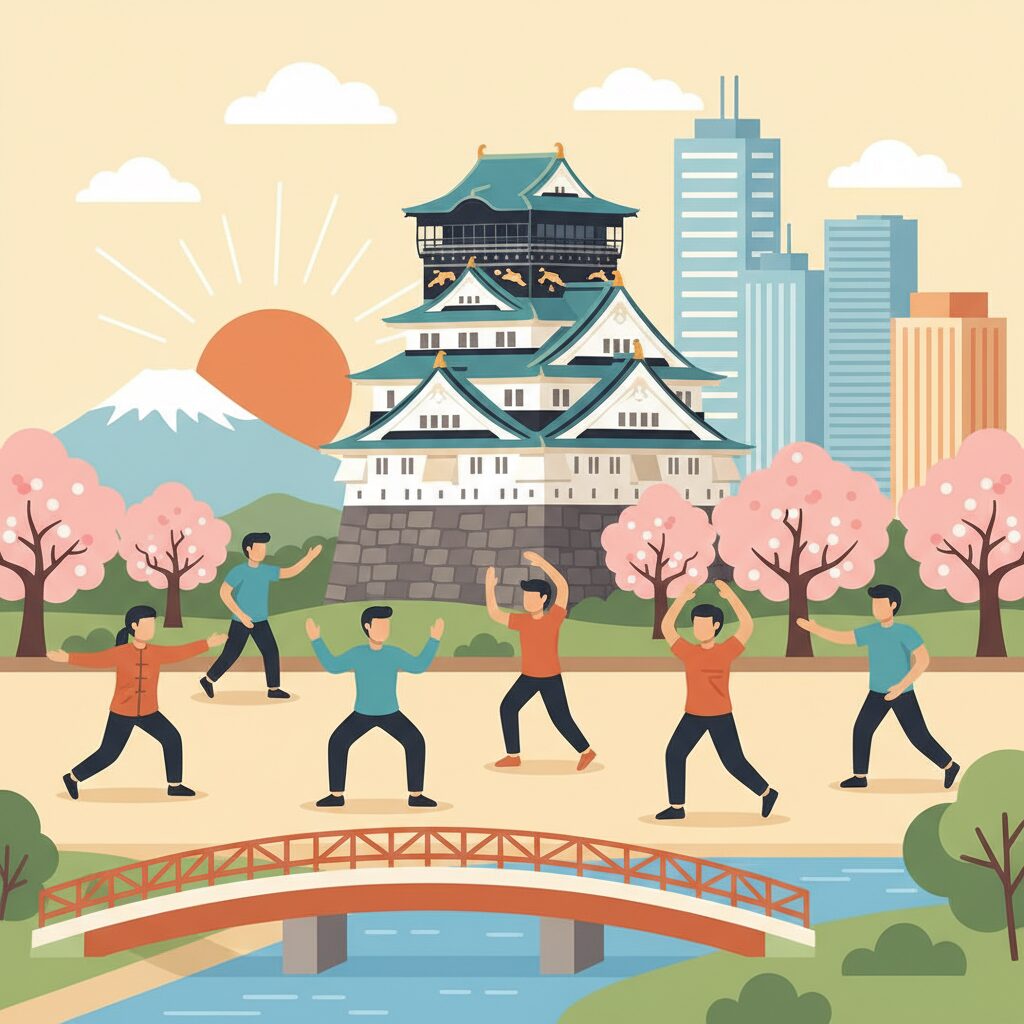
Walk through any decently sized park in Osaka around 6:30 in the morning, and you’ll see it. Before the cicadas start their deafening summer chorus, before the salarymen flood the subway stations, there’s a quiet, rhythmic gathering. A group of people, mostly seniors but with a surprising mix of ages, standing in loose formation. They’re moving together, a slow-motion ballet of arm stretches, knee bends, and gentle torso twists, all performed in near-perfect unison. From a small, tinny radio perched on a park bench, a gentle piano melody spills out, accompanied by a calm, encouraging male voice counting out the rhythm. This is Radio Taiso, or Radio Calisthenics, a morning ritual so deeply woven into the fabric of daily life here that most people don’t even think to explain it. For a newcomer, it’s a baffling, yet strangely peaceful, spectacle. It feels like a secret club you’ve stumbled upon, a silent pact to greet the day with collective movement. But this isn’t just about fitness. It’s not a Zumba class or a boot camp. This simple, ten-minute routine is a powerful window into the operating system of Osaka society. It’s about community, consistency, and a deeply pragmatic approach to social connection that defines this city. This is where the neighborhood checks in, where the social fabric is quietly re-stitched each dawn, long before the city’s famously boisterous personality wakes up. It’s the city’s gentle, collective inhale before the loud, vibrant exhale of the day begins.
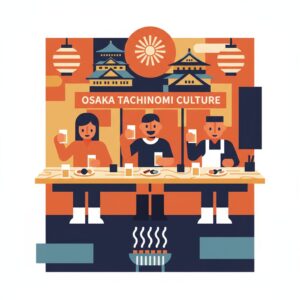
The shared spirit of Osaka’s early routines is mirrored in the city’s vibrant social scenes, as seen in Osaka tachinomi culture, where community bonding transforms everyday moments into celebrations of life.
More Than Just a Stretch: The Social Glue of the Neighborhood Park
The first thing to understand about Radio Taiso is that the exercises themselves are almost incidental. The true purpose of this gathering is the gathering itself. It’s a low-stakes, highly efficient way to maintain community connections. An unspoken invitation lingers in the air; there’s no need to sign up, pay a fee, or be formally introduced. You simply show up. This is a fundamental principle of Osaka’s social logic: participation is open by default. You find a spot, follow the movements, and just like that, you’re part of it. This might feel unfamiliar to a foreigner accustomed to more structured social events, but it’s pure practicality. The group isn’t there to screen you; they’re there to stretch. Your presence is your application, and your ongoing attendance is your membership.
The Attendance Card Ritual
For many, especially children during their summer breaks, the experience is gamified through the rajio taisō kaado. It’s a simple cardstock with a grid of empty squares, one for each day. A volunteer, usually a long-standing member, sits by the radio with a stamp and ink pad. After the exercises conclude, participants line up to receive their daily proof of attendance. For kids, filling the card often earns a small prize at summer’s end—a bag of snacks or some inexpensive stationery. It’s a clever way to build a sense of routine and achievement. For adults, the card is less about rewards and more about a quiet, personal record. It’s a non-digital streak, a tangible log of one’s discipline. It’s a promise kept to oneself, witnessed by the community. No one is monitoring you, but the simple act of getting that stamp creates a bond of shared consistency. It says, “I was here today. You were here today. We began the day together.”
The Post-Exercise Social
After the final musical flourish from the radio fades and the stamps are handed out, the second—and more important—part of the ritual begins: the chat. The group breaks into smaller clusters of two or three. This isn’t a lengthy coffee session. It’s a quick, efficient exchange of information lasting about ten minutes. They talk about the weather forecast, rising vegetable prices at the local market, news about a neighbor who’s unwell, or updates on the Hanshin Tigers baseball team. This is the neighborhood’s analog social media feed. It’s where you learn who needs help, who has extra tomatoes from their garden, and who recently visited the new doctor down the street. It’s both incredibly ordinary and vitally important. This daily, face-to-face check-in strengthens the local network, creating a safety net of casual surveillance in the best sense. It ensures no one slips through the cracks unnoticed.
Osaka’s Version of a Town Square: Pragmatism in Green Spaces
To truly understand the role of Radio Taiso, you need to appreciate how Osaka perceives its public spaces. In a city as densely populated as this one, every square meter must serve a purpose. Parks aren’t merely decorative green lungs for aesthetic enjoyment; they function as vibrant, dynamic community hubs. This subtle yet important difference sets Osaka apart from Tokyo. In many Tokyo parks, there’s a stronger sense of anonymity. People jog with headphones, individuals find quiet benches for solitary reflection, or groups come together for organized, specific events. The space often serves as a backdrop for personal activities. In Osaka, however, the park feels more like a communal living room. It’s understood that the area will be used collectively, and Radio Taiso represents the ultimate expression of that spirit.
The “Ame-chan” Culture in Motion
You may have heard of Osaka’s ame-chan culture, the well-known practice of older women handing out candy to both strangers and acquaintances. Often seen as a simple quirk, it is actually a refined social lubricant. Offering an ame-chan is a way of saying, “I see you. We share this space. Let’s have a small, positive exchange.” Radio Taiso is essentially the full-body counterpart to this. The shared routine, the morning greeting, the brief conversation—it’s a mutual gesture of recognition. It establishes a foundation of familiarity and goodwill among people who might otherwise never engage. It represents an unspoken agreement to be a community rather than just a group of individuals living in the same area. This isn’t about becoming close friends; it’s about sustaining a practical, low-friction social environment. It’s deeply pragmatic, a true reflection of the Osaka mindset.
The Cast of Characters
Spend a few mornings at a Radio Taiso gathering, and you’ll quickly recognize the cast of characters. There’s the unofficial leader, the person who brings the radio daily and knows the routine perfectly, moving with a fluid grace that belies their age. There’s the stoic gentleman who stands in exactly the same spot every morning, rain or shine, offering a single, solemn nod as his only form of communication. A group of women forms the social core, their post-exercise chatter buzzing with energy and laughter. You might spot a young mother with a toddler in tow, the child humorously trying to mimic the adults’ movements. Occasionally, you might see another foreigner, perhaps as curious and perplexed, quietly observing from the edges. This isn’t an exclusive club; it’s a self-selecting cross-section of the neighborhood, a living snapshot of the community.
Decoding the Movements: The Language of Shared Routine

At first glance, the exercises of Radio Taiso may appear somewhat simple, even old-fashioned. They consist of thirteen movements, designed to be accessible for people of all ages and fitness levels. These include arm rotations, side bends, gentle hops, and deep breathing exercises. However, dismissing them as merely light stretching completely misses the point. The strength of the routine lies not in its physical intensity, but in its absolute, unwavering consistency.
The Music and the Voice
The piano melody accompanying Radio Taiso is instantly recognizable to nearly everyone in Japan. It is a sound deeply embedded in the national consciousness, evoking nostalgic memories of childhood summer holidays. The calm, encouraging voice of the instructor on the broadcast is a familiar guide, a comforting presence that has led the nation through these same movements for decades. There are three official versions of the routine, but Radio Taiso Number One is the classic—what you’ll hear every morning in the park. This shared soundtrack acts as a unifying force. When that music plays, you know that across the entire archipelago, from Hokkaido to Okinawa, thousands of small groups are performing the exact same movements. It’s a quiet, daily act of national solidarity.
Perfection Isn’t the Point
One of the biggest mistakes a newcomer can make is worrying about performing the movements perfectly. This is not a performance. No one is judging your form or flexibility. If you look closely, you’ll notice a wide range of variations. Some older participants might only move their arms while keeping their feet firmly planted. Others might perform a more subdued, modified version of each exercise. Some will be focused and precise, while others go through the motions with a dreamy, half-awake expression. The sole goal is participation. The value lies in showing up and moving in unison with the group. This emphasis on collective involvement over individual performance offers a key insight into the local culture. It rejects the competitive individualism often seen in Western fitness culture. Here, the group’s rhythm matters more than any one person’s perfect execution.
How to Join (Without Feeling Awkward)
For many foreigners, the thought of spontaneously joining a group of strangers in a synchronized exercise routine can feel intimidating. The social norms seem unclear. However, integrating into a Radio Taiso group is much easier than you might think, as long as you grasp the unwritten etiquette. It’s a process of quiet observation and patient persistence.
The Practical Guide
First, find your location. Nearly every neighborhood park with a flat, open area (often called a hiroba) will have a group. The prime time is from 6:25 to 6:30 AM, since the broadcast begins promptly at 6:30. Watch for the tell-tale signs: a portable radio on a bench and a small group of people milling around, doing their own warm-up stretches. There won’t be a welcome banner or sign-up sheet. The absence of an explicit invitation is the invitation.
Your First Day
Avoid walking into the center of the group and introducing yourself. That would be disruptive and, honestly, a bit awkward. The best approach is to find a spot on the edge or at the back. Give yourself enough room to move, but stay part of the collective shape. Your first day is for observing. Notice how others position themselves. Listen to the rhythm of the music. Follow the movements as best you can. When the routine ends, don’t linger expecting a welcome party. A simple, quiet nod or a soft “Otsukaresama deshita” (a phrase loosely meaning “Thanks for your hard work”) to those nearby is sufficient. Then, just leave. Repeat this the next day, and the day after.
What to Expect
Your presence will be noticed, but likely not remarked on for the first few days. The locals are watching you, too. They are assessing your consistency. Are you a tourist who stumbled upon this once, or a resident making an effort? After showing up three or four times in a row, the ice will begin to break. Someone might greet you with a simple “Ohayo gozaimasu” (Good morning). This is your cue to respond likewise. A few days later, one of the more outgoing members might ask in simple Japanese or by gestures where you’re from. This is the start of conversation. The key is to let the community absorb you at its own pace. Trust is built not through a single bold introduction, but through the steady, reliable accumulation of shared mornings. Your actions—specifically the act of consistently showing up—are your introduction.
Beyond the Park: The Ripple Effect of a Simple Morning Habit

The daily Radio Taiso gathering may appear to be a small, insignificant part of Osaka’s vast urban life, but its influence extends outward, shaping the character of the neighborhoods it anchors. It serves as a microcosm of the city’s social philosophy, one grounded in practical connections and mutual awareness. This simple morning routine nurtures a community that is both resilient and profoundly humane.
The Unseen Safety Net
In a nation facing an aging population, the informal check-in system offered by Radio Taiso is a priceless community resource. The regular participants know each other’s habits well. If Mrs. Tanaka, who hasn’t missed a day in twenty years, suddenly fails to appear for three consecutive mornings, it doesn’t go unnoticed. Someone will quietly ask, “Has anyone seen Tanaka-san?” If no one has, a neighbor will be sent to knock on her door or make a phone call. This is not prying; it’s a social immune system in action. It’s a highly localized, person-to-person safety net that helps catch people before they slip into isolation. It offers a sense of security that no government program or digital app could ever match. It’s the reassurance that you are seen, and that your absence would be noticed.
It’s Not About Being “Friendly,” It’s About Being “Connected”
There’s a common cliché that “Osaka people are friendly.” While not untrue, this is often misunderstood by outsiders. It’s not the bubbly, effusive friendliness found in some other cultures. Instead, it’s a more practical, grounded sense of connection. Osaka’s version of friendliness is based on the recognition that we all share this crowded space, so we might as well make it work. It’s about acknowledging mutual dependence. The people in your Radio Taiso group are not necessarily your close friends. You may not know their life stories or deepest secrets. But they are your community. They are the ones who will notice when you’re absent. This pragmatic approach to relationships is what makes Osaka function. It’s less about sentimentality and more about shared existence. The bonds form through shared routine and physical proximity, creating a society that is strong, supportive, and deeply aware of its members. So next time you see that group exercising in the park at dawn, don’t just view it as a quirky morning workout. See it for what it truly is: a masterclass in community building, Osaka-style. It’s an invitation to find your place in the city’s rhythm, one synchronized stretch at a time.