As a historian, I’m trained to look for the grand narratives, the pivotal battles, the seismic shifts that shape a culture. Yet, after years of living in Osaka, I’ve come to understand that the city’s truest character isn’t found in its magnificent castle or its neon-drenched entertainment districts. It reveals itself in quieter, more mundane moments. It’s in the rhythm of the morning commute, the banter in a covered shopping arcade, and most profoundly, in the humble ritual of the ‘Morning Set’ breakfast. When I first arrived, fresh from the UK and accustomed to the starkly transactional nature of a London café, I saw the convenience store as the epitome of Japanese efficiency. An onigiri, a can of coffee, consumed in three minutes flat. It was a system, and it worked. But I soon noticed something else, a parallel universe operating on a different clock. Tucked away on side streets, nestled under the rumbling train tracks, were the kissaten—Japan’s traditional coffee shops. Their windows often displayed faded plastic food models: a slice of unnaturally thick toast, a perfectly spherical boiled egg, a small green salad, and a cup of coffee. The sign would read ‘モーニングセット’ (Morning Set), often for a price that barely covered the cost of the coffee alone. My initial thought was one of confusion. How could this business model possibly survive? Who were these people, lingering over coffee and toast, when a perfectly good, faster, and equally cheap option existed a few doors down? That question became my entry point, not just into a breakfast habit, but into the very soul of Osaka. This article isn’t a guide to the best toast in the city. It’s an exploration of what the ‘Morning Set’—this simple, anachronistic meal—tells us about the Osaka mindset, its unique social fabric, and the subtle but profound ways it differs from the rest of Japan. It’s a look at the city’s public living room, a place where commerce, community, and caffeine intertwine in a way that is utterly, unmistakably Osaka.
To truly grasp this social fabric, one must also understand the unique conversational routines in Osaka’s local shopping arcades.
The Anatomy of a ‘Morning’: More Than Just Toast and Coffee

The Osaka ‘Morning Set,’ or simply ‘Morning’ as it’s locally called, may seem straightforward on the surface, yet each element is rich with cultural meaning. It’s a deceptively simple dish that embodies economic philosophy, social contract, and local pride. To dismiss it as just an inexpensive breakfast misses the entire point. It’s a complex exchange disguised as an ordinary meal, a daily expression of Osaka’s core values. The plate itself exemplifies balance and tradition, a formula honed over decades to deliver maximum satisfaction at minimal cost, but the true essence lies in the unspoken understanding between the proprietor and the customer. Essentially, it is the city’s merchant spirit presented on a small ceramic plate.
Deconstructing the Deal: The ‘Service’ Mentality
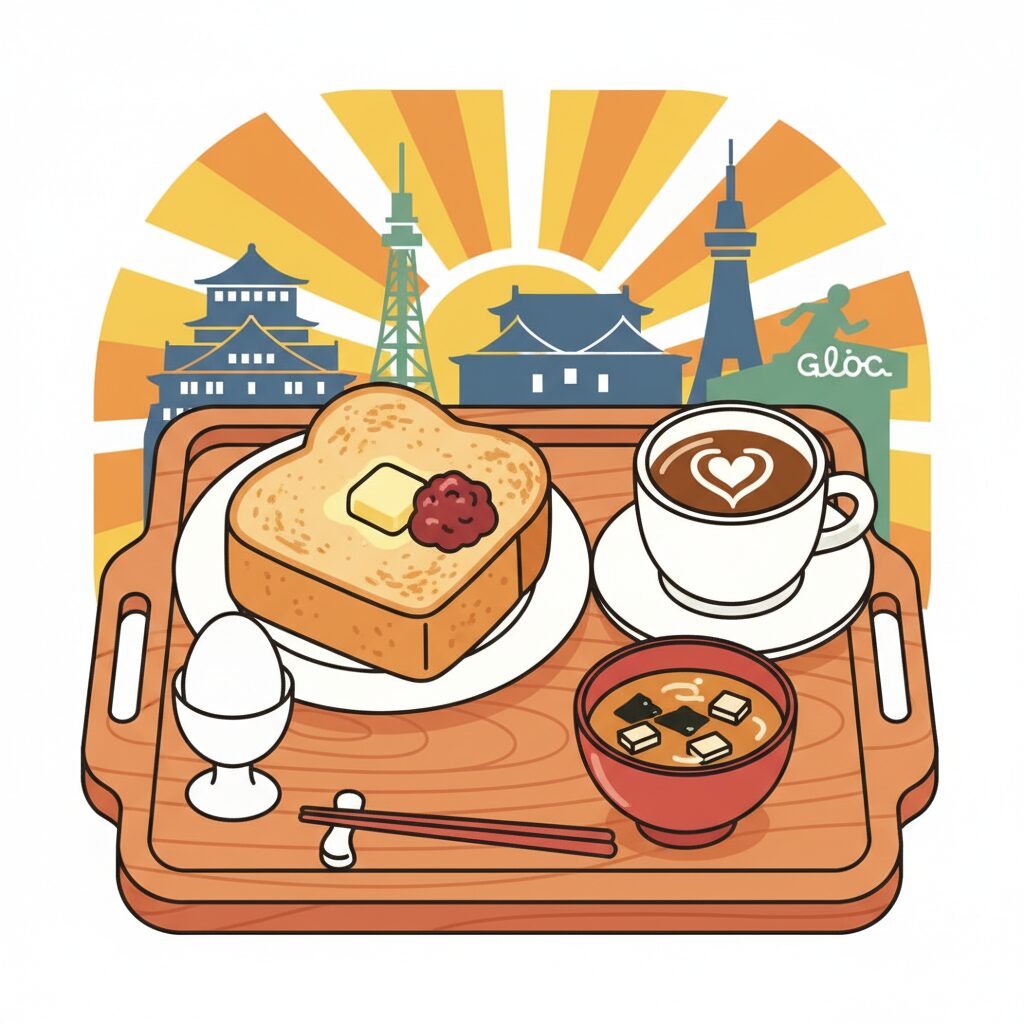
First, let’s examine the physical components. The centerpiece is nearly always the toast. This isn’t the thin, pre-sliced supermarket bread; it’s atsugiri toast—a thick slab of fluffy, white shokupan, generally at least an inch and a half thick. It’s toasted to a perfect golden-brown crust while remaining soft and pillowy inside, served with a pat of butter or margarine melting into its crevices. Alongside it lies a hard-boiled egg, sometimes peeled, sometimes not, quietly complementing the toast. A small, almost symbolic salad of shredded lettuce and cabbage, lightly dressed, adds a touch of freshness. And then there’s the coffee, the cornerstone of the entire experience. Typically a dark, robust blend brewed by siphon or flannel drip method, it stands far apart from the automated espresso of global chains. The entire set often costs an astonishingly low 400 to 500 yen—about the same price as a single cup of coffee ordered alone after 11 a.m. This is the key point: you aren’t paying for the food; the food represents service (サービス, pronounced sābisu in Japanese).
This concept of ‘service’ is central to understanding Osaka’s merchant spirit, the akindo shikon. In Tokyo, transactions are usually direct and clear-cut: you pay for a product, you receive that product, and any extras are carefully calculated. In Osaka, commerce is more of a relationship. The ‘Morning’ is an act of goodwill, a strategic investment in loyalty. The proprietor, or ‘Master’ as often called, isn’t focused on the profit margin of a single slice of toast. Instead, they’re thinking about securing a customer for the afternoon, tomorrow, and years ahead. By offering such incredible value, they’re not losing money—they’re building social capital. They create a reason for you to choose their establishment over countless competitors. It’s a classic loss-leader strategy, but carried out with warmth and personal investment that elevates it beyond business tactics to a cultural institution. It’s a daily message saying, “Thank you for your patronage. Please come again.” This generosity fosters a powerful sense of reciprocity. You develop loyalty toward the place that treats you so well, making you more likely to return later for a pricier coffee or a plate of spaghetti Napolitan at lunch. It’s a long-term business vision that values human connection and repeat patronage over short-term profits—a philosophy becoming increasingly rare today.
The Unspoken Menu: Customization and Regulars
After frequenting a kissaten for some time, you begin to notice subtle variations—the unspoken menu reserved for regulars, the jōren-san. The standard set is merely a starting point. For a small extra charge, you might add a thick layer of sweet red bean paste (ogura) to your toast, turning it into an indulgent Ogura Toast, a Nagoya specialty embraced enthusiastically in Osaka. The salad might be swapped for a small bowl of yogurt or a piece of fruit. Some shops offer a miniature sausage or a slice of ham. But true customization comes from the relationship you cultivate with the Master.
Becoming a regular is a gradual, organic process. It begins when the Master recognizes your face. Then comes a nod of recognition. Soon, they might start preparing your coffee as you enter. They learn you prefer your egg slightly soft-boiled, or an extra pat of butter. This isn’t the scripted personalization of a Starbucks app; it’s earned intimacy. A quiet understanding formed over many shared mornings. I found my own spot in the Tenma district—a small family-run place with dark wood paneling and the faint, sweet scent of decades-old coffee and tobacco smoke. For the first month, my interactions were limited to pointing at the menu and saying a polite “arigatou.” Then one day the elderly woman behind the counter asked, “Itsumo no?”—”The usual?” It was a small exchange but a meaningful milestone. It marked my crossing from anonymous customer to a recognized fixture of the morning routine.
This is a microcosm of social life in Osaka. Despite its scale, the city functions through networks of personal relationships. Being known, being a jōren, carries significance. It means you belong. In this context, the kissaten isn’t just a place to eat; it’s a place to be seen, to be acknowledged, to affirm your belonging in the local community. It’s a deeply human experience that sharply contrasts with the sterile anonymity of convenience stores or global coffee chains, where your identity is reduced to a loyalty card number or an order name shouted across a crowded room.
The Kissaten as a ‘Third Place’: Osaka’s Public Living Room
The survival of the traditional kissaten amid fierce competition is about more than just affordable toast; it reflects the essential social role these establishments fulfill. They exemplify what urban sociologist Ray Oldenburg described as the ‘third place’—an informal public space distinct from the two main social settings of home (‘first place’) and work (‘second place’). These are the cornerstones of community life, places where people can relax, connect, and experience a sense of belonging. While in my native Britain a pub might serve this role, in Osaka, the kissaten reigns supreme as the third place—a communal living room for the whole neighborhood.
Not a Cafe, Not a Restaurant: The Unique Role of the Kissaten
It is important to differentiate a kissaten (喫茶店) from a modern ‘cafe’ (カフェ). This difference goes beyond terminology; it reflects distinct philosophies, atmospheres, and purposes. A modern cafe, whether an international chain or trendy independent, is generally bright, airy, and designed with contemporary aesthetics. Music is carefully selected, seating encourages quick turnover, and the main goal is efficient service of coffee and food. In contrast, the kissaten hails from a different era, usually the Showa Period (1926–1989). Lighting tends to be dim and warm, furniture includes plush, low-slung velvet or vinyl chairs, and the air often carries the nostalgic scent of old books and, until recently, cigarette smoke. The decor is not deliberately styled; it simply accumulates over time. There is no effort to be ‘fashionable.’ Its purpose is comfort rather than efficiency. It is intended for lingering.
In a kissaten, you are not merely a customer—you are a guest in a place that feels more like home than a business. Often, the television is on, tuned to morning news or a baseball game. Stacks of newspapers and manga are available for anyone to browse. You might see a group of elderly men absorbed in the horse racing section of a sports paper, their conversation a soft, ongoing murmur. Nearby, a local shopkeeper from the nearby shotengai (shopping arcade) may hold an informal business meeting, their discussion accompanied by the clinking of coffee cups. A housewife might be taking a well-deserved break after dropping her children off at school, quietly lost in thought for twenty minutes. The ‘Morning Set’ is the entry ticket to this space. For the price of a coffee, you gain the right to occupy a small corner of this public living room for an hour—to read, think, chat, or simply be.
The ‘Master’ and the Community: More Than a Barista
At the center of every genuine kissaten is the ‘Master’ (マスター). This title, borrowed from ‘master of the house,’ fits better than ‘barista’ or ‘manager.’ The Master is the owner, the coffee brewer, the cook, and, above all, the social linchpin of the establishment. They are the quiet core around which the community turns. A skilled Master has an almost uncanny ability to be present without intruding. They know when to engage in conversation and when to leave a guest to their thoughts. They serve as keepers of the neighborhood’s oral history, unofficial counselors, and guardians of the local social network.
I have seen Masters act as vital conduits for local information, delivering messages between patrons who just missed one another. I have overheard them offering gentle advice to a young person struggling at work or expressing concern for an elderly regular’s spouse. One morning, an elderly woman rushed into my local kissaten in distress, worried because she couldn’t reach her friend who lived alone and wasn’t answering her phone. Without hesitation, the Master picked up her own phone, called another regular living in the same apartment building, and within minutes confirmed that the friend was fine but had simply forgotten to charge her phone. This is a form of social infrastructure no app or government service can replicate. It is care woven into the fabric of commerce. The Master is not just serving coffee; they are caring for their community. This is why the kissaten endures. It offers something far more valuable than cheap food or free Wi-Fi: a sense of being known and cared for. In a vast metropolis of millions, it creates a pocket of village-like intimacy.
The Osaka Mindset on Display: Pragmatism, Value, and Human Connection
The ‘Morning Set’ perfectly captures the essence of the Osaka mindset. It is a daily ritual where the city’s defining traits—sharp business sense, a passion for value, and a deep-rooted belief in human connection—are clearly displayed. To truly understand the ‘Morning Set’, one must appreciate the delicate balance of seemingly contradictory qualities that shape the people of Osaka. They are known for being pragmatic and careful with money, yet remarkably generous. They value independence strongly but flourish through community ties. The kissaten serves as the stage for this cultural interplay every single day.
‘Mōkarimakka?’ – The Economics Behind the Morning Set
The signature Osaka greeting isn’t ‘Konnichiwa’ but ‘Mōkarimakka?’, meaning ‘Are you making a profit?’. The customary response is ‘Bochi bochi denna,’ which translates to ‘So-so’ or ‘Bit by bit’. To outsiders, or even Tokyoites, this can sound blunt, a direct and somewhat rude question about personal finances. However, this is a misconception of its intent. It’s a form of commercial camaraderie, a way to check in rooted in Osaka’s history as Japan’s merchant capital. This greeting acknowledges everyone’s hard work to earn a living and expresses goodwill in that effort. It is business serving as social glue.
The ‘Morning Set’ embodies this philosophy in edible form. It reflects an almost fanatical commitment to kosupa, a shorthand for ‘cost performance,’ or simply, value for money. Osakans have a collective talent for spotting a good bargain. They aren’t swayed by flashy branding, minimalist interiors, or celebrity endorsements. What truly matters is the tangible worth of what you get. A visitor might bypass a shabby-looking kissaten with worn curtains to enter a sleek, trendy café nearby. An Osakan, however, knows that a humble exterior often hides the best kosupa. They willingly forgo stylish surroundings for a heartier slice of toast, a superior cup of coffee, and an honest price.
This sets Osaka apart markedly from Tokyo. In the capital, image and presentation carry high value, and many are willing to pay extra for the experience of being in a chic or famous spot. There, brand identity is part of the worth. In Osaka, value must be concrete—found in the food, the drink, and the price. The ‘Morning Set’ is a daily affirmation of this principle. Its ongoing presence proves that for Osakans, true value isn’t about fleeting fads but rather consistent, genuine quality at a fair cost. The Master serving an excellent ‘Morning Set’ earns respect not just for generosity but also for sharp business insight. They truly understand their customers’ desires and meet them without fuss or affectation.
The ‘Kecchiri’ and ‘Omake’ Paradox
To fully comprehend the ‘Morning Set’ dynamic, one must grasp the core paradox of the Osaka character: the coexistence of kecchiri and a love for omake. Kecchiri is a dialect term meaning frugal, thrifty, or somewhat stingy. It’s the impulse behind an Osakan comparing vegetable prices at multiple shops or good-naturedly haggling over clothing costs. Conversely, omake means ‘extra’ or ‘a little something thrown in for free’. It’s the shopkeeper who adds a free apple to your bag after payment or the takoyaki vendor who gives nine octopus balls instead of the usual eight. Osakans can be both tight-fisted shoppers and generous providers simultaneously.
The ‘Morning Set’ is where these seemingly contradictory tendencies converge in perfect harmony. By selecting the ‘Morning Set’, the customer is practicing kecchiri. They maximize the value of their 500 yen coin, securing a satisfying meal at the price of a single drink. Meanwhile, the Master is executing omake on a grand scale: the entire food portion is essentially a large omake. This creates a meaningful, unspoken agreement. The customer feels savvy and content, having scored a great deal, while the owner feels proud, having showcased both generosity and business acuity. It’s a win-win exchange that builds lasting relationships.
This dynamic isn’t about cheapness but reflects a sophisticated understanding of relational economics. The omake isn’t a random act of goodwill; it’s a strategic investment in future business, a way to communicate ‘I value you as a customer.’ The customer’s kecchiri mindset isn’t about stinginess but about recognizing and appreciating value—and rewarding it with loyalty. This interplay between thrift and generosity powers Osaka’s local economy and community life. The ‘Morning Set’ is simply its most delicious and accessible expression.
Navigating the Culture: A Practical Guide for the Foreign Resident
Grasping the cultural importance of the ‘Morning Set’ is one thing; incorporating it into your daily routine as a foreign resident is quite another. It demands a subtle shift in mindset, moving away from the convenience-focused habits many of us bring from our home countries. It involves embracing a slower pace, prioritizing local knowledge over online reviews, and being open to the quiet process of becoming part of a community. The reward is not just a satisfying breakfast, but a deeper bond with the city you now call home. Discovering your local kissaten can be a transformative experience, unlocking a more authentic, neighborhood-level perspective on life in Osaka.
Finding Your Spot: Beyond the Guidebooks
Your initial impulse might be to search online for the ‘best morning set Osaka’. In my view, this is the wrong approach. The ‘best’ kissaten isn’t the one with the most Instagram posts or the highest travel blog rating. The essence of this culture is its hyperlocal nature. The best kissaten is your kissaten. It’s the one a five-minute walk from your place, the one you can comfortably visit in slippers on a Saturday morning. The goal isn’t to be a tourist chasing famed spots, but a resident finding their local anchor.
So, how do you find it? You walk. Explore the side streets and back alleys of your neighborhood. Wander through the local shotengai, the covered shopping arcades that form the heart of many Osaka communities. Look for clues: a hand-painted sign in the window, a simple ‘モーニングサービス’ (Morning Service) banner, the familiar revolving barber pole (often found near older neighborhood hubs), and rows of ‘mommy bikes’ (mamachari) parked out front. Don’t be deterred by a dated or slightly worn exterior. These places are lived in, not curated. Some of the city’s richest kissaten culture thrives in areas like the expansive Tenjinbashisuji Shotengai, the retro-bohemian Nakazakicho neighborhood, or the gritty, nostalgic streets of Shinsekai. But even in quieter residential areas, these treasures await discovery. Push open the door. The worst that can happen is you enjoy a simple cup of coffee. The best is you find your new third place.
Unspoken Etiquette and How to Become a Regular
Etiquette inside a kissaten is usually relaxed and intuitive, but a few unspoken rules apply. During the peak morning rush, generally from 8 a.m. to 10 a.m., be mindful of your time. This is when locals grab a quick bite before heading to work. It’s fine to read the paper, but probably not the best time to spread out your laptop and settle in for hours. Later, as the crowd thins, the atmosphere becomes more relaxed. The key is to sense the mood.
Becoming a regular, a jōren, is an art that unfolds over time. It can’t be rushed. Consistency is the most important factor. Try to visit around the same time, even if only a few times a week. This helps the Master integrate you into the daily rhythm of the shop. Make a small effort with greetings. A clear ‘Ohayou gozaimasu’ (“Good morning”) on arrival and a heartfelt ‘Gochisousama deshita’ (“Thank you for the meal, it was wonderful”) when leaving make a difference. Make eye contact and offer a slight nod or smile when you pay. At first, you’ll be met with polite, professional courtesy. But gradually, that distance will shrink. Conversations will grow warmer. You might be asked where you’re from or what you do. Answering simply and honestly is part of the process. It’s how you shift from a faceless customer to a recognized neighbor. Eventually, your ‘usual’ will be brought to your table without a word. That’s the moment you know you’ve been accepted.
A Note on Language and Communication
Don’t let limited Japanese skills hold you back. The language needed for ordering a ‘Morning’ is minimal. You can simply say ‘Morning Setto, kudasai’ (“Morning set, please”) or even point at the menu or plastic food model in the window. The beauty of kissaten is that it functions on a shared routine and context that often transcends words. Yet the true linguistic value of kissaten lies in passive immersion. You’re surrounded by natural, unscripted Osaka-ben—the city’s famously fast, direct, and colorful dialect. Listening to nearby conversations is one of the best ways to absorb the rhythm and melody of the local language. You’ll pick up the characteristic ‘yanen’ and ‘hen’ endings, playful banter, and rapid exchanges of stories. It’s a living language lesson served alongside your coffee, far more valuable than any textbook.
The ‘Morning’ as a Counterpoint to Modern Life
In our hyper-connected yet increasingly isolated world, the Osaka kissaten and its ‘Morning Set’ tradition feel more essential than ever. They stand as a quiet but resolute counterpoint to the relentless push for efficiency and anonymity that characterizes much of modern urban life. This modest breakfast ritual is not merely a charming remnant of the past; it is a vital and active element of the city’s social well-being. It offers a space for spontaneous, unstructured social interaction that is crucial for nurturing strong communities—a role that newer, more transactional business models struggle to fulfill.
An Antidote to an Anonymous City
Living in a major metropolis can be a deeply lonely experience. Cities like Tokyo, despite their vibrancy and opportunities, often feel like sprawling collections of strangers. Anonymity is the norm. It’s possible to live in the same apartment building for years without ever learning your neighbors’ names. Osaka, although one of Japan’s largest cities, has preserved a different kind of texture. It often feels less like a single, monolithic city and more like a rich tapestry of distinct villages, each with its own character, shopping arcade, and network of kissaten. These establishments serve as the glue that holds each ‘village’ together.
By offering a stable, welcoming ‘third place,’ the kissaten acts as a powerful remedy to urban alienation. It is a place where you are not merely a consumer but a participant. Different generations and social classes mingle in ways they might not elsewhere. The elderly pensioner and the young freelancer, the construction worker and the small business owner—all share the same space, read the same newspapers, and enjoy the same simple meal. This daily, casual intermingling strengthens the social fabric of the neighborhood. It cultivates a sense of collective identity and mutual responsibility. Choosing a ‘Morning’ at a local kissaten over a soulless convenience store breakfast is a small but meaningful choice for community over isolation, for connection over convenience.
Why the Convenience Store Can’t Compete
To be clear, I do not mean to criticize the Japanese convenience store, the konbini. It is a marvel of modern logistics and customer service, an indispensable part of everyday life in Japan. It offers an impressive range of goods and services around the clock, and its efficiency is remarkable. For a quick, functional breakfast, it is unbeatable. But its primary purpose is transaction, not interaction. You enter, pick your items, pay a highly efficient and polite cashier you’ll likely never encounter again, and leave. The entire experience is designed to be as seamless and impersonal as possible. You get what you need, but nothing beyond that.
The ‘Morning Set’ experience is its philosophical opposite. It is intentionally inefficient from a purely transactional perspective. It asks you to pause. It invites you to sit and stay for twenty, thirty, or even forty minutes. In that pause, life unfolds. You might overhear a piece of local news, strike up a conversation with the person next to you, or simply watch the morning unfold outside the window. It is a small act of defiance against the tyranny of the clock. It asserts that there is value in slowness, in observation, and in the simple, unstructured act of sharing space with your neighbors. The konbini provides nourishment for the body, while the kissaten offers nourishment for the soul. It cannot be replicated, automated, or optimized, because its worth lies precisely in its humanity.
Conclusion: Your Invitation to the Osaka Morning
The story of Osaka’s ‘Morning Set’ goes far beyond a simple breakfast tale. It is a narrative about the enduring spirit of the city. Each day, it serves as an edible lesson in the Osaka worldview—a philosophy that skillfully merges sharp pragmatism with heartfelt generosity, fierce independence with a steadfast dedication to community. The modest plate of thick toast, boiled egg, and coffee embodies the akindo shikon, the merchant spirit that prioritizes long-term relationships over short-term profits. The kissaten itself acts as the city’s public living room, a ‘third place’ where the social fabric is woven and mended daily by the quiet, steady hand of its Master.
For any foreigner eager to truly grasp what drives Osaka, to look beneath the friendly yet often enigmatic local culture, I can offer no better advice: find your ‘Morning’. Step away from the bright, sterile lights of convenience stores and the predictable charm of global coffee chains. Push open the door to that small, slightly old-fashioned coffee shop in your neighborhood—the one with the faded awning and handwritten sign. Take a seat in the worn velvet chair. Order the ‘Morning Set’. Sit back, listen, watch, and absorb.
The reward will be more than just a delicious and incredibly affordable meal. It will offer a glimpse into the heart of your adopted city. It will serve as an introduction to your neighbors. And, if you remain patient and consistent, it may well be the first step in transforming from a resident into a local, discovering your own small place within the vibrant, welcoming, and profoundly human world of the Osaka morning.