Walk away from the shimmering rivers of light in Dotonbori. Turn your back on the steel-and-glass canyons of Umeda. Keep going. Past the trendy cafes, past the private railway lines whisking commuters to pristine suburbs. Eventually, you’ll see them. Rising from the urban plain like quiet, concrete mountains. They are uniform, unadorned, and absolutely everywhere. These are the danchi, the public housing complexes of Osaka, specifically the prefectural-run Fuei Jutaku. For the tourist, they are invisible. For the average Tokyoite, they might seem like relics of a bygone era. But for anyone trying to truly understand the rhythm of life in Osaka, these buildings are the key. They are the answer to the question that echoes in the mind of every foreigner who looks at apartment listings: “How does anyone actually afford to live here?”
Most people picture life in a Japanese metropolis as a choice between a shoebox-sized, wildly expensive apartment in the city center or a crushing, hours-long commute from a distant suburb. It’s a narrative largely shaped by Tokyo, a city that runs on prestige, polish, and price tags that can make your eyes water. But Osaka plays by a different set of rules. This is a city built by merchants, not samurai. A place where a good deal is a thing of beauty, and practical value trumps polished appearances every single time. The Fuei Jutaku system is the ultimate expression of that ethos. It’s not just a housing program; it’s a living, breathing testament to the city’s priorities: community over isolation, stability over speculation, and a fair shot for the working families that form its backbone. Before we dive into the unspoken rules and the deep-seated culture baked into these concrete walls, let’s get our bearings on the city they define.
Immerse yourself further in Osaka’s unique blend of community and modernity by exploring the charm of traditional kissaten, which offers another facet of the city’s authentic lifestyle.
The Anatomy of an Osaka Solution: What is Fuei Jutaku?
To the untrained eye, one concrete apartment block appears much like another. However, the distinction between a private condominium and a Fuei Jutaku building is as pronounced as the difference between a department store food hall and a local shotengai shopping arcade. One emphasizes commerce and image; the other centers on sustenance and community.
More Than Just Affordable Rent
First, it’s important to clarify what Fuei Jutaku is. It’s public housing overseen by the Osaka Prefectural government. Its main purpose is to offer stable, affordable homes to residents whose incomes fall below specified thresholds. This doesn’t imply it’s housing for the destitute. It serves working-class families, single parents, elderly couples living on pensions, and individuals with disabilities. It acts as a social safety net woven directly into the city’s fabric. Securing a unit isn’t as straightforward as signing a lease. Applicants must apply, and if they meet the eligibility criteria, their names are entered into a lottery. That’s right, a lottery. Demand is so consistently high that obtaining housing often depends on chance. This simple fact reveals much about the economic realities of urban living and the immense value this system offers. A friend of mine, a single mother working at a neighborhood bakery, described the day she won the housing lottery with the same awe others might reserve for a wedding day. For her, it was far more than just an affordable apartment; it marked the end of instability. It was the foundation on which she could build a secure life for her daughter.
An Unembellished Aesthetic: The Appeal of Functionality
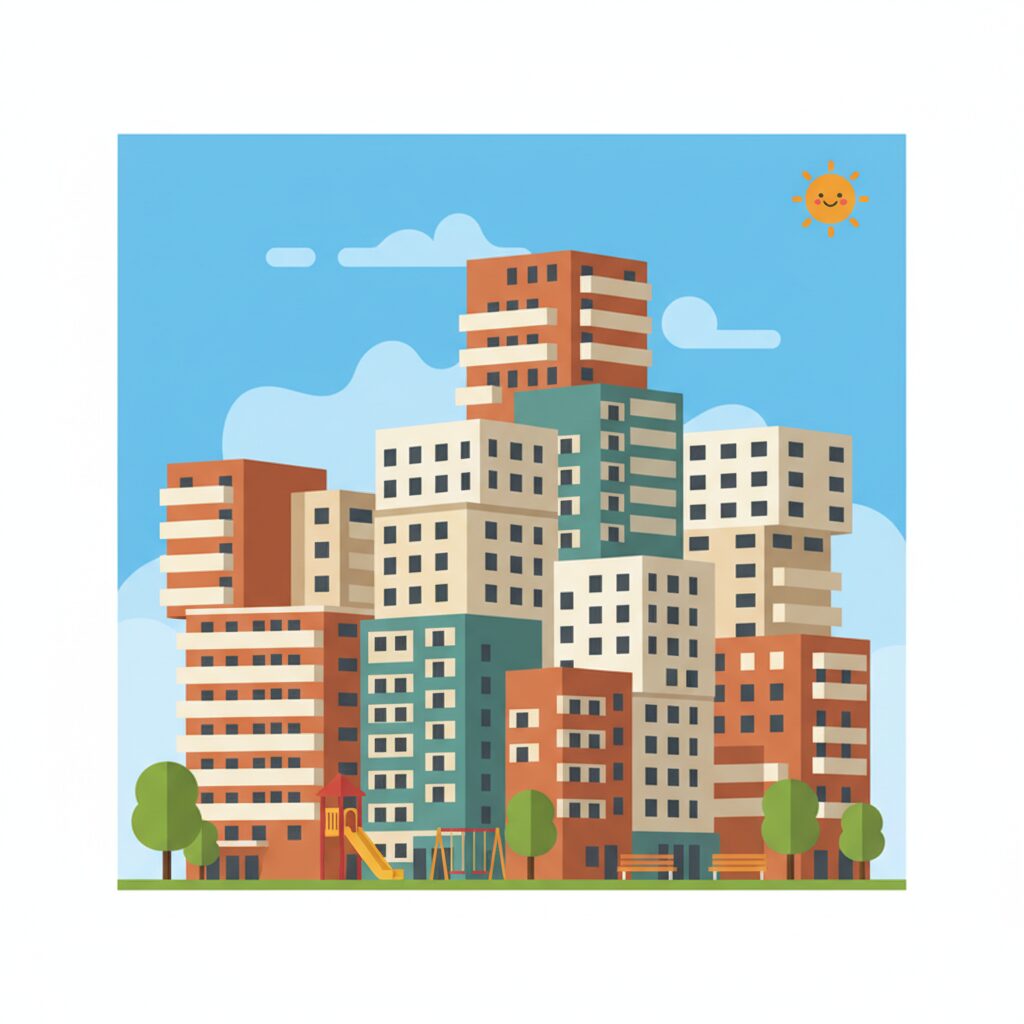
Let’s discuss the appearance. These buildings stand as monuments to the Showa Era (1926–1989), especially the post-war economic boom period. They reflect a time when the objective was to accommodate as many people as possible, efficiently and durably. There are no elaborate lobbies, fashionable balconies, or architectural embellishments. There is concrete. Rows of uniform windows and laundry poles. The color scheme ranges from weathered gray to subdued beige. From a Tokyo perspective, where novelty and design are highly valued, they may seem bleak. But in Osaka, this lack of pretension is interpreted differently. It’s not unattractive; it’s straightforward. It’s a building that fulfills its purpose without any affectation. The interior of a typical unit embodies this philosophy. You’ll often find traditional tatami mat rooms alongside wooden-floored ones. Kitchens are practical rather than gourmet. Bathrooms are compact unit baths. While they may show the wear of decades of family life, they are often surprisingly roomy compared to modern private apartments that squeeze rooms into ever-shrinking spaces. You get space to truly live, not just a place to sleep.
The Osaka Mindset Cast in Concrete
To live in or even simply understand Fuei Jutaku is to grasp the fundamental principles of the Osaka character. These buildings are not merely passive structures; they actively shape and mirror the city’s social dynamics. They reveal a set of values that sharply contrast with the individualism and status-consciousness found in Tokyo.
The Gospel of the Good Deal: Pragmatism Over Prestige
In Tokyo, your address serves as a business card. Living in neighborhoods like Azabu or Daikanyama conveys something about who you are. The name of your high-rise condo signifies success. People might subtly boast about their rent or the view from their 30th-floor apartment. In Osaka, the opposite holds true. The ultimate brag isn’t how much you spend, but how much you save. This reflects the spirit of kechi, often translated as “stingy” but more accurately as “frugal” or “cleverly economical.” An Osakan will proudly say their rent is only ¥40,000 a month for a three-room apartment in a danchi, sharing it with a sparkle in their eye—much like a Tokyoite might mention their proximity to a Michelin-starred restaurant. This isn’t about being poor; it’s about being savvy. Why waste money on a fancy facade when you can invest it in your business, your children’s education, or an excellent meal? This mindset explains why the plain, practical Fuei Jutaku isn’t looked down upon. It’s seen as a sensible choice, a rejection of the vanity that inflates costs in other cities. It embodies jitsuri, or practical benefit—a concept that governs everything here, from business dealings to everyday shopping.
The Unspoken Social Contract: Life in the Danchi
If the financial aspect is about pragmatism, the social aspect is about a profound, sometimes demanding, sense of community. Moving into a modern Tokyo apartment building often means entering a world of polite anonymity, where you might never learn your neighbors’ names. In an Osaka danchi, that’s not an option. You aren’t just renting a space; you’re joining a society with its own rules, rituals, and obligations. The first is aisatsu, or greetings: you greet everyone you pass in hallways, courtyards, and elevators. A simple “Ohayo gozaimasu” in the morning or “Konnichiwa” in the afternoon is obligatory. Silence is perceived as rude and suspicious. Then there’s the jichikai, the residents’ association, whose membership is often expected. This group organizes local festivals, manages garbage collection rules, and shares information. It acts as the hyper-local government of the building. Alongside the jichikai comes responsibility, most notably the communal cleaning day, or soji. On a designated weekend morning, residents come out with brooms, dustpans, and gloves to sweep public walkways, weed planters, and scrub communal areas. While participation isn’t strictly mandatory, your absence doesn’t go unnoticed. This system can be surprising to outsiders, especially from more individualistic cultures, and may feel intrusive. Yet it is the community’s engine—a system of mutual oversight and support. The same neighbor who notices you skipped cleaning day is the one who’ll see that you haven’t collected your mail for a few days and will check to make sure you’re okay. It’s a social safety net built on countless small, reciprocal interactions.
Daily Life in the Concrete Corridors
Living in Fuei Jutaku is a world apart from the polished images of Japan presented in travel brochures. It’s messier, louder, and deeply human. It represents the authentic, unvarnished life of a major Japanese city.
A Neighborhood Ecosystem
These housing complexes are seldom located in the sparkling city center. Instead, they anchor residential neighborhoods in places like Higashiosaka, Sakai, or Yao. Life here isn’t centered around department stores or tourist spots—it revolves around the local shotengai. These covered shopping arcades serve as the community’s heartbeat. Here, you’ll meet the butcher who knows your favorite cut of pork, the fishmonger who’ll inform you of the freshest catch of the day, and the vegetable vendor who might sneak an extra onion into your bag. Prices are affordable, and the conversation flows freely. This is where you catch up on neighborhood gossip while gathering ingredients for dinner. The ecosystem is supported by public schools where children can walk to class, small parks filled with the sounds of playing kids and chatting mothers, and perhaps a local sento (public bath) that still functions as a community gathering spot. The day’s rhythm is marked by the distant rumble of trains, the school bell ringing at dismissal, and the aroma of dinner wafting from hundreds of open windows at dusk.
The Foreigner’s Journey: From Outsider to Neighbor
For a non-Japanese resident, moving into a Fuei Jutaku can be a trial by fire. At first, the experience can be one of heightened visibility. You might be the only foreigner in the entire complex. Every trip to the garbage collection point invites curious stares. Decoding the handwritten jichikai notices posted in the lobby can be a challenge. The unspoken community rules aren’t documented anywhere. A well-intentioned foreign resident might try to help by putting out garbage the night before, only to discover this is a serious breach of local customs. The pressure to conform can feel overwhelming. Yet, for those who persist, the rewards are significant. This is genuine immersion. By participating—showing up for cleaning day, exchanging greetings, asking a neighbor to help read a notice—you gradually shift from being “the foreigner” to simply “the person in room 405.” You cultivate real relationships grounded in shared space and shared duties. Neighbors might start leaving vegetables at your door. The older woman downstairs may offer to watch your child for a few minutes while you run to the store. You become part of a web of mutual support, gaining an intimate glimpse of Japanese life’s unfiltered reality—far richer and more intricate than what you’d find in transient, anonymous environments.
A Tale of Two Cities: Osaka’s Model vs. The Rest
Choosing to live in Fuei Jutaku is ultimately a decision about what you prioritize. Compared to other housing options in Osaka and especially Tokyo, the differences in cost, community, and contract terms are striking.
The Gap in Cost and Complexity
Let’s examine the numbers. Rent for a family-sized 2LDK or 3DK apartment in an older Fuei Jutaku building can be as low as ¥30,000 to ¥50,000 per month. A private apartment of similar size in Osaka typically costs ¥80,000 to ¥120,000, and that’s before factoring in the notorious initial fees. In Japan’s private rental market, you usually must pay a security deposit, a month’s rent in advance, and, most painfully, reikin (“key money” or “gift money”)—a non-refundable payment to the landlord amounting to one or two months’ rent. Additionally, there are guarantor fees and contract renewal fees every two years. The total upfront expense can add up to the equivalent of four to six months’ rent. In contrast, Fuei Jutaku doesn’t involve these fees. You only pay a small, refundable deposit. That’s it. This stark difference eliminates one of the largest barriers to mobility and housing security for working people. In Tokyo, finding a comparable private apartment under ¥150,000 in a convenient area is nearly impossible. The financial relief provided by Osaka’s public housing is not just a minor discount; it represents a fundamentally different way of living.
Community Contract vs. Rental Contract
Another option in Japan, closely related to public housing, is UR (Urban Renaissance Agency). UR housing tends to be newer, does not require key money or a guarantor, and is generally more accessible to foreigners in its application process. For many non-Japanese residents, it serves as an ideal middle ground. It offers affordability and simplicity without the significant social obligations that come with Fuei Jutaku. Living in UR is a straightforward rental agreement, while living in Fuei Jutaku means entering a social contract where you are expected to contribute. In private apartments, your contract is with the landlord; your main responsibilities are timely rent payment and property care. Your relationship with neighbors remains personal and separate. Choosing among these three models—private, UR, and Fuei Jutaku—means deciding what matters most: the privacy and freedom of a private lease, the ease and transparency of UR, or the affordability and strong community of public housing.
The Future of Osaka’s Concrete Heart

These buildings, once shining symbols of post-war recovery, now confront the challenges of the 21st century. Their future remains uncertain, yet their legacy and the insights they provide into urban life continue to hold deep significance.
Aging Buildings, Shifting Demographics
Many danchi have now stood for over fifty years. The concrete shows stains, the plumbing is outdated, and the fixtures are worn out. The original residents, who moved in as young families during the 1960s and 70s, are now in their seventies and eighties. A stroll through the hallways during the day can be a quiet experience, as many apartments house elderly retirees. This demographic change poses a significant challenge. Who will lead the jichikai? Who has the energy to participate in communal cleaning days? Some complexes are being demolished and replaced with modern buildings, while others undergo renovation. Yet the process remains slow and costly. Meanwhile, a new wave of residents is arriving. Young families, unable to afford private homes, are finding support here. Increasingly, foreign families, especially from other Asian countries, are attracted by the affordability of the danchi. They bring fresh life, new languages, and diverse cultural perspectives to these aging communities, shaping a new, evolving definition of the Osaka neighborhood.
A Lesson in Urban Resilience
In an era marked by hyper-gentrification and soaring urban housing costs worldwide, Osaka’s Fuei Jutaku system stands as a striking, though imperfect, alternative. It asserts that housing should be a right, not a luxury commodity. It demonstrates that a city can be built where working people are not priced out or forced into exhausting commutes. More than that, it shows that community is not something that happens passively; it is an active process requiring participation, responsibility, and a bit of constructive friction. These concrete apartments serve as the social glue for a large portion of Osaka’s population. They nurture the city’s renowned neighborhood spirit. While tourists flock to see castles and glowing advertisements, the true story of Osaka’s resilience and character is etched on the weathered walls of these buildings. Understanding them—their history, their purpose, and the vibrant, intricate life within—is the key to moving beyond the stereotype of Osaka as merely a loud, fun-loving city. It reveals the city’s reality: a resilient, pragmatic, and deeply communal place that has, in its own unique way, found how to care for its people.