The air in Osaka changes at five o’clock. It’s a physical shift, a tangible release of pressure. The low hum of industry and commerce that thrums beneath the city’s concrete skin doesn’t just fade; it transforms. The rhythmic clatter of the subway gates quickens, the shuffling footsteps on the pavement gain a new urgency, and a collective exhale seems to ripple through the sprawling urban labyrinth. This isn’t the tired, shoulder-slumped trudge you might see in other major world cities. This is a migration with a purpose. It’s the sound of Osaka’s working class, untethered from their desks, their factory lines, their shop counters, heading for their sanctuary. They are heading for the tachinomi.
For the uninitiated, a tachinomi is a standing bar. It’s a simple concept that does little to capture the sheer cultural weight these establishments carry. My first encounters were confusing. I’d come to Japan with visions of serene temples, meticulous etiquette, and a society that prized quiet harmony. Then I found myself in Osaka, a city that vibrated on a different frequency entirely. Peering through the steamed-up windows of a tiny bar near Kyobashi Station, I saw a scene of glorious chaos. Men in work uniforms and rumpled suits were packed shoulder-to-shoulder, shouting over one another, their faces flushed with laughter and cheap shochu. There were no chairs, no tables, just a long wooden counter groaning under the weight of small plates and overflowing ashtrays. It looked loud, cramped, and intimidating. It looked like everything I was told Japan wasn’t. But I soon learned that to understand the tachinomi is to understand the soul of Osaka itself. It’s not just a place to grab a drink; it’s a vital, living institution. It’s a pressure valve, a community center, and a nightly affirmation of an identity that is fiercely, proudly, and unapologetically Osakan.
To truly grasp this unique social dynamic, it helps to understand the city’s famous comedic rhythm of boke and tsukkomi.
More Than Just a Bar: Tachinomi as a Social Pressure Valve

Calling a tachinomi simply a bar is like referring to a town square as just a patch of pavement—it overlooks the essence entirely. In a nation characterized by strict social hierarchies and a clear divide between one’s public persona (tatemae) and private feelings (honne), the tachinomi serves as the designated space where these masks come off. It occupies a liminal space between the structured demands of work and the responsibilities of home. For the cost of a 400-yen draft beer and a 150-yen skewer, you gain about thirty minutes of pure freedom. Here, there are no bosses, no clients to impress, and no family expectations to fulfill. Only the worn counter, the company of fellow travelers navigating daily life, and the simple, sincere pleasure of a cold drink remain.
The customers represent a perfect cross-section of Osaka’s working population. You might find a salaryman, his tie loosened, grumbling about spreadsheets with a colleague. Nearby could be a construction worker, dust clinging to his boots, sipping a large bottle of Asahi. A woman in a department store uniform might quietly enjoy a plate of pickles, her gaze distant as she unwinds from a day of forced smiles. This diversity is crucial. The tachinomi acts as a great equalizer. Social rank, company status, and income levels all seem to vanish at the doorway. Everyone stands, everyone meets at the same eye level, and everyone is there for the same purpose: to decompress. It is a raw, democratic form of social therapy that plays out every night in thousands of small establishments.
The brilliance of the tachinomi is found in its speed and transience. It isn’t meant for a lengthy, drawn-out evening. The absence of chairs is intentional; it discourages lingering. The aim is a swift, powerful dose of relaxation. The typical visit involves one or two drinks and one or two small dishes. You arrive, order, eat, drink, pay, and leave. This entire cycle can take less than thirty minutes. This efficiency reflects the Osaka mindset, which prizes practicality and despises waste—whether time or money. This ritual serves as a vital buffer, a moment of personal reset before returning home. It provides a pause that helps frustrations fade, preventing them from spilling into family life. It is a small, daily act of self-preservation that maintains the city’s collective sanity.
The Osaka vs. Tokyo Divide, Distilled in a Glass of Beer
The fundamental contrast between Osaka and Tokyo is most vividly demonstrated in their respective standing bar scenes. A foreigner living in Japan might visit a standing bar in Tokyo’s Shinjuku or Shibuya and assume they grasp the concept. They would be wrong. The experience is vastly different, reflecting the deep-rooted cultural divide between the two cities.
Tokyo’s standing bars, especially the newer ones, often feel carefully curated. They tend to be sleek, minimalist spaces focusing on craft beer, natural wine, or artisanal sake. They are clean, well-lit, and orderly. If conversation occurs between strangers, it is usually polite and restrained. More often, groups of colleagues stick together, their talk a muted extension of the office environment. It feels more like a trendy, efficient drinking option than a raw, social necessity. There is a certain cool detachment, a facade of metropolitan sophistication. While enjoyable, it can sometimes feel like you’re part of a staged performance of casual drinking rather than genuinely letting loose.
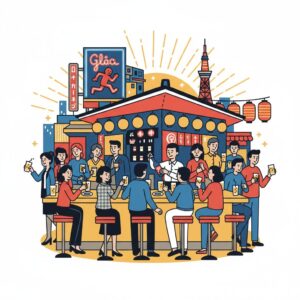
Then there is Osaka. An Osaka tachinomi assaults the senses from the moment you slide open the rattling door. The air is heavy with the smell of sizzling grilled mackerel, sweet and savory doteyaki stew, and stale cigarette smoke (though the latter is thankfully less common now). The sound is a constant, lively roar—not just conversation, but booming laughter, the sharp clatter of ceramic dishes on the counter, the hiss of the deep fryer, and the gruff yet affectionate shouts of the staff. It’s cramped. Personal space is a laughable concept. You’ll be rubbing elbows with your neighbor, and that’s part of the unspoken agreement. This forced closeness is no inconvenience; it is the very engine driving the social life of the place. It tears down barriers by making them physically impossible to keep.
This is the origin of the cliché that “Osaka people are friendly.” It’s not a superficial, smiling-for-the-sake-of-it warmth. It’s a practical, situational friendliness born from shared experience in tight quarters. In a packed tachinomi, you can’t ignore the person next to you, so you might as well talk to them. Conversations are direct, unpretentious, and often seasoned with the city’s trademark self-deprecating humor. Strangers will ask where you’re from, what you’re eating, and whether you think the Hanshin Tigers stand a chance this year—all within the first five minutes. There is no formal dance of introduction. In Tokyo, starting a chat with a stranger can be a delicate social act. In Osaka, it’s more often the default. The tachinomi isn’t a place to be anonymous; it’s a place to become part of the beautiful, noisy, human chaos.
The Unspoken Rules of Standing Your Ground
Like any deeply rooted cultural practice, tachinomi follows a set of unspoken rules. Breaking them won’t get you kicked out, but following them shows you truly get it. For a foreigner wanting to blend into daily life, mastering this etiquette is a vital step toward feeling like a local rather than a visitor. These guidelines focus less on strict politeness and more on maintaining the smooth, efficient rhythm of the environment.
Rule 1: Know Your Space, Defend Your Turf
Upon entering a packed tachinomi, your first job is to find a narrow spot at the counter—this is your territory, usually no wider than your shoulders. You hang your bag on a hook below or place it on a small shelf, claim your few inches of wood, and this becomes your home for the next half hour. The trick is to be present and own your space with quiet confidence. Don’t spread out, lean back, or make large gestures. Be mindful of the person behind you ordering and the one beside you eating. It’s a delicate dance of small movements, a shared understanding that everyone’s comfort depends on mutual respect for these invisible boundaries. You’re a temporary resident in a crowded spot; behave accordingly.
Rule 2: Order with Confidence and Cash in Hand
The pace at a tachinomi is relentless, especially during the 6 PM rush. The master behind the counter moves quickly—pouring beer, plating food, taking payments. They don’t have time for hesitation. It’s best to know what you want before catching their eye. A simple “Nama-hitotsu” (One draft beer) is a classic opening. Many tachinomi operate on a cash-on-delivery system, known as kyasshu on. You set your money in a small tray on the counter, and the staff deducts the cost of your order, returning change immediately. This is pure Osaka efficiency. It settles each bill on the spot, eliminating a final check and allowing for a quick exit when ready. Searching for your wallet at the end disrupts the flow. Have your cash ready and the process will run smoothly.
Rule 3: The Art of Tachinomi Conversation
While chatting with strangers is common, it’s not required. Standing alone and quietly enjoying your drink while watching the bar’s lively scene is perfectly acceptable. But if you’re open to it, conversation will often come to you. The usual opener is simple and direct: “Onii-san, doko kara?” (Brother, where are you from?). The key is to respond with the same straightforward, unpretentious tone. This isn’t a place for long, complex talks; it’s for quick, humorous exchanges, shared complaints about work, and bold opinions on sports or politics. Humor is essential. Osaka humor thrives on fast back-and-forth banter, known as tsukkomi and boke. Don’t be surprised if a regular playfully insults you—it’s often a sign of affection. Take it in stride, laugh it off, and you’ll blend right in.
Rule 4: The Graceful Exit
A tachinomi is a waypoint, not a final destination. The biggest mistake a newcomer can make is overstaying their welcome. The standing bar ethos centers around senbero, meaning “getting tipsy for 1,000 yen.” The idea is to have a few inexpensive drinks and a snack, enjoy a pleasant buzz, then move on. You might be heading home or to a more settled second spot. Lingering for hours nursing a single drink at a crowded counter is poor form. It occupies valuable space that someone fresh off their shift is waiting to claim. The graceful exit is quick and simple: finish your last bite, down your final drink, nod a quick “Gochisousan” (Thanks for the meal) to the staff, and slip away into the night, freeing your spot for the next person seeking refuge.
A Tour Through the Tachinomi Archetypes
Referring to “the” tachinomi oversimplifies a complex reality. The term encompasses a wide and varied ecosystem of establishments, each boasting its own distinct character, clientele, and culinary specialties. To understand these archetypes is to grasp the many facets of Osaka’s personality. They range from gritty remnants of a bygone era to contemporary reinterpretations that preserve the tradition for a new generation.
H3: The Showa-Era Time Capsule
These are the revered sanctuaries of the tachinomi world. You’ll find them hidden in the shotengai shopping arcades of Tenma or down the narrow back alleys of Shinsekai. Typically, the entrance is a simple sliding frosted-glass door or a heavy plastic curtain that offers little protection against the winter chill. Inside, time seems frozen since the 1960s. The walls are stained deep brown from decades of smoke and grease. Yellowed posters of long-forgotten movie stars or sumo wrestlers curl at the edges. The air is thick with nostalgia.
The master is usually a quiet, elderly man who moves with the slow, deliberate precision of someone who has performed the same rituals for fifty years. The regulars are of a similar age, men who have occupied the same spot at the counter since their youth. The menu is brief and unchanging. Beer is always Kirin Lager or Asahi Super Dry served in heavy glass bottles—not on tap. The sake is an inexpensive, fiery futsushu poured in a simple glass. The food evokes pure comfort: doteyaki, a rich stew of beef sinew and konjac simmered for hours in sweet miso; oden in winter, with its various ingredients gently floating in a kelp-infused broth; and plain skewers of grilled chicken skin or pork belly, seasoned only with salt. Drinking here is to commune with the spirits of Osaka’s past, a tribute to resilience and the beauty of things that refuse to change.
H3: The Market-Side Fueling Station
These spots prioritize function over ambiance. You’ll find them on the edges of major markets like Kuromon Ichiba or in the covered arcades branching off from main train stations. Often, they are little more than a counter attached to the front of a fishmonger, butcher, or liquor store. The lighting is harsh and fluorescent white. The floors are usually bare concrete, easy to hose down at the end of the day.
The atmosphere is purely transactional. Local shoppers, delivery drivers, and off-duty chefs drop in for a quick pit stop. It’s a place to refuel, not to relax. The advantage here is the extraordinary freshness of the products. A tachinomi attached to a fish shop might serve sashimi sliced from a fish caught that very morning, for a fraction of the restaurant price. A bar run by a butcher could offer a single, perfectly grilled steak or a plate of rare beef tataki. The drinks are straightforward: canned chu-hai from a cooler, cheap shochu mixed with soda, and beer. There’s no pretense—just a celebration of the product, a direct line from source to consumer, embodying Osaka’s historical identity as “the nation’s kitchen.”
H3: The Modern Hybrid
A new generation of tachinomi has emerged, especially in trendy neighborhoods like Fukushima or Ura Namba. These venues honor the brilliance of the traditional model while updating it for contemporary tastes. Interiors are cleaner, brighter, and more thoughtfully designed, often featuring polished concrete, light wood, and stylish industrial lighting. The crowd is younger and more diverse, with notably more women and couples.
These modern hybrids maintain the core elements of tachinomi—no chairs, quick service, excellent value—while enhancing the experience. Instead of cheap sake, they offer curated lists of regional craft sakes, each with distinct tasting notes. The beer might be a local IPA. The menu is where they truly excel, extending beyond traditional stews and grilled dishes to serve creative small plates. You might encounter Japanese-Italian fusion dishes such as daikon simmered in gorgonzola sauce, smoked duck with figs, or elaborate carpaccios. These places demonstrate that tachinomi is not a relic but a flexible, enduring concept. They signify that the spirit of standing and drinking together is being preserved, adapted, and reimagined—ensuring its survival for decades ahead.
Decoding the Language of the Counter
Spending an evening in an Osaka tachinomi immerses you in an intense crash course of Osaka-ben, the city’s unique and notoriously challenging dialect. The language reflects the culture: it’s quicker, more direct, and more expressive than the standard Japanese taught in textbooks. While knowing a few key phrases is important, grasping the rhythm is even more crucial.
Upon entering, you won’t hear the typical polite “Irasshaimase!” (Welcome!). Instead, you’re met with a brief, guttural “Maido!” or “Maido, ookini!” This phrase, rooted in the city’s merchant history, serves as a quick, familiar acknowledgement meaning something like “Thanks for your continued support!” It’s warm, efficient, and instantly sets an informal tone.
Ordering is equally straightforward. Rather than a polite “Sumimasen, chuumon onegaishimasu” (Excuse me, I’d like to order), you simply catch the master’s eye and state your request. Common phrases are sharp and direct. “Toriaezu, nama” (For now, a draft beer) is the universal starting signal. When describing food, the Osaka term for “very” is meccha. Something delicious isn’t totemo oishii but “meccha umai!”—a stronger, more heartfelt expression of gustatory delight.
Perhaps the dialect’s most iconic word is “akan,” meaning “no good,” “impossible,” or “don’t do that,” and it’s used incredibly often. “Double dipping the kushikatsu skewer in the communal sauce pot? Akan!” “Trying to pay with a credit card? Akan!” It’s a blunt, final-sounding word that may seem rude to outsiders, especially those familiar with Tokyo’s more indirect speech. But in Osaka, it’s simply efficient. It wastes no time in delivering the message. This directness is often mistaken for rudeness by foreigners but is rarely intended to be hostile. It’s a form of honesty, cutting through the fluff to get straight to the point—a highly valued trait in Osaka’s business and social culture.
Why This Matters for Living in Osaka
So why does this nightly ritual of standing in a crowded room hold such significance? Because tachinomi is not merely an escape from the realities of life in Osaka; it embodies the city’s most genuine expression. It represents a living, breathing microcosm of the city’s fundamental values. To grasp the essence of tachinomi is to understand why Osaka feels so distinct from any other city in Japan.
First, it highlights the city’s deep-rooted pragmatism and value-conscious mindset. Osakans are renowned for their frugality—not stingy, but savvy with their money. Tachinomi offers maximum social and psychological reward for minimal financial outlay. The senbero culture exemplifies this perfectly: a structured, socially accepted way to enjoy oneself without overspending. This practicality influences every facet of life here, from business dealings to everyday shopping.
Second, it illustrates the city’s unique sense of community. In a country that can often feel socially isolating, tachinomi encourages interaction and builds a shared identity. It’s a place where people are judged not by their job or background, but by their willingness to engage in the communal experience. This creates a strong, albeit temporary, social bond. This raw, straightforward communality is why many foreigners find it easier to connect with people in Osaka compared to the more reserved capital.
Finally, tachinomi serves as the ultimate classroom for understanding the Osaka spirit. The direct communication, the loud laughter, the sharp wit, the disdain for pretense—all are on full display. Here you learn that the gruffness often signals intimacy, and that the apparent chaos is actually guided by an unspoken order. It provides the perfect counterpoint to the polished, often misleading image of Japan shown to the outside world.
For anyone living in Osaka or thinking about moving there, I wholeheartedly recommend the tachinomi experience. Don’t visit as a tourist simply checking off an item. Go as an observer, a student of culture. Find a small, modest spot, claim your place at the counter, order a beer, and just listen. Watch how people interact. Listen to the rhythm of their speech. Feel the city collectively unwind. While a visit to Osaka Castle reveals the city’s history, spending half an hour in a standing bar reveals its soul.