Hi everyone, Megumi here. As an event planner from Tokyo, my life is about understanding flows—the flow of people at a concert, the flow of conversations at a party. But nothing prepared me for the daily, rhythmic, and sometimes bewildering flow of people in Osaka. When I first moved here for a long-term project, I thought I knew Japan. I knew the quiet, orderly dance of the Tokyo commute. I stepped off the Shinkansen at Shin-Osaka, confident in my mastery of Japanese public transport. Then I hit the escalators at Umeda Station, and my world tilted. I did what any Tokyoite would do: I planted myself firmly on the left side to stand, leaving the right lane open for those in a hurry. The result? A series of gentle but firm “sumimasen” (excuse me), a few exasperated sighs, and the distinct feeling of being a salmon swimming against the current. In Osaka, you stand on the right. This isn’t just a quirky regional difference; it’s the opening chapter in the story of what makes this city tick. The daily commute here isn’t just a journey from home to work. It’s a crash course in the Osaka mindset—a world of pragmatism, impatience, and a unique brand of social logic that feels worlds away from the capital. Forget your tourist guides. If you really want to understand Osaka, join the river of people flowing through its train stations every morning. It’s where the city’s true character is on full display.
To truly immerse yourself in the city’s unique social logic, consider how its pragmatic spirit extends to the lively and unpretentious world of Osaka’s tachinomi culture.
The Great Escalator Divide: Why Right is Right in Osaka
That initial escalator ride was quite a lesson. The rule is simple, yet it stands as the most profound and immediate indication that you are no longer in Tokyo. In Osaka, you stand on the right and walk on the left. This reversal of the national standard—where Tokyo and most of Japan stand on the left—is not just a random choice. It’s a deliberate and fiercely upheld expression of local identity. It serves as the first test of your ability to adapt to the local pace.
A Tale of Two Cities: The Historical Background
Why the difference? Several theories circulate, and Osakans enjoy debating them. The most popular theory traces back to the 1970 World Expo held in Suita, Osaka. This major international event led the city to design its infrastructure for a global audience. Organizers are believed to have adopted the London Underground’s ‘stand on the right’ convention to accommodate foreign visitors. The habit, apparently, just stuck and became a permanent feature of the city—an enduring legacy of Osaka’s history as an international port and a globally oriented city. Another, perhaps more symbolic, explanation is that it reflects Osaka’s historical rivalry with Tokyo. Edo (now Tokyo), the center of samurai culture, was a city where swords were worn on the left hip, making standing on the left practical for drawing blades if needed. Osaka, meanwhile, was a merchant city, driven by commerce rather than conflict. This theory suggests that martial considerations weren’t necessary there. Whether historically accurate or not, this story perfectly captures the self-image of the two cities: Tokyo as the formal, tradition-bound capital, and Osaka as the pragmatic, business-savvy challenger. Standing on the right is a small daily act of rebellion—a quiet assertion that “we do things our way here.”
The Escalator as a Social Microcosm
Observe an escalator at Umeda Station during rush hour, and you’ll witness an unspoken social choreography masterpiece. The right lane is for standing, yet it’s far from a static, sleepy queue. People remain alert, holding bags in front, poised to disembark efficiently. The left lane, the ‘walking lane,’ is no place for hesitation. It functions as a high-speed artery, filled with people moving with unmistakable purpose. They don’t merely walk; they power-walk, weaving around each other with instinctive grace. The speed and intensity can be daunting at first. In Tokyo, the walking lane feels more like a polite suggestion; in Osaka, it feels mandatory. The flow must be preserved. If you get the rule wrong, the response perfectly illustrates the Osaka spirit. You’re unlikely to hear angry shouting or witness dramatic confrontations. Instead, you’ll sense subtle pressure from behind—a quick but polite “sumimasen,” or perhaps a quiet sigh from the person forced to navigate around you. The disapproval isn’t about breaking a sacred rule but about disrupting the system. You’ve created a bottleneck in an otherwise efficient machine. It’s a pragmatic reaction, not a moral judgment. The aim is to fix the inefficiency and restore flow as swiftly as possible. This small interaction reveals a core value: efficiency over formality, and collective movement over individual hesitation.
Inside the Carriage: More Than Just a Ride
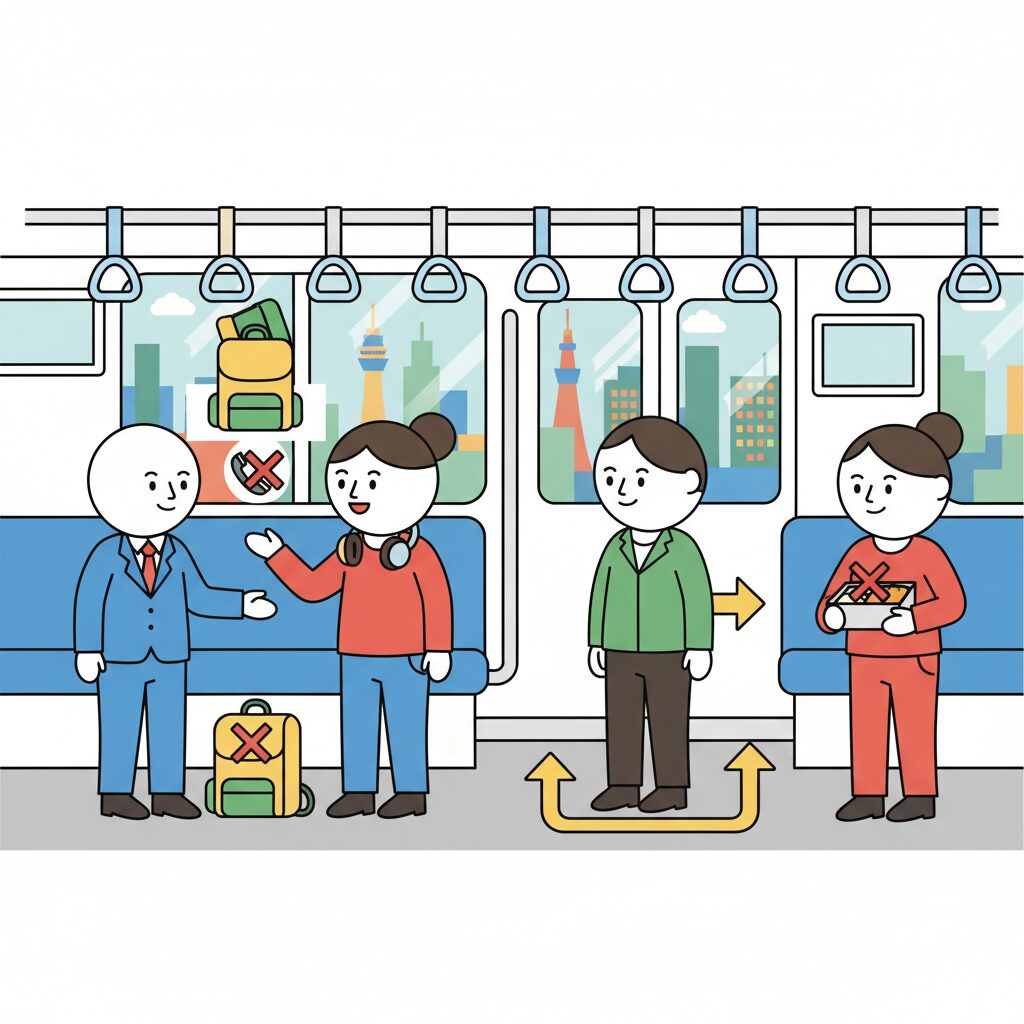
After navigating the escalator and platform, the train carriage introduces a whole new range of cultural signals. The famous sterile silence of a Tokyo subway car is known worldwide. It’s a space where individuals retreat into their own private bubbles, protected by headphones and smartphone screens. Boarding the Midosuji Line in Osaka, one of the city’s main thoroughfares, offers a completely different sensory experience. It’s not a rolling party, yet it is audibly and vibrantly alive.
The Sound of Silence… Or Is It? The Noise Level Debate
In Osaka, conversations take place on the train. They aren’t shouted, but they resonate at a volume that would draw attention on Tokyo’s Yamanote Line. Friends catching up after work, a mother speaking to her child, colleagues chatting about their day—these are familiar soundscapes. The rich, melodic rhythm of Kansai-ben, the local dialect, fills the air. Laughter and exclamations are common. This isn’t seen as rude or intrusive; it simply reflects a culture that is generally more expressive and less reserved. The social boundary between public and private space feels more permeable here. During my first few commutes, I found myself instinctively lowering my voice on the phone, only to notice the two women beside me joyfully chatting at full volume about their weekend plans. The general mindset appears to be that life doesn’t have to pause just because you’re on public transport. This can be startling for those accustomed to Tokyo’s quiet, but it isn’t a sign of disrespect. Rather, it’s a sign of a city that openly shows its emotions—a place where human connection isn’t concealed.
Personal Space: A Fluid Concept
Every major city faces brutal rush hours, and Osaka is no exception. The sensation of being packed into a train is universal. However, the way people handle it differs subtly yet significantly. In Tokyo, the crush is a shared, silent endurance. People shrink themselves, avoid eye contact, and minimize their presence. There’s an art to pressing against strangers without acknowledging them. In Osaka, the experience can feel more direct, more… physical. People are less hesitant to use their bodies to claim a needed sliver of space. It’s not aggressive, but unapologetically practical. An ‘obachan’—a middle-aged or elderly woman, often a formidable presence in Osaka society—might use her shopping bag as a gentle yet firm wedge to secure a spot near the door. A salaryman might push forward with a straightforwardness that says, “We all need to get on this train, so let’s make it happen.” There’s less of the delicate dance of avoidance found in Tokyo. The underlying message is one of shared struggle and pragmatic problem-solving. It can feel abrasive if you’re unaccustomed to it, but it stems from a place of efficiency, not malice. The goal is to get everyone aboard and on their way. Social niceties of maintaining a perfect, untouched personal bubble come second to that primary purpose.
The Platform Playbook: Unspoken Rules Before You Board
The commute game starts before the train even arrives. The station platform serves as a stage where many of Osaka’s distinctive social norms unfold. Navigating this space skillfully is essential for a smooth journey. Here, the city’s unique mix of order and apparent chaos becomes most evident.
Queuing Culture: Organized Chaos
In Tokyo, train queues are a model of precision—single-file lines strictly following the platform’s painted markings. Breaking the line is considered a major offense. This system relies on visual order and strict discipline. Osaka’s queues, however, operate differently. People do line up, but the formations tend to be looser—more like clusters or wide funnels aimed at the door markings. Especially on busy private lines such as Hankyu or Hanshin at Umeda, lines can be two or even three people wide. From a Tokyo viewpoint, it may seem messy or chaotic, but there is an underlying logic. People are keenly aware of who arrived first. Even within these seemingly disorganized groups, there’s an understood mental queue that is generally respected. The visual neatness of the line matters less than the functional principle of ‘first come, first served.’ This is classic Osaka pragmatism. Why bother forming a perfectly tidy single line when a well-managed cluster achieves the same end? The focus is on results, not appearance. This attitude—prioritizing substance over form—is evident throughout Osaka life, from its food culture to its business practices.
The ‘Door Dash’: A Calculated Risk
Within this more relaxed queuing system, a high-level maneuver exists that is both intriguing and nerve-wracking to watch: the ‘door dash.’ Rather than lining up directly, a door-dasher waits to the side near the train doors. Just as the doors open and the main queue starts boarding, they deftly slip into the flow of people. This requires impeccable timing and social attunement. It is not the same as boldly cutting ahead at the front of the line. Instead, it’s a subtler move that takes advantage of natural gaps as the crowd begins to move. In Tokyo, such behavior would be met with icy stares and silent disapproval. In Osaka, while it’s not exactly praised, it is often met with reluctant acceptance. It’s viewed as ‘shikata ga nai’ (it can’t be helped) or recognized as a clever opportunistic tactic. If executed without disrupting the main flow, it’s seen as playing the game well. This reflects the city’s competitive, merchant spirit—seizing opportunity where it arises—a mindset that helped build Osaka’s commercial success. It serves as a reminder that in Osaka, rules often come with flexibility, and a bit of hustle is frequently respected.
Station Staff and the Human Element
Even the ‘official’ aspects of commuting—the station infrastructure and staff—have a distinct feel in Osaka. The automated, often impersonal efficiency typical of Tokyo’s system is softened here by a more evident human touch. The people operating the trains are as much a part of the city’s character as the commuters themselves.
The Voice of the Station: Announcements with Character
Listen carefully to the announcements on trains and in stations. In Tokyo, they exemplify clarity and uniformity. The language is formal, the tone neutral, and the rhythm consistently precise. In Osaka, however, there’s a surprising amount of personality. Conductors, especially on private railway lines cherished in the Kansai region like Hankyu, Hanshin, and Kintetsu, often sound less robotic and more human. Their speech might carry the warm, melodic rise and fall of Kansai-ben. They might even ad-lib a little, adding warmth or emphasis. For instance, a conductor on the Hankyu line—known for its elegant maroon trains and polished interiors—might close an evening announcement with, “Honjitsu mo ichinichi, otsukaresama deshita. Okiotsukete okaeri kudasai.” (Thank you for your hard work today. Please take care on your way home.) Such an addition of ‘otsukaresama deshita’—a phrase acknowledging mutual appreciation for a day’s effort—feels personal and sincere. It transforms a routine announcement into a shared human moment. This reflects the ‘wet’ side of Osaka culture, a readiness to blend emotion and personality with practicality, contrasting with Tokyo’s often more ‘dry,’ detached efficiency.
Asking for Help: Straightforward and Clear
Interactions with station staff also reveal a key difference in communication styles. When I ask for directions in a Tokyo station, the exchange, though always polite, can feel quite formal, with a predictable script and expected deferential language. In Osaka, conversations tend to be more straightforward and concise. This doesn’t imply rudeness—far from it. Staff are often extremely helpful and eager to resolve your issue. But the preliminary pleasantries tend to be briefer. You’re expected to explain your problem clearly and succinctly, and receive a direct, practical response. There is less focus on ‘tatemae,’ the polite social veneer, and more on ‘honne,’ the genuine substance of the matter. I once observed a tourist struggling to articulate a complicated ticket problem to a station attendant in Umeda. An older Osakan man behind him, growing impatient, stepped forward, asked the tourist a few quick questions in simple English, then explained the entire situation in a rapid burst of Kansai-ben to the attendant. Within thirty seconds, the issue was resolved. The exchange was blunt, somewhat hectic, but ultimately highly effective and helpful. That’s Osaka in a nutshell: a city that values practical results over formalities.
Beyond the Rules: The Commuter Mindset
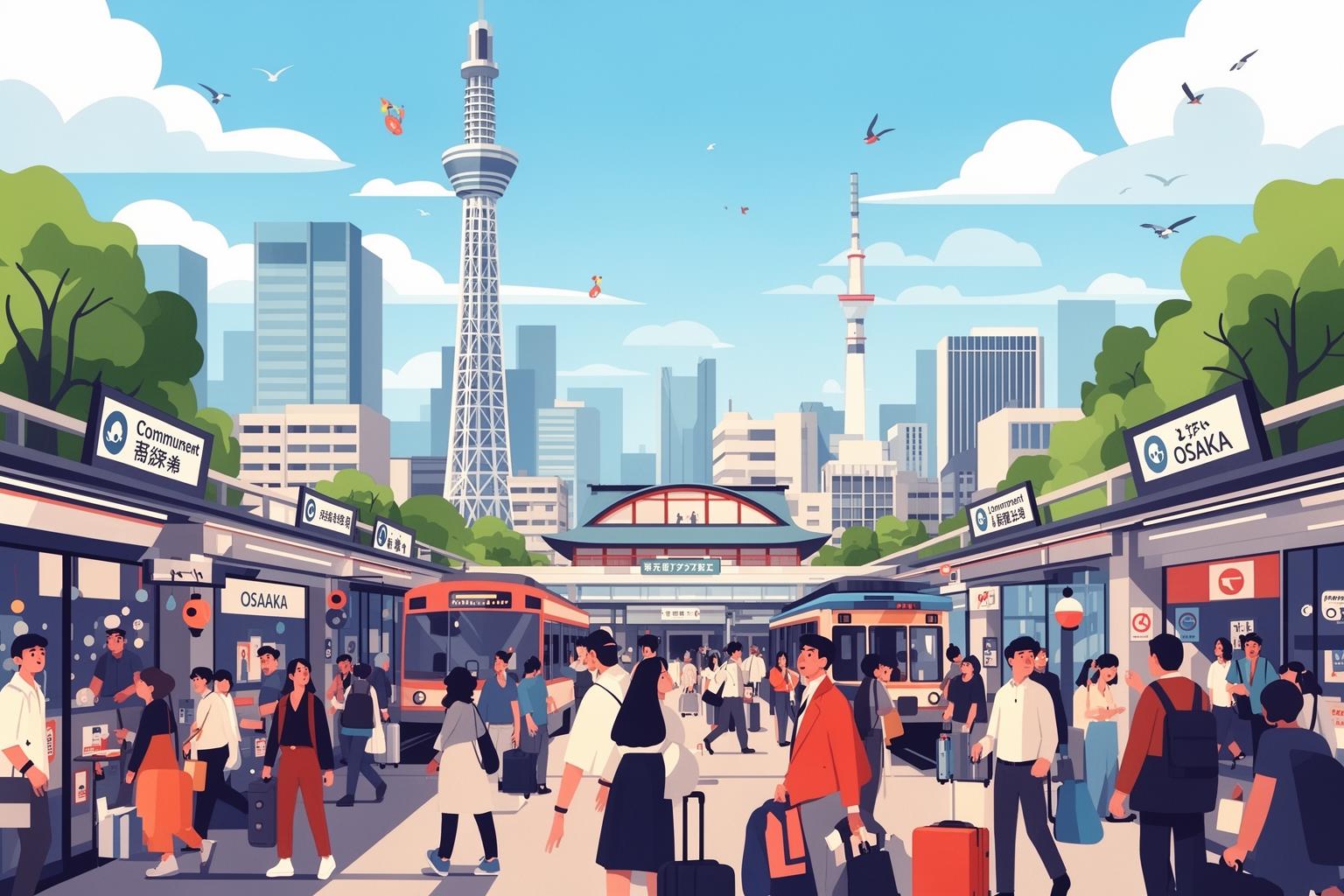
Ultimately, the escalator rule, noise levels, and queuing styles are all symptoms of a deeper cultural framework. To truly grasp the Osaka commute, you need to understand the fundamental principles guiding its people’s behavior. Two key words are crucial to your vocabulary: ‘seikachi’ and ‘kospa.’
‘Seikachi’ and ‘Kospa’: The Driving Forces
‘Seikachi’ is a term from the Kansai dialect that roughly means ‘impatient’ or ‘hasty,’ but without a negative tone. It reflects a strong desire to avoid wasting time. A ‘seikachi’ person wants things to proceed quickly and efficiently. This mindset explains nearly everything about commuting in Osaka. The fast lane on the escalator is reserved for ‘seikachi’ people. The direct, straightforward communication is ‘seikachi.’ The pragmatic focus on boarding the train, even if the queue isn’t perfect, is ‘seikachi.’ It’s an unyielding drive for forward momentum. Closely linked is the concept of ‘kospa,’ an abbreviation of ‘cost performance.’ Osakans are known for being savvy consumers, always seeking the best value for their money and time. This approach extends to their commute. Choosing which train line to take from Umeda to Namba is a classic ‘kospa’ dilemma. Do you take the Midosuji subway line, the most direct and fastest route but also the most crowded with a flat fare? Or do you choose the Yotsubashi line, which is less direct but often has more seats? Or walk to a different station to catch a cheaper private line? These decisions occupy the minds of Osaka commuters daily. This continuous, almost instinctive analysis of time, cost, and comfort is essential in a city built on commerce. Your commute is a resource to manage, not simply a journey to endure.
What Foreigners Misunderstand: Rudeness vs. Directness
This is the final and most important lesson of the Osaka commute. For outsiders, especially those from Tokyo or more reserved Western cultures, many of these behaviors can be misread as rudeness. The person who doesn’t offer a deep bow or a profuse apology for a minor bump. The loud conversations that seem to disregard others. The person who slips onto the train just ahead of you. It’s easy to interpret these as discourteous. But this is a fundamental misunderstanding of the local social code. In Osaka, social harmony is maintained not through strict adherence to formal rules and unspoken taboos, but through a shared understanding of practical goals and a high tolerance for human imperfections. The directness isn’t meant to be aggressive; it’s intended to be clear and efficient. The noise isn’t meant to be intrusive; it’s the natural sound of a community in motion. The hustle isn’t about taking advantage of others; it’s about everyone contributing to a system where speed and practicality are valued. There is warmth here, but it isn’t a gentle, polite warmth—it’s a robust, pragmatic warmth based on the idea that ‘we’re all in this together, so let’s keep things moving.’
In the end, the daily commute is your most personal and honest introduction to Osaka. That escalator, standing on the right, is your first step into a different mindset. It symbolizes a city that has always forged its own path, valuing results over appearances and directness over delicacy. Learning to navigate its trains is about more than getting from your apartment to your office. It’s about tuning into the city’s rhythm, understanding its impatience, appreciating its humanity, and finding your place in its constant, energetic flow. Forget what you think you know about Japan. Come to Osaka, stand on the right, and let the real education begin.