You’re standing in the aisle of a Life supermarket, staring at a wall of soy sauce bottles. Light, dark, tamari, dashi-infused—the choices are overwhelming. You look confused, and you are. Before you can even pull out your phone to ask a translation app for help, a voice materializes beside you. It’s an older woman, maybe in her late sixties, with a perm that’s a work of structural genius. She taps the bottle in your hand. “Not that one for stir-fry,” she says in a thick, rhythmic Kansai dialect. “Too salty. You need this one.” She plucks a different bottle from the shelf, shoves it into your hand, gives you a satisfied nod, and then continues on with her shopping, leaving you blinking in her wake. You weren’t asking for help. But you got it anyway. Welcome to Osaka. You’ve just had your first real taste of ‘osekkai’.
This word, ‘osekkai,’ doesn’t have a perfect English equivalent. It’s often translated as being nosy, meddlesome, or being a busybody. And sometimes, it can feel that way. But in Osaka, it’s something much more complex. It’s a cultural cornerstone, a form of proactive, unsolicited kindness that oils the gears of daily life. It’s the city’s social immune system kicking in when it spots a problem, big or small. It’s a stranger fixing your collar, an old man telling you a faster way to get to the station, or a shopkeeper giving you a free onion because you “look like you need more vegetables.” This isn’t the reserved, polite distance you might find in Tokyo. This is an engaged, sometimes loud, and deeply human form of community care. Understanding osekkai is fundamental to understanding the rhythm and soul of Osaka, transforming your experience from that of an outsider to someone who truly gets the beautiful, chaotic logic of this incredible city.
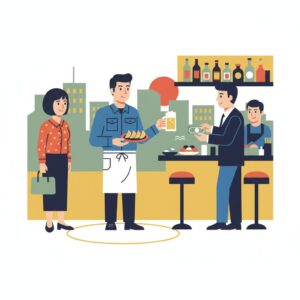
To truly immerse yourself in this culture of proactive engagement, consider experiencing it firsthand at a local standing bar.
The Philosophy Behind the Meddling
To those unfamiliar, osekkai can seem intrusive. Why is this stranger involving themselves in my affairs? The explanation lies deep in Osaka’s history. This wasn’t a city of samurai and bureaucrats; it was the ‘tenka no daidokoro,’ the nation’s kitchen. It was shaped by merchants and shopkeepers whose survival and success relied entirely on their connections with one another. In this busy, crowded merchant city, community wasn’t just a pleasant ideal; it was a critical business strategy and a means of survival. This way of thinking has been handed down through the generations and continues to resonate beneath the surface of the modern metropolis.
It’s Not Nosiness, It’s Community Glue
In the old merchant districts, your neighbor’s problem was your problem. If their shop suffered, it impacted the whole street. If someone fell ill, the community pitched in. This fostered a culture where boundaries were fluid and mutual responsibility was understood. Osekkai is the modern reflection of that social pact. When an ‘obachan’ notices you struggling with a train map, her merchant-city instincts activate. She doesn’t see a stranger to be politely ignored; she sees a minor logistical issue in her community that demands a quick, practical fix. Her intervention isn’t about criticizing your map-reading but about restoring the smooth functioning of the collective. It’s a form of care for the social fabric. In her small way, she’s ensuring the city operates seamlessly. This contrasts sharply with a more individualistic attitude where one might say, “That’s not my problem.” In Osaka, the unspoken circle of “my problem” is far wider.
Efficiency Over Etiquette
Osaka is known for being pragmatic and direct, traits rooted in its commercial heritage. Time is money, and clarity is paramount. This ethos extends to social exchanges. Whereas other parts of Japan may prioritize subtlety and maintaining harmony (‘wa’) above all else, Osaka often opts for the most efficient route to resolution. Osekkai embodies this perfectly. Why watch someone struggle for minutes when a quick ten-second help can solve it? Why hint delicately when you can simply state the issue and solution plainly? The person who points out your open backpack isn’t trying to embarrass you. They’re performing a quick verbal patch—spotting the security gap that your wallet might fall out and instantly alerting you with a shout of, “Hey, your bag’s open!” Their delivery may be blunt, but the intent is purely practical and, in its way, highly considerate. They’re sparing you the larger trouble of losing your belongings. This is social fine-tuning, happening all day, every day, throughout the city.
A Culture of Shared Space
Another vital aspect of understanding osekkai is how public space is viewed. In many big cities, public areas are anonymous zones. People exist within their private bubbles, moving through streets and stations with headphones on, shielding themselves from the outside world. In Osaka, that bubble is much more permeable. Public spaces—the train, the supermarket, the ‘shotengai’ (shopping arcade)—are seen more like a shared living room. In such a living room, natural interaction occurs. You comment on someone’s nice cake, help if they drop papers, or warn if their child is about to draw on the wall. That’s osekkai. It’s applying living-room manners to the entire city. Someone struggling at a ticket machine is not just a faceless individual; they’re a guest in the shared space who deserves assistance. This mindset transforms the city from a collection of millions of strangers into a vast, lively, and interconnected neighborhood.
Tokyo’s Polite Distance vs. Osaka’s Engaged Proximity
The cultural contrast between Japan’s two largest cities sparks endless national debate, with osekkai at its core. Living in Tokyo can feel ghostly; you might go all day with barely any unsolicited interaction. People excel at minding their own business. This isn’t coldness, but a form of civic respect—an unspoken agreement to grant everyone the privacy that comes with anonymity. Osaka, on the other hand, runs on a completely different social wavelength, favoring connection—however brief or awkward—over the polished distance of polite detachment.
The Unspoken Bubble in Tokyo
Picture yourself on the Yamanote Line in Tokyo during rush hour. It’s packed but silent. Everyone stays in their own bubble. If you drop a glove, the person next to you might gently nudge it toward you with a foot or quietly tap your shoulder and point. The interaction is minimal, efficient, and discreet, designed to cause the least disruption. Now imagine you’re trying to operate a complex vending machine in Shinjuku Station, clearly puzzled. People will flow around you like a river flowing past a rock. They won’t step in unless you explicitly ask for help. To do so would imply you’re incapable, which might be taken as disrespectful. They’re respecting your personal space and independence. The prevailing social rule is: do not impose, do not intrude.
Osaka’s Permeable Boundaries
Now let’s replay those scenes in Osaka. You’re on the Loop Line. It’s just as crowded, but there’s a gentle murmur of conversation. If you drop your glove, an ‘obachan’ across the carriage might call out, “Hey miss, your glove!” Someone nearby will grab it, pass it along the line of passengers, and it will arrive in your hand, accompanied by a few nods and perhaps a “Cheers for that.” The vending machine scenario speaks volumes. If you look confused at a ticket machine in Umeda Station for more than thirty seconds, nearly everyone would step in to help. “Where to? Namba? No, not that button, this one. Here, let me do it.” They might even put in the money for you. This isn’t about doubting your intelligence; it’s about noticing and solving a problem in their shared space. The line between ‘your problem’ and ‘our problem’ disappears. Osaka’s social logic is: a problem seen is a problem to be solved, no matter whose it is.
A Tale of Two Train Rides
This difference is an everyday reality. A Tokyo train ride is a lesson in silent, coordinated movement. People line up neatly, board calmly, and stand or sit in quiet stillness until their stop. It’s highly efficient and orderly. A train ride in Osaka feels more organic and human. You might hear an elderly group laughing and sharing snacks. A salaryman might strike up a conversation with a student about the book they’re reading. If you have a large suitcase, someone will almost certainly offer to help load or unload it without being asked. It can feel a bit chaotic, somewhat louder, but it’s undeniably warmer. You feel like you’re in a space occupied by real people, not just commuters. That’s the trade-off. In Tokyo, you earn the peace of anonymity. In Osaka, you accept occasional interference, but gain the warmth of community.
Decoding the Intent: Friendliness or Intrusion?
For many foreigners, the initial encounters with osekkai can be quite startling. It doesn’t fit neatly into Western ideas of politeness or rudeness. The directness may seem aggressive, the unsolicited advice can feel critical, and the sheer forwardness might come across as intrusive. It’s easy to misread these behaviors as someone thinking you’re incompetent or simply being nosy. The important thing is to look beyond the delivery and understand the underlying intention, which is almost always grounded in a sincere, if blunt, desire to be helpful.
“Am I Doing Something Wrong?”
This is a common reaction. A man might stop you on the street to tell you that you’re holding your umbrella incorrectly in the wind and it could break. Your first thought might be, “Who is this guy to tell me how to hold my umbrella?” You feel singled out and criticized. But within the Osakan context, he’s simply offering practical, preventative advice. He foresees a potential problem—your umbrella breaking in the rain—and wants to spare you that trouble. He’s not judging you; he’s sharing local, hard-earned knowledge. The same applies to a neighbor who comments on how you’re sorting your recycling. This might feel like an accusation, but it’s usually meant to help you avoid a shameful note from the garbage collectors. They are trying to help you navigate the community’s unwritten rules smoothly. It’s a friendly correction offered freely.
The Assumption of Rudeness
Osaka’s Kansai dialect is quicker, more direct, and more expressive than standard Japanese. When combined with the osekkai impulse, it can sound unexpectedly blunt to a non-native listener. A shopkeeper shouting, “That’s too expensive, get the one on sale!” isn’t being hostile; they’re trying to save you money with a sense of financial solidarity. They see you as a fellow consumer who shouldn’t be overcharged. The loudness and directness convey urgency and sincerity, not anger. Learning to separate tone from intent is essential for enjoying life in Osaka. You need to adjust your social radar to realize that what sounds like a command in English is often just a very enthusiastic suggestion in Osaka-ben.
It’s Not a Transaction
After receiving an unexpected act of osekkai—like a woman at the bus stop silently sharing her umbrella with you during a sudden downpour—the foreign instinct is often to offer something in return or to thank them excessively. This can sometimes create an awkward moment. Osekkai is not transactional. It’s a spontaneous expression of social goodwill, not the start of a negotiation over favors. The person who helped you is not seeking gratitude or a reward. They noticed a problem and fixed it. That’s all there is to it. A simple, cheerful “Ookini!” (“Thanks!” in Kansai dialect) is the perfect reply. It acknowledges the kindness with local charm and closes the exchange without fuss. The best way to “repay” osekkai is to one day pass it on to someone else. That’s how the system continues to thrive.
Osekkai in the Wild: Your Everyday Osaka Encounters
Once you know what to notice, you’ll find osekkai everywhere. It’s the unseen energy that brings life to the city’s public spaces. It appears in the exchanges at the market, the coordinated flow at the train station, and the quiet attentiveness within your own neighborhood. Living here means becoming part of this network of unsolicited help and commentary.
The Shotengai Symphony
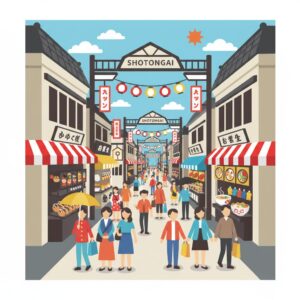
The ‘shotengai,’ or covered shopping arcade, is the perfect stage for osekkai. These arcades are the lifeblood of local life, and the interactions there exemplify community living at its best. Stroll through Tenjinbashisuji, Japan’s longest shotengai, and simply listen. You’ll hear a fishmonger giving a young woman detailed tips on how to grill the mackerel she just purchased. You’ll witness a butcher sneak an extra slice of pork into a regular customer’s bag with a knowing smile. If you drop a bag of oranges, you won’t be the only one picking them up; at least two others will instinctively crouch down to help, handing them back to you while clucking about the importance of a sturdy bag. People even ask strangers which daikon radish looks fresher. It’s a vibrant, engaging, and cooperative shopping experience—quite different from the silent, sterile aisles of modern supermarkets.
Navigating the Station Maze
Osaka’s major train stations, like Umeda or Namba, are infamous for their confusing, maze-like layouts. They’re also prime spots for osekkai. If you pause with a slightly puzzled look while studying a map, you’re basically sending a distress signal that an Osakan is hardwired to answer. Someone will come over. “Where are you headed?” they’ll ask. But they don’t just point you in a direction. They usually provide a detailed explanation, naming landmarks (“Turn left at the fancy bakery, not the cheap one”), and might even walk with you for a bit to make sure you’re on track. They take a certain civic pride in navigating their complex city and genuinely enjoy sharing that knowledge. To them, a lost tourist isn’t a nuisance; it’s a chance for a meaningful and satisfying human connection.
The Apartment Building Guardians
This kind of osekkai can feel the most personal and, for some, the hardest to get used to. Neighbors, especially older residents who’ve lived in the building for many years, may take a warm interest in your life. It’s not unusual for someone to comment, “You were out late last night!” It’s not meant as an accusation; it’s their way of saying, “I see you. You belong here, and I’m aware of your comings and goings.” They might offer you vegetables fresh from their garden or a plate of food, gently suggesting you might not be eating well enough. At first, this can seem intrusive. But over time, you recognize it as a quiet, informal security network. These are the people who notice if your mail starts to pile up, who accept deliveries for you, and who form a subtle but caring support system. It’s the village mentality, shrunk down to the scale of one apartment building.
How to Respond
The art of receiving osekkai is straightforward: accept it graciously. A smile and a sincere “Ookini” or “Arigatou gozaimasu” are your best responses. There’s no need for a deep bow or elaborate speech. Simply acknowledge the kindness, accept the offer, and move on. If it’s advice you don’t want or need, a polite “Thank you, but I’m okay” (“Arigatou, demo daijoubu desu”) will do perfectly. No one takes offense. They’ve done their part by offering; you do yours by politely acknowledging it. The key is to avoid being defensive. See it not as a critique of your abilities but as a gift of their attention. Treasure the moment of connection, however brief.
Embracing the Beautiful Meddling
Living in Osaka is a constant balance between the anonymity of a sprawling global city and the closeness of a tight-knit village. Osekkai serves as the bridge that connects these two worlds. It’s the city’s way of ensuring its residents don’t become strangers to one another. This social code values human connection above personal boundaries and practical assistance over polite silence. It can be messy, unexpected, and occasionally overwhelming, but at its heart, it always stems from genuine care.
To truly thrive in Osaka, you must learn to embrace this kind of thoughtful interference. It means understanding that a stranger correcting your train ticket purchase is, in their own way, welcoming you. It’s about recognizing that the woman who gives your child free candy is reinforcing the idea that this is a shared community where everyone looks out for one another. You surrender some privacy in exchange for an invaluable amount of informal support and a deep sense of belonging. When you find yourself warning a stranger their train is about to depart or helping an elderly man carry his groceries upstairs without hesitation, you’ll realize you’re no longer just living in Osaka. You’ll understand that Osaka is living within you.