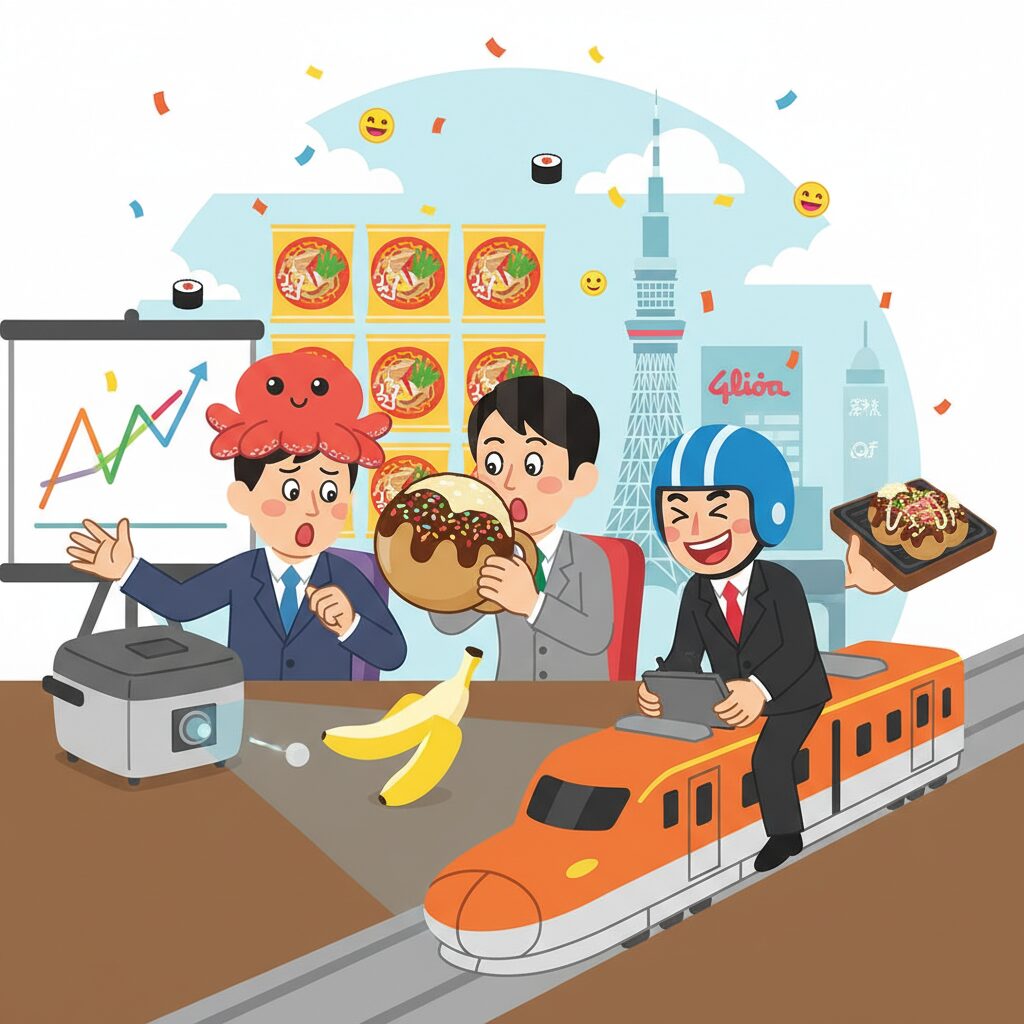
I still remember my first proper business meeting in Osaka. I was fresh off the plane from the UK, armed with a crisp suit, a stack of freshly printed business cards, and a textbook understanding of Japanese corporate etiquette. I’d rehearsed the bows, memorized the honorifics, and prepared for a session of solemn, stone-faced negotiation. We were gathered in a small, cluttered office in Higashi-Osaka, a place humming with the sound of light industry and the smell of hot metal. The company president, a man in his late sixties with a warm, wrinkled smile, was reviewing my proposal. He squinted at a chart, tapped his pen, and then looked up at me with a perfectly straight face. “Miller-san,” he said, his voice gravelly, “this graph is so beautiful, my wife will get jealous. I might have to frame it and hide it from her.”
My brain short-circuited. Was this a compliment? A bizarre flirtation? A test? I mumbled a flustered “thank you,” my cheeks burning. Then, his sales manager, who had been sitting quietly beside him, leaned over and lightly smacked the president on the shoulder. “Shachou! Stop scaring the poor boy! Your wife hasn’t been jealous of anything you’ve brought home in thirty years!” The room erupted in laughter. The president, the manager, the two other employees—everyone was laughing. And in that moment, all the formal tension I had built up inside me simply evaporated. This wasn’t the Japan I had read about. This was something else entirely. This was Osaka.
That experience was my baptism by fire into the city’s unique communication style, a world where the punchline is often the point, and where humor is not a distraction from business but an essential part of it. For any foreigner planning to work or live here, understanding this dynamic is more critical than knowing the train map. It’s the invisible architecture of daily life, the unspoken language that dictates relationships, builds trust, and ultimately gets things done. Forget the stereotype of the silent, stoic Japanese salaryman; in Osaka, the workplace often feels more like a fast-paced comedy club than a boardroom. This article is your guide to navigating that club, to understanding the rhythm of the banter, and to cracking the code of Osaka’s most misunderstood and vital cultural export: its humor.
To truly grasp this unique business culture, it’s essential to understand the underlying Osaka merchant spirit that shapes its approach to deals and relationships.
The Great Divide: Why Osaka Isn’t Tokyo, Especially from 9 to 5
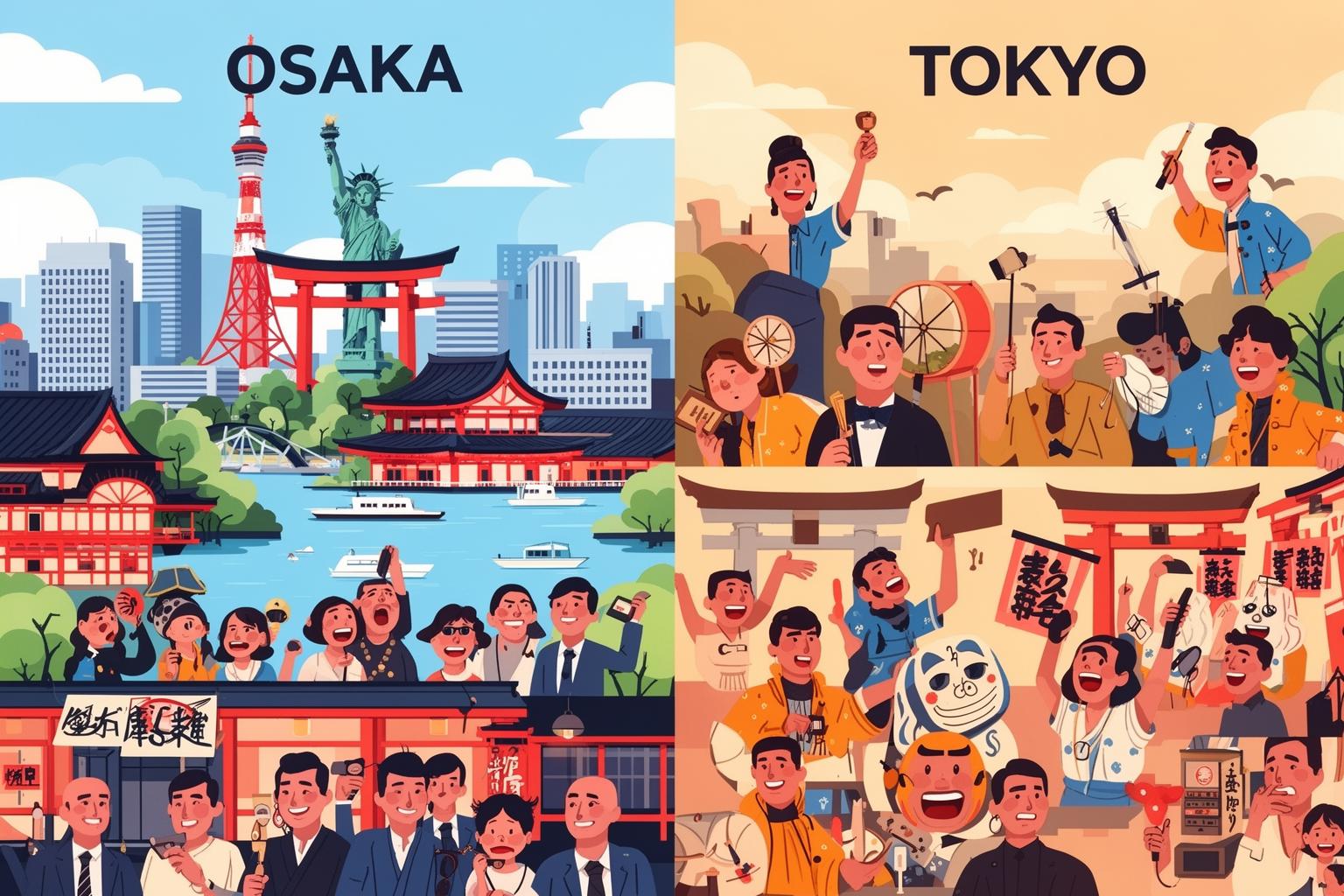
For many people worldwide, the phrase “Japanese work culture” evokes a very specific image: one of strict hierarchy, intense formality, long hours spent in near-monastic silence, and communication so indirect it almost seems telepathic. While this portrayal isn’t entirely inaccurate, it is geographically limited. It reflects Tokyo’s culture. Osaka, by contrast, operates on a different wavelength, shaped by centuries of unique history, economics, and social values. Entering an Osaka office after working in Tokyo is like switching from a classical music station to a lively jazz channel. The basic notes of business remain the same, but the rhythm, improvisation, and energy are vastly different.
The Myth of a Uniform Japanese Workplace
The first step is to abandon the idea that Japanese business culture is uniform across the country. Although smaller than California, Japan encompasses countless regional identities, and the most significant rivalry shaping the national character is the ongoing clash between Kanto (around Tokyo) and Kansai (centered on Osaka). Tokyo, as the seat of the shogunate and later the imperial government, developed a culture grounded in bureaucracy, order, and protocol. Social interactions were and still are carefully choreographed to preserve harmony and respect established hierarchies. Formality acts as both a shield and social lubricant, ensuring everyone understands their role and interactions proceed smoothly. In Tokyo offices, what is left unsaid often matters more than what is spoken. The atmosphere is rich with nuance, with the primary aim being to avoid offense or disruption of group harmony.
Osaka, meanwhile, was a commercial hub—tenka no daidokoro, the “nation’s kitchen”—a bustling port city where merchants from across Japan gathered to trade rice, sake, and countless other goods. In this setting, a different skill set was essential. Success relied not on rigid protocol but quick thinking, sharp negotiation, and the ability to quickly build rapport with strangers. Shyness or excessive formality were luxuries no merchant could afford. Communication had to be direct, efficient, and, most importantly, persuasive. Humor was a vital tool—a shared laugh could disarm tough negotiators, build trust faster than formal ceremonies, and transform a business partner into a friend. This merchant spirit remains ingrained in Osaka’s professional culture. Efficiency isn’t just about processes or spreadsheets; it’s about rapid human connection.
The Merchant DNA: The Historical Roots of Communication
To understand why an Osaka manager might tease you about your PowerPoint skills, consider the city’s history. While Edo’s samurai practiced swordsmanship and poetry, Osaka’s merchants sharpened their wit. Their environment was the marketplace—a loud, chaotic, and fiercely competitive arena. Communication evolved to be exceedingly practical, shaped by a prevailing attitude of akireru, a pragmatic frustration with inefficiency and pretentiousness. Time was money, and beating around the bush was a costly waste. This gave rise to a directness that can be startling to those used to Tokyo’s delicate dance of indirectness.
Moreover, despite their wealth, merchants ranked at the bottom of the rigid Edo social hierarchy, beneath samurai, farmers, and artisans. This fostered an underdog mentality and a healthy skepticism toward authority and pomp. Humor became a means of leveling the playing field, subtly mocking societal rigidities. That spirit endures; Osakans often take pride in being less polished, more down-to-earth, and more relatable than their Tokyo peers. Joking about the boss (within limits) isn’t disrespect—it celebrates an egalitarian, anti-pretentious ethos. It reinforces the idea that everyone is united in the effort to make a profit and enjoy the process. This historical context clarifies why relationship-building in Osaka leans less on formal gift-giving and more on sharing a laugh over takoyaki. The aim is to see the real person behind the business card, with humor serving as the fastest bridge.
Language as a Cultural Gauge: Kanto-ben vs. Osaka-ben
This cultural divide is even reflected in language. The standard Japanese heard on national news is based on the Tokyo dialect, Kanto-ben, which tends to have flat intonation and is viewed as more formal and polite. In contrast, Osaka-ben, the Kansai regional dialect, is lively, rhythmic, and filled with distinctive expressions that are inherently more emotive and expressive. Words like meccha (very/super) and honma (really/truly) add emphasis and personality often missing in standard Japanese. The phrase nande ya nen (roughly “what the heck?” or “why on earth?”) exemplifies this—it’s not just a question but a performance: a verbal eye-roll, a playful challenge, and a punchline all at once.
The dialect’s structure encourages lively, interactive conversations, often ending sentences with rising intonations inviting response. This back-and-forth forms the perfect basis for banter. Where a Tokyo businessperson may say the polite and formal soudesune (“that is so, isn’t it?”), an Osaka counterpart might enthusiastically say honma sore na! (“that’s so true!”), sounding more like friends than formal colleagues. The language itself rejects stiffness and impersonality; it’s crafted for connection, emotion, and well-timed humor. Using even a bit of Osaka-ben signals you’re more than a visitor—you understand the local rhythm. It is, essentially, the soundtrack of the city’s personality.
Deconstructing the Laugh: The Mechanics of ‘Nori-Tsukkomi’
At the core of Osaka’s comedic communication style lies a concept as essential to social interaction here as saying please and thank you is elsewhere. This is the dynamic of nori-tsukkomi, a conversational dance that influences everything from TV shows to business meetings. It’s not merely about telling jokes; it’s a structured, interactive, and collaborative form of humor. This dynamic fuels Osaka banter, and learning to identify its elements is the key to participation. Fundamentally, it’s a two-part, sometimes three-part, routine taken directly from manzai, the traditional Japanese stand-up comedy perfected and popularized in Osaka.
The Setup (‘Boke’) and the Punchline (‘Tsukkomi’)
The entire system is built on two essential roles: the boke and the tsukkomi. Understanding these roles is crucial.
The boke, from the verb bokeru (to be senile or air-headed), plays the fool, saying or doing something absurd, incorrect, or just plain silly. This is the setup. The boke deliberately throws the conversation off balance, creating humorous tension. It’s not about genuinely being stupid; it’s a deliberate performance meant to provoke a certain reaction. For example, a colleague might deadpan, looking at a complex financial spreadsheet, “So if we just flip this chart upside down, our profits will soar.” That’s a classic boke act.
The tsukkomi is the straight man. The term comes from the verb tsukkomu (to thrust or poke into). The tsukkomi’s role is to quickly highlight the absurdity of the boke’s remark, restoring order with a sharp, witty correction. This is the punchline. In response to the upside-down chart comment, the tsukkomi might say, “Don’t be ridiculous! The only thing that will skyrocket is the CEO’s blood pressure if he sees you doing that.” The speed and sharpness of the tsukkomi make the exchange funny. It’s a verbal slap that indicates, “I’m paying attention to your nonsense.” This dynamic is a rapid back-and-forth, a conversational game of tennis where the boke serves an absurdity and the tsukkomi returns it with force.
Introducing the Secret Ingredient: ‘Nori’
Here’s where it becomes more intricate and where many foreigners struggle. Between the boke and the tsukkomi, there is often a vital, unspoken step called nori. The word nori comes from the verb noru, meaning “to get on” or “to ride.” In banter, it means to go along with the joke, to ride the wave of absurdity the boke has initiated, even if only momentarily. It’s an act of collaborative improvisation. When someone takes the boke role, the best response isn’t an immediate tsukkomi but showing nori by playing along and validating the silly premise before the punchline arrives. This transforms the exchange from a simple joke into a shared comedic experience.
Returning to our office meeting example: the president says your graph is so beautiful his wife will get jealous. That’s the boke. A poor response would be confusion or a literal explanation (“Thank you, shachou, I used the latest version of Excel for the pie chart.”). A good response shows nori. You play along: “Of course, shachou. Should I prepare a smaller, less attractive version for your wife so she won’t worry?” By doing this, you accept his comedic premise and build on it. You demonstrate that you “get it.” Then the sales manager delivers the tsukkomi (“Stop scaring the poor boy!”), completing the comedic loop. Failing to show nori is a social misstep. It signals disinterest, inattentiveness, or lack of social grace to join in. In an Osaka workplace, showing good nori often impresses more than technical skills.
The Art of the ‘Tsukkomi’: More Than Just a Rebuttal
A common misconception is that the tsukkomi is harsh or mean-spirited. In Western cultures, repeatedly correcting someone can be seen as rude or arrogant. But in Osaka, a skillfully executed tsukkomi signifies closeness and engagement. It’s active listening. It says, “I heard your joke, understood it, and care enough to do my part in completing it.” A sharp tsukkomi compliments a clever boke. It validates their wit.
There is also a physical element that newcomers might find surprising. The tsukkomi is often accompanied by a light, theatrical tap, usually with an open hand on the shoulder or back of the head. This is definitely not workplace violence. It’s a punctuation mark, a physical counterpart to the verbal punchline, borrowed from manzai stagecraft. The gesture should be quick, gentle, and always paired with laughter. Context is key. The appropriateness of both the verbal and physical tsukkomi depends heavily on the relationship and hierarchy between people. A manager might lightly tap a subordinate, and close colleagues of the same rank might do it to each other. A junior employee rarely would do it to a senior executive. Mastering the tsukkomi is an advanced skill, but recognizing it as a gesture of comedic rapport is an essential first step for any foreigner in an Osaka office.
The Osaka Office in Action: Case Studies and Scenarios
Theory is one thing, but observing how this communication style unfolds in real-life situations is quite another. The rhythm of nori-tsukkomi serves as the daily pulse of the Osaka workplace, manifesting in both major and minor moments. Recognizing these scenarios will help you anticipate conversational flow and understand the role of humor in various professional settings. What might appear as a chaotic string of jokes is often a remarkably efficient, if unconventional, method for managing teams, solving problems, and fostering relationships.
Scenario 1: The Morning Meeting (‘Chourei’)
In many Tokyo companies, the chourei is a serious, formal ritual. Information is delivered top-down, with the team standing at attention, listening to the manager’s announcements, then bowing together before quietly dispersing. It emphasizes discipline and order.
An Osaka chourei feels entirely different. The manager might start by raising his coffee cup and saying, “Sato-san, your coffee today is so bitter, it made my face pucker up like a pickled plum!” This is a boke, an opening bait. The team is expected to respond. Sato-san, who made the coffee, might retort with a tsukkomi: “Buchou, that’s not the coffee, that’s just what your face looks like on a Monday morning!” The group laughs, the morning tension breaks, and a sense of camaraderie is quickly established. After this brief warm-up, the meeting shifts to the day’s agenda, but the tone has been set. The humor has a practical role: it serves as a quick emotional check-in. If the team can banter, it signals everyone is in good spirits and ready to collaborate. It turns a mandatory routine into a moment of human connection.
Scenario 2: Giving a Presentation
Imagine presenting a quarterly report to your team. As you advance through the slides, you spot a glaring typo on a key chart. The sales figures for May are mistakenly labeled “Mey.” In a more formal environment, this could trigger intense embarrassment. Colleagues might discreetly ignore it to save your face, or a superior might point it out sternly after the presentation.
In Osaka, the response is likely immediate, public, and humorous. Your boss might interrupt, pointing at the screen with mock outrage: “Oi, Miller! Who’s this Mey? A new client you’ve been hiding? Is she paying well?” This is the boke. The team laughs—not to ridicule you, but to reframe your mistake. It ceases to be a professional slip-up; it becomes a funny story. You respond by playing along, showing nori. You could bow theatrically and say, “My secrets are out! I’ll introduce you all to Mey-san later.” Then deliver a light tsukkomi on yourself: “Alright, alright, sorry everyone, my fingers got ahead of me.” You correct the slide and continue. The humor instantly diffuses the tension, making your error feel minor and human, allowing the team to move on without awkwardness. It’s supportive teasing that preserves group harmony by acknowledging flaws with laughter rather than shame.
Scenario 3: Negotiations with a Client
One might assume this joking manner vanishes in high-stakes situations like client negotiations, but that’s not always true. While the humor becomes more subtle, its principles remain a strategic tool for building relationships. An Osaka salesperson knows that deals are ultimately made between people, not corporations. Their first aim is often to break down formal buyer-seller walls and establish a personal connection.
This often involves self-deprecating humor. Meeting a client from a prestigious Tokyo company, an Osaka sales manager might open with something like, “Welcome! Sorry our office isn’t as grand as your Marunouchi skyscraper. We spend all our budget on making good products, not fancy carpets!” Such a comment does multiple things at once: it shows humility, subtly expresses confidence in their product, and invites the client to lower their formal guard. It reframes the dynamic from a small company petitioning a large one to two people having an honest conversation. The goal is to build trust and partnership, making the client feel they’re dealing with a genuine, down-to-earth person rather than a faceless corporate entity. It’s a calculated risk, but in Osaka’s business culture, it’s often key to sealing the deal.
Scenario 4: The After-Work ‘Nomikai’ (Drinking Party)
The nomikai is where the training wheels come off. These after-work get-togethers are vital across Japan’s professional scene, but in Osaka, they become the main stage for the company’s nori-tsukkomi culture. With alcohol loosening inhibitions, the pace of banter quickens and the jokes grow bolder. Here, you witness the complex web of relationships within the team: junior staff gently teasing their direct managers, senior employees sharing self-deprecating tales of past mistakes.
The nomikai is more than a party; it’s a social proving ground. Your ability to join the banter, to take a joke and deliver one in return (appropriately), is closely watched. Can you keep up? Do you grasp the rhythm? Do you laugh at the right moments? Navigating a nomikai successfully signals high social intelligence. It’s where you strengthen bonds essential for smooth collaboration during office hours. Skipping these events or remaining quiet in the corner can mark you as an outsider—not due to dislike, but because you’re absent from the primary ritual of team bonding.
The Foreigner’s Survival Guide: How to Play the Game
Grasping the theory behind Osaka banter is one thing; successfully putting it into practice without embarrassing yourself is quite another. For a foreigner, diving into this fast-paced, culturally nuanced humor can be daunting. The fear of making a misstep, misunderstanding a joke, or being branded the “unfunny foreigner” is very real. Yet, avoiding participation altogether is often a worse choice. The secret is to begin gradually, observe carefully, and pick your moments thoughtfully. You don’t have to become a manzai expert overnight—you just need to show a willingness to join in.
To ‘Boke’ or Not to ‘Boke’: A Beginner’s Dilemma
My strongest advice to any newcomer is: under no circumstances should you try to be the boke right away. Although the boke role appears simple, it demands a deep understanding of context, timing, language, and what your particular group finds funny. A poorly performed boke doesn’t come across as humorous; it reads as a genuine blunder, an awkward moment, or worse, an insult. You risk appearing incompetent or just plain odd. The line separating a clever, absurd remark from a senseless one is razor-thin—and you won’t perceive it until you’ve spent ample time observing your team.
Your initial role should be that of an anthropologist. Watch and listen carefully. Identify the key players in your office. Who naturally takes on the boke role, initiating humor regularly? Who is the sharpest tsukkomi, the one everyone looks to for the retort? How do they interact? Which topics are open for jokes, and which are off-limits? Spend your first months mapping the comedic dynamics of your workplace. This passive observation is an active strategy—you’re learning the rules before attempting to score.
Your First Move: Mastering the ‘Nori’
Your entry point into Osaka banter is nori. This is the safest, simplest, and most effective way for a foreigner to get involved. It’s a low-risk, high-reward tactic. All you need to do is show you recognize and appreciate the joke. When your manager takes the boke role and says something absurd, your job is to play along. A smile is the bare minimum; a hearty laugh is better; a verbal confirmation is best. If a colleague says, “This project is so tough, I think I’ll run away and join the circus,” don’t respond with a logical solution like, “Let’s analyze the workflow to fix bottlenecks.” Instead, show nori: “Great idea, Tanaka-san! Save me a ticket—I’ve always wanted to be a trapeze artist.” You don’t have to be witty or original—just affirm the comedic premise. This small gesture signals everything your colleagues need to know: you’re listening, you have a sense of humor, and you’re a team player willing to contribute to a positive atmosphere. Mastering the art of enthusiastic agreement is your most crucial social skill in an Osaka office.
The Gentle ‘Tsukkomi’: Your Entry-Level Punchline
After a few months of observing and gaining confidence with nori, you might be ready to try your first tsukkomi. The key is to start small and safe. You’re not aiming for a brilliant, cutting retort; rather, a gentle, formulaic reply that shows you’re playing the game. The most useful phrase to learn is “なんでやねん!” (Nande ya nen!). It’s the classic Osaka tsukkomi, a versatile punchline fitting countless situations. When your deskmate sighs dramatically and says, “I’m so handsome, it’s a burden,” you can respond with a cheerful “Nande ya nen!” and a smile. Because it’s a beloved local phrase, your coworkers will likely be pleased and impressed that you’ve made the effort. It acts as a cultural password, granting you access to deeper interaction. Other safe options include simple playful negations like “アホか!” (Aho ka! — Are you an idiot!) or “ちゃうちゃう” (Chau chau! — No, no, no!) delivered with a big grin. Tone is everything; as long as you’re smiling and your body language is friendly, these phrases convey affectionate banter rather than genuine insults.
Reading the Air (‘Kuuki wo Yomu’): The Ultimate Skill
Ultimately, this all boils down to the quintessential Japanese social skill of kuuki wo yomu—“reading the air.” Osaka office humor is lively but not a free-for-all. Invisible boundaries and unspoken rules exist. You must cultivate sensitivity to gauge the mood and context. A joke that’s hilarious on a relaxed Friday afternoon might be completely inappropriate during a tense Monday morning deadline. Teasing a colleague about their poor taste in ties is usually acceptable; poking fun at a costly mistake is not. The goal of humor is always to foster group unity. Any joke that singles someone out negatively, causes real embarrassment, or touches on sensitive personal topics breaks the code. This is the hardest skill to master because it relies on intuition rather than explicit rules. Watch closely how others respond. If a joke is met with uneasy silence, take note—that’s a boundary. Learning to read the air is your final exam in Osaka communication, and passing it is the key to genuine integration.
When It Goes Wrong: Misunderstandings and Pitfalls
Despite your best efforts, there will be occasions when you misunderstand a situation or experience cultural miscommunication. The interactive, teasing style of communication common in Osaka can be tricky for foreigners, especially those from cultures where workplace interactions are more straightforward and less playful. Being aware of common pitfalls can help you handle these confusing moments and avoid unintentionally offending others or isolating yourself.
Is This Bullying? Distinguishing Teasing from Harassment
This is likely the biggest and most serious source of confusion for Westerners. You might hear your manager openly criticizing a junior colleague’s mistake in front of everyone, or notice coworkers constantly teasing one person about their favorite baseball team. Your internal alarm bells might immediately shout “Workplace harassment!” or “Bullying!” In many Western contexts, you would be justified. But in Osaka, it’s important to look deeper before making judgments.
The key difference lies in intent and the group’s response. Osaka-style teasing aims primarily at inclusion. By gently mocking someone, the group is giving them attention. They are saying, “We see you, we know you, and we feel comfortable enough with you to joke around.” The person being teased is expected to be in on the joke, laugh at themselves, and respond with playful banter. The laughter from others is supportive, aimed at sharing the humorous moment with the individual. Bullying, or ijime, is the opposite. Its purpose is exclusion. It seeks to isolate and hurt. In bullying situations, the group’s laughter is malicious, directed at the individual, or there is an awkward, uncomfortable silence instead. The best advice is to observe your Japanese colleagues. If a manager teases a subordinate and everyone else laughs easily while the target smiles (even if a bit sheepishly), you are likely witnessing a normal, healthy team dynamic. If people look away, stop smiling, or if the target appears genuinely upset, then a boundary has probably been crossed.
The “Serious” Foreigner Stereotype
One of the quickest ways to become socially marginalized in an Osaka workplace is to consistently miss the banter or fail to join in. This often happens when you respond to a boke with logic. For example, your boss looks out at the pouring rain and says, “Perfect weather for a picnic!” You, eager to help, reply, “Actually, the forecast says the rain will continue until at least 6 p.m., so a picnic isn’t advisable.” While factually correct, you have just made a major social faux pas. You took the boke literally, killing the joke and the lighthearted mood. Doing this repeatedly will earn you a reputation for being overly serious, pedantic, and humorless—someone who “cannot read the air.” Gradually, your colleagues will stop including you in their banter, not out of ill will, but because they sense you don’t enjoy it. This can lead to feelings of isolation that impact your work life since much of the important information and relationship-building happens during these informal moments.
Overdoing It: The ‘Samui’ Foreigner
The opposite mistake is trying too hard. After learning about the importance of humor, some foreigners attempt to be the office comedian from day one. They constantly make jokes, try complex boke without the necessary linguistic or cultural background, and generally force the humor. This often leads to being labeled samui, which literally means “cold.” In this context, it means your jokes are so unfunny that they create an awkward, chilly atmosphere. Everyone feels secondhand embarrassment for you. Genuine Osaka humor is spontaneous, situational, and responsive. It flows naturally from the moment. It isn’t a series of rehearsed jokes. You’ll have much better success if you let humor arise organically during conversation rather than forcing laughter. As with everything else, the best approach is to start small. A well-timed nori or a simple tsukkomi is worth far more than a hundred failed attempts at being a comedic genius.
The Punchline is Connection
After examining boke, tsukkomi, and reading the air, it’s easy to get caught up in the mechanics and lose sight of the core purpose. The intricate, humor-infused communication style of Osaka is more than just an amusing cultural quirk. It’s a highly developed social technology aimed at achieving one clear goal: connection. In a society that can often feel hierarchical and reserved, Osaka’s banter serves as a powerful tool to break through formality and foster genuine human relationships with remarkable speed and efficiency.
The jokes, teasing, and playful shoulder taps are all invitations—calls for interaction. When a colleague throws you a boke, they’re tossing you a conversational ball. How you respond—whether by catching it and playing along (nori), striking it back with a witty comeback (tsukkomi), or letting it fall into awkward silence—shapes the course of your relationship. It’s not really about humor per se; it’s about being present, engaged, and signaling your willingness to participate in the group’s collective life. This is the city’s distinctive way of building trust.
For a foreigner, navigating this system can be challenging. It demands keen observation, patient listening, and a readiness to occasionally appear foolish. Some days you’ll miss the joke completely; others, your own humor might be met with puzzled looks. Yet embracing this style of communication is one of the most rewarding steps you can take toward truly integrating into life in Osaka. It unlocks the vibrant, energetic, and deeply human core of the city. When you find yourself effortlessly trading barbs with your manager and laughing with your team, you’ll realize you’re doing much more than closing a deal or completing a project—you’re connecting.