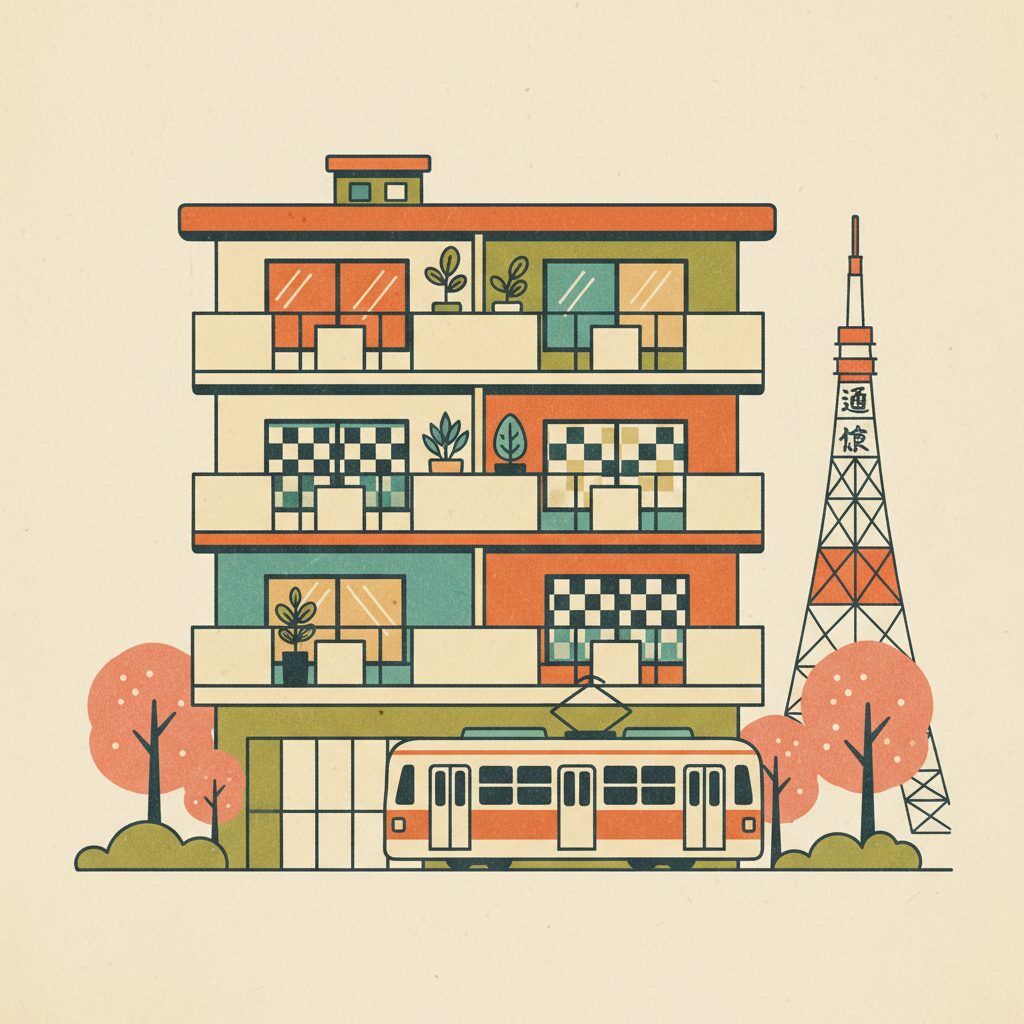
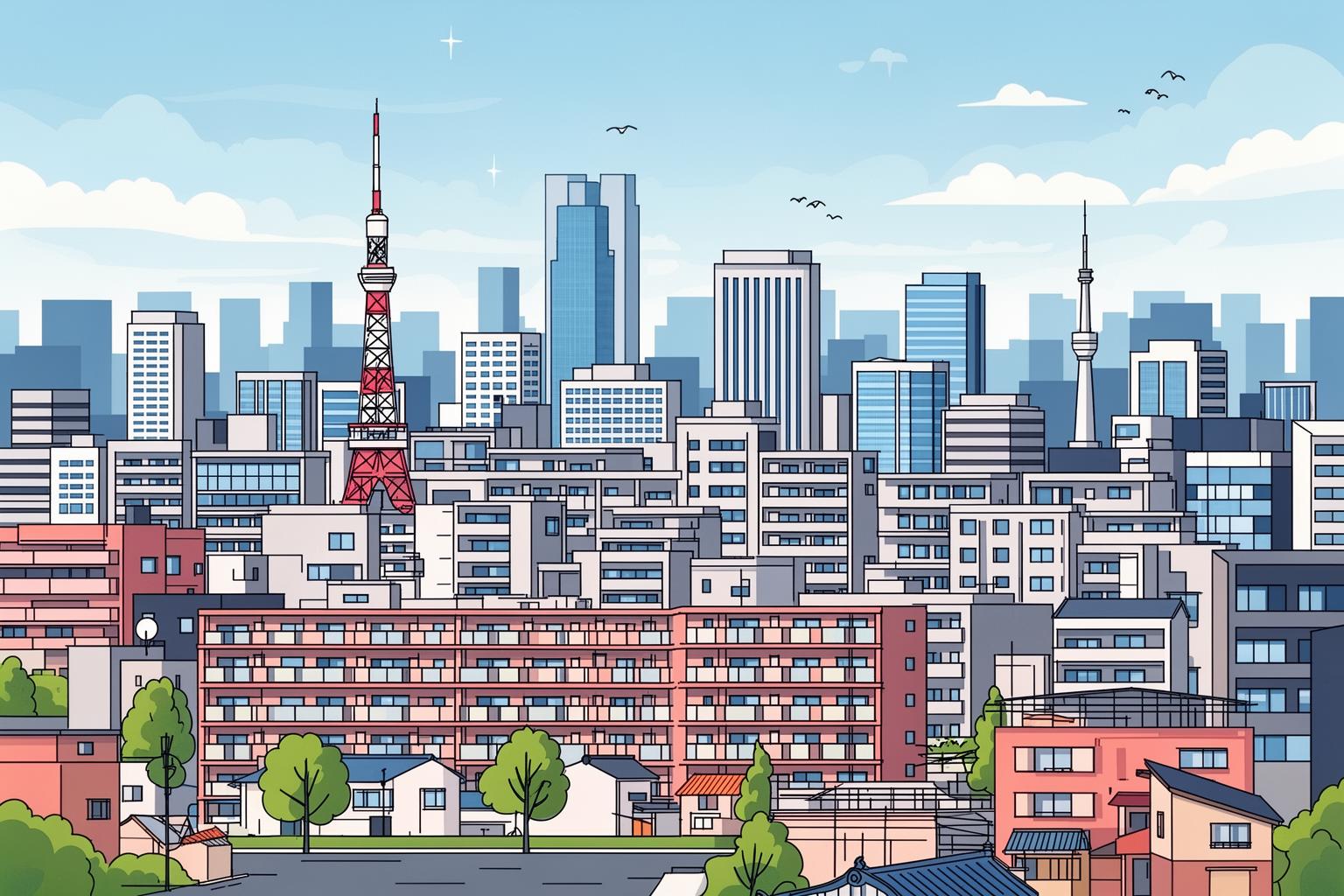
Walk away from the electric pulse of Namba, past the gleaming corporate towers of Umeda, and keep going. Sooner or later, your train will glide past them: vast collections of uniform, concrete apartment blocks, standing in silent formation against the sky. They’re often surrounded by surprising pockets of lush green, a stark contrast to their rigid geometry. You’ve probably seen them and wondered. What are these places? They don’t look like the sleek, modern mansions or the charmingly dilapidated single-family homes that fill out the rest of the urban landscape. They feel like something else entirely, a relic from a different era. This is the world of the Japanese “danchi” (団地), and for those in the know, it’s one of the best-kept secrets for affordable, authentic living in Osaka.
For many foreigners, the idea of public housing conjures up a specific set of images, not always positive. But in Japan, and especially in Osaka, the danchi is a different story. It’s not just a block of flats; it’s a time capsule, a community hub, and a surprisingly stylish canvas for modern life. These complexes were the very picture of post-war prosperity, the dream homes for a rising middle class. Today, they offer a unique window into the city’s soul, far from the tourist trails. Living in a danchi is choosing a different rhythm. It’s trading a five-minute walk to a pulsing subway station for sprawling parks and the friendly, if sometimes nosy, chatter of your neighbors. It’s about discovering the Osaka that operates on a human scale, built on relationships forged over shared laundry lines and at the local tofu shop.
As a writer who spends my days immersed in the world of fashion and art, I’m drawn to the danchi’s aesthetic. There’s a certain minimalist beauty in their unadorned concrete forms, a “Showa-retro” chic that designers and artists are now actively seeking out. They are blank slates, waiting for a new generation to splash their personality onto their well-worn walls. But beyond the visuals, it’s the practical side that’s truly revolutionary, especially for foreigners. Renting here sidesteps many of the infamous hurdles of the Japanese real estate market. It’s a path to a stable, spacious, and affordable life in a city that can often feel impenetrable. This isn’t just about finding a cheap place to live. It’s about unlocking a more grounded, communal, and ultimately, a more human way of experiencing Osaka. It’s about understanding the city not through its landmarks, but through its living rooms.
To truly embrace this communal lifestyle, you might find yourself enjoying the city’s unique traditions like the Osaka morning service.
What Exactly is a “Danchi”? Deconstructing the Concrete Canvas
Before living in a danchi, it’s essential to understand what it truly represents. The term 団地 literally means “group land,” but it carries deep cultural and historical significance. These structures aren’t just random buildings; they stand as monuments to a pivotal era in Japanese history, and their design philosophy continues to influence the residents’ lives today. Viewing them simply as inexpensive housing misses their true essence—they are living museums of Japan’s 20th-century ambitions.
A Brief History: From Post-War Recovery to Retro Appeal
The danchi story begins amid the ruins of World War II. Faced with a severe housing shortage, the Japanese government urgently sought solutions. From the 1950s through the rapid-growth decades of the 60s and 70s, the Japan Housing Corporation (now UR) built vast complexes on the outskirts of major cities. For those who moved in, a danchi apartment represented the height of modern living and earned the nickname “apartments of longing.”
Picture the leap from a small, dim wooden house with shared amenities to a bright concrete apartment featuring a private kitchen, flush toilet, and stainless steel sink. It was a revolution. The phrase “danchi wife” (団地妻) emerged, symbolizing a new type of housewife overseeing her modern household—a sign of the nuclear family and rising middle-class life. These buildings physically embodied Japan’s economic miracle: clean, efficient, and forward-looking.
However, as Japan’s economy evolved, so did the danchi. The young families who first moved in aged, and the buildings, once symbols of progress, began to feel outdated. Private developers started creating more luxurious and centrally located “mansions” (modern condominiums), and the danchi’s prominence waned. They became associated with an aging population, neglected suburbs, and a persistent Showa-era mindset.
Yet, over the past decade, the danchi has experienced a remarkable renaissance. A new generation—consisting of young Japanese creatives, families, and savvy foreigners—now views danchi with renewed appreciation. They see not decline but opportunity: affordable housing in an expensive rental market, spacious layouts compared to cramped city apartments, and a unique retro aesthetic known as “Showa-retro” (昭和レトロ) that feels genuine and stylish. Much like vintage denim—well-crafted, full of character, and ready for a new chapter—the danchi is being rediscovered as a chic and thoughtful choice for today.
The Danchi Aesthetic: Beyond Brutalism, a Way of Life
Standing amid a large danchi complex, the first impression is one of massive scale and repetition. Rows of five-story concrete buildings, often without elevators, are laid out in precise geometric patterns. While the architectural style might be described as a gentler, more optimistic take on brutalism, it’s practical rather than harsh. The real charm lies in the spaces between the buildings.
Unlike modern developments that squeeze out every possible square meter for profit, danchi were designed with a utopian community ideal. This means expansive green areas: manicured lawns, mature trees towering over the buildings, and carefully tended gardens are common. Playgrounds outfitted with nostalgic metal climbing frames and sandpits, benches where elderly residents gather, and even communal vegetable patches are found here. This focus on shared outdoor space sets danchi apart from Western public housing models. The grounds are safe, immaculately maintained, and actively used—a collective backyard for thousands.
Inside, the apartments tell a story of another era. Traditional layouts often include one or two tatami mat rooms that aren’t mere decorative remnants but highly versatile spaces—living rooms by day, bedrooms by night. The soft floors and their earthy scent after rain add to their charm. Sliding paper doors, or “fusuma” (襖), separate the rooms, allowing flexible and open living arrangements long before they became popular elsewhere. Kitchens are modest but efficient, and balconies—essential for drying laundry—offer a quintessentially Japanese touch. From any danchi window, one can see a colorful display of drying futons and clothes, vivid signs of life within these concrete shells.
This distinctive aesthetic is now catching the attention of major brands. For instance, the collaboration between MUJI and UR revitalizes old units by exposing their beautiful structural bones and creating minimalist, open-plan spaces that are highly desirable. This transformation proves the danchi’s core design is robust—a versatile canvas that adapts smoothly to contemporary tastes.
The Osaka Danchi Vibe: Why It’s Not Tokyo
Living in a danchi varies depending on the city, and in Osaka, it has a unique character all its own. The city’s renowned pragmatism, love of a good bargain, and strong sense of community spirit find their fullest expression in these expansive complexes. This lifestyle contrasts sharply with the cool, detached anonymity often seen in Tokyo’s neighborhoods.
The Geography of Affordability: Where to Find Osaka’s Danchi
First, a reality check. You won’t come across a sprawling danchi complex near Osaka Castle or with a view of the Umeda Sky Building. By nature, these are suburban developments. They were created as “bed towns” (ベッドタウン), self-contained communities designed for commuters. The most notable example in Osaka is Senri New Town (千里ニュータウン), one of Japan’s earliest large-scale planned housing projects from the 1960s. Situated in the northern suburbs of Toyonaka and Suita, it typifies a danchi landscape with rolling hills, vast parks, and mid-rise apartment buildings linked by pedestrian pathways.
Other prominent danchi clusters are scattered throughout the Osaka prefecture: in Sakai to the south, Kadoma and Moriguchi to the east, and along private railway lines extending from the city center. The arrangement is straightforward: you exchange a longer commute for considerably more space and much cheaper rent. A 30-to-45-minute train ride may sound lengthy, but it’s a typical commute for millions across Japan. In return, you can rent a two- or three-bedroom apartment for the price of a tiny studio in the city center. You gain a quiet neighborhood, fresh air, and a genuine sense of leaving the urban rush behind at day’s end. For many—especially families or those working from home—this trade-off makes perfect sense.
The Social Fabric: Closer Bonds, Louder Conversations
This is where Osaka’s spirit truly stands out. Life in a Tokyo danchi can still feel quite anonymous. People tend to keep to themselves, and a polite nod in the hallway might be the extent of your interaction. In Osaka, however, the danchi’s design—the shared corridors, central parks, and local shopping arcades—amplifies the naturally outgoing and communal nature of its residents.
Expect conversations. Your neighbors will want to know who you are, where you come from, and what you do. This isn’t intrusive gossip—it’s how community security functions. The elderly woman sweeping the entrance path isn’t just tidying up; she’s keeping track of everyone who passes by. The gentleman sorting recyclables beside you will almost certainly start a chat, perhaps sharing unsolicited but well-intentioned tips on crushing your plastic bottles properly. This reflects the Osaka mindset: direct, practical, and deeply communal. Privacy here is less about invisibility and more about being a trusted, recognized member of the community.
Osaka’s famous “friendliness” isn’t a myth, though it’s often misunderstood. It isn’t the polished, service-oriented politeness typical of Tokyo. Instead, it’s a louder, informal, and sometimes meddlesome kind of care. It’s the neighbor who knocks on your door to share daikon radishes she grew. It’s the local butcher asking if you’re eating well. It’s the chorus of “Itterasshai!” (Have a good day!) and “Okaeri!” (Welcome home!) from residents you pass on the stairs. For an outsider used to urban anonymity, it can be overwhelming at first. But once you see it as a collective looking-out-for-one-another, it becomes deeply comforting. In an Osaka danchi, you are rarely alone.
The Hunt: Your Practical Guide to Renting a Danchi Apartment
So, the retro aesthetic and community atmosphere have drawn you in. How exactly do you go about renting one of these places? This is where the danchi system shows its biggest advantage for foreigners. The process is transparent, bureaucratic in a helpful way, and free from many of the financial and social barriers common in the private rental market.
The Landlords: Getting to Know UR and Public Entities
The most important acronym to remember in your search is UR. It stands for the Urban Renaissance Agency (UR都市機構, UR Toshi Kiko), a semi-public organization that manages a vast portfolio of former Japan Housing Corporation properties. UR is essentially the largest and most accessible landlord in the country, and they have a well-deserved reputation for being foreigner-friendly.
Their system is based on what’s called the “Four Nos,” which are music to the ears of any foreigner who has apartment-hunted in Japan before:
- No Key Money (礼金, reikin): This notorious non-refundable “gift” to the landlord, typically amounting to one or two months’ rent and common in the private market, is never charged by UR.
- No Agent Fee (仲介手数料, chuukai tesuuryou): Renting directly from UR means no real estate agent fees, saving you about a month’s rent.
- No Guarantor (保証人, hoshounin): This is often the biggest obstacle for foreigners. Most private landlords require a Japanese co-signer who assumes financial responsibility. UR requires no guarantor at all.
- No Renewal Fees (更新料, koushinryou): In the private market, tenants usually pay a fee—often one month’s rent—every two years to renew their contract. UR does not charge renewal fees.
All told, renting through UR can save you between three and five months’ rent upfront compared to private apartments, making relocation not only feasible but financially smart. Although there are prefectural (府営, fuei) and municipal (市営, shiei) housing alternatives, these often come with strict income limits or lottery systems, making them less predictable and accessible for many foreigners. For a straightforward, welcoming experience, UR is the clear winner.
The Search Process: From Online Browsing to In-Person Viewing
Your search starts on the UR Chintai website, a comprehensive database of available properties. While parts of the site are in English, you’ll find more options if you navigate the Japanese version, possibly with a browser translation tool. Search for areas you’re interested in—like Suita, Toyonaka, or Sakai—and begin browsing. You’ll find floor plans, photos, and detailed information on rent, size, and building age.
After identifying a few places you like, the next step is to visit a UR office, called a UR Eigyou Center. Several are located throughout Osaka. While an appointment isn’t always required, it may be helpful. Bring your essential documents: your Residence Card (Zairyu Card) and proof of income, such as a recent payslip or employment certificate. The staff are professional and experienced with foreign residents. They will verify your eligibility on the spot and help you arrange a viewing, or “naiken” (内見).
During the naiken, take your time. Since these are older buildings, inspect carefully for mold, leaks, and water pressure. Note the number of electrical outlets, as older apartments often have few. Observe how much natural light the unit receives—a south-facing balcony is highly valued for sunlight and drying laundry. From a safety standpoint, especially for women, I always check the locks on the main door and balcony window. Walk around the complex: Is it well-lit at night? How far is it from the nearest train station or bus stop? Does the community feel active and safe? Trust your instincts about the apartment and neighborhood.
The Money Talk: Understanding Costs and Requirements
Though UR eliminates many fees, renting isn’t free. The key financial requirement is income. Generally, your average monthly salary must be at least four times the monthly rent of the apartment you want. For example, to rent a 70,000 yen apartment, you must show a monthly income of at least 280,000 yen. This is a strict and transparent rule—there’s no ambiguity or subjective judgment; you either qualify or you don’t.
The initial move-in cost is straightforward. You’ll pay a security deposit (敷金, shikikin), usually two months’ rent. This refundable deposit assumes you leave the apartment in good condition. You’ll also pay the first month’s rent upfront. So for a 70,000 yen apartment, your total move-in cost is 140,000 yen (deposit) plus 70,000 yen (first month’s rent), totaling 210,000 yen. In comparison, private apartments with the same rent often demand upfront costs exceeding 400,000 yen after key money, agent fees, and other charges. This financial accessibility is truly a game-changer.
Life Inside the Danchi: The Unspoken Rules and Daily Rhythms
Securing the keys is just the first step. Living in a danchi means becoming part of a well-established ecosystem with its own rhythms, rules, and social expectations. It’s a microcosm of Japanese society, where group harmony and following procedure are essential. Successfully navigating this environment is crucial for a happy and peaceful life in your new retro home.
Community Obligations and Social Cues
Upon moving in, you’ll likely encounter the neighborhood association, or “chounaikai” (町内会). This resident-run group oversees the local affairs of the danchi block or complex. They organize seasonal events like summer matsuri and New Year’s mochi-pounding. They also manage cleaning duties, known as “souji touban” (掃除当番), often on a rotating schedule where residents take turns sweeping hallways, weeding flowerbeds, or cleaning the garbage area. While participation isn’t always legally required, opting out is a significant social faux pas. Contributing is seen as a fundamental part of being a community member.
Then there’s the garbage. Japan’s detailed waste separation system is well-known, and in a danchi, it becomes a public ritual. Trash isn’t simply left on the curb; there’s a designated collection point, often enclosed, with specific days for burnables, plastics, cans, bottles, and large items. Following this system carefully is vital. Using the wrong bag or placing trash out on the wrong day can result in a gentle neighbor’s reminder at best, or a formal violation notice at worst. It’s the most visible way to demonstrate your respect for rules and communal living spaces.
Noise is another important factor. Although the concrete walls of a danchi are thick, they aren’t soundproof. The unspoken rule is that life quiets down considerably after 9 or 10 PM. Sounds like running children, loud music, or a late-night washing machine carry through. This isn’t a place for wild parties. It’s a community built on the peaceful, steady rhythms of working families and retirees. Respecting this calm is a key part of being a good neighbor.
The Perks and Quirks of Retro Living
Life in a danchi offers a distinct set of benefits and challenges not often found in modern city apartments.
The advantages are notable. Foremost is access to green space. Having a large, park-like area just outside your door is a rare luxury in urban Japan. It provides a safe place for children to play, a pleasant spot for morning walks, and a seasonal connection often lost amid concrete. Many danchi also feature a small shopping arcade, or “shoutengai” (商店街). This isn’t a flashy mall; it’s a cluster of mom-and-pop shops—a butcher, greengrocer, fishmonger, dry cleaner, and small clinic. Shopping here is a social experience. Shopkeepers will get to know you, ask about your day, and maybe even toss in an extra orange. This fosters a level of community commerce largely disappeared in much of modern Japan.
However, the retro charm comes with its quirks. The infrastructure, by nature, is old. You may face issues with outdated plumbing or wiring that can’t support many high-tech appliances running simultaneously. Most units won’t have air conditioners; you’ll need to buy and install your own. Insulation in older concrete buildings is often poor, making them cold in winter and hot in summer. You’ll become skilled in layering clothes and using space heaters. And yes, being closer to nature means encountering more insects, so bug spray is a household essential. Finally, the demographic reality is that many neighbors will be elderly, creating a safe, quiet, and slow-paced environment. For some, this is a welcome refuge; for others, it might feel a bit too tranquil.
Redecorating Your Danchi: From Tatami Box to Your Personal Palace
One of the most thrilling aspects of living in a danchi is the chance to take a simple, unembellished space and make it uniquely your own. The interiors serve as a blank canvas, combining Showa-era practicality with traditional Japanese features. With some creativity, these apartments can be transformed into stylish, cozy, and deeply personal homes.
Embracing the Japanese Canvas: Working with Tatami and Fusuma
For many foreigners, the tatami room is both a novelty and a design challenge. How should it be furnished? The secret is to work with it, not against it. Tatami is a beautiful, natural material but quite delicate. Avoid heavy furniture with sharp legs that could dent or tear the woven straw mats. Use protective coasters or small boards beneath table and chair legs. Even better, adopt a low-profile lifestyle. A low table, or “kotatsu” (炬燵), accompanied by floor cushions creates a warm, flexible living space. Futons, which can be folded and stored in the spacious closets, or “oshiire” (押入れ), open up the entire room during the day.
Fusuma, the sliding doors, are another ingenious feature. They enable you to reconfigure your space in seconds. You can open them to create a large, airy living area or close them to form two separate, private rooms. They are much more versatile than fixed walls. While traditional paper designs may not suit everyone’s taste, they can be easily and affordably re-papered. You can select from hundreds of modern patterns or even use fabric to craft a distinctive accent wall that showcases your personal style.
Renovation Rules: What You Can and Cannot Change
When renting from UR, you generally cannot make major structural changes. You are not permitted to knock down walls, change the flooring, or remodel the kitchen. However, there is considerable freedom for cosmetic updates. Painting the walls is often allowed, though you may need to restore them to their original color when you move out. Be sure to check your contract thoroughly for specific regulations.
In recent years, UR has introduced “DIY” friendly apartments. These are usually older, unrenovated units offered at reduced rent. The catch is that tenants are given a budget and the freedom to execute significant renovations themselves, such as installing new kitchen counters, re-tiling the bathroom, or putting down new flooring. For those with a creative flair, this presents an amazing opportunity to design a home from the ground up at a fraction of the typical cost.
For most renters, the best strategy is to focus on non-permanent solutions. Peel-and-stick wallpaper or floor tiles can dramatically transform a room and are easy to remove. Tension rods are a renter’s best ally in Japan; they can create extra storage in closets, hang curtains without drilling holes, or even serve as room dividers. Good lighting also makes a big difference. Replacing a basic ceiling fixture with a stylish pendant lamp can elevate the entire space. Finally, fill your apartment with plants. The contrast between the lush green of indoor plants and the stark concrete exterior of the building is a classic danchi styling trick that brings warmth and life into your home.
Is Danchi Life in Osaka Right for You? An Honest Assessment
Choosing to live in a danchi means opting for a particular lifestyle. It can be an incredibly rewarding experience for the right person, but it’s not a one-size-fits-all choice. It demands a certain mindset and a willingness to embrace a different way of life. It’s a deliberate trade-off, and being honest about your priorities is essential for making the right decision.
Who it suits:
Danchi life in Osaka suits certain individuals perfectly. It’s ideal for budget-conscious individuals or families tired of paying sky-high rent for tiny apartments and yearning for more space to breathe. It appeals to artists, writers, and designers who view the retro aesthetic not as outdated but as iconic, appreciating the idea of a blank, minimalist canvas to craft their own vision. It’s a refuge for young families with children, who can fully benefit from the safe, car-free green spaces and playgrounds that define every complex. It serves as a lifeline for foreigners frustrated by the opaque and often discriminatory private rental market, providing a transparent, fair, and welcoming alternative without the need for a guarantor. Above all, it’s for those seeking a deeper, more authentic connection to Japan—those wanting to move beyond the surface and experience daily life within a genuine Japanese community, with all its responsibilities and rewards.
Who might find it challenging:
Conversely, danchi life isn’t suited for everyone. If you thrive on the nonstop energy of the city center and find a 30-minute commute unbearable, you may feel isolated in a quiet suburban complex. If you value extreme privacy and anonymity, the close-knit, talkative nature of an Osaka danchi community might seem intrusive. If your comfort depends on the latest modern conveniences—such as built-in dishwashers, floor heating, and auto-locking building entrances—the peculiarities of a 50-year-old building will likely cause ongoing frustration. And if you’re uneasy with community duties like cleaning shifts and neighborhood meetings, you may struggle to fit into the social fabric.
Ultimately, choosing to live in a danchi means engaging with Osaka on its own terms. It invites you to step behind the facade of neon lights and commerce and into the city’s living room. It offers a life that is slower, more intentional, and more interconnected. While it might lack the shine of a new high-rise, it provides something far more valuable: a sense of place, a true community, and an honest, unfiltered glimpse into the heart of this wonderfully pragmatic and deeply humane city.