You’ve probably heard the whispers, the culinary shorthand that defines Osaka in the global imagination. Takoyaki, those molten balls of octopus-studded batter. Okonomiyaki, the savory pancake that’s more of a delicious, cabbage-filled canvas. Kushikatsu, the art of deep-frying anything and everything on a stick. These are the titans of Osaka’s food scene, the dishes that draw queues and fill Instagram feeds. But to truly understand the city’s pulse, to get a taste of the grit and soul that fuels its people through long workdays and even longer nights, you have to go deeper. You have to look past the neon-lit headliners and find the food that Osakans eat not for the tourists, but for themselves. You have to find a bowl of Kasu Udon.
At first glance, it doesn’t scream refinement. The broth is a deep, murky brown, shimmering with a layer of rendered fat. The noodles are thick and soft, swimming alongside humble green onions. And floating on top are the mysterious, dark nuggets that give the dish its name: kasu. This isn’t the clean, elegant udon you might find in a serene Kyoto restaurant. This is something else entirely. It’s hearty, it’s unapologetically pungent, and it carries the weight of a working-class history in every spoonful. Kasu Udon is more than just a meal; it’s a statement of Osakan identity. It embodies the city’s core philosophies: ultimate pragmatism, a profound aversion to waste, and a love for direct, powerful flavors that don’t mince words. To dismiss it based on its humble appearance is to misunderstand Osaka itself. This bowl of offal noodle soup is a culinary key, unlocking the complex, unpretentious, and deeply satisfying character of Japan’s kitchen. It’s the city’s engine, its late-night comfort, its soul-warming secret. And once you understand it, you’ll understand Osaka in a way no guidebook can ever teach you.
This pragmatic, waste-averse approach to food is a perfect example of the city’s famous Shimatsu spirit.
Deconstructing the Bowl: What Exactly is Kasu Udon?
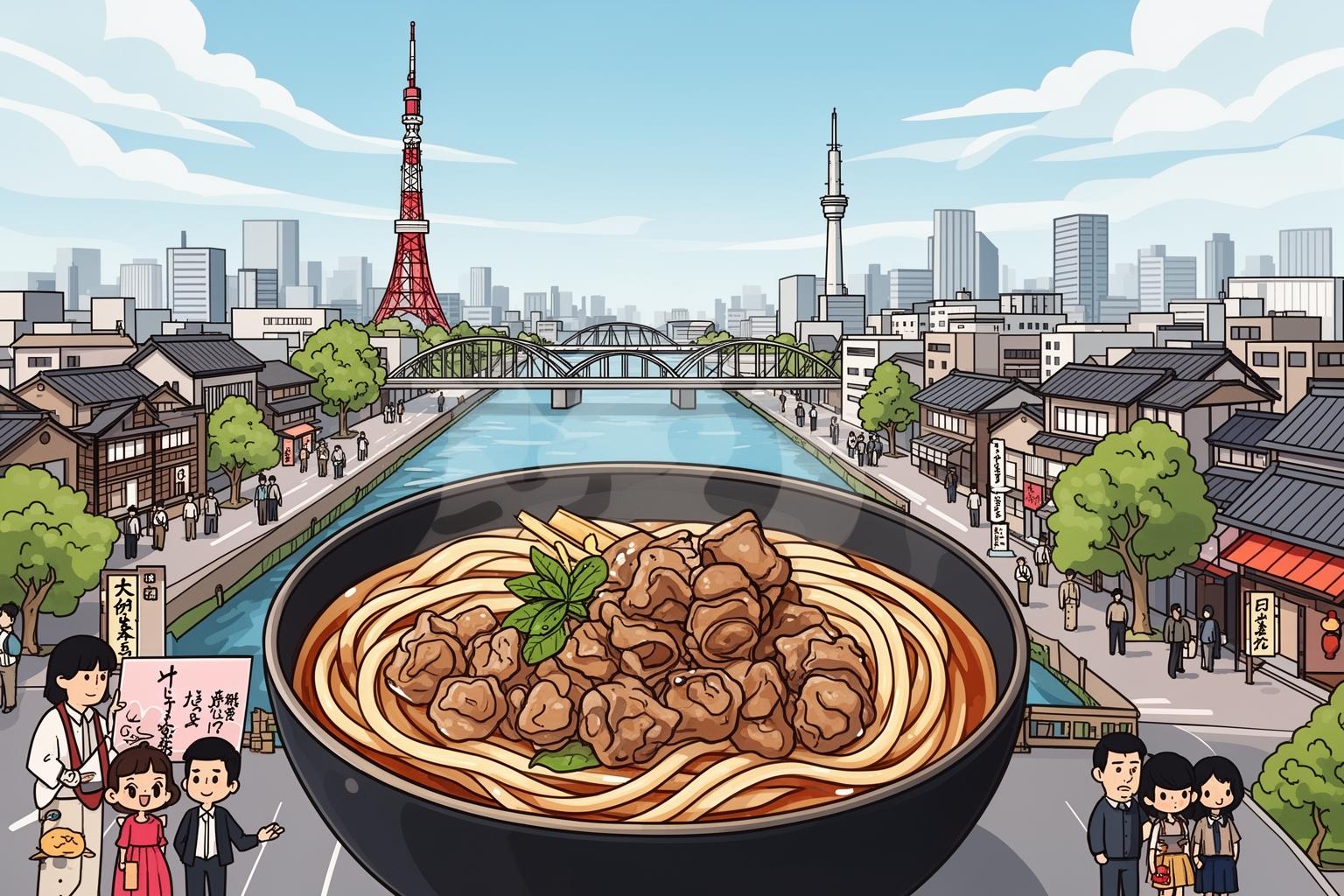
To those unfamiliar, a bowl of Kasu Udon might raise a host of culinary questions. It feels both familiar and unusual. It’s udon, but not quite as you expect. To truly savor it, we must dissect it into its essential parts, each revealing a chapter of Osaka’s culinary heritage. This trio of elements works together in a distinctive, almost bold harmony: the tender noodle, the subtle broth, and the robust topping that lends the dish its name and spirit.
The Udon Itself: Osaka’s Gentle Embrace
Let’s begin with the base: the noodles. If your main exposure to udon is the Sanuki style—the prevailing variety throughout Japan, known for its firm, square-edged, and highly chewy texture called koshi—then Osaka udon will seem almost alien. Here, the noodles are rounder, softer, and have a mild, yielding character. They don’t resist; they yield graciously. This isn’t a flaw—it’s intentional.
Osaka udon is designed for absorption. Its role isn’t to be the textural star but to serve as the ideal conduit for the soup around it. The noodles work like a sponge, soaking up every bit of the complex broth, ensuring that each mouthful delivers flavor. This preference reflects something essential about the Kansai palate. It’s less about achieving a perfect texture and more about the overall experience of the bowl. It offers a comforting, almost maternal touch. The noodles soothe and satisfy, carrying the taste of the dashi and the richness of the kasu straight to your soul. In a fast-paced, hardworking city, this soft, warm embrace offers a moment of sheer comfort.
The Dashi: The Heart of Kansai Cuisine
Beneath the strong scent of the kasu lies the foundation of all Kansai cooking: the dashi. This clear, umami-rich stock distinguishes the region’s cuisine from the rest of Japan. While Tokyo and the Kanto area favor dark soy sauce and dried bonito flakes (katsuobushi) for a bold, sharp flavor, Kansai’s dashi is lighter and more refined. Its primary essence comes from kombu, a type of kelp, imparting a deep, savory, and slightly sweet umami that is subtle yet profound. A gentle touch of bonito layers in to create a broth that is golden, fragrant, and surprisingly complex.
In Kasu Udon, this refined dashi is essential. It complements the star ingredient perfectly. On its own, the dashi is elegant and understated. But when aburakasu is added, a remarkable transformation unfolds. The delicate, umami-packed broth becomes a canvas for the intense, fatty, beefy kasu to paint its flavor. The dashi cuts through the richness, preventing it from overwhelming the palate while adding a savory depth that elevates the entire dish. It’s a careful balancing act of flavors. The dashi brings the light; the kasu adds the shadow, creating a dynamic tension in the bowl that’s deeply compelling and distinctly Osakan.
The Star of the Show: Aburakasu
Finally, we come to the centerpiece, the ingredient that defines Kasu Udon: aburakasu. The name can be misleading. Abura means oil or fat, and kasu means dregs or leftovers. Together, the name may not sound appetizing. Yet it is a culinary gem born from creativity. Aburakasu is made from beef small intestine, or horumon. The intestines are carefully cleaned and then slow-cooked over low heat for hours. This method renders out excess fat, which melts away, leaving behind small, shriveled, and intensely flavorful morsels.
What remains is a textural marvel. The exterior is slightly crispy and caramelized, while the interior remains rich, gelatinous, and chewy. When these nuggets are placed in the hot udon broth, they rehydrate, unleashing a burst of deep, beefy umami and a luxurious richness from the remaining collagen and fat. The flavor is unique—intensely savory, subtly sweet, with a smoky depth that infuses the entire bowl, transforming the light dashi into a hearty, powerful soup. Historically, aburakasu was a byproduct of the meat industry, especially in Osaka Prefecture’s Minami-Kawachi area. It was a way for butchers and meatpackers to use every part of the cow, ensuring nothing went to waste. Elevating these humble “dregs” into a treasured delicacy perfectly illustrates Osaka’s resourcefulness.
The Philosophy in the Flavor: Kasu Udon and the Osaka Mindset
A bowl of noodles is never merely a bowl of noodles, especially in a culturally vibrant city like Osaka. Food is a language, and Kasu Udon eloquently reflects the spirit of the people who created and continue to cherish it. It’s a liquid embodiment of the city’s core values—a philosophy you can savor. To eat Kasu Udon is to embrace the very essence of the Osakan character: practical, straightforward, and entirely free from superficiality.
Mottainai as a Guiding Principle
The existence of aburakasu, the heart of the dish, is deeply grounded in the Japanese concept of mottainai. Often translated as “waste not, want not,” its significance runs much deeper. Rooted in Buddhism, it conveys a feeling of regret over waste—whether of food, time, or potential. In Osaka, a merchant city where every yen was meticulously earned and accounted for, mottainai is far from a quaint notion; it is a fundamental pillar of local culture.
Aburakasu embodies mottainai in its most delicious form. It transforms what was once regarded as discarded parts of the animal—the offal and leftovers—into a culinary highlight through patience and care. This approach is not about scarcity but about value: seeing potential in what’s overlooked and having the creativity to bring it forth. This ethos permeates everyday life in Osaka. You witness it in shotengai (shopping streets) where vendors offer small omake (extras) to ensure genuine value. You see it in the repurposing of old buildings instead of demolition. It’s a deeply held belief that everything is valuable, and true skill lies in discovering and maximizing that worth. Kasu Udon reminds us that the most precious things are often not the most expensive or polished, but those born of resourcefulness and respect.
Unpretentious Pragmatism: Flavor Over Formality
Enter a typical Kasu Udon eatery, and you won’t find minimalist decor, hushed ambiance, or elaborate settings. Instead, you’ll find a simple counter, a few modest tables, steam rising from the kitchen, and the unmistakable sound of slurping. The focus is unmistakably on the bowl before you. Kasu Udon is the opposite of performative dining. It’s not crafted for Instagram; it’s created for your stomach and soul.
This reflects Osaka’s fundamental pragmatism. As a city shaped by merchants and artisans, substance trumps style, and results outweigh presentation. The essential questions in Osaka are not “How does it look?” but “Does it work? Is it tasty? Is the price fair?” This stands in sharp contrast to Tokyo’s aesthetic emphasis, where food presentation often forms a critical part of the experience. An Osakan prefers a delicious, soul-nourishing meal in a cramped, no-frills spot over a mediocre one in a swanky restaurant. This is the heart of kuidaore, the famous Osaka saying meaning “to eat oneself into ruin.” It’s not about splurging on Michelin stars but about an unwavering pursuit of flavor and value, no matter how humble the setting. Kasu Udon perfectly suits this philosophy—affordable, filling, and infinitely more flavorful than the sum of its simple ingredients.
A Taste of Raw Power: Direct and Unapologetic
The flavor of Kasu Udon is boldly unapologetic. From the moment the bowl arrives, the strong, beefy aroma hits you. The first sip delivers a wave of rich, fatty, savory intensity. The kasu itself is a concentrated burst of flavor. There is no subtlety, no gentle lead-in. It’s a straightforward, powerful statement.
This flavor mirrors Osaka’s communication style. Osakans are known throughout Japan for being more direct, expressive, and candid than people in other regions, especially Tokyo. Where Tokyo’s style tends toward indirectness, careful phrasing, and reading the air (kuuki wo yomu), Osaka favors saying exactly what you mean. Outsiders may sometimes perceive this as blunt, loud, or aggressive, but for Osakans, it’s a matter of honesty and efficiency. Why waste time on ambiguity when you can get straight to the point? The food reflects this as well. It doesn’t aim to be delicate or coy. It confidently presents its robust, beefy richness just as it is. Like an Osakan friend who tells you the hard truth out of care, a bowl of Kasu Udon offers powerful, honest comfort without pretense.
The Social Context: Where and When to Eat Kasu Udon

Food is never consumed in isolation. It is deeply woven into the daily rhythms of life and the social rituals that unite communities. Kasu Udon is no exception. Its role in Osaka is both distinct and meaningful. It is not an everyday lunch for everyone, nor a celebratory feast. Instead, it occupies two main places in the city’s social landscape: as the ultimate late-night cure and as essential sustenance for the working class. Understanding when and where people eat Kasu Udon is to grasp the very pulse of Osaka itself.
The Late-Night Healer
Stroll through the entertainment districts of Namba, Shinsaibashi, or Umeda after midnight. As bars begin to close and crowds pour onto the streets, the warm glow of Kasu Udon shops invites you in. Many remain open until the early hours, strategically catering to the post-drinking crowd making their way to the last train home. This is Kasu Udon’s natural environment.
In Japan, the meal enjoyed at the end of a night of drinking is called a shime. While ramen is a popular shime choice nationwide, in Osaka, Kasu Udon holds a unique status. There is folk wisdom behind it: the rich, fatty broth is believed to coat the stomach, softening alcohol’s effects and helping prevent hangovers. The warm, tender noodles provide comfort, and the salty flavor helps replenish lost minerals. But it’s more than just practical—it’s ritual. Gathered around a counter with friends or colleagues, slurping a bowl of Kasu Udon becomes a communal act that closes the night. It’s a moment of shared recovery, a warm, savory full stop to an evening of celebration before everyone disperses into the quiet city streets. It’s the taste of a night well spent.
The Working-Class Fuel
Beyond the nightlife, Kasu Udon is fundamentally a nourishing meal. It’s calorie-rich, full of protein and fat, and affordable. This makes it ideal for those doing physical labor or working long hours. You’ll find many beloved Kasu Udon shops concentrated in the city’s industrial areas, among small factories, warehouses, and construction sites. It’s the go-to lunch for taxi drivers, delivery workers, and laborers who need a quick, hearty, satisfying meal to keep them going through their shifts.
This directly ties into Osaka’s identity as a city of industry and commerce. Unlike the political and imperial centers of Tokyo and Kyoto, Osaka’s history is rooted in commerce, built on the efforts of its workers. The food favored in such a city is naturally the food that sustains it. Kasu Udon is not a dish for leisurely dining—it’s a meal for refueling. The fast pace of the shops, the emphasis on speed and efficiency, and the meal’s substantial caloric content all reflect a city that values hard work and needs the energy to support it. Eating Kasu Udon is a way to participate in the city’s industrious spirit—a taste of the engine driving Osaka’s economy.
A Local Secret, Slowly Going Mainstream
For decades, Kasu Udon was a hyper-local specialty. Its heartland was the Minami-Kawachi area—cities like Fujiidera, Habikino, and Matsubara—historically connected to Japan’s meat processing industry. Within Osaka city, it was a dish known mainly to insiders, a treasured secret of certain neighborhoods. It was absent from tourist maps and unheard of in the polished food courts of department stores.
However, in recent years, that has begun to change. Chains such as Kasuya, which originated in Fujiidera, have expanded successfully, bringing the dish from the suburbs to the city center and beyond. This has introduced Kasu Udon to a new generation and a broader audience. This mainstreaming is a double-edged sword. On one hand, it’s wonderful that more people can enjoy this unique and flavorful part of Osaka’s culinary heritage. On the other, expansion carries the risk of standardization, smoothing away the rough, authentic qualities that made the dish special. This evolution reflects a larger trend in modern Japan, as regional culinary treasures are discovered and marketed nationally. It raises a vital question for locals and newcomers alike: how can a culture preserve the soul of its traditions as they grow in popularity and commercialize?
Kasu Udon vs. The World: An Osakan Anomaly
To fully understand the significance of Kasu Udon, it helps to view it within a wider context. How does this hearty bowl of offal noodles measure up against Japan’s culinary landscape, especially when compared to its longtime rival, Tokyo? And what insights does it offer to foreign residents trying to unravel the complexities of Japanese food culture beyond the familiar stereotypes of sushi and ramen? Kasu Udon stands out as an anomaly—a delicious outlier that challenges preconceived ideas and highlights the core differences that make Osaka unique.
A Sharp Contrast to Tokyo’s Culinary Scene
If Osaka is Japan’s kitchen, then Tokyo is its grand dining room. Tokyo’s food culture is often defined by refinement, precision, and an unyielding pursuit of perfection that has earned it more Michelin stars than any other city worldwide. Consider the art of Edomae sushi, where every detail—the rice’s temperature, the fish’s aging, the exact placement of wasabi—is controlled with near-scientific precision. Or think about soba, where the emphasis lies on the delicate, nutty flavor of buckwheat and the clear, sharp taste of the dipping sauce. Tokyo cuisine is subtle and aesthetically focused.
Kasu Udon is Osaka’s retort to this. It is bold where Tokyo is reserved. It is rustic where Tokyo is polished. It is loud and unapologetic where Tokyo is subtle and measured. The dish isn’t about breaking flavors down to their purest essence; rather, it’s about combining them forcefully to create something fresh and impactful. This culinary contrast mirrors the cities themselves. Tokyo is the hub of government, finance, and high culture—a city that often feels refined, orderly, and restrained. Osaka, by contrast, is a historic merchant city—boisterous, chaotic, pragmatic, and fiercely independent. The food embodies this spirit. A dish like Kasu Udon simply wouldn’t find broad appeal in Tokyo’s upscale districts; it’s too raw, too straightforward, too inherently Osakan.
What Foreigners Often Overlook
Most foreigners visiting or living in Osaka are naturally drawn to the city’s famed “big three”: takoyaki, okonomiyaki, and kushikatsu. These dishes are essential experiences that truly reflect the city’s love for communal, flour-based, and playful foods (konamon). However, over time, they have also become part of the tourist circuit, somewhat staged for outsiders.
In contrast, Kasu Udon remains primarily a local specialty. Seeking it out and developing a taste for it is a deeper step into understanding the city. It serves as an initiation into daily life beyond the tourist-packed streets of Dotonbori. This dish confronts you with a different facet of Japanese cuisine—one that isn’t always delicate or visually pristine. Its murky broth and unfamiliar chunks of horumon can be off-putting to some, clashing with the clean, minimalist image many hold of Japanese food. Yet overcoming this initial resistance leads to a revelation: Japanese cuisine is not a single entity. It is diverse, regional, and shaped by the everyday lives of those who prepare and consume it. Appreciating Kasu Udon means recognizing the resourcefulness, pragmatism, and unpretentious spirit rooted in Osaka’s working-class heritage. It offers a taste of the real city—not the one portrayed on postcards.
Experiencing Kasu Udon: A Practical Guide for the Uninitiated

So, you’re convinced and ready to dive into a bowl to taste the soul of Osaka for yourself. However, approaching a new and deeply local dish can feel intimidating. What should you order? What’s the etiquette? Where should you go? Don’t worry. Kasu Udon is one of the most welcoming and unpretentious dining experiences you can enjoy. Here’s a simple guide to help you navigate your first tasting.
Navigating the Menu: Toppings and Variations
The classic bowl of Kasu Udon is delicious on its own, but Osakans love to personalize it. Most shops offer a range of toppings to elevate your meal, allowing you to customize the experience to your taste. Consider the standard bowl as your blank canvas.
Popular additions include Niku (thinly sliced sweet and savory beef), which amplifies the meaty flavor; Wakame or Konbu (seaweed), adding a subtle oceanic umami and texture; Tempura, usually a large shrimp or vegetable fritter that slowly softens in the hearty broth; and a raw egg (Tamago), stirred in to provide a silky, creamy richness. A unique Osakan twist is Kimchi Kasu Udon. The spicy, fermented kick of kimchi beautifully balances the broth’s richness, reflecting the deep and longstanding Korean cultural influence in the city. Don’t hesitate to experiment—adding toppings is part of the fun and truly captures Osaka’s spirit of getting more value and making the dish your own.
The Etiquette of the Slurp
If you’re new to Japan, the noisy atmosphere of a noodle shop might surprise you. The slurping can be loud and enthusiastic, which might seem rude to Westerners used to quiet dining. In the context of noodles, it’s quite the opposite. Slurping is not only accepted; it’s encouraged. It serves two practical purposes: it cools the hot noodles as you eat them and aerates the broth, something experts say enhances its flavor and aroma.
So, when your bowl of Kasu Udon arrives, embrace the local custom. Pick up your noodles with chopsticks, bring them to your mouth, and slurp them energetically. No one will judge you; in fact, it’s a sign of enjoyment. The mood in these shops is fast-paced and practical. People come to eat, not linger. It’s common to finish your meal within ten or fifteen minutes and move on. Kasu Udon shops are places of delicious purpose.
Finding Your Spot: From Local Haunts to City Chains
Your Kasu Udon experience will vary depending on where you go. For purists seeking the most authentic flavor, a pilgrimage to its birthplace in the Minami-Kawachi area is essential. Family-run shops in Fujiidera or Habikino often have recipes perfected over generations. The atmosphere in these places is truly local, offering a glimpse of an Osaka Prefecture side many visitors never see.
For those in central Osaka, this might not be convenient for a casual meal. Fortunately, chains like Kasuya have expanded, making Kasu Udon readily available. You can find their locations near major hubs like Namba and Umeda. Although the vibe in these newer, brighter shops differs from traditional haunts, the quality is generally excellent and consistent. They serve as a fantastic and convenient introduction for newcomers. The best approach is to try both—start with a chain for familiarity, and if you love the taste, venture out to the heartland to experience the original.
Beyond the Bowl: The Enduring Legacy of a Humble Dish
As you finish the last drop of broth and set your bowl down, a deep, soul-warming satisfaction settles in. Yet, the impact of Kasu Udon lingers long after the meal ends. This is because the dish is more than mere nourishment; it is a living piece of cultural history. It symbolizes the city’s spirit, tells a story of resilience, and offers a taste of community. Grasping its lasting legacy is the final step in understanding why this humble bowl of noodles is so central to Osaka’s identity.
A Symbol of Resilience
At its heart, Kasu Udon is a dish born from hardship and resourcefulness. It emerged from the need to maximize every available ingredient, finding value in what was discarded. This story of crafting something remarkable from modest origins mirrors Osaka itself. The city has always been a fighter, an underdog. It has lived in the shadow of Tokyo’s political power and Kyoto’s imperial prestige. Devastated during World War II, it had to rise again from the ashes.
Through it all, Osaka has endured and flourished—not through elite support, but through the grit, creativity, and commercial spirit of its people. The resilience embodied in a bowl of Kasu Udon—turning offal into a delicacy—is the same resilience that has allowed the city to continually reinvent itself. It stands as a tribute to the Osakan spirit of confronting challenges head-on, adopting practical, no-nonsense approaches not just to survive, but to thrive. It is the flavor of survival.
The Taste of Community
Consider the places where Kasu Udon is most often enjoyed: a quick lunch break for construction workers, a late-night meal shared by friends reflecting on the evening, a solitary taxi driver finding a moment of calm. In all these settings, the dish acts as a social glue. It’s a shared ritual that reinforces a common identity. It’s an insider’s meal, a culinary signal that says, “You understand. You belong.”
In a vast metropolis, these small, shared rituals build a sense of community. The love for a distinctly local dish like Kasu Udon forges connections between strangers. It’s a flavor that links a factory worker in the eastern suburbs with an office employee downtown. This is especially meaningful in Osaka, a city known for its warm, human-centered culture, often contrasted with Tokyo’s perceived coldness. Kasu Udon is not solitary or contemplative food; it fuels the city’s social, hardworking, and communal life.
Why Understanding Kasu Udon Means Understanding Osaka
We return to the beginning: the bowl itself. That murky, oily, intensely aromatic broth. The soft, tender noodles. The potent nuggets of fried offal. It might not fit the stereotypical image of Japan you brought with you, but it may be one of the most genuine. Kasu Udon is Osaka in liquid form. It is pragmatic, born from the principle of mottainai. Its flavor is direct and bold, much like the candid people who speak their minds freely. It is unpretentious, valuing substance over superficial appearance. It fuels the city’s working heart and comforts its late-night soul.
To overlook this dish is to miss a vital insight into the city’s character. To embrace it is to gain a deeper, richer understanding of what drives Osaka. It challenges both your palate and your cultural preconceptions. So next time you’re hungry in Osaka, resist the takoyaki stand. Find a small shop whose windows are fogged with steam and whose red lantern glows softly outside. Order a bowl of Kasu Udon, take a deep breath, and slurp without hesitation. You won’t just be eating a meal; you’ll be tasting a story—a story of resilience, community, and the unapologetically delicious soul of Osaka.