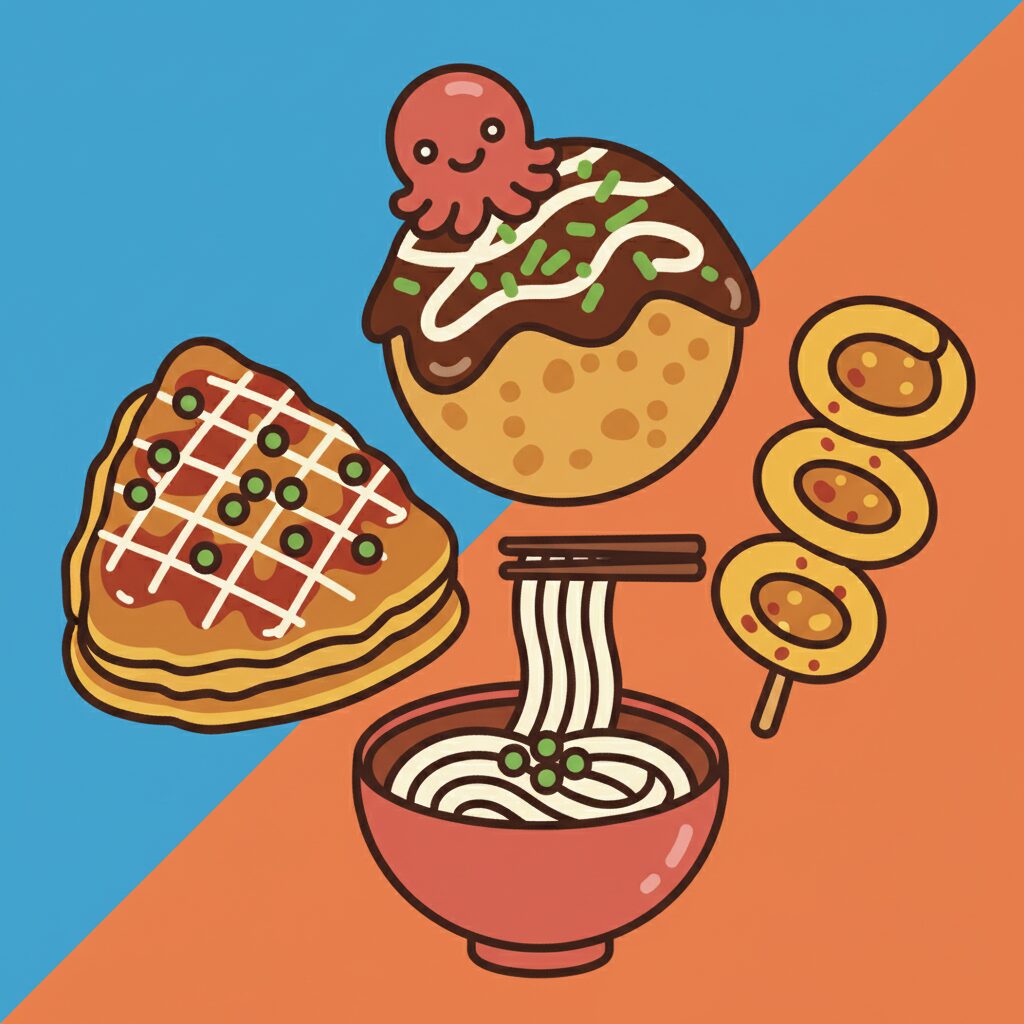
Walk through Osaka at night, and the city speaks to you in a language of sizzles and steam. The scent of savory batter hitting hot iron hangs in the air, a constant perfume rising from the countless takoyaki stands and okonomiyaki joints that line the shotengai arcades and crowded Dotonbori alleys. For the visitor, this is the quintessential taste of Osaka: a quick, delicious, piping-hot snack served up with a flick of the wrist and a hearty “Omatase!” This is the public face of ‘konamon’—the flour-based soul food that fuels Japan’s second city. But what happens when that food goes home? What does it mean when the street stall is swapped for a living room, the vendor for your friend, and the paper boat for a ceramic plate?
This is where the real Osaka reveals itself, far from the neon glow and tourist trails. The true art form isn’t just the food itself, but the social ritual built around it: the ‘Konamon Party,’ or ‘Konapa’ as it’s affectionately known. This isn’t a dinner party in the Western or even the Tokyo sense of the term. It’s louder, messier, more chaotic, and infinitely more collaborative. It’s a window into the Osaka psyche, a place where the city’s famous pragmatism, love of a good deal, and direct communication style all come together on a single, scorching hot plate. To be invited to a konapa is to be invited past the curtain, to see how the city’s boisterous public energy translates into the private sphere. It’s where you stop being a guest and start being part of the action. Forget what you thought you knew from that stall in Namba; the real education begins around a dining table, skewer in hand.
To truly embrace the communal spirit of Osaka’s food culture, you can explore how to practice the city’s famous kuidaore mindset even with mindful or special dietary needs.
From Street Food Staple to Home Court Advantage

In most regions of Japan, specialized cooking equipment is typically kept by enthusiasts. A Tokyo apartment might feature a high-end rice cooker or an elegant single-origin coffee dripper, but it’s unlikely to contain tools dedicated to hyper-regional street food. Osaka follows a completely different logic. Here, these tools aren’t a hobbyist’s indulgence; they are everyday domestic essentials, as fundamental in the kitchen as a microwave or cutting board.
The Ubiquitous ‘Takoyaki-ki’
Enter an Osaka home, and you will almost certainly spot a ‘takoyaki-ki,’ an electric grill dotted with hemispherical molds used for making the city’s iconic octopus balls. It could be a standalone device stored in a cupboard or a removable plate for a larger tabletop hot plate system. Its presence is indispensable. Not having one is like an American household not owning a toaster—a peculiar and somewhat questionable omission. This single appliance reveals everything about the city’s social life. It’s a tool for spontaneous gatherings, a clear sign of readiness. It means, “Friends may drop by anytime, and we’ll be ready to feed, entertain, and do so affordably.”
In Tokyo, if a friend mentions owning a takoyaki maker, it’s treated as a novelty that invites questions like, “Oh, you’re into that?” It’s seen as a quirky, occasional party trick, perhaps used once a year. In Osaka, the only query is, “Gas or electric?” The takoyaki-ki is not reserved for special occasions but for a typical Tuesday night, a lazy Sunday afternoon, or a “we need to use up cabbage and eggs” kind of day. It embodies a culture where hospitality is informal and ongoing rather than planned and formal. This piece of equipment is meant for community and is deeply embedded in the domestic environment.
‘Konamon’ as a Canvas, Not a Recipe
The word ‘konamon’—literally “flour things”—is wonderfully straightforward and unpretentious. It broadly includes takoyaki, okonomiyaki, negiyaki, and numerous other variations. Often the centerpiece of home gatherings is okonomiyaki, the savory pancake whose name means “grilled as you like it.” This phrase encapsulates the entire philosophy. It’s not the strict, rule-bound realm of haute cuisine or the precise ceremony of a tea gathering; it’s culinary improvisation. The basics are simple: a flour-and-dashi batter, heaps of shredded cabbage, and some kind of protein. Beyond that, it’s open to interpretation.
What’s in the fridge shapes the dish. Leftover pork belly? In it goes. Some squid? Perfect. Kimchi, cheese, mochi, corn, tempura scraps (tenkasu)? Absolutely. An Osaka konapa is a masterclass in creativity and practicality. The debate isn’t over authenticity; it’s about what works. Does adding mountain yam (nagaimo) make the batter fluffier? How finely should the cabbage be chopped for ideal texture—a crisp crunch or a blended softness? These are passionate, lively, and lighthearted debates around the hot plate. It’s a meal born from pragmatism—a way to transform inexpensive, humble ingredients into something communal and truly satisfying. It’s not about rigidly following a recipe; it’s about using the recipe as a springboard for a delicious dialogue.
The Social Grammar of a ‘Konapa’
A dinner party in Tokyo typically follows a familiar routine. The host prepares the meal in the kitchen and serves carefully arranged dishes to guests who sit politely at the table, their main role being to eat, appreciate, and engage in conversation. An Osaka konapa dismantles this routine. The kitchen is only used for preparation; the real excitement takes place in the center of the room, around a communal hot plate that serves as both stove and stage. This isn’t a meal you receive; it’s an event you actively take part in.
Everyone’s a Chef, Everyone’s a Critic
From the moment you arrive, you are implicitly part of the production team. You might be handed a bowl and whisk to mix batter, a knife to chop scallions, or a bag of octopus to portion out. Passive observation isn’t an option. The layout—with everyone gathered in a circle around the heat source—obliterates the distinction between host and guest. You’re all in it together, a team brought together for the sole purpose of creating and consuming large amounts of grilled batter. As the hot plate sizzles, social roles emerge naturally, not by assignment. There’s often a self-appointed ‘yaki-bugyo,’ the grill magistrate, who manages the process, offering unsolicited but usually accurate advice on flipping times and oil distribution.
Someone plays the experimenter, trying out a rogue ingredient in the takoyaki mold. Another insists on the classic mix of octopus, pickled ginger, and green onion. You, the newcomer, will be handed a pair of long bamboo skewers and encouraged to try flipping the takoyaki—a deceptively tricky move that involves rotating the batter-filled sphere 90 degrees to cook the other side. Your first attempts will be awkward, misshapen, maybe even disastrous. Everyone will laugh—not at you, but with you. This shared activity, this collective, low-stakes battle against physics and hot oil, acts as a powerful social glue. It’s impossible to keep a polite distance when everyone leans over the same hot surface, focused on the same simple, tangible goal. Small talk gives way to practical talk: “Is it ready to flip?” “Pass the sauce.” “Don’t burn that one!”
The Unspoken Rules of the Grill
Though chaotic, the konapa follows its own internal logic and etiquette. It’s a dance of spatial awareness and shared responsibility. You learn to claim your space on the grill without being greedy. You master the subtle art of the takoyaki flip—a moment of personal triumph that earns quiet nods of approval. There’s a friendly but clear competition over whose takoyaki can be the most perfectly spherical, golden-brown outside with a molten interior. Feedback is immediate and unfiltered. A Tokyo friend might offer a gentle, noncommittal “Oishii” (delicious) regardless of the result. An Osakan friend will examine your lopsided creation, poke it with their skewer, and say, “You hesitated on the flip. More confidence next time,” before demonstrating the proper wrist motion. This isn’t rude; it’s helpful. It’s a sign of inclusion. They care enough about your takoyaki skills to offer honest critique. This directness is characteristic of Osaka communication. The aim isn’t to maintain a fragile, superficial harmony, but to engage sincerely, share knowledge, and collectively enhance the experience for everyone. The teasing, critiques, and loud debates over toppings are all part of the flavor.
How ‘Konamon’ Explains the Osaka Psyche

Why flour? Why such a fixation on this modest ingredient? To grasp the deep cultural significance of konamon is to grasp the historical and economic essence of Osaka itself. This was Japan’s merchant capital, the “nation’s kitchen,” a city founded on trade, pragmatism, and a healthy skepticism toward the lofty formalities of the political capital, Edo (now Tokyo). This legacy is baked into every bite of okonomiyaki.
‘Cospa’ Culture and the Logic of Flour
No concept is more central to the Osaka mindset than ‘cospa,’ short for “cost performance.” It’s a relentless, nearly religious pursuit of maximum value for minimal expense. Osakans take pride in their knack for spotting bargains and getting the most bang for their yen, whether buying electronics or ordering lunch. Konamon is the undeniable champion of cospa cuisine. Flour, water, cabbage, an egg, a few scraps of meat—these are among the cheapest ingredients available. Yet, with a hot plate and some camaraderie, they can be transformed into a meal that is both incredibly satisfying and endlessly entertaining. A konapa can feed a dozen people for the price of a couple of movie tickets.
This sharply contrasts with the potential aesthetics of a gathering in Tokyo. A Tokyo home party, if held, might lean toward curated elegance: a selection of natural wines, artisanal cheeses, or perhaps a beautifully arranged sashimi platter from a depachika food hall. The focus often lies on presentation, rarity, and showcasing a certain level of taste. The Osaka konapa is a joyful rejection of such values. The worth lies not in the prestige of the ingredients but in the shared abundance and the collective act of creation. It is the ultimate expression of rational, egalitarian fun. Why spend a fortune on something fancy when you can have a better time for less money? This fundamental question Osaka asks, with konamon as its delicious answer.
Communication, Osaka-Style: Direct, Messy, and Delicious
The konapa serves as a perfect metaphor for Osaka’s communication style. While Tokyo’s social interactions often prioritize indirectness, reading the air (kuki wo yomu), and maintaining surface-level harmony (tatemae), Osaka values directness, honesty (honne), and straightforwardness. The messy, collaborative, and sometimes argumentative process of making okonomiyaki together reflects this. There’s no room for ambiguity when deciding if the batter needs more dashi or if a pancake is on the verge of burning. You must speak up, share your opinion, and engage in the debate.
This can initially shock outsiders, including foreigners and Japanese from other regions. The rapid-fire teasing, blunt feedback, and general volume can feel abrasive. But interpreting it as aggression misses its true purpose. In Osaka, this direct interaction is a form of intimacy. It’s a way of saying, “I see you, I hear you, and I’m comfortable enough with you to be my unfiltered self.” Being corrected on your flipping technique isn’t an insult; it’s a lesson from a friend. Arguing over whether to add cheese isn’t a conflict; it’s a collaborative problem-solving session with a delicious outcome. The konapa teaches you to embrace this messy, honest, and ultimately more effective form of human connection. It shows that true harmony isn’t about avoiding disagreement but working through it with a shared goal and a sense of humor.
Surviving (and Thriving at) Your First ‘Konapa’
So, the invitation arrives. It might come as a casual message: “Doing takoyaki on Saturday, you in?” Your response should be an enthusiastic yes. This is your ticket to the real experience. But what should you do? How do you navigate this delicious chaos without embarrassing yourself? The good news is, it’s nearly impossible to fail, because the only real expectation is your participation.
What to Expect and How to Participate
First, relax. No one expects you to be a konamon expert. In fact, your beginner status adds to the fun for everyone else. Your clumsy attempts with the skewers will become a source of shared laughter and a chance for your new friends to become teachers. The most important thing is to show a willingness to try. Grab a skewer. Make a mess. It’s your effort, not your skill, that counts. When it comes to contributions, keep it simple. Your host provides the main event. Your role is to bring supplementary items. A six-pack of beer or a bottle of shochu is always a well-received and appropriate choice. If you want to bring food, think of it as adding a new color to the painters’ palette. A block of cheese, a bag of chips to snack on while the grill heats up, or even an unexpected ingredient like avocado or pepperoni can make you a hero. Avoid bringing a complicated pre-made dish; that misses the point entirely. The point is to cook together.
Embrace the noise and energy. A konapa is never a quiet gathering. Multiple conversations will happen at once, with loud exclamations and plenty of laughter. Don’t be shy. Ask questions. Share your thoughts on the cheese-to-batter ratio. Compliment someone’s perfectly flipped okonomiyaki. Most importantly, laugh at your own mistakes. When your takoyaki collapses or sticks to the grill, the best reaction is a loud groan and a smile. This shows you understand the spirit of the event: it’s about connection, not perfection.
The Real Invitation
When you leave a konamon party, you’ll take away more than a full stomach and the faint scent of cooking oil on your clothes. You’ll gain a fundamentally clearer understanding of Osaka. You’ll have experienced the city’s famous friendliness not as a vague stereotype, but as an active, participatory phenomenon. It’s a warmth that goes beyond a smile and a hello; it involves pulling you into the circle, handing you a tool, and making you part of the team. An invitation to a konapa is a meaningful gesture. It means you have crossed a social threshold. You are no longer just a coworker, neighbor, or foreign acquaintance. You are being welcomed into the inner circle of Osaka life—a space that is messy, unpretentious, loud, and incredibly warm. Here, food is not merely sustenance, but the very medium of friendship. And in that moment, when you finally master the perfect takoyaki flip and your friend gives you a congratulatory slap on the back, you’ll realize you’re not just eating in Osaka—you’re truly starting to live here.