
Walk into a business meeting in Tokyo, and you’ll feel the air. It’s crisp, it’s starched, it’s silent except for the rustle of papers and the polite, measured tones of negotiation. The unspoken rule is that seriousness equals respect. Business is a solemn affair, a ritual of exchanging business cards, bowing at precise angles, and sticking to the agenda. Now, take the Shinkansen two and a half hours west and step into a meeting in Osaka. The air is different. It’s electric, it’s buzzing, and it’s punctuated by… laughter? A sales manager makes a joke about his own receding hairline. The CEO of the client company retorts with a witty comeback about the sales manager’s garish tie. For a moment, it feels less like a corporate negotiation and more like a live comedy show. A foreigner, accustomed to the rigid decorum of Japanese business, might feel a jolt of culture shock. Is this a real meeting? Are these people serious about their work? The answer is a resounding yes. In Osaka, they’re just serious in a completely different way. Here, humor isn’t a distraction from business; it’s a fundamental part of how business gets done. It’s a tool, a strategy, and a language all its own. For anyone looking to live or work in this dynamic city, understanding this unique approach to communication is not just helpful—it’s essential. It’s the key to unlocking the true nature of Osaka’s commercial soul, a soul built not on stiff formality, but on the very human art of the shared laugh.
To truly grasp this unique business culture, it’s also insightful to understand the underlying principles of Osaka’s daily life.
The Merchant’s Smile: Why Humor is Hardwired into Osaka’s DNA
To understand why an Osaka boardroom can resemble a comedy club, you need to look back centuries. Tokyo, or Edo as it was known, was a city of samurai and bureaucrats, built on hierarchy, rules, and strict social structures. Osaka, by contrast, was Japan’s kitchen—the commercial center where merchants, the shōnin, held sway. For a merchant, success wasn’t about obeying a feudal lord’s orders; it was about building relationships, reading people, and closing deals. In this world of fluid negotiations, having a good product wasn’t enough. You also needed charm, wit, and the skill to make a quick personal connection.
Humor became the ultimate social lubricant, the fastest way to break down formal barriers and see the real person beneath the stoic business facade. A well-timed joke could disarm a tough negotiator, create a bond of familiarity, and transform a transactional interaction into a lasting partnership. This tradition continues today. An Osaka businessperson uses humor to signal, “We’re all human here. Let’s drop the pretense and find ways to help each other.” It’s a method of bypassing the stiff tatemae (public facade) and getting to the honne (true feelings), where genuine business unfolds.
Think of it as a conversational shortcut to trust. In Tokyo, trust develops gradually through proven reliability and strict adherence to protocol. In Osaka, trust can ignite instantly with a shared laugh. It signals that you’re on the same wavelength, adaptable, and that you value human connection as much as the numbers on a spreadsheet. That’s why the first few minutes of a meeting in Osaka are so important; they’re not about jumping into the agenda but about the warm-up—the banter, the lighthearted teasing—that lays the groundwork for a cooperative rather than confrontational negotiation.
Deconstructing the Deal: The Anatomy of an Osaka Business Joke
Osaka’s business humor isn’t mere random silliness; it’s a well-structured art form with its own rules and classic techniques. The most renowned of these is the dynamic of manzai, the traditional Japanese stand-up comedy style that is almost like a religion in Osaka. It features two performers: the boke (the funny one who says something absurd or incorrect) and the tsukkomi (the straight man who sharply corrects him, often with a light smack). This rhythm is deeply woven into everyday conversation and is frequently seen in the workplace.
The Boke and Tsukkomi Playbook
In a business setting, the smacking is purely figurative, but the verbal exchange is the same. A senior manager (buchō) might offer an overly optimistic sales forecast, acting as the boke. A trusted subordinate then takes on the tsukkomi role, responding with something like, “Buchō, at that pace, we’ll be bigger than Toyota next year! Are you sure those numbers are accurate?” Everyone laughs, the tension eases, and the manager can present the real, more modest figures. The initial exaggeration isn’t an error; it’s a deliberate act meant to open the floor for lighthearted interaction. This collaborative dance reflects a team comfortable and close enough to joke even about serious matters.
The Power of Self-Deprecation
Another cornerstone of Osaka humor is jigyaku, or self-deprecation. While humility is respected throughout Japan, Osaka raises it to another level. Bragging is seen as tasteless; instead, people elevate themselves by humorously putting themselves down. For example, a business owner welcoming a new client might say, “Welcome to our tiny, messy office! Sorry it’s not as fancy as yours.” This isn’t a true apology but a strategic move that makes the speaker appear humble and approachable, inviting the client to respond with praise, like, “Not at all! Your company has a fantastic reputation.” This simple exchange immediately creates a warm, non-threatening atmosphere. Likewise, if someone slips up during a presentation, they might slap their own forehead and say, “Ah, my brain must still be on vacation!” This kind of proactive self-criticism diffuses awkwardness and makes the person more relatable.
The Strategic Pun
A final, often groan-inducing, device is the dajare, or pun. While puns are regarded as the lowest form of humor in many cultures, in Osaka business circles they serve a clear purpose. Dropping a simple pun isn’t about comedic brilliance; it signals that you don’t take yourself too seriously. It’s a subtle way to be playful and break the formal mood. When a colleague makes a terrible pun and everyone groans with a smile, it creates a shared moment that bonds the group. It’s the conversational equivalent of a friendly nudge, reminding everyone that work doesn’t have to be all somber and serious.
The Laughter Litmus Test: Reading the Room in Real Time
In Osaka, humor frequently serves as a diagnostic tool. It’s a method to gauge the atmosphere, test the adaptability of a potential partner, and collect information without posing direct questions. A reaction to a joke can reveal more than an entire page of a business proposal. When an Osaka negotiator makes a lighthearted remark early in a meeting, they observe the response very closely. It acts as a litmus test for the relationship ahead.
Picture a situation where an Osaka-based supplier is meeting a potential new client from a notoriously strict Tokyo corporation. The Osaka manager might start with, “Wow, thanks for coming all the way down here. We were worried that the famed Tokyo efficiency meant you’d just do this over a video call!” This is a gentle tease, a classic Osaka versus Tokyo stereotype. The reaction is crucial.
The Positive Signal
If the Tokyo client laughs and joins in, perhaps replying, “Well, we heard the takoyaki is better down here, so we had to come check for ourselves,” it’s a strong green light. This response suggests they aren’t a typical, rigid Tokyoite. They are flexible, possess a sense of humor, and are open to cultivating a genuine relationship. The Osaka team can relax, feeling free to speak more openly and develop rapport on a personal level.
The Warning Sign
If, on the other hand, the client responds with a blank look, a nervous cough, or a terse, “Let’s stick to the agenda,” it’s an immediate red flag. This indicates that the person is either uneasy with this communication style or is purposefully keeping a formal distance. The Osaka team will immediately adjust their approach. The jokes will cease, the tone will become more formal, and the negotiation will proceed strictly by the book. The attempt at humor wasn’t a failure; rather, it was a successful information-gathering mission. They now understand exactly what type of negotiation they are facing.
This is why foreigners often feel confused. The initial banter may seem like wasted time, but for an Osaka businessperson, it is the most valuable part of the meeting. It’s where they evaluate the character of their counterpart and determine the overall strategy for the rest of the interaction.
The Foreigner’s Field Guide: How to Survive and Thrive in Osaka’s Humor Culture
For a non-Japanese individual, navigating this environment can feel like stepping onto a minefield. The fear of saying something inappropriate or misinterpreting a joke is very real. The key to success is not to try to become a comedian overnight, but to become a skilled audience member. Your role is to appreciate, not to perform.
The Don’ts: Common Pitfalls to Avoid
First and foremost, avoid initiating humor, especially early in a business relationship. The nuances of what’s funny and what’s offensive are incredibly subtle and deeply tied to cultural context. A joke that works perfectly between two Osakans might come off as rude or just plain strange coming from a foreigner. The risk of getting it wrong is simply too high.
Never joke about someone’s incompetence, even if they frequently make self-deprecating jokes about it themselves. When they say, “I’m terrible at this,” it’s a performance of humility. Agreeing by saying, “Yes, you do seem to be struggling,” crosses a major line. Instead, your role is to disagree and offer a compliment: “Not at all, I think you’re doing a great job!”
Be very cautious about sensitive topics. Joking about a person’s age, appearance, family, or regional stereotypes (unless you are repeating a joke an Osaka person just made about Tokyo) is off-limits. Humor should be a bridge, not a weapon. Stick to safe, lighthearted subjects.
The Do’s: Your Strategy for Success
Your most powerful tool is a receptive smile. When a joke is told, your positive reaction is your contribution. Laugh along, nod, and show that you appreciate the effort to create a friendly atmosphere. This signals that you are culturally aware and easy to work with. You don’t need to grasp every layer of the pun; just understand the intent behind it.
Learn to recognize the performance. When your counterpart dramatically exclaims, “Mō akimasen wa!” (“It’s hopeless! We’re finished!”), observe their face. Is there a twinkle in their eye? A slight smile? They are probably not declaring bankruptcy. This is Osaka-style dramatic flair, a way to emphasize a challenge before triumphantly revealing the solution. Don’t take the words literally; read the energy in the room.
If you want to participate genuinely, the safest way is through self-deprecation. A lighthearted joke about your own struggles with the Japanese language or confusion over a local custom is almost always safe. For instance, “I tried to order coffee this morning and accidentally asked for a carp. My Japanese still needs work!” This shows humility and makes you relatable, hitting all the right notes of Osaka-style communication.
More Than Just Meetings: How Humor Permeates the Workday
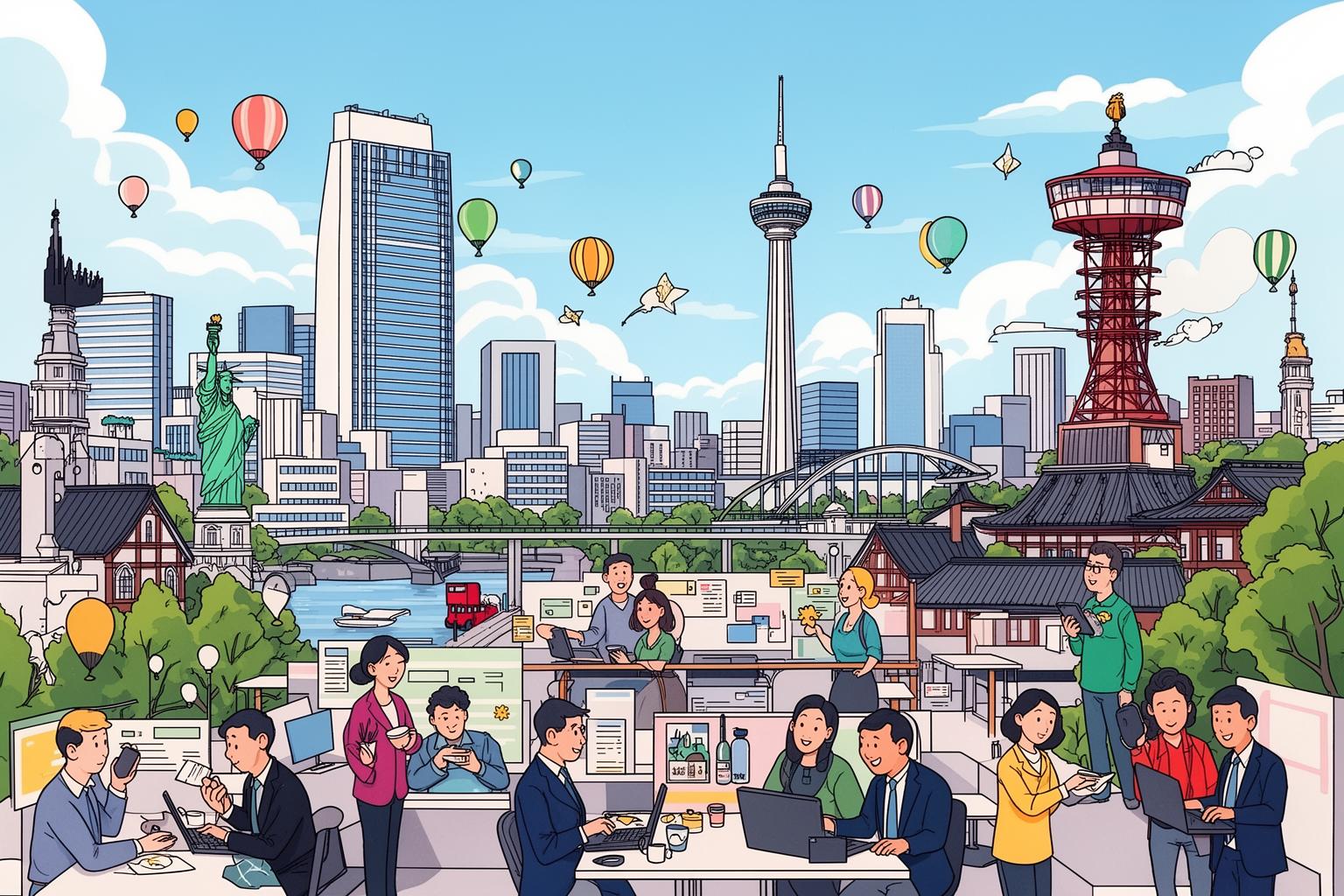
This culture of humor is not limited to client-facing negotiations; it permeates the very atmosphere of many Osaka offices. It influences internal team dynamics, management approaches, and the overall workplace vibe. In a typical Tokyo office, the predominant sound is the quiet tapping of keyboards, with a strong focus on individual work. In contrast, in an Osaka office, you’re more likely to hear bursts of laughter and lively exchanges between desks.
A manager might deliver constructive criticism with a joke to soften the impact. Instead of saying, “Your report had several typos,” they might say, “Hey, were you writing this report after a few highballs last night? I found some creative spelling!” The point gets across, but the tone remains supportive rather than accusatory. This creates an environment where people feel less afraid to make mistakes and more open to communication.
This attitude extends beyond the office as well. The nomikai, or after-work drinking party, is not merely an optional social gathering; it is a vital part of the workplace culture. Here, professional hierarchies loosen further, allowing jokes and stories to flow freely. Over plates of grilled skewers and beers, team bonds truly strengthen. Sharing laughter about the day’s challenges helps transform a group of colleagues into a united team.
For those coming from a more reserved work culture, this can be an adjustment. The boundary between “professional” and “personal” becomes much more blurred. Yet for many, it fosters a more human, less stressful, and ultimately more enjoyable work environment. It’s a culture that understands people perform best when they feel connected, comfortable, and yes, even happy.
Ultimately, the strategic use of humor in Osaka’s business world mirrors the character of the city itself. It is a city that values pragmatism over protocol, relationships over rules, and a hearty laugh over a silent, stoic nod. It may seem confusing at first—a chaotic medley of punchlines and witty remarks. But once you learn to listen closely, you realize it’s not chaos at all. It is a highly refined form of communication that emphasizes the human element in every interaction. For any foreigner seeking to understand how Osaka truly operates, appreciating this rhythm is the crucial first step. It’s about realizing that in this city, the most effective business tool isn’t always a sharp suit or a flawless presentation—sometimes, it’s simply a really good joke.