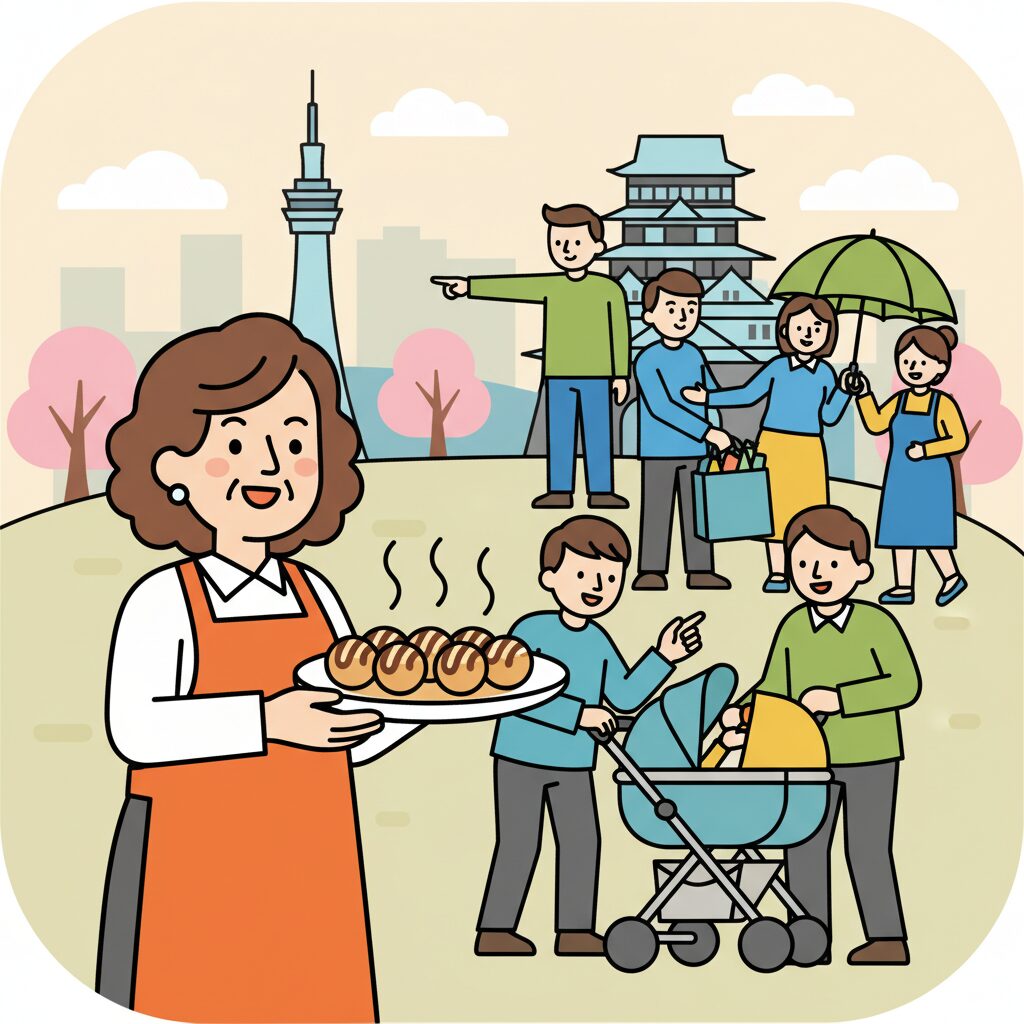
The first time it happened, I froze. I was standing in a small, family-run fruit shop deep in the labyrinthine Tenjinbashisuji Shotengai, trying to decide which mikan oranges looked best. The air was thick with the sweet scent of strawberries and the damp, earthy smell of the tiled floor. Suddenly, the shopkeeper, a woman with a perm as tight as a ship’s knot and a voice that could cut through the market chatter, abandoned her post behind the register. She marched right up to me, peered into my basket, then looked me up and down. “Just those?” she asked, her voice a friendly bark. “You’re too skinny! You need more vitamins. Are you eating properly? You’re not from around here, are you?” My mind raced. Was I being judged? Was my fruit selection somehow inadequate? In the sterile, silent supermarkets of other cities I’d lived in, the only interaction was the beep of the barcode scanner. This was something else entirely. This was my introduction to the beautifully complex, often misunderstood, and quintessentially Osakan concept of osekkai.
Often translated with the slightly negative connotations of “nosiness,” “meddling,” or “being a busybody,” osekkai in Osaka is a different beast altogether. It’s a form of proactive, unsolicited kindness, a social glue that holds neighborhoods together. It’s the human algorithm of the city, constantly running in the background, making connections and checking on the welfare of those around it. It’s a culture shock for many, a stark contrast to the polite distance often found in Tokyo and the reserved individualism of many Western cultures. To truly understand what it feels like to live in Osaka, you have to decode this unique social language. It’s not just about friendly shopkeepers; it’s a window into the city’s soul, a place where community isn’t just a concept, but a daily, vocal practice. This is the world of the Osaka markets, where a simple purchase can turn into a conversation, a consultation, and a genuine human connection.
To fully appreciate this unique social fabric, it’s essential to explore the distinct character of Osaka’s local markets, where daily life and community truly intersect.
What Exactly is ‘Osekkai’? A Word Beyond Nosiness
To understand Osaka, you first need to come to terms with the dual nature of the word osekkai (お節介). In a typical Japanese dictionary, and in the perception of many Tokyo residents, it carries a somewhat negative connotation. It suggests someone who meddles where they aren’t wanted, offering unsolicited advice or help. It implies overstepping a boundary, a social misstep in a culture that often values non-interference. If you tell someone in Tokyo, “You’re being osekkai,” it’s a clear and often sharp reprimand meaning “mind your own business.” But here, amid the lively, bustling streets of Osaka, the word takes on a cultural flip. It sheds its negative charge and becomes a term of affection, a symbol of communal pride. Here, osekkai is care made audible—a form of love expressed with a generous helping of unsolicited advice.
The Dictionary vs. The Reality
The gap between the dictionary definition and the reality in Osaka reflects a vast cultural divide. In Osaka, osekkai is grounded in the belief that being part of a community entails responsibilities, including looking out for one another, even if it requires being a bit assertive. It’s a social safety net woven from casual conversations and curious questions. This isn’t intrusion for gossip’s sake; it’s gathering information to safeguard the collective well-being. The shopkeeper isn’t simply nosy; she’s conducting a quick, informal wellness check. This mindset contrasts sharply with the frequently upheld principle of kikubari (気配り) elsewhere in Japan, which focuses on silently anticipating others’ needs and acting discreetly. Osaka’s osekkai throws subtlety to the wind. It’s loud, direct, and unapologetically present. It assumes if you appear to need help, you probably do, and waiting to be asked wastes precious time.
The Anatomy of an ‘Osekkai’ Interaction
An osekkai exchange is a lesson in social diagnostics, disguised as casual conversation. Take the interaction with the fruit-stand owner: every seemingly random question serves a clear purpose and follows a script perfected through generations of market chatter.
First, the initial observation: “Just those? You’re too skinny!” This isn’t a personal critique of your body. It’s a typical Osaka icebreaker, a hook to spark a reaction and open dialogue. It immediately sets a familiar, almost familial tone. She’s not a corporate worker; she’s a neighborhood auntie.
Next come the diagnostic questions: “Are you eating properly? You’re not from around here, are you?” This phase collects information. The first question directly addresses your well-being. The second aims to place you within the community. If you’re a tourist, you receive one kind of advice. If you’re a student living alone for the first time, it’s another. If you’re a new family in the area, the guidance shifts again. Your answers help the shopkeeper tailor her response. This isn’t idle curiosity; it’s a purposeful effort to provide relevant support.
Finally, the prescription: “You need more vitamins. Here, try one of these. On the house.” This is the payoff. The conversation isn’t mere talk but leads to a concrete act of kindness. It might be a piece of fruit, a discount, or essential advice. Perhaps you’re buying fish, and after similar questions, the fishmonger shares the best way to grill that mackerel and includes some ginger for free. The osekkai cycle completes itself: Observation, Diagnosis, Action. This rhythm of care defines daily life in these markets.
The East Asian Connection
Having grown up immersed in Chinese culture, this Osakan trait feels both foreign and deeply familiar. It echoes the concept of rènao (热闹), describing a lively, bustling atmosphere where human interactions are vivid and loud. Many Chinese communities share a similar culture of communal care, where neighbors share a degree of responsibility for each other. Your affairs are, to some extent, their affairs. Yet the Osakan expression is unique. It is infused with distinct humor and a merchant’s pragmatism. It lacks the hierarchical respect that sometimes characterizes other East Asian social interactions. In Osaka, a vegetable seller and a university professor can engage in the same direct, teasing banter. It’s a democratized form of caring, where everyone is fair game for friendly meddling, creating a strong sense of horizontal community—a feeling that everyone is in this together, on equal footing.
The ‘Shotengai’ as the Stage for ‘Osekkai’
To witness osekkai in its natural environment, you need to explore a shotengai, the traditional covered shopping arcades winding through Osaka’s neighborhoods. These spaces are more than mere commercial areas; they are the community’s lifeblood. Places like the expansive Tenjinbashisuji, Japan’s longest shopping street, or the tourist-famed Kuromon Ichiba Market, are prime examples, but the true essence of osekkai often thrives in the smaller, local shotengai scattered throughout the city, far from tourist maps. These are the neighborhood’s living rooms, where commerce and community merge seamlessly.
More Than Just Shopping
Visiting a supermarket is a task of sterile efficiency: you enter, buy what you need, pay, and leave. Human interaction is minimized by design. By contrast, a trip to a shotengai is a deeply social experience. Its architecture encourages this. The covered roof shields you from the weather, creating a semi-enclosed public space where people tend to linger. Shops are small and open-fronted, blurring the boundaries between public and private spaces. Shopkeepers are not hidden behind counters; they stand out front, arranging goods, calling out to passersby, and engaging in ongoing conversations with customers and neighbors alike. You don’t just buy tofu; you speak with the tofu maker who has been working there for forty years. You don’t merely pick up fish; you receive the day’s catch report from a vendor whose hands carry the scent of the sea. This setting provides the ideal environment for osekkai to flourish—a place designed for people, not just transactions.
The Merchant Philosophy: ‘Akinai’ and Human Connection
The cultural ethos underpinning the shotengai is rooted in Osaka’s merchant philosophy of akinai (商い). This term is often contrasted with shobai (商売), the more common Japanese word for business. Though both refer to commerce, their implications differ significantly. Shobai tends to denote a straightforward, profit-driven enterprise, while akinai, especially in Osaka’s context, represents a more holistic approach. It implies sustainable business practices based on long-term relationships, trust, and mutual satisfaction. An old Osaka saying captures this well: “Shobai is for profit, akinai is for blessing.”
This mindset explains the shopkeeper’s meddling. From an akinai perspective, your well-being is connected to their long-term success. If they provide quality goods, sound advice, and genuine care, you won’t just return tomorrow—you’ll become a lifelong customer, part of the shop’s community. The osekkai questions are a form of relationship marketing so deeply embedded in the culture that they feel entirely sincere. When a shopkeeper asks if you’re eating well, it’s not mere kindness; it’s a way to ensure her customer base remains healthy and happy. This blend of practical business sense and authentic human compassion is a direct legacy of Osaka’s history as Japan’s merchant capital, where reputation and relationships were the most valuable currency.
Transactions as Conversations
In this world, the line between customer and vendor fades. Purchasing an item opens the door to social exchange, negotiation, and connection. The listed price often serves as a conversation starter. You might receive a discount for buying in bulk, or the seller might include an extra item for free, known as omake. This tradition of omake embodies osekkai: an unsolicited gift, a small gesture to enhance the deal and deepen the relationship. Declining an omake can be seen as a social faux pas, like refusing a handshake. It is more than just receiving a free potato; it’s a reaffirmation of the bond. This ongoing interplay of verbal and material generosity transforms a simple chore into a rich, unpredictable, and deeply human experience—a stark contrast to the silent, frictionless, and impersonal efficiency of a Tokyo department store.
‘Osekkai’ vs. Tokyo’s ‘Enryo’: A Tale of Two Cities
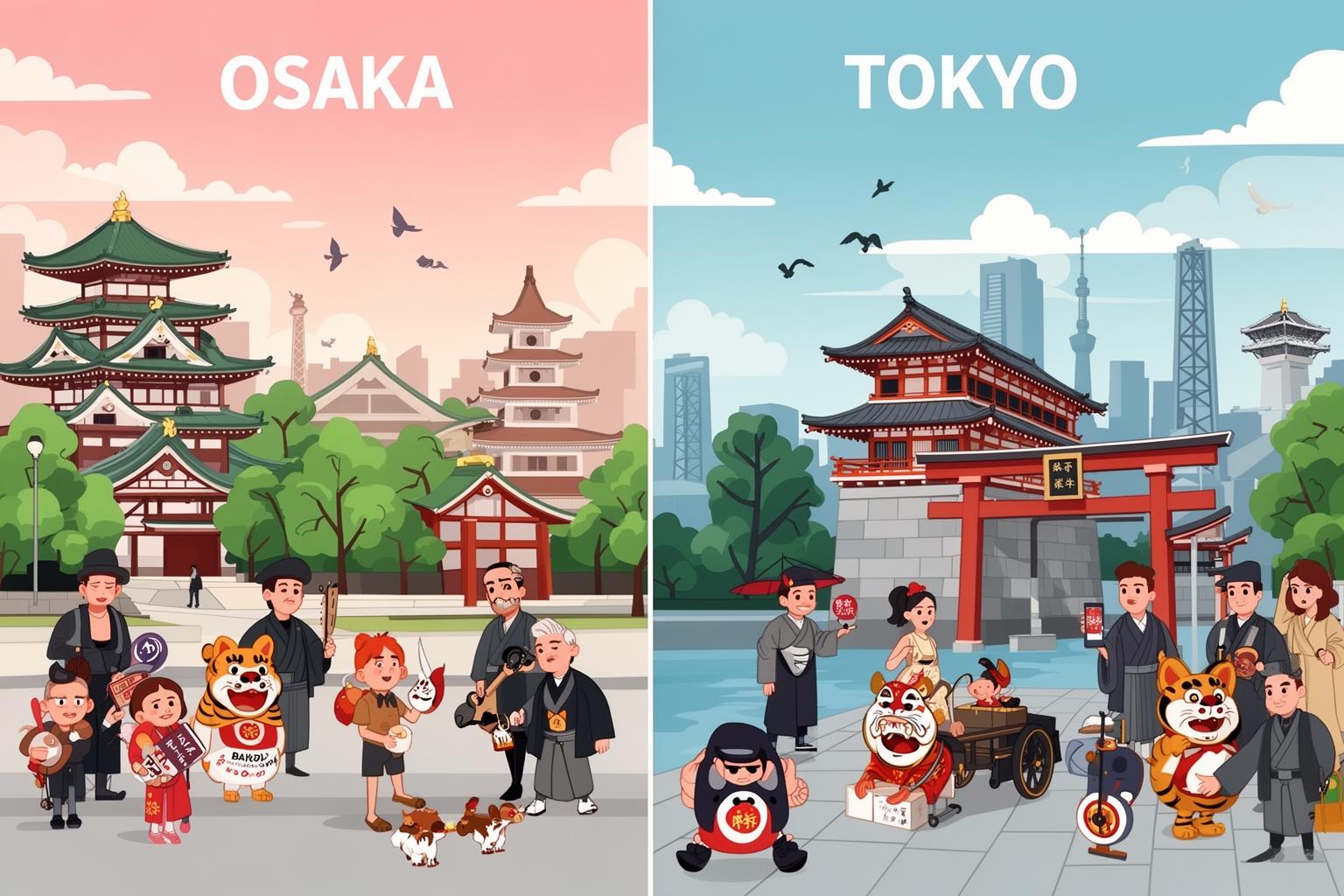
Nowhere is the distinctiveness of Osaka’s osekkai culture more evident than when contrasted with the prevailing social atmosphere of Tokyo. The difference goes beyond accent or demeanor; it represents a fundamental contrast in the philosophy of public interaction. While Osaka’s social framework is based on proactive engagement, Tokyo’s is rooted in a principle of respectful restraint, known as enryo (遠慮).
The Invisible Walls of Tokyo
Enryo is the cultural custom of holding back, exercising restraint out of consideration for others. It centers on not wanting to impose or be a nuisance. In Tokyo, a city with immense population density, enryo serves as a social lubricant, enabling millions to coexist in close quarters with minimal friction. People keep to themselves on the train, avoid speaking loudly on the phone, and maintain a polite but clear distance from strangers. Asking a shopkeeper personal questions—or being asked—would violate this unwritten social contract, seen as rude and invasive. While people are polite and willing to help if asked, the default mode is non-interference. The invisible walls between individuals remain firmly intact. This creates an environment that is orderly, efficient, and predictable, but for some, it can also feel cold or impersonal.
Osaka’s Logic: Silence is Unfriendly
In Osaka, the logic is reversed. Here, those same invisible walls are viewed not as respectful, but as unfriendly. Silence feels awkward; lack of engagement is interpreted as coldness or disinterest. The Osakan approach is to bulldoze those walls with friendly chatter and humor. The aim is to establish a connection as quickly as possible, moving from “stranger” to “acquaintance” in seconds. This is why foreigners often find Osaka overwhelmingly “friendly.” It’s not just about kindness; the social barriers are practically nonexistent. Attempts to engage are almost always met with enthusiasm. To remain distant, adopting a Tokyo-style enryo, can be perceived as aloof or even arrogant. The social expectation is to participate, to banter, and to be actively present in public.
Practical Examples of the Divide
This difference appears in many everyday scenarios. Imagine you’re lost in the complex Shinjuku Station in Tokyo and ask a station attendant for directions. You’ll likely receive a polite, efficient, and precise set of instructions. The exchange will be professional, concise, and end as soon as your problem is resolved. Now picture the same situation at Umeda Station in Osaka. Upon asking for directions, you might first hear a loud, “Eh? You’re going there? Why?” This isn’t a challenge but an invitation. What follows could be a lively discussion with a passerby about the best route, questions about your final destination, a strong recommendation for a must-try takoyaki stand, and a detailed, hand-drawn map. The person might even accompany you partway, chatting about their nephew who studied abroad in your country. The goal is not just to solve your problem but to create an interaction.
Consider another example: you’re in a clothing store. In Tokyo, staff will greet you and then maintain a respectful distance, ready to assist if you signal them. In a shop in Osaka’s Amerikamura, staff are more likely to approach you directly. “That looks great on you! But you know what would look even better? This one! Try it on! No, really, just try it! What size are you?” The approach is proactive, almost aggressive, but driven by genuine enthusiasm. It’s osekkai in a retail setting. For some, it may be overwhelming; for others, it’s a welcome change from feeling invisible.
Navigating ‘Osekkai’ as a Foreign Resident
For someone new to Osaka, especially from a culture that highly values personal space and privacy, the initial encounters with osekkai can be quite startling. The continuous flow of questions, unsolicited advice, and casual physical touches—like a shopkeeper’s pat on the back—may all feel like an invasion of personal boundaries. It’s easy to misread this behavior as rude, judgmental, or condescending. For many foreign residents in Osaka, the experience involves gradually adjusting their social expectations and learning to interpret this unfamiliar expression of care.
The Initial Shock: Is This Rude?
My first few months in Osaka were filled with confusion and occasional unease. When the butcher asked if I was cooking for a boyfriend, was he criticizing my single status? When an elderly woman at the bus stop said my scarf wasn’t warm enough, was she questioning my judgment? The natural reaction is to become defensive and erect barriers to protect your privacy. You might respond with short, clipped answers to cut the conversation short. However, in Osaka, this often has the opposite effect. Your reserve might be read as sadness or trouble, leading to even more osekkai as people try to understand what’s wrong and how they can help. Early on, living in Osaka means unlearning the assumption that a stranger’s interest in your life is automatically suspicious. It takes a leap of faith to accept that the intent behind such intrusions is almost always kindness.
How to Respond: Embrace the Banter
Learning to handle osekkai doesn’t mean giving up your privacy; rather, it means mastering a new cultural dance. It’s an interactive game. The key is to engage, but on your own terms. You don’t need to share your entire life story. Simple, friendly, and sometimes humorous replies are the currency of these exchanges. When a shopkeeper asks if you’re eating enough, you might laugh and say, “I’m trying! That’s why I’m here buying your delicious vegetables!” This turns a potential grilling into a lighthearted conversation. Think of it as a game of conversational tennis: they serve a personal question, you return it with a friendly, non-committal answer, and maybe toss back a question of your own. “Yes, I’m cooking just for myself tonight. What’s your favorite way to prepare this fish?” This shows your willingness to join the interaction and shifts the focus back to them. Humor is your best ally—Osakans appreciate a good laugh, especially if it’s self-deprecating. Confessing you’re a terrible cook might earn you a laugh, a recipe, and even an extra onion. And as mentioned earlier, when offered an omake (a small gift), always accept it graciously—it’s the final gesture in a successful social exchange, signaling that a connection has been made.
When ‘Osekkai’ Becomes a Lifeline
There will come a time when this “nosiness” evolves from a cultural curiosity to a vital support network. Living abroad can be lonely. You’re far from family, friends, and familiar support systems. In those vulnerable moments, the true value of Osaka’s osekkai culture becomes clear. I remember suffering a bad flu one winter while living alone and too weak to cook. I dragged myself to the local pharmacy, where the pharmacist—a kindly older woman—did more than just sell me medicine. She spent ten minutes asking about my symptoms, living situation, and whether I had anyone to help me. She gave me detailed advice on what to eat and drink. The next day, at the vegetable stand in the same shopping street, the owner saw me and said, “I heard from the pharmacist that you’re sick! You look awful! You should make okayu (rice porridge).” She then selected the best green onions and ginger for me and refused to accept payment. In that moment, the neighborhood’s meddling didn’t feel intrusive; it was a comforting embrace of care. The informal community network had been activated on my behalf. This is the hidden strength of osekkai: it ensures no one is truly anonymous, and no one slips through the cracks unnoticed.
The Future of ‘Osekkai’ in a Changing Osaka
In an era dominated by online shopping, vast Aeon malls, and the quiet efficiency of 24-hour convenience stores, one might wonder about the future of this deeply personal, analog form of social interaction. Is the osekkai culture of traditional markets merely a relic of a bygone age, destined to disappear with the older generation of shopkeepers? Or is it an essential part of Osaka’s DNA, strong enough to adapt and endure in the modern world?
The Supermarket vs. The ‘Shotengai’
The conflict between old and new is evident throughout Osaka. Large supermarkets offer undeniable appeal with their convenience and lower prices. You can find everything you need in one spot without having to speak to anyone. Yet, the shotengai persist. They endure because they provide something supermarkets cannot: a sense of belonging. People continue to support small, family-run shops not just out of habit, but because they appreciate the relationships cultivated over years. They treasure the daily banter, the unsolicited advice, and the feeling of being recognized by name. The shotengai doesn’t just compete on price; it competes on human connection. As long as people crave that personal touch and would rather chat than scan a barcode, the stage remains set for osekkai.
A Fading Art or an Enduring Trait?
It’s true that younger Osakans, raised on the internet and global culture, may show less overt osekkai than their parents and grandparents. The world has changed, and social norms have evolved. Yet, I believe the core spirit of osekkai—its directness, humor, desire to connect, and low barrier to human interaction—is not vanishing. It’s merely shifting in how it expresses itself. You might find it in the way a young barista at a trendy café strikes up a conversation about your day, or in the lively, welcoming vibe of a local standing bar where strangers become friends by evening’s end. The fundamental Osakan urge to break down social barriers and engage with those around them is too deeply rooted to disappear entirely. It is the city’s essential character, its cultural heartbeat.
Why It Matters for Anyone Living Here
For anyone thinking about making a life in Osaka, understanding osekkai isn’t just academic—it’s the key to unlocking the city and finding your place within it. It explains why life here feels so distinct from other parts of Japan. It’s why a sprawling metropolis of millions can, in its best moments, feel like a network of interconnected small towns. Learning to appreciate, and even take part in, this culture of friendly meddling is the final step in moving from visitor to resident. It’s how you go from being an anonymous face in the crowd to “the foreign girl who lives on the third floor, is a terrible cook, but is trying her best.” The day a shopkeeper yells across the street to ask if you remembered your umbrella, you’ll know you’ve truly arrived. You’re no longer just living in Osaka; you’ve become part of its loud, caring, and wonderfully nosy family.