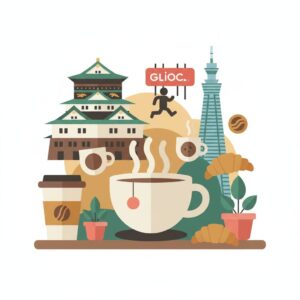
Walk down any given street in Osaka, especially in the early hours, and you’ll notice something. It’s not the neon glow of Dotonbori, not yet anyway. It’s not the rush of salarymen pouring out of Umeda Station. It’s a quieter, more foundational hum. It’s the smell of roasted coffee beans and buttery toast seeping from the doorways of unassuming, often time-worn, little shops. These are Osaka’s ‘kissaten,’ the traditional Japanese coffee houses. And if you really want to understand the heartbeat of this city, you don’t start at the castle or the flashy shopping malls. You start here, with a ‘mōningu sābisu,’ the morning service, or as everyone calls it, ‘mōningu.’ It’s a concept that seems simple on the surface: order a coffee, and for a small, almost symbolic, extra fee—or sometimes for free—you get a breakfast set. Usually, it’s a thick slice of toast, a hard-boiled egg, and maybe a tiny side salad. But to mistake this for a simple breakfast special is to fundamentally misunderstand Osaka. In Tokyo, a cafe is a place you go to do something: to work, to study, to be seen, to grab a precisely crafted latte on the run. It’s a space of transaction and individual purpose. In Osaka, the kissaten ‘mōningu’ is a place you go to be. It’s a communal living room, an unofficial office, a social safety net, and the daily stage upon which the city’s unwritten rules of pragmatism, community, and commerce are played out. It’s where you’ll find the soul of the city, hiding in plain sight, served on a small ceramic plate next to a steaming cup of siphon-brewed coffee. This isn’t just about fueling up for the day; it’s about plugging into the city’s grid, absorbing its rhythm before the noise of the metropolis takes over. It’s a daily ritual that says more about the people of Osaka, their values, and their way of life than any guidebook ever could.
This daily ritual of connection is mirrored in the city’s vibrant nightlife, where the art of Osaka’s ‘hashigo-zake’ bar-hopping offers another window into its communal soul.
The Anatomy of ‘Mōningu’: A Ritual, Not Just a Menu
To those unfamiliar, the morning set might seem like a simple meal. Yet every element, every sensory nuance, is part of a carefully crafted, deeply rooted cultural tradition. It forms a unique language, expressing values that are distinctly Osaka. The ‘mōningu’ is less a mere menu item than a membership card to the local community’s daily rhythm—a subtle acknowledgment that you belong to the neighborhood’s fabric.
Beyond Toast, Egg, and Coffee
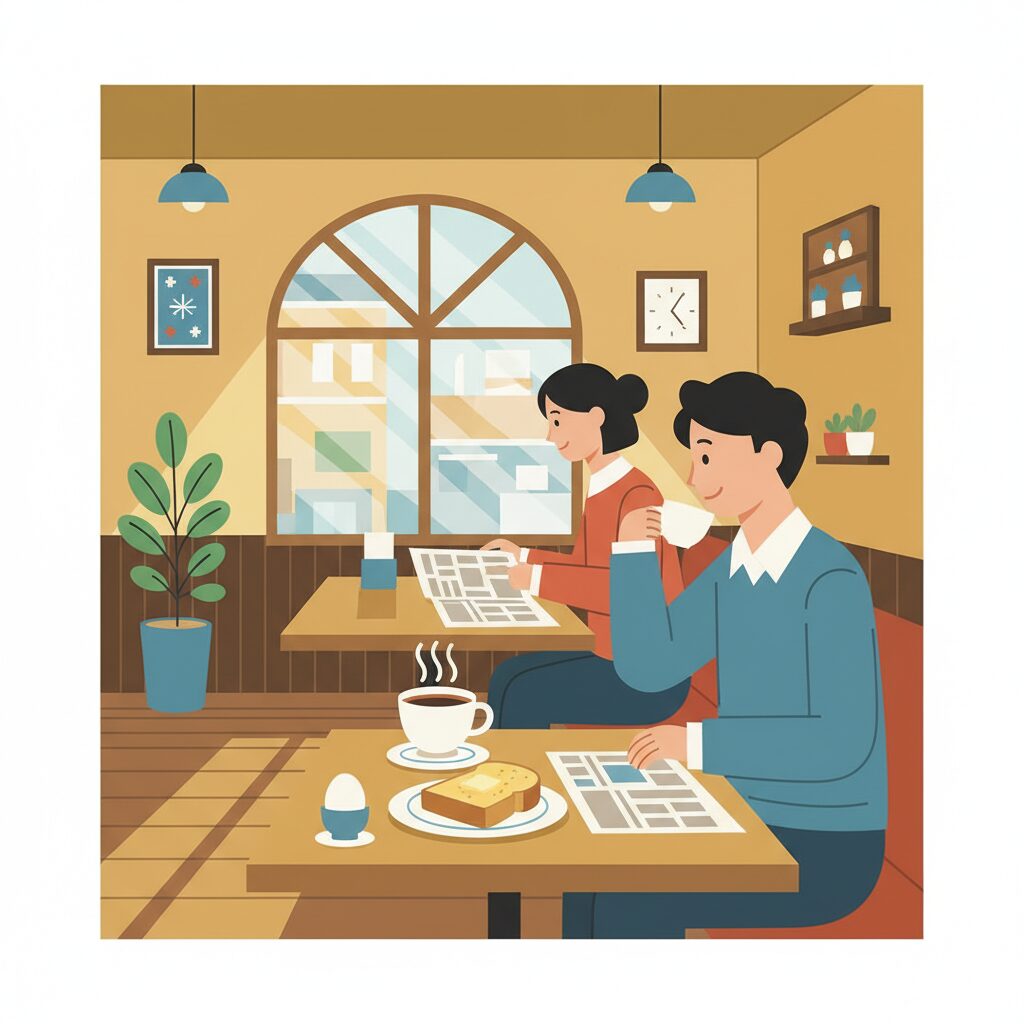
The classic ‘mōningu’ centers on a holy trinity: coffee, toast, and egg. But the charm lies in the details. The coffee is seldom a fancy single-origin pour-over; instead, it’s often a dark, rich blend brewed by siphon or in a large drip batch, crafted to deliver a consistent, comforting kick. This coffee doesn’t invite analysis; it simply invites drinking. It’s a tool, not a trophy. The toast itself deserves admiration. It’s not the fragile pre-sliced bread from a supermarket bag but ‘shokupan,’ the Japanese milk bread, sliced thickly—often over an inch—and toasted to be crisp outside while remaining exquisitely soft and airy inside. Accompanied by a pat of butter or margarine and a small packet of jam, it elevates simple pleasure through texture. The egg is usually a hard-boiled one, or ‘yude tamago,’ served in its shell alongside a small salt shaker. Peeling it yourself becomes part of the ritual, a quiet, meditative start to the day. Occasionally, a small salad joins the plate—a few lettuce leaves, a tomato slice, a cucumber sliver, often dressed with sesame dressing—offering a touch of balance and freshness.
Of course, variations exist. Some cafes serve Ogura toast, a Nagoya specialty adored in Osaka, featuring thick toast covered with sweet red bean paste (‘anko’) and butter. Others might offer a hot dog sandwich, a ‘tamago sando’ (egg salad sandwich), or pizza toast. But the principle remains consistent: a simple, satisfying meal included in the price of a drink. This embodies the essence of Osaka’s mindset: ‘kosupa’ or cost performance. Obtaining a full meal for the price of a coffee (around 400 to 500 yen) represents peak value. To an Osakan, this isn’t just a cheap breakfast; it’s a clever deal, a practical and efficient way to begin the day. It’s not about frugality but smartness. Spending extra on an overpriced, trendy breakfast is seen as wasteful when a perfectly adequate, arguably more fulfilling option is right in a neighborhood kissaten. This pragmatism is woven into the city’s merchant spirit. Every yen has purpose, and the ‘mōningu’ embodies one of the wisest morning investments.
The Soundscape of the Kissaten
Stepping out of the city’s bustle into a kissaten reveals a shift in atmosphere. The acoustics change. It’s not silence but a particular kind of quiet—a woven fabric of soothing, analog sounds. The dominant noises are the gentle clinking of ceramic cups on saucers and the soft scraping of spoons stirring sugar. One hears the quiet rustle of newspapers as elderly men, the ‘jōren’ or regulars, fold and unfold sports and stock market pages carefully. Conversations remain low murmurs, rarely disturbing the serene mood. Behind the counter, the soft hiss of a siphon coffee maker sounds like a comforting science experiment, or the rhythmic thump of the ‘Master’ tamping espresso grounds might be heard. Music often plays but remains in the background—perhaps crackly old jazz, classical radio, or nostalgic Showa-era ‘kayōkyoku’ pop. It’s wallpaper music, intended to soothe rather than dominate.
This soundscape sharply contrasts with a modern cafe, where the loud hiss of a high-powered espresso machine, baristas shouting orders, frantic keyboard clicks, and upbeat indie pop playlists create a lively, high-energy environment. A kissaten, by contrast, offers calm refuge. Its sounds contribute to an environment where one can be alone with their thoughts without feeling isolated. It’s a shared quietude, an unspoken pact to uphold peace. This atmosphere draws many visitors—a place to unwind before the day’s demands, read quietly, or simply gaze out the window as the neighborhood awakens. The soundscape forms a protective bubble against outside pressures.
The ‘Master’: Guardian of the Space
At the center of this ecosystem stands the ‘Master.’ Neither manager nor mere barista, the title ‘Master’ (‘masutā’) reflects the respect and authority held in this small domain. Often older men or women, sometimes couples, the Masters are the kissaten’s heart and soul. They may have run the place for thirty, forty, or even fifty years, witnessing neighborhood changes, children growing up, and regulars passing away. They silently preserve the community’s stories.
The Master’s style of service is an art form. It lacks the loud, enthusiastic ‘Irasshaimase!’ heard in chain stores, favoring instead a quiet nod, a gentle ‘Ohayō,’ a gesture of recognition. For regulars, words often aren’t needed. They take their usual seat, and their customary order—the ‘mōningu’ set with black coffee, no sugar—appears almost magically. The Master knows their tastes, habits, and quirks. This service goes far beyond mere transaction; it’s a relationship built on years of quiet observation and mutual respect. The Master guards the space’s atmosphere, discerning when to exchange small talk and when to leave customers to their thoughts. They are a stable, reliable presence amid constant change. For many, especially the elderly, daily interaction with the Master may be one of the day’s few meaningful social connections. Part social worker, part confidant, part stoic observer, they embody a form of Osaka friendliness often misunderstood—not loud or exuberant, but a deep, quiet familiarity earned over time.
A Tale of Two Cities: Kissaten Culture in Osaka vs. Tokyo
The fundamental differences between Osaka and Tokyo are vividly illustrated when comparing their respective coffee cultures. It’s not merely about taste or decor; it’s about the entire philosophy behind what a public space for enjoying coffee should represent. One focuses on function and fashion; the other centers on familiarity and foundation.
Tokyo’s Cafe Scene: Efficiency, Trends, and a Third Space for Work
In Tokyo, the cafe serves as the ultimate ‘third space’—a neutral zone between home and office. It’s a highly functional setting. Step into a typical Tokyo cafe, whether a major chain like Starbucks or an independent specialty coffee shop in a trendy area such as Kiyosumi-Shirakawa, and you instantly sense a clear purpose. People work on laptops, faces glowing from screen light, typing away. Others hold quick, efficient business meetings, with agendas spread out on small tables. Students cram for exams amid textbooks and highlighters. The design is often sleek, minimalist, and highly Instagram-worthy, featuring clean lines, light wood, and perfect lighting. The coffee is the centerpiece. Baristas are artisans, exchanging tasting notes about single-origin beans from Ethiopia or Colombia. Latte art is almost competitive. The experience is personalized: you order, pay, receive your tailored beverage, and find a small spot to plug in and focus. This environment is crafted for speed, efficiency, and a certain stylish anonymity.
Social interaction is usually limited to the transaction at the counter. People sit close but remain in their own private bubbles, separated by headphones and screens. While these spaces are vital to Tokyo’s lifestyle, offering an escape from cramped apartments and strict offices, they rarely foster deep community connections. They are transient places, designed for a population constantly on the move, working, and striving. The value lies in the quality of the coffee, the speed of the Wi-Fi, and the aesthetic appeal. Essentially, it’s a beautifully designed public utility.
Osaka’s Kissaten: The Community’s Living Room
Osaka’s kissaten embraces an entirely different philosophy. It is not a ‘third space’; for many regulars, it extends their ‘first space’ (home) or ‘second space’ (work). It’s literally the neighborhood’s living room. The decor contrasts sharply with Tokyo cafes. Minimalism is absent; instead, there is comfortable clutter. Dark wood paneling, plush velvet or vinyl chairs, Tiffany-style lamps, and shelves stocked with old manga, newspapers, and trinkets collected over decades. The furniture is often worn, tables may wobble slightly, but that only adds to the charm. The aesthetic aims to be timeless and, above all, comfortable—not trendy. You’re not pressured to be productive here; you’re invited simply to exist.
The patrons reflect the neighborhood’s diversity. Mornings see elderly men gathering at their usual table, solving the world’s problems over sports pages. Local shopkeepers from the nearby shōtengai (shopping arcade) engage in informal chats about business. Housewives take a break after dropping their kids at school. The kissaten serves its immediate community. It’s a place for nurturing relationships, not just conducting transactions. Coffee matters, but it’s secondary to the atmosphere and sense of belonging. Its value lies in consistency, not novelty. You visit a kissaten precisely because it remains unchanged—a stable anchor amid the turbulent flow of modern life. It’s a space designed not for transient individuals but for a permanent community.
The ‘Jōren’: The Unspoken Membership of Regulars
At the heart of the kissaten is the concept of the ‘jōren,’ the regulars. Unlike chain cafes where all customers receive uniform politeness, the kissaten follows a subtle social hierarchy in which the ‘jōren’ are essential. They sustain the business during quiet weekday afternoons and create the cozy, lived-in atmosphere. A newcomer entering a classic kissaten for the first time may feel somewhat like an intruder. All seats might seem unofficially “taken.” The regulars might glance briefly before returning to their newspapers or conversations. This isn’t hostility; it’s simply an acknowledgment that you are new to their space.
The interaction between the Master and the ‘jōren’ is a beautiful exchange. It’s a dance of unspoken cues and shared history. A regular arrives, the Master nods slightly, and the coffee preparation begins without a word. The Master knows whether they take milk, sugar, or both, and whether the regular is in a hurry or can stay awhile. This deep familiarity lies at the core of the kissaten’s charm. For outsiders, it can initially feel intimidating—you may feel like an outsider looking in. But persistence and respectful visits are key. Greet the Master, quietly enjoy your coffee, and leave without causing a fuss. Do this several times, and your face becomes familiar. A nod turns into a quiet “hello.” Over time, you may graduate from customer to ‘jōren’ yourself. It’s a quiet rite of passage, symbolizing not just living in the neighborhood, but truly becoming part of it.
The Economic and Social Bedrock of the Neighborhood

The kissaten is more than simply a spot for a morning coffee; it serves as a crucial institution supporting the economic and social well-being of its community. It embodies a microcosm of Osaka itself—a city grounded in commerce, practicality, and close human connections. Its significance extends well beyond mere hospitality.
‘Shōbai no Machi’: The City of Merchants and Its Morning Ritual
Osaka has long been known as ‘shōbai no machi,’ the city of merchants. Its culture is deeply rooted in a history of trade, finance, and a straightforward approach to business. The kissaten ‘mōningu’ directly descends from this merchant culture. The concept is said to have originated in the textile district of Ichinomiya, just outside Nagoya, where busy factory owners needed a place to hold business meetings over coffee and were offered a simple breakfast as a gesture of good service (‘sābisu’). The idea quickly caught on in Osaka, a city that instantly recognized its practical brilliance. For busy salespeople or small business owners, the kissaten became the go-to morning office. It provided an affordable and efficient setting to meet clients, review documents, and plan the day ahead.
Even today, this tradition is evident. In business districts like Yodoyabashi or Honmachi, kissaten are filled with suited men engaged in quiet, serious discussions. This is where real business happens in Osaka, often outside sterile corporate boardrooms. It centers on ‘ningen kankei’—human relationships. Deals are often finalized not with formal contracts but with handshakes over finished cups of coffee. These bonds are built over many mornings, through casual talk about the Hanshin Tigers or the weather. Business follows naturally from the trust fostered in this neutral, comfortable environment. This pragmatic, relationship-first approach defines Osaka’s business style, and the kissaten stands as its natural home.
A Social Safety Net for the Aging Population
Beyond commerce, the kissaten plays an arguably even more vital role as a social safety net, especially for Japan’s rapidly aging population. For many elderly retirees, particularly those living alone, the daily visit to their local kissaten forms the essential structure of their day. It gives them a reason to get up, dress, and leave the house. It offers a point of human contact in an increasingly isolating world. The morning gathering of ‘jōren’ serves as an informal support group. They exchange news, commiserate about health issues, and simply enjoy each other’s company in a relaxed, low-pressure setting. It is a powerful antidote to loneliness.
The Master of the kissaten often acts as an unofficial community guardian. They know the routines of their elderly regulars deeply. If Mr. Sato, who arrives every morning at exactly 8 AM for his toast and black coffee, fails to show up for a day or two, the Master notices. They may ask other regular customers if they have seen him or even call his home to check if all is well. This informal system has saved lives. It is a quiet, unassuming, yet profoundly important form of community care that operates outside formal government programs. In an aging society, these spaces are not a luxury but a necessity. They stand as a testament to a time when community was built on face-to-face interaction and mutual responsibility.
The Language of the Kissaten: Osaka-ben in Its Natural Habitat
If you want to hear authentic, unfiltered Osaka dialect, or ‘Osaka-ben,’ the kissaten is the best classroom you could wish for. This is where the language is spoken in its most natural, candid form. Forget the polite, standardized Japanese (‘hyōjungo’) of Tokyo or the formal tone of business emails. Here, the language is direct, expressive, and rich with unique, earthy humor. You’ll hear distinctive sentence endings like ‘-nen’ and ‘-yan,’ along with straightforward, almost blunt questions and statements.
For instance, a typical greeting between business acquaintances might be ‘Mōkarimakka?,’ which literally means ‘Are you making a profit?’ In other parts of Japan, this would be considered an intrusive or rude question. But in Osaka, it is a common greeting, akin to saying ‘How’s business?’ or ‘How are things?’ The usual response is ‘Bochi bochi denna,’ roughly translating to ‘So-so’ or ‘Can’t complain.’ This exchange is a linguistic ritual affirming a shared cultural understanding rooted in commerce and pragmatism. You’ll hear banter, jokes, and debates carried out in the lively, rapid pace of Osaka-ben. For foreigners learning Japanese, it can be daunting at first, but listening to these conversations offers an invaluable insight into how local culture operates. It is language stripped of affectation, used for sincere communication and connection rather than mere polite formalities.
Navigating the Unspoken Rules: A Guide for the Foreign Resident
For a non-Japanese resident, a kissaten can often feel like an exclusive club governed by a secret code of conduct. Although they are generally welcoming, grasping the unspoken rules is essential for a positive experience and for truly appreciating their role within the community. It’s less about memorizing a list of dos and don’ts and more about learning to sense the atmosphere and respecting the established rhythm of the space.
To Talk or Not to Talk: Reading the Room
A common source of confusion for foreigners is the expected level of social interaction. Should you try to start a conversation with the Master or the person at the next table? In most cases, the answer is probably no. The key rule is ‘kūki o yomu,’ or ‘read the air.’ Pay attention to the general mood of the room. Most customers in a kissaten are engaged in their own routine—reading, thinking, or quietly chatting with a companion. Disrupting this calm is usually frowned upon. The social agreement here is one of shared space, not enforced interaction. The ‘friendliness’ of Osaka doesn’t mean strangers will constantly strike up conversations with you.
That said, this doesn’t imply you should be cold or distant. Offering a polite greeting upon entry (‘Ohayō gozaimasu’ in the morning, ‘Konnichiwa’ later in the day) and a word of thanks when you leave (‘Gochisōsama deshita,’ meaning ‘Thank you for the meal’) is absolutely important. This acknowledges the Master and shows respect for their efforts. Over time, as you become a familiar presence, the Master might initiate a brief chat—a comment about the weather or a local sports team. Relationships here develop naturally: slowly, quietly, and based on consistency. Let them lead the way. Don’t force conversation. The goal is to blend in, not stand out.
The Taboo of Technology
One of the biggest cultural mistakes a newcomer can make is treating a kissaten like a modern café or co-working space. Pulling out a laptop and settling in for a long work session with just one cup of coffee is a major breach of unspoken etiquette. These small, independent establishments rely on ‘kaitenritsu,’ or table turnover, especially during busy morning hours. The morning set is offered at a low profit margin, with the expectation that customers will eat, drink their coffee, and move on within a reasonable time—usually under an hour. Occupying a table for an extended period is considered selfish and disrespectful to the Master and to other guests who may be waiting.
Likewise, speaking loudly on a mobile phone is completely unacceptable. If you need to take a call, the polite thing to do is step outside. Even loud conversations among friends can disturb the calm atmosphere that others come to enjoy. The kissaten is a refuge from the digital, hyper-connected world. The absence of Wi-Fi in many older establishments is not an oversight, but a deliberate feature. It encourages you to disconnect from your screen and connect instead with your surroundings or your own thoughts. Respect this analog sanctuary.
Finding Your Own Kissaten: A Neighborhood Quest
One of the most rewarding experiences for a foreign resident in Osaka is discovering ‘their’ kissaten. It’s a sign that you’re truly settling in. This isn’t something you’ll find on a top-ten list or a travel blog. It takes exploration and a bit of courage. The best spots are often hidden on side streets or deep within a local ‘shōtengai.’ Wander around your neighborhood. Look for hand-painted signs, old-fashioned plastic food displays in the window, and worn awnings. Peek inside. If you see a few elderly regulars reading newspapers and a Master working behind the counter with a siphon brewer, you’ve likely found an authentic place.
Don’t be put off by a dated or modest exterior. In Osaka, substance always outweighs style. The most unassuming cafés often serve the best coffee and offer the warmest atmosphere once you become a regular. Visit a few places. See which one feels right. Is the coffee to your taste? Is the toast perfectly thick? Does the ambiance feel comfortable? When you find the one that fits, make it part of your routine. Visit once or twice a week. Become a familiar face. Finding your kissaten is like putting down roots. It’s your personal anchor in the city, where you are not merely a passing foreigner, but a recognized member of the local community.
The Future of the Kissaten: A Fading Gem or a Resilient Tradition?
Although the traditional kissaten holds profound cultural significance, its future remains uncertain. Like many cherished institutions from a bygone era, they confront numerous modern challenges. Nevertheless, there are sparks of hope, indicating that while their form may transform, their essence is too deeply embedded in Osaka’s identity to ever vanish completely.
The Challenge from Chain Cafes and Convenience Stores
The most apparent threat stems from the unyielding advance of modernization. The spread of chain cafes such as Starbucks, Doutor, and Tully’s provides a different yet attractive value proposition: consistency, free Wi-Fi, comfortable seating for extended stays, and a modern, globally recognized brand. These features often appeal more to younger generations and remote workers than the analog charm of a traditional kissaten. Additionally, the emergence of high-quality, 100-yen coffee from convenience stores (‘konbini’) has eroded the market for a quick, inexpensive caffeine fix. Small, family-run businesses struggle to compete with the purchasing power and marketing strength of these corporate giants.
Another major challenge is demographic. Many kissaten Masters are now in their 70s or 80s. The work is physically demanding, with long hours and limited time off. Their children, having witnessed these hardships and often pursuing more profitable white-collar careers, rarely show interest in inheriting the family business. When the Master retires or passes away, the kissaten frequently closes permanently, leaving a void in the community fabric that is difficult to mend.
The Retro Boom and a New Appreciation
Just as the traditional kissaten appears to be waning, a counter-movement is gaining momentum. Among younger Japanese people, a growing ‘retoro’ (retro) boom—a nostalgic affection for the aesthetics and culture of the Showa era (1926–1989)—has brought renewed attention to the humble kissaten. Young people now seek out these spaces not just for the coffee, but for the overall experience and aesthetic. Vintage furniture, distinctive ceramic cups, and classic menu items like cream soda floats, parfaits, and Neapolitan spaghetti have become highly ‘Instagrammable.’ They perceive the kissaten not as outdated, but as authentic and charming—a welcome respite from the uniform design of modern cafes.
This revived interest has also inspired a new wave of entrepreneurs. ‘Neo-kissaten’ are emerging, run by younger owners who carefully recreate the atmosphere of a Showa-era coffee house with a contemporary twist. They may use higher-quality specialty coffee beans or slightly update the menu, but remain dedicated to preserving the traditional kissaten’s core ambiance. This trend suggests that the appeal of these spaces is timeless and can be adapted for a new generation.
Why the Kissaten Will Endure in Osaka
Ultimately, the kissaten is likely to endure in Osaka—perhaps in smaller numbers but with a more devoted following—because it aligns so perfectly with the city’s fundamental character. Osaka values community over isolation, pragmatism over pretense, and lasting relationships over fleeting trends. The kissaten embodies these values physically. It is a place designed for human connection, not digital productivity. It stands as a testament to the idea that the best things in life are often simple, consistent, and shared with others.
As long as neighborhoods in Osaka maintain close-knit communities, as long as people believe that business is best conducted face-to-face, and as long as there remains a need for a quiet, stable place to start the day, there will be a place for the kissaten. It is more than just a coffee shop; it is the city’s morning ritual, its communal hearth. It is where one learns that in Osaka, a simple cup of coffee and a piece of toast is never merely breakfast. It’s about checking in, connecting, and affirming one’s place within the vibrant, chaotic, and deeply human tapestry of the city.