Welcome to Osaka, a city that moves to a rhythm all its own. It’s a symphony of sizzling street food, the cheerful roar of the Hanshin Tigers fans, and the constant, underlying hum of a metropolis in motion. But listen closer, beneath the rumble of the trains and the chatter of the crowds, and you’ll hear it—a more subtle, yet persistent sound. It’s the gentle whir of tires on pavement, the occasional, polite ding-ding of a bell, the soft click of a kickstand hitting the concrete. This is the sound of Osaka’s true lifeblood: the bicycle. Here, the bicycle isn’t just a mode of transportation; it’s a cultural institution, an extension of the home, and the most authentic way to experience the city’s vibrant, sprawling soul. From the sleek road bikes zipping along the Yodo River to the indomitable mamachari laden with groceries and children, two wheels define the daily dance of Osakan life. For any foreigner looking to truly settle in, understanding this dance isn’t just helpful—it’s essential. The official rulebook will only get you so far. To truly navigate these streets with grace, you need to learn the unspoken rules, the intuitive flow, the delicate etiquette that governs the city’s two-wheeled world. This is your guide to mastering the bicycle beat of Osaka, a journey into the heart of how this city truly moves.
Once you’ve mastered the city’s cycling rhythm, you might find that unwinding in a traditional Osaka sento is the perfect way to relax after a day of pedaling.
The Mamachari Monarchy: Osaka’s Beloved City Cruiser
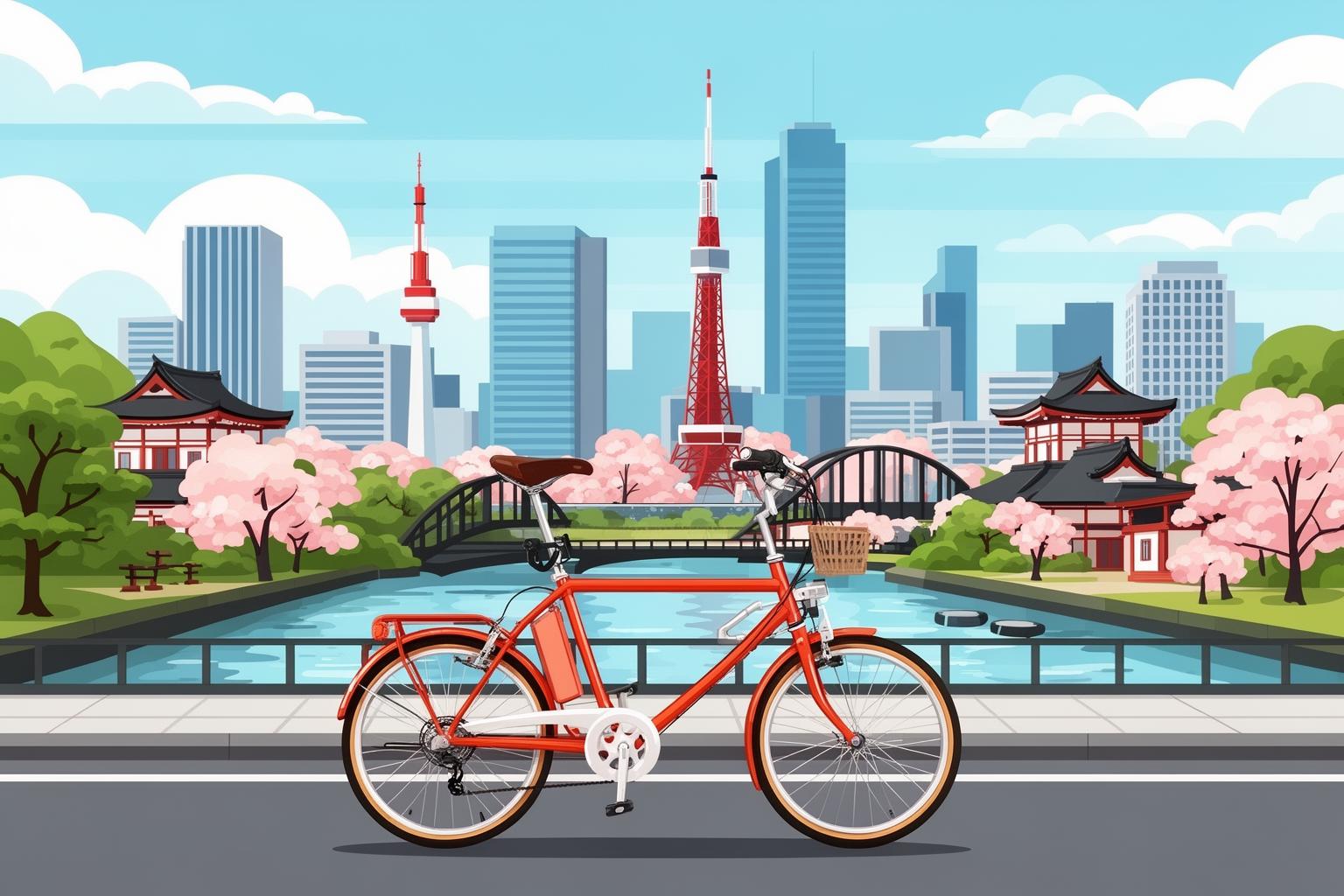
Before we delve into the intricate flow of the streets, you must first meet the queen of the road: the mamachari. The name literally means “mom’s chariot,” and there is no better way to describe this marvel of Japanese engineering and practicality. Forget the lightweight, carbon-fiber frames and razor-thin saddles of competitive cycling. The mamachari is quite the opposite. It’s a workhorse, designed for stability, durability, and a lifetime of relentless service. These bikes form the backbone of Osaka’s communities, the unsung champions of daily errands and family logistics. Wander through any residential area, from the tranquil lanes of Tezukayama to the lively streets of Tenma, and you’ll find them everywhere, standing ready and proud.
What exactly makes a mamachari a mamachari? Look for its distinctive features. A deep, step-through frame allows easy mounting and dismounting, even when wearing a skirt or carrying heavy bags. The handlebars are high and swept back, encouraging an upright, comfortable posture ideal for keeping an eye on the road ahead. At the front, you’ll almost always spot a roomy basket, ready to hold everything from leeks and daikon radishes to a briefcase or school backpack. The rear is equipped with a sturdy luggage rack, often fitted with a child seat—or sometimes two. A full chain guard keeps your trousers clean from grease, mudguards protect against splashes, and a built-in ring lock on the rear wheel provides a quick, convenient way to secure the bike during short stops. They’re heavy and slow, but absolutely indestructible and perfectly suited to the rhythm of city life.
The cultural importance of the mamachari cannot be overstated. It stands as a symbol of domestic life, community, and a practical approach to urban living. You’ll see mothers pedaling gracefully with a toddler in the back seat and a baby strapped to their chest on the way to the park. Elderly gentlemen ride to their local shogi (Japanese chess) clubs, their posture as dignified as their ride. University students use them to commute to part-time jobs, their baskets overflowing with textbooks. In recent years, the electric-assist mamachari has revolutionized things, especially for parents. These bikes, with quiet electric motors, make climbing hills and carrying heavy loads effortless, enabling more people than ever to choose two wheels over four. Owning a mamachari is like having a reliable family station wagon, but infinitely more nimble and economical. It embodies a shared understanding that in a dense city like Osaka, the simplest way is often the best way to live.
Sidewalk or Street? The Great Osaka Cycling Debate
Now, here is the single most perplexing question you will face as a new cyclist in Osaka: where exactly should you ride? According to official Japanese traffic laws, the answer is clear: bicycles are classified as light vehicles and, with few exceptions, must travel on the left side of the street, following the flow of traffic. But if you step outside and watch for just five minutes, you’ll notice that this rule is, to say the least, interpreted quite loosely. Cyclists appear everywhere—on the road, on sidewalks, in pedestrian shopping arcades, and seemingly in a space between the two. This forms the core of Osaka’s unspoken cycling etiquette.
In truth, while the law mandates street riding, local custom has largely chosen the sidewalk instead. Why? The reasons are a mix of perceived safety and basic practicality. Osaka’s streets can be narrow, crowded, and intimidating. Taxis stop suddenly, delivery trucks double-park, and cars can travel at speeds that feel dangerous on a simple city bike. For the typical mamachari rider—not a Lycra-clad athlete but a parent, student, or retiree—the sidewalk feels like a safer refuge. Generally, this sidewalk-riding culture is tacitly accepted by everyone, including the police, provided you follow the unwritten rules of conduct.
Mastering sidewalk riding is an art. The foremost, non-negotiable rule is that pedestrians hold priority—you are a guest in their space. This means your speed should be just a bit faster than walking pace. You aren’t there to race but to glide. The aim is to weave gently, not to charge ahead. You need to become adept at anticipating, reading subtle cues from people ahead. Is someone about to stop and peer in a shop window? Will a group of friends spread out? You learn to sense the ebb and flow of foot traffic and adjust your path smoothly, often without anyone even realizing you passed by. It’s a delicate dance of constant small adjustments.
Then there’s the issue of the bell. In many Western cultures, ringing a bicycle bell is an assertive command: “Move out of my way!” In Osaka, it’s quite the opposite. A loud, frantic bell is seen as very rude and will earn you dirty looks. The bell here is a last resort, a gentle, polite way to announce your presence. A soft, quick ding from a distance says, “Excuse me, just letting you know I am quietly approaching from behind.” Often, you don’t even need the bell. The subtle click of your brake levers or the hum of your tires can serve as enough of an auditory signal. The true masters of Osaka’s sidewalks can navigate the busiest shopping street almost silently, their presence more like a gentle breeze than an intrusion.
The Art of Parking: A Tetris Game of Two Wheels
Your journey is complete, and you’ve reached your destination: the train station, the supermarket, or the local cafe. Now comes the next big challenge: parking. In a city where millions depend on bicycles, finding a spot to leave yours can feel like a high-stakes game of musical chairs mixed with Tetris. Once more, there’s a clear divide between the official system and the reality on the ground.
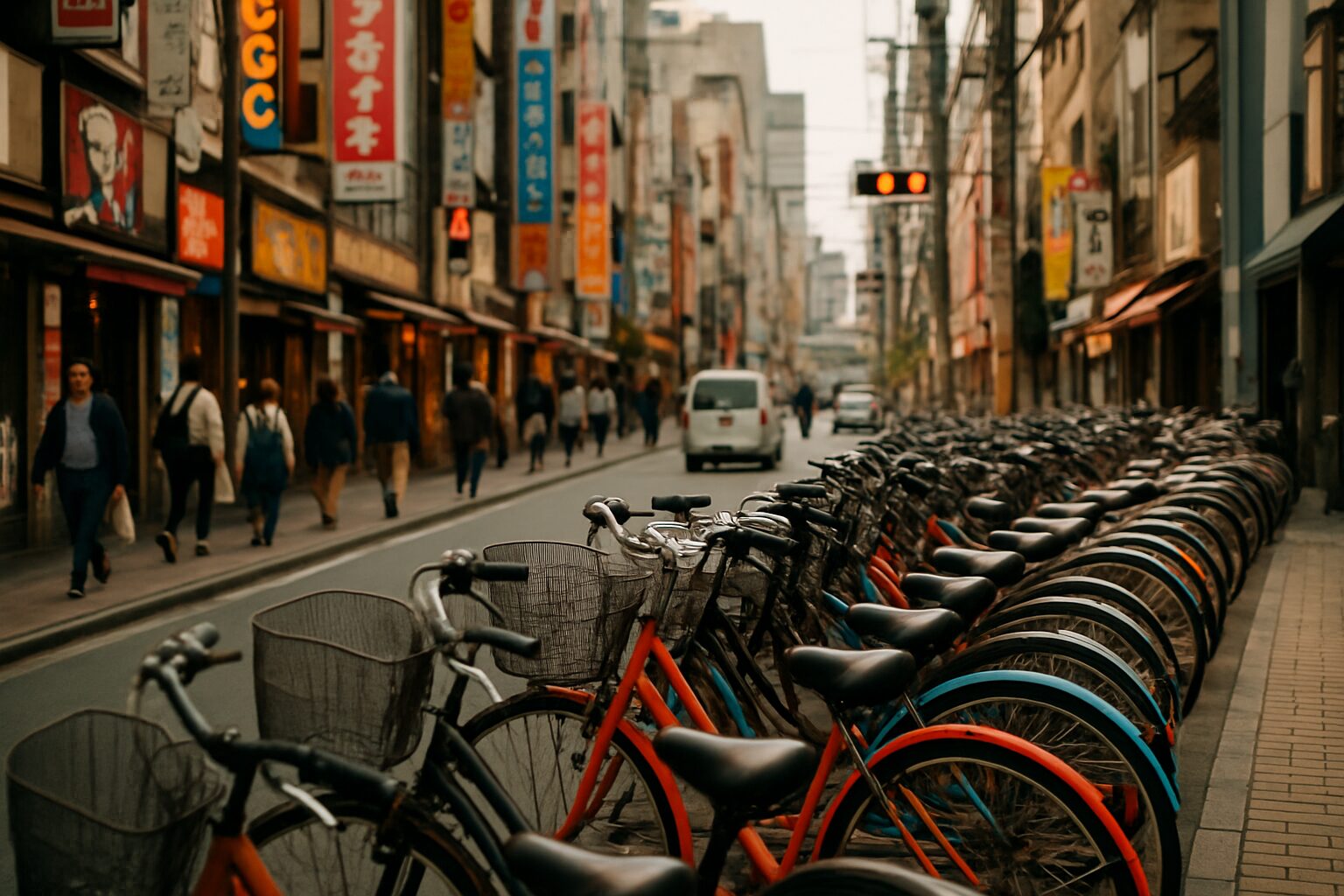
The official option is the designated bicycle parking lot, or churinjo. These are found everywhere, especially near train stations and large commercial centers. They come in different forms. Some are large, multi-story garages where you slot your bike into a double-decker rack. Others are simple, open-air lots with metal bars for locking your bike. Many are free for the first few hours, after which a small fee (usually around 100-150 yen for 8-24 hours) applies. These paid systems are often automated; you slide your bike into a lock that clamps onto the wheel and pay at a central machine when you return. Using a churinjo is the safest, most responsible way to park your bike, particularly if you plan to leave it for a while.
However, you’ll quickly notice that churinjo spots are often full, or that people running quick errands choose a more… creative method. Welcome to the world of unofficial, or “guerilla,” parking. You’ll spot bikes lined up with surgical precision against convenience store walls, tucked neatly beside vending machines, or forming a long, orderly line along a park railing. This isn’t random abandonment; there’s a clear etiquette. The unspoken rule is to remain as unobtrusive as possible. Never block entrances, fire hydrants, emergency exits, or tactile paving for the visually impaired. Position your bike perfectly parallel to the wall, kickstand down, handlebars turned to be flush. It’s about minimizing your footprint and respecting shared space.
But beware, this approach carries risks. In busy areas, especially near major train stations like Umeda or Namba, you’ll see signs warning of a “Bicycle Removal Zone.” These zones are monitored by city workers who tag illegally parked bikes with a warning. If the bike isn’t moved within a few hours, it’s loaded onto a truck and taken to a distant impound lot. Retrieving your bike is a bureaucratic and costly ordeal, requiring a trip to an out-of-the-way city office, proof of ownership and ID, and payment of a fine of several thousand yen. Getting that dreaded tag wrapped around your handlebars is a rite of passage for many Osaka cyclists, but one you should do your best to avoid. Local wisdom says this: for a quick five-minute stop at the conbini, unofficial parking is usually okay; for anything longer, especially in busy areas, find a proper churinjo. The risk simply isn’t worth it.
Navigating Intersections and Crossings: The Osaka Flow
Osaka’s intersections resemble a chaotic ballet of cars, buses, trucks, pedestrians, and, naturally, a swarm of bicycles. Approaching one for the first time can feel like trying to merge onto a highway while riding a unicycle. Yet, like everything else in Osaka’s cycling culture, there is an underlying, intuitive logic beneath the chaos. The key is to stop thinking like a car driver and start thinking like a pedestrian on wheels.
Although cyclists on the street are legally required to obey vehicle traffic signals, the vast majority in Osaka actually follow pedestrian signals. When the little green walking figure lights up, the group of cyclists waiting on the sidewalk surges forward alongside the pedestrians, using the crosswalk (oudan hodou) to reach the other side. Technically, this is illegal, but it is so widely practiced that it has become the de facto norm. Trying to follow car signals while everyone else follows pedestrian signals can be more confusing and dangerous, as you fall out of sync with the flow of two-wheeled traffic.
This brings us to the most essential survival skill: hyper-awareness. The mantra is: “look both ways, then look again, and then look up and down for good measure.” Cars might turn left on a green light, crossing directly through the crosswalk where you are riding. Scooters may weave through traffic. Other cyclists might come from unexpected directions. You must cultivate 360-degree awareness, constantly scanning your surroundings. Never assume you have the right of way, even when the light is green. Right of way belongs to whoever is bigger or moving with more confidence. Your goal is to be predictable to others while anticipating the unpredictability of everyone else.
In many areas, you will observe a fascinating phenomenon: safety in numbers. When a group of cyclists gathers at a corner awaiting the light to change, a collective consciousness seems to form. Once the light turns green, the group moves as one, creating a temporary critical mass that makes them more visible and commands respect from turning vehicles. Riding with this pack often feels safer than crossing a large intersection alone. You become part of a larger, more noticeable entity. Likewise, on streets without dedicated bike lanes, an “invisible bike lane” commonly forms on the far left side. It is a narrow strip of asphalt between parked cars and the moving traffic lane. Riding there demands immense concentration due to the dangers of passing cars on your right and the sudden opening of car doors on your left. It is like navigating a canyon on a bike and requires your full focus.
Essential Gear and Local Habits
Beyond the bike itself, a few essential pieces of gear and an understanding of local customs are crucial for a smooth ride. First, let’s consider the weather. Rain frequently visits Osaka, but it seldom deters the city’s cyclists. You’ll witness an impressive display of skill that seems to defy physics: riders balancing their bikes with one hand while holding a large umbrella in the other. This practice, known locally as kasa-sashi unten, is very common but also quite dangerous and, as of a few years ago, officially illegal with hefty fines. A sudden gust of wind can turn an umbrella into a sail, causing swerving into traffic or pedestrians. While some still ignore the rule, safer and smarter options include wearing a full-body rain poncho (kappa) or using a handy device called a kasasuta—a clamp that attaches to your handlebars to hold your umbrella, freeing both hands to steer and brake.
As dusk falls, another rule comes sharply into focus and is strictly enforced: you must have a working front light. Riding without a light at night almost guarantees being stopped by police. It’s a straightforward safety measure taken very seriously. Most modern bikes in Japan are equipped with a dynamo hub that powers the light automatically as you pedal, leaving no excuse. If your bike lacks one, affordable battery-powered lights are widely available.
Now, let’s talk about security. Although Japan is known for its safety, bicycle theft is surprisingly common, especially with unlocked bikes or those secured by weak locks. This leads to an important administrative step when acquiring a bike: bicycle registration, or bouhan touroku. This mandatory, one-time registration requires filling out a form with your name, address, and phone number when you purchase a new or used bike. The shop then places a small, durable orange sticker with a unique registration number on the bike’s frame. This sticker serves as your proof of ownership. If your bike is stolen and later recovered, the police will use this number to contact you. It also acts as a deterrent to thieves. During random police checks (which do happen), officers scan this sticker to verify the bike isn’t stolen. Riding an unregistered bike, or one registered to someone else, will lead to a lengthy and awkward discussion at the local police box (koban). So, get your bike registered—it costs only 600 yen and can save you a lot of trouble.
Finally, a modern rule that cannot be emphasized enough: do not use your smartphone while riding. Texting, calling, or even glancing at a map on a phone mounted to your handlebars while moving is strictly forbidden and carries severe penalties. It is extremely dangerous and considered one of the most inconsiderate actions a cyclist can take. If you need to use your phone, stop completely in a safe spot before doing so. Navigating Osaka’s streets demands your full and undivided attention.
The Social Contract: Being a Good Cycling Citizen
If you distill all these unspoken rules, habits, and etiquette into one core philosophy, it would be the Japanese concept of omoiyari, which roughly means a deep, empathetic consideration for others. Cycling in Osaka is not about individual speed or efficiency. It is a communal activity, a continuous negotiation of shared space. Your actions have an immediate and direct effect on the many people around you. The aim is not to assert your rights but to contribute to the overall harmony, the wa, of the street.
This involves practicing give and take. You slow down and give plenty of space to an elderly woman pulling a small shopping cart. You come to a complete stop to allow a mother with a stroller to cross your path. You ring your bell softly, or sometimes not at all. In return, pedestrians often show consideration for you, hearing you approach and instinctively stepping aside to let you pass. They recognize that everyone is part of the same urban ecosystem.
Ultimately, the most valuable skill to develop is the ability to read the room—or in this case, the street. Every neighborhood, street, and time of day has a distinct rhythm. The lively energy of the Dotonbori canals at night contrasts sharply with the quiet pace of a residential street on a weekday morning. The key is to stay observant. Watch how locals ride—notice their speed, positioning, and subtle interactions. When you first arrive, your instinct may be to adhere strictly to the law. But soon, you’ll realize that blending in is the better approach. Follow the flow. Blend seamlessly. When you can cycle through a crowded shotengai (shopping arcade) without causing anyone to break their stride, you’ll know you’ve truly arrived. You are no longer just a cyclist; you are a participant in Osaka street’s social contract.
Where to Ride: From Urban Jungle to Riverside Bliss
Once you’ve gained confidence and familiarized yourself with local customs, the entire city of Osaka reveals itself in a way that’s impossible to experience by train or on foot. A bicycle becomes your key to discovering the city’s hidden corners and linking its diverse neighborhoods into a single, cohesive map.
For a purely urban adventure, nothing beats exploring by bike. You can glide through Nakazakicho’s backstreets, filled with bohemian cafés and vintage shops housed in quaint wooden buildings. You can pedal through the vibrant, gritty energy of Shinsekai, circle the iconic Tsutenkaku Tower, and soak in the retro-futuristic vibe. A ride around the vast grounds of Osaka Castle presents a striking contrast between feudal history and a modern skyline. Riding a bike lets you cover plenty of ground while still moving slowly enough to notice small details: a tiny shrine nestled between apartment buildings, the scent of roasting coffee from a local kissaten, or the sound of wind chimes drifting from a balcony.
When the concrete jungle starts to feel overwhelming, your bike becomes your ticket to tranquility. Osaka is blessed with several large rivers whose banks are lined with beautiful cycling paths. The Yodo River Cycling Road is the most famous, offering a long, uninterrupted stretch of smooth pavement that feels worlds away from the city’s hustle. Here, the rules are simpler—no pedestrians to dodge, no cars to worry about. It’s just you, your bike, and the open sky. You’ll share the path with serious road cyclists in full gear, families out on weekend picnics, and couples enjoying leisurely rides. It’s the perfect place to clear your head, stretch your legs, and discover a more natural side of Osaka’s personality. From the city center, you can ride all the way to Osaka Bay or head inland toward Kyoto, following the gentle curve of the river.
If you don’t yet own a bike, don’t worry. The city offers several bike-sharing systems, with docks scattered throughout the central wards—ideal for one-way trips or spontaneous explorations. For a more comfortable experience, numerous local shops rent well-maintained mamachari or even sportier cross bikes on a daily basis. It’s a fantastic way to try out cycling in Osaka without the commitment of ownership.
A Final Spin: Embracing the Rhythm
Mastering the art of cycling in Osaka is a journey that doesn’t happen overnight. There will be moments of confusion, perhaps a near miss or two, and maybe even a gentle reprimand from an oba-chan if you park thoughtlessly. But don’t be discouraged. Think of it as a language learned not from books, but through immersion. Every ride teaches observation, adaptation, and consideration.
Embrace the rhythm. Release the urge to rush. Realize that your two wheels connect you to the city in the most personal way possible. You’re not enclosed in a metal box or speeding underground in a subway. You’re out in the open, experiencing the city with all your senses. You feel the seasons change, smell the rain on scorching summer asphalt, and hear the vibrant life of the neighborhoods you pass through. To cycle in Osaka is to sense the city’s pulse, move with its rhythm, and become part of its relentless, beautiful, and distinctly unique beat. So, grab a bike, take a deep breath, and join the dance. The streets are waiting.