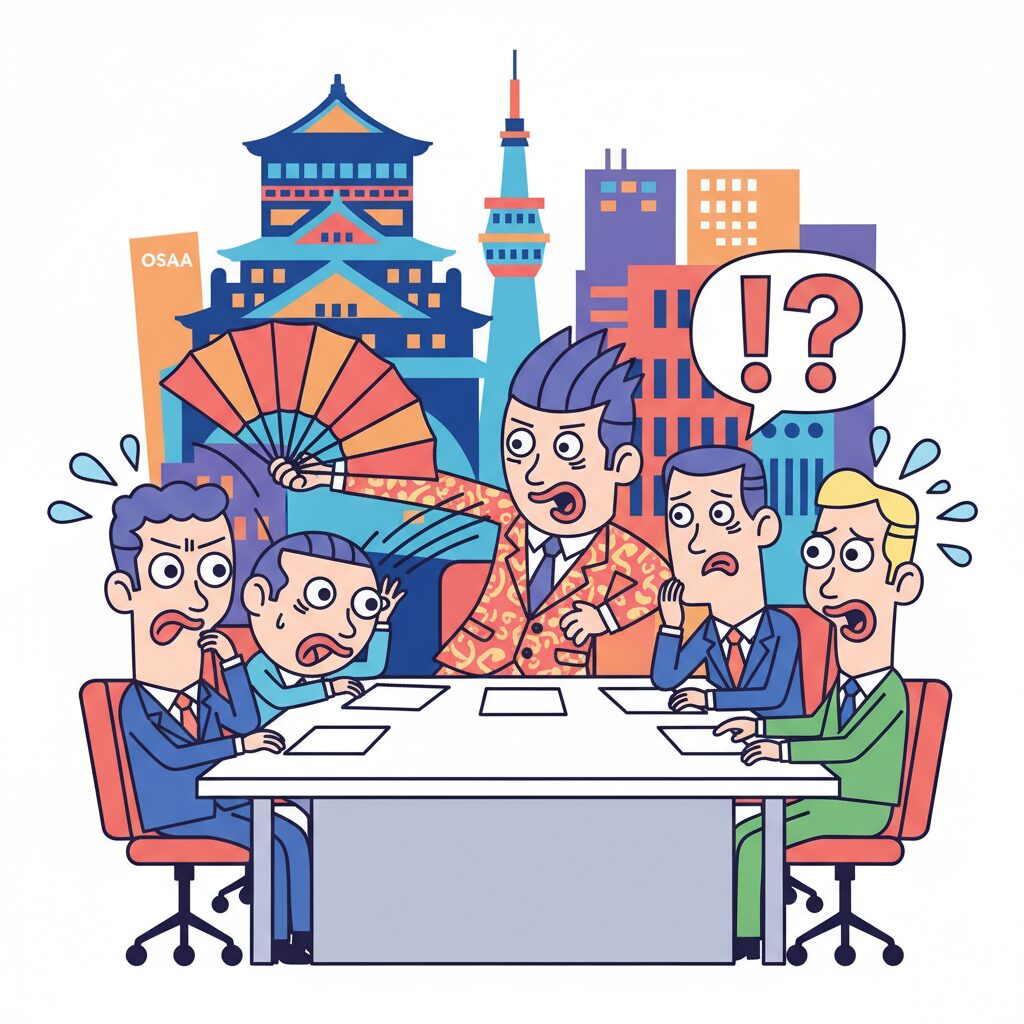
My first big presentation in Japan. I was working for a mid-sized trading company in Honmachi, the heart of Osaka’s business district. The air in the conference room was thick with the scent of stale coffee and anticipation. My Japanese was clumsy, my slides were dense, and my nerves were shot. I finished, bowed stiffly, and braced for the silent, analytical judgment I’d been told to expect in corporate Japan. My boss, a stout man with a permanent glimmer of mischief in his eyes, leaned back in his chair. He tapped his pen on the table, letting the silence stretch. Then, he looked at me, looked at my trembling colleagues, and announced to the room, “Well, that was… surprisingly not terrible. For an American.” A few people snorted into their coffee. My direct manager gave me a quick, reassuring nod. I stood there, utterly bewildered. Was I just publicly insulted? Was my career over before it began? Or did I just receive… a compliment? Welcome to the confusing, hilarious, and highly effective world of business in Osaka, where the line between a punchline and a promotion is finer than a thread of silk.
This wasn’t the Japan I had read about in business guides. Those books painted a picture of monolithic harmony, of subtle consensus-building known as nemawashi, and of a rigid formality where a misplaced business card could cause an international incident. That Japan certainly exists. You’ll find it in the polished corridors of power in Tokyo’s Marunouchi district. But Osaka operates on a different frequency. It’s a city built by merchants, not samurai, and that DNA informs everything, especially how people interact in a professional setting. Here, humor isn’t just a way to break the ice; it’s a precision tool used to build rapport, test intelligence, convey feedback, and ultimately, get things done faster. To survive and thrive in an Osaka office, you need to understand the rhythm of its comedy, specifically the conversational dance of boke and tsukkomi. This isn’t just about telling jokes. It’s a fundamental communication style that, once you decode it, will unlock a deeper understanding of what makes this city tick. It’s the difference between being a confused outsider and an integrated, effective member of the team.
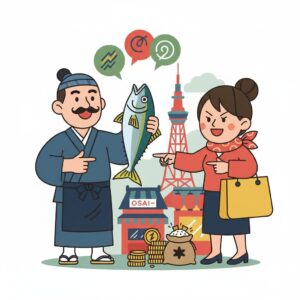
This direct, transactional communication style is a hallmark of Osaka’s merchant DNA, much like the city’s famous haggling culture.
The Comedy Club or the Conference Room? The Anatomy of an Osaka Meeting
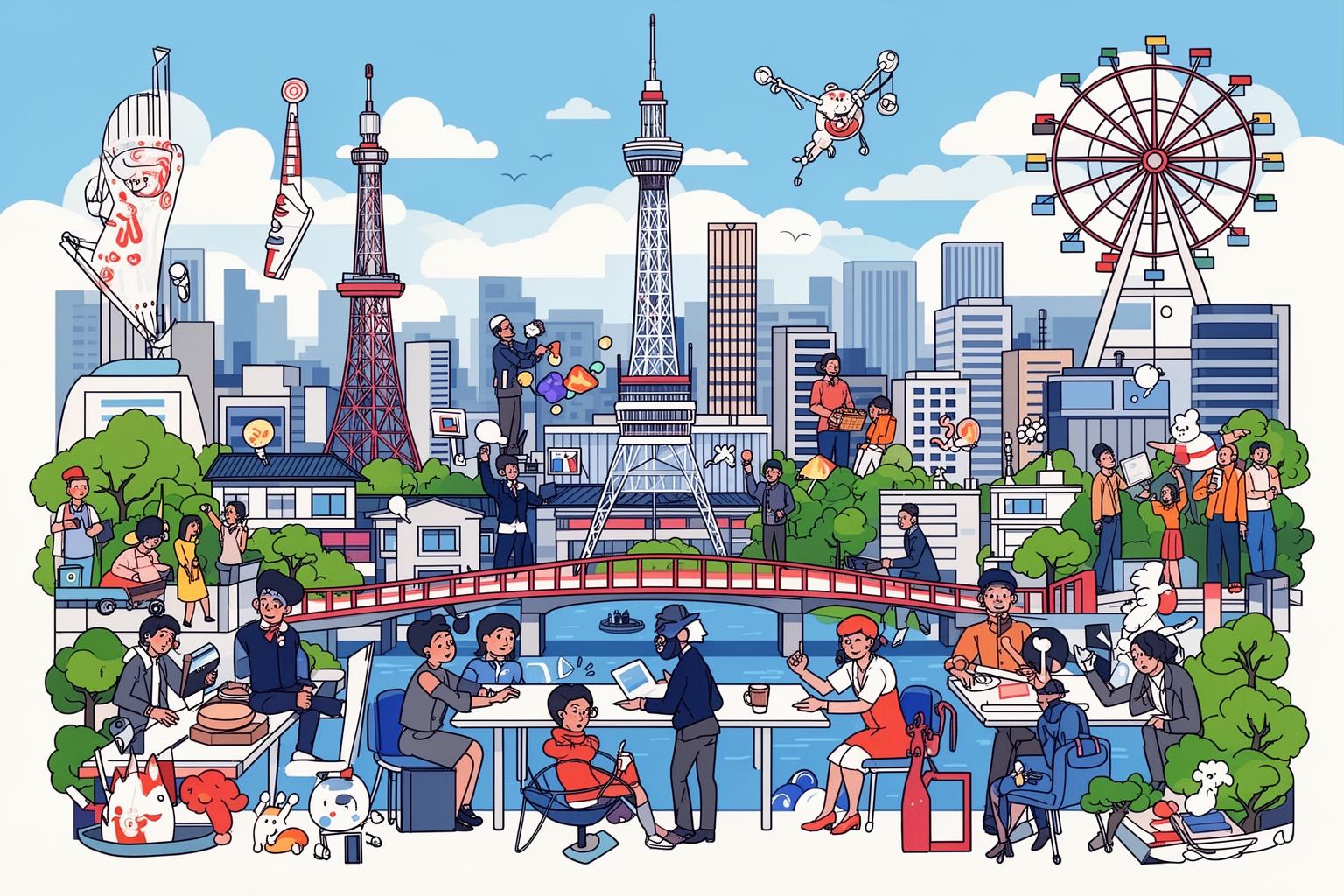
Step into a meeting in Tokyo, and you can often sense the burden of unspoken rules. The seating is intentional, greetings are formal, and the dialogue follows a carefully pre-approved path. The aim is to preserve surface harmony, or wa, at any cost. Direct confrontations are uncommon; instead, points are conveyed through subtle hints and careful wording. The atmosphere itself feels curated and controlled. Now, enter a meeting in Osaka. The energy is vibrant. People often speak simultaneously. Laughter breaks out unexpectedly. The pace is quicker, the language more straightforward, and the entire interaction feels less like a rehearsed play and more like an improvisational show. This isn’t disorder; it’s a different kind of order, grounded in the comedic duo dynamic of the manzai tradition.
Reading the Air vs. Punching the Air
The well-known Japanese concept of kuuki wo yomu, or “reading the air,” is crucial in Tokyo. It involves sensing the mood, grasping the unspoken, and aligning your behavior with the group’s tacit consensus. Failure to do so brands you as awkward and socially unaware. In Osaka, they also read the air, but they aren’t afraid to punch it—alter its pressure with a well-timed joke or sharp retort. The aim isn’t just to passively understand the mood but to actively influence it. A tense discussion about budget cuts might be defused instantly when a senior manager groans, “If we cut any more, my lunch will be just a single grain of rice. And I’ll have to share it.” This isn’t viewed as unprofessional; it’s seen as a skillful way to acknowledge collective stress while reminding everyone of their shared humanity, allowing the conversation to reset on a more productive note.
The Holy Trinity: Boke, Tsukkomi, and the Bottom Line
Central to this dynamic are two essential roles: the boke and the tsukkomi. Understanding these is crucial for anyone working in Osaka.
First, there’s the boke. This is the comic, the fool, the one who says or does something absurd, incorrect, or silly. Importantly, playing the boke is not a sign of weakness or ignorance. It’s a deliberate strategy. A manager might intentionally present a slide with an outrageously optimistic, impossible sales figure. This is a boke. It’s a small, intentional flaw introduced into the discussion. The goal is to create an opening, temporarily lower one’s status, and invite participation. It’s a way of saying, “I’m not an infallible authority. I’m human. Let’s solve this together.”
Next is the tsukkomi. This is the straight man, the one who highlights the absurdity with a sharp, clever comment. The tsukkomi acts as the corrective force. When the manager displays the impossible sales figure, a colleague will immediately offer the tsukkomi: “Sato-bucho, at that rate we could all retire next Tuesday. Did you forget a decimal point?” This isn’t insubordination; it’s the expected and necessary response. The tsukkomi accomplishes several things at once: it corrects the mistake without harsh criticism, shows attentiveness, and strengthens the group bond through shared laughter. The person delivering the tsukkomi is regarded as sharp, engaged, and socially skilled.
The final element of this trinity is the bottom line. The humor isn’t just for entertainment. This quick exchange of boke and tsukkomi fulfills a clear business function. It corrects factual errors, eases tension, and gets the team back on track within seconds. What might require five minutes of careful, face-saving explanation in a more formal context is handled with a single, laugh-out-loud moment. It is efficiency disguised as entertainment.
The Unspoken Rules of Roasting: How to Navigate ‘Tsukkomi’ Without Getting Burned
For a foreigner, navigating this can feel like walking through a minefield. You watch your colleagues playfully jab at one another and assume it’s a free-for-all. It isn’t. There’s a complex, unspoken etiquette dictating who can say what to whom. Misreading these rules can result in awkward silence or, worse, genuine offense. The key is to understand that this is a structured form of communication, not mere random joking.
Rule #1: It’s About the Situation, Not the Person
A proper tsukkomi is rarely a personal attack. It targets the action, statement, or situation. It comments on the absurdity of the moment rather than judging an individual’s character. If you’re late to a meeting and your boss says, “Ah, Tanaka-san has arrived! We were just about to send a search party. Did you take the scenic route from your desk?” this is a tsukkomi. He’s addressing your tardiness in a way that conveys the point without a formal reprimand. The focus is on being late. An improper personal attack would be something like, “Tanaka-san, you’re always so disorganized.” The former builds rapport while correcting behavior; the latter is just an insult. Osakans are experts at this distinction.
Rule #2: Hierarchy Still Exists, It Just Takes a Lighter Tone
The casual, laughter-filled setting can mislead foreigners into thinking corporate hierarchy has disappeared. This is a risky misunderstanding. Senpai-kohai (seniority and respect) rules remain firmly in place; they’re just expressed differently. Generally, tsukkomi flows downward or between peers. A boss can deliver a tsukkomi to a subordinate. Colleagues of similar rank can exchange them freely. But a junior employee directing a sharp tsukkomi to a senior executive is risky. It’s possible but only if a very strong, nearly familial relationship has been formed. For a newcomer, it’s a boundary best not crossed.
Still, a savvy junior employee can use this dynamic by playing the boke. You might make a small, self-deprecating joke. For instance, when asked to pull some data, you could say, “I’ll get right on it. Hopefully, I press the right buttons. Last time, I think I accidentally ordered 500 pizzas.” This invites your boss to offer a gentle tsukkomi, such as, “Just stick to the spreadsheets. We’ll handle the catering.” This exchange lets you engage warmly with a superior, building rapport without violating hierarchy.
Rule #3: Silence Is Your Signal
What happens when a joke falls flat? In many Western cultures, a polite chuckle might ease the awkwardness. In Osaka, you might receive silence instead. This is known as suberu, which literally means “to slip” or “to bomb.” The silence isn’t meant to be harsh; it’s honest and immediate feedback indicating that the joke was inappropriate, mistimed, or simply unfunny. Most importantly for a foreigner, it may signal that your relationship with the group isn’t yet strong enough for this type of joking. If your boke is met with blank stares, the message is clear: retreat. Don’t insist or try to explain the joke. Just let it go and accept it as a social cue—it’s valuable data. The group is saying, “We’re not there yet.” Recognizing and respecting this silence is as crucial as understanding laughter.
“Why Are You Being So Serious?” – The Osaka Mindset vs. the Tokyo Standard
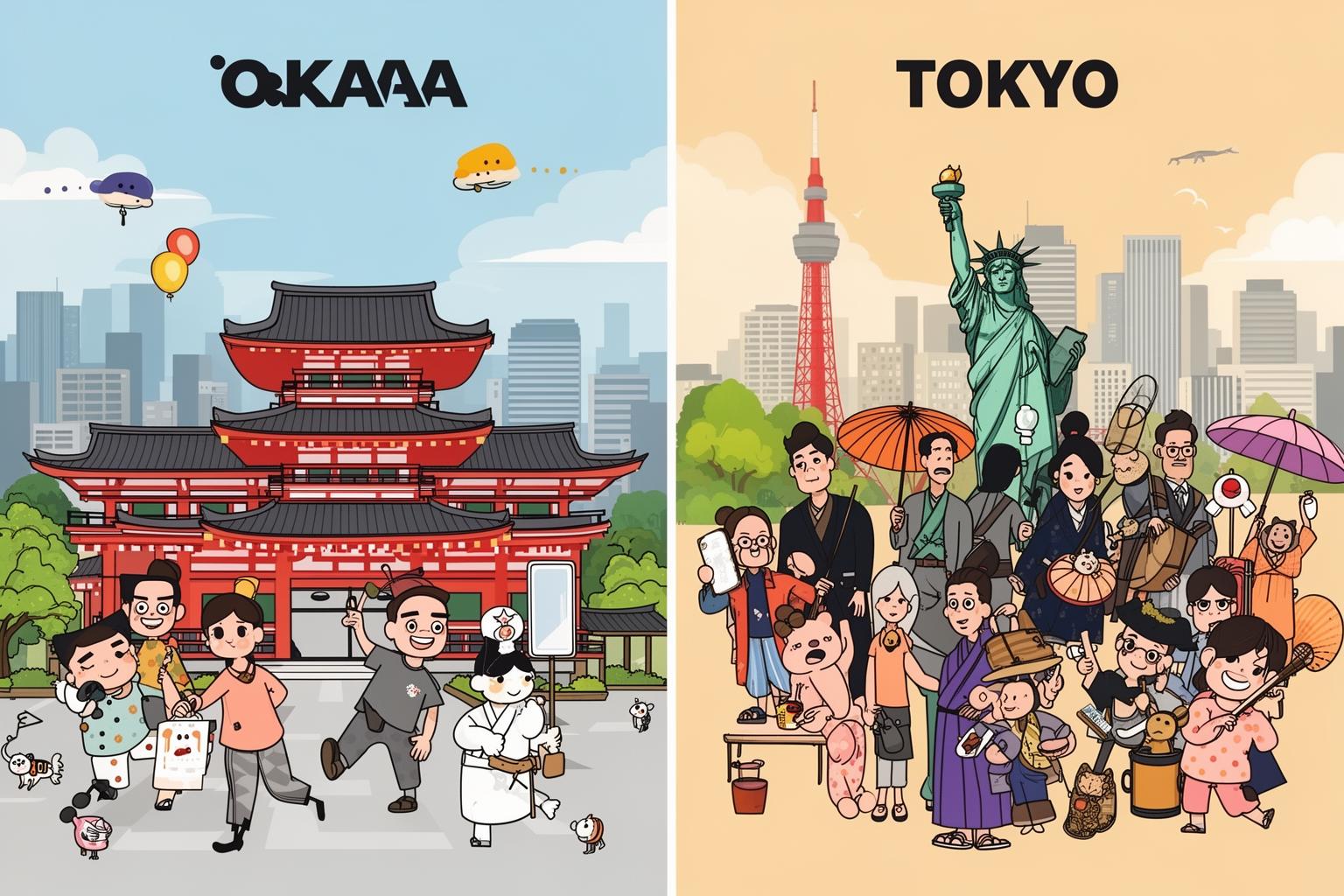
This fundamental difference in communication style arises from deep historical and cultural origins. Tokyo, as the seat of the shogunate and later the imperial government, developed a culture rooted in the rigid hierarchies and formal etiquette of the samurai class and court bureaucracy. Precision, procedure, and maintaining appearances (tatemae) became essential. Osaka, by contrast, was known as the nation’s kitchen (tenka no daidokoro), a city of merchants, traders, and artisans. For them, the highest values were not ceremony and formality, but speed, pragmatism, and the bottom line. There was no time to spend weeks on formal pleasantries when a shipment of rice awaited at the docks.
Efficiency Through Laughter
From the Osakan viewpoint, the Tokyo style can appear frustratingly slow and indirect. The process of nemawashi, laying the groundwork and building consensus behind the scenes, can consume a great deal of time. Osakans prefer gathering everyone in one room to resolve issues directly. Humor acts as the lubricant that enables this directness without causing constant conflict. By using a boke and tsukkomi format, one can disagree with an idea without directly attacking its proposer. Flaws can be pointed out with a laugh rather than an accusation, allowing for a more open and honest debate in real time. For example, a colleague might present a plan, and another could say, “That’s a great idea if our goal is to go bankrupt by Christmas. What about the logistics?” This is a direct challenge wrapped in humor, understood as a prompt to defend the plan’s weaknesses rather than a personal insult.
The Merchant’s DNA: Building Relationships is the Real Currency
In a merchant culture, reputation and relationships are the most valuable assets. It’s essential to quickly determine whether a potential partner is trustworthy, sharp, and reliable. The formal, guarded nature of traditional Japanese business etiquette can make this assessment difficult, creating a barrier. The Osaka approach uses humor to break through that barrier. Can this person think on their feet? Can they take gentle teasing without offense? Do they have the social intelligence for a witty exchange? This banter acts as a rapid-fire diagnostic tool. Someone who thrives in it signals confidence, quick wit, and a lack of the rigid formality mask. Sharing a laugh builds human connection far faster than exchanging business cards. In Osaka, joking with you is often a sign of growing trust. Business is personal, and the path to a strong personal relationship is paved with good-natured humor.
A Tale of Two Capitals: The Coffee Meeting
Picture a first business meeting over coffee in Tokyo. The process would be highly ritualized. You would exchange business cards with both hands, holding the other person’s card respectfully. The conversation would likely begin with polite small talk before moving carefully through the agenda. The language would be formal and indirect, with frequent use of honorifics (keigo).
Now, imagine that same meeting in a cafe in Osaka’s Umeda district. Your potential partner might open with, “Wow, you’re on time! I’m impressed. Most people get lost in this station. I still get lost in this station.” This immediately breaks the formal tone. Business card exchange might be more casual. The conversation could jump straight into business but be interspersed with anecdotes, jokes, and asides. They might interrupt you, not rudely but out of enthusiasm. They’re trying to get a sense of you as a person. Are you someone they can work with? Someone they can share a beer with after closing the deal? The vibe is less about ceremony and more about having a genuine, business-focused conversation.
A Foreigner’s Survival Guide to the Osaka Office
So, how do you, as a non-Japanese professional, navigate this intricate comedic landscape? It can be daunting, but certainly not impossible. The key is to begin as an observer, absorb the rhythms, and then gradually participate in small, low-risk ways.
Whether to ‘Boke’ or Not to ‘Boke’?
At the start, avoid trying to be the office comedian. Your primary role is to watch and listen carefully. Who typically plays the tsukkomi in your team? Who usually takes on the boke role? What topics are acceptable for jokes? Are the jokes mainly about work, or do they extend to personal matters? Take in these patterns. Your safest entry into this style of humor is through self-deprecation—a universally recognized form of comedy and an ideal way to play the boke without risk. For instance, if you’re having trouble with a certain piece of software, you might say, “I think this computer is smarter than I am. I ask it to create a spreadsheet, and it asks if I want to play solitaire.” This gentle, self-directed boke invites a friendly tsukkomi from a colleague, such as, “Don’t worry, we’ll get you a more basic model—maybe one with an abacus.”
Mastering the “Nande ya nen!” (Why the heck!?)
This is the quintessential Osaka tsukkomi phrase. You’ll hear it repeatedly, often paired with a light, playful slap on the arm or shoulder. It’s a flexible expression of mild disbelief or protest. While you shouldn’t start tossing it into professional conversations right away, understanding its meaning is essential. It represents the pure sound of the tsukkomi. A safe way to begin using it is in casual, non-work situations. For example, if a colleague from Kobe insists their beef is the best, a smiling “Nande ya nen!” is a perfectly acceptable and even appreciated response. It signals that you’re tuning into the local culture and willing to join in. It communicates, “I understand the game and am ready to participate.”
When the Laughter Ends: Identifying Genuine Criticism
This is perhaps the most important skill to master: distinguishing between playful tsukkomi and serious criticism. While tsukkomi serves as the preferred method for minor corrections, significant problems are addressed differently. The signs are usually obvious if you know what to look for. The setting changes; a serious reprimand typically happens privately, not in front of the team. The tone shifts noticeably; the playful inflection disappears and is replaced with a flat, serious voice. Body language becomes closed and tense. The laughter stops completely. The playful energy typical of a tsukkomi exchange vanishes. Being able to detect this shift is crucial. An Osakan boss might tease you in a team meeting for a typo, but they’ll pull you aside for a quiet, stern conversation if you mishandle a major client account. Don’t confuse the two.
Beyond the Boardroom: How Humor Shapes Daily Life in Osaka
This style of communication isn’t limited to the office. It’s the heartbeat of the city, a cultural hallmark you’ll encounter everywhere from the department store to the doctor’s office. Understanding it in a professional setting becomes easier once you realize it’s part of a much wider social fabric.
The Banter at the Butcher Shop
Visit any of Osaka’s vast shopping arcades, like Tenjinbashisuji Shotengai. Stop by a fruit stand and ask the price of a melon. The elderly woman running the stall might glance you up and down and say, “For you? Expensive. For a handsome man like you, very expensive!” She’s not being rude—this is an opening line, an invitation to banter. The expected reply isn’t to haggle aggressively but to join in. “Only expensive? I thought it would be free for your best customer!” A smile, a laugh, and a shared moment of connection follow. You’re no longer just a transaction; you become part of the neighborhood’s everyday life. This ongoing, low-key banter strengthens social bonds and makes daily errands feel more personal.
The Train Conductor’s Announcement
Even in the famously uniform world of Japanese public transport, Osaka’s personality stands out. On certain train lines, especially those operated by private companies like Hankyu or Kintetsu, you might hear a conductor whose announcements feel like a stand-up routine. Instead of a flat “The doors are closing,” you could hear, “The doors are closing! Please don’t get caught! If you do, you’ll be famous on YouTube for all the wrong reasons!” This would be unimaginable on Tokyo’s Yamanote Line, where strict adherence to the manual is the norm. In Osaka, it’s a cherished quirk—a small reminder that those in charge are human, and even the most mundane commute can contain a moment of humor and connection.
When I first heard my boss’s comment in that conference room years ago, I was frozen by confusion and a little fear. I interpreted his words through my own cultural lens, seeing them as a sarcastic, public put-down. I couldn’t have been more mistaken. What I eventually realized was that his tsukkomi was a sign of acceptance. It was his way of saying, “The formal presentation is over. You did well. You’ve passed the test. Now you’re part of the team, which means I can stop being formal and start joking with you.” It was a warm welcome disguised as a roast.
In Osaka, humor isn’t a distraction from ‘real work.’ It often is the real work—the work of building trust, encouraging open communication, and creating a resilient team that can face pressure with a laugh rather than a scowl. It’s a merchant’s pragmatism applied to human relationships. Why waste time on stiff formalities when a shared joke can reveal more about someone in thirty seconds than a week of polite emails? It takes time to learn the rhythm, to know when to play the boke and when to deliver the tsukkomi. But once you do, navigating the professional world in Osaka becomes not only manageable but genuinely rewarding and, dare I say, far more enjoyable. So next time your Osakan colleague makes a ridiculous claim with a straight face, don’t just stare. Smile, take a breath, and deliver your best “Nande ya nen!” You’re not just making a joke—you’re doing business.