Tokyo whispers. Kyoto implies. Osaka, however, speaks. It doesn’t just speak; it projects, it declares, it sometimes yells with a grin. The first time you encounter a true, unfiltered Osaka interaction, it can feel like a cultural jolt. You’re standing in a shop, and the owner, a woman with a perm that defies gravity, tells you point-blank that the shirt you’re holding is the wrong color for you. There’s no gentle, “Perhaps this other one would also suit you,” that you’ve been conditioned to expect. There is only, “Nah, not that one. Makes you look pale. Try this.” In that moment, you’re faced with a choice: take offense, or understand that you’ve just received a piece of brutally honest, well-intentioned advice. This is the essence of life in Osaka, a city that trades the delicate art of subtlety for the powerful currency of straight talk. It’s a communication style forged in the fires of commerce and tempered by the rhythm of stand-up comedy. For foreigners trying to build a life here, navigating this landscape can be the difference between feeling constantly on edge and feeling truly at home. This isn’t about whether Osaka is “friendly” or “rude”—those words are too simple. It’s about understanding the complex, vibrant, and often hilarious social language that defines Japan’s second city. It’s about learning to see the warmth hidden within the grit, and deciding if your personality thrives in a place where the social filter is set to low.
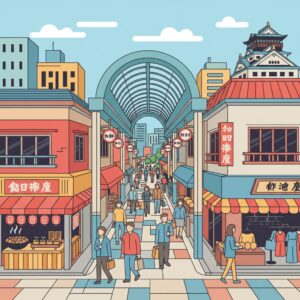
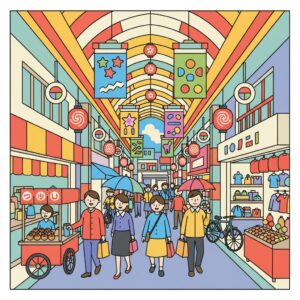
These candid interactions extend beyond individual encounters, reflecting the vibrant shotengai culture that infuses every corner of Osaka with its unfiltered urban spirit.
The Anatomy of Osaka-ben: More Than Just an Accent
To grasp Osaka’s directness, you first need to understand its dialect, Osaka-ben. Outsiders often mistake it as merely a collection of quirky words, a rustic counterpart to the polished, standard Japanese spoken in Tokyo. However, this is a serious misunderstanding. Osaka-ben is the core of the city’s communication style. It’s a language designed for speed, clarity, and emotional expression, often sacrificing formality. While Tokyo Japanese uses layers of politeness and vague phrasing to soften requests and opinions, Osaka-ben gets straight to the point. Take the common phrase “chotto…,” the Swiss Army knife of Tokyo ambiguity, which can mean “a little,” “it’s difficult,” “I’m busy,” or a gentle “no.” Listeners are expected to read between the lines and infer the true meaning. In Osaka, you’re more likely to hear a clear “Muri,” meaning “Impossible,” or “Akan,” a wonderfully versatile word meaning “No good,” “Don’t,” or “That’s not going to work.” There’s no guessing involved. It’s a definitive statement, delivered with a finality that can be startling if you’re unprepared. Intonation plays a crucial role. Osaka-ben has a musical, almost percussive rhythm. Sentences rise and fall dramatically, giving conversations a lively, animated feel. A simple “Honma?” (“Really?”) can express a world of meaning—skepticism, shock, delight—depending entirely on how it’s said. This expressive tone means people’s feelings are often openly displayed. There’s less of the calm, neutral emotional baseline you might hear elsewhere. This doesn’t mean people are always angry or excited; rather, the language itself serves as a more direct outlet for emotion. It eliminates the need for excessive interpretation, creating a social atmosphere where what you hear is, more often than not, exactly what you get.
Commerce and Comedy: The Twin Pillars of Osaka’s Communication
The essence of Osaka’s communication style was shaped in two distinct arenas: the marketplace and the comedy stage. These two foundations—one rooted in the necessity of clear transactions, the other in the craft of the punchline—have defined how people in Osaka engage with the world and with one another. To live here is to exist in a continuous balance between the merchant’s pragmatism and the comedian’s timing.
The Merchant’s Mindset: Time is Money, Honesty is Currency
Osaka has long been Japan’s kitchen, warehouse, and commercial hub. It is a city of `shonin`, or merchants. This history is not merely a detail in a textbook but a living, dynamic force that shapes everyday life. In a merchant’s world, ambiguity is the enemy, leading to bad deals, wasted time, and broken trust. From this foundation arose a communication style that prizes efficiency and honesty above all. You can sense this pulse within the city’s expansive `shotengai`, the covered shopping streets that are the heart of its neighborhoods. Here, conversations are brisk, straightforward, and purposeful. A fishmonger won’t just sell you a fish; he’ll tell you precisely how to cook it, which ones are freshest today, and which to avoid. This isn’t a sales tactic; it’s a transfer of practical knowledge. He wants you to enjoy a good meal so you’ll return tomorrow. That relationship is built on the trust that he won’t sell you inferior goods. This approach extends beyond transactions—feedback, in general, is delivered without sugarcoating. If a colleague spots a flaw in your idea, they’ll point it out plainly. It’s not a personal attack, but a way to improve the final result. Ideas are treated like merchandise, assessed for quality. Whereas in Tokyo, criticism often comes swathed in praise and suggestions, in Osaka, you’re handed the problem openly, expected to be professional enough to address it without taking offense. It’s a culture of practical problem-solving focused on good outcomes rather than preserving fragile egos.
The Comedian’s Spirit: Life’s a Stage, and Everyone has a Punchline
If commerce gave Osaka its directness, comedy gave it its soul. Osaka stands as the undisputed capital of Japanese comedy, the birthplace of `manzai`, a rapid-fire style of stand-up performed by a duo. This is more than entertainment; it’s a social framework. The heart of `manzai` lies in the interaction between the `boke` (the silly, scatterbrained character) and the `tsukkomi` (the sharp-witted straight man who often corrects the `boke` with a theatrical smack). In Osaka, every conversation can become a `manzai` routine, and everyone knows how to take on both roles. That blunt remark you received isn’t necessarily an insult; it’s often a setup. It’s a `boke` moment, inviting you to respond as the `tsukkomi`. A friend might notice your new, slightly quirky haircut and say, “What happened? Did you get into a fight with a lawnmower?” This is a test. The wrong answer is to feel offended or quietly embarrassed. The right reply is a clever comeback: “No, this is the latest style from Paris. You wouldn’t get it.” This playful verbal sparring, known as `ijiri`, acts as social glue. It’s how people express affection, build rapport, and include you in their world, checking to see if you can keep up. Being teased in a lighthearted way signals acceptance. Silence or polite indifference—that’s what you should worry about. This comedic instinct turns social gatherings into lively, chaotic, and deeply interactive events. People interrupt, talk over one another, and build on each other’s jokes. It’s a collective performance where the cost of entry is a willingness both to be the target of jokes and to deliver the punchline.
Who Thrives in the Osaka Straight-Talk Arena?
So, who is truly suited for this environment? Who considers Osaka’s straightforward, lively culture not merely bearable, but freeing? Certain personality types don’t just endure here; they thrive, drawing vitality from a social atmosphere that others might find harsh. This city rewards those who appreciate unfiltered honesty and can skillfully navigate its distinct style of social interaction.
The Extrovert Who Values Authenticity
If you’re someone drained by the effort of decoding hidden meanings and unspoken emotions, Osaka will feel like a refreshing change. It’s a city for those who want clarity about where they stand. The social energy is vibrant, and for an extrovert, it’s exhilarating. Conversations with strangers spark effortlessly on trains, at bars, or in lines. The continuous banter offers countless chances for connection. More importantly, that connection feels genuine. When someone in Osaka compliments you, you can trust they mean it, as they wouldn’t hesitate to tell you if they felt differently. This sincerity fosters strong, low-maintenance friendships. You don’t need to worry if a friend is secretly upset—they would have told you already, likely in detail. For anyone who believes true kindness lies in honesty, even when it’s uncomfortable, Osaka’s social code is an ideal fit. It’s a place to relax, be yourself, and speak your mind, confident that others will do likewise.
The Entrepreneur and the Creator
Osaka’s merchant spirit makes it an outstanding place for those aiming to create something new. Its culture of direct feedback is invaluable for entrepreneurs, artists, and creators. In more reserved settings, obtaining honest criticism can be challenging. People tend to offer vague encouragement to avoid offense, which feels nice but isn’t very helpful. In Osaka, if you share your prototype, business plan, or artwork, you’ll receive immediate, unfiltered opinions. People will tell you what they like, dislike, and suggest improvements. This isn’t negativity; it’s collaborative and outcome-focused thinking. The city’s pragmatic atmosphere is less bound by rigid hierarchies. A good idea is a good idea, whether it comes from the company president or the newest intern. This fosters a dynamic, agile environment where progress happens swiftly. If you have resilience and a sincere desire to enhance your work, Osaka’s critical yet constructive culture can be a powerful driver for growth and achievement.
The Socially Resilient and Humorous
To flourish in Osaka, a strong sense of humor is more than just helpful; it’s essential. Specifically, you must be able to laugh at yourself. The culture of `ijiri`, or teasing, is constant and serves as a main form of affection. If you can take a joke and, even better, return one, you’ll fit in naturally. Those who are easily offended or overly serious will find it difficult. The teasing is rarely meant to harm but is persistent. It functions as a way to test boundaries and develop a relaxed, informal connection. Someone who can receive a lighthearted jab about their fashion, accent, or latest blunder—and respond with a self-mocking smile—is someone who earns respect. This resilience goes beyond humor. It involves recognizing that blunt remarks aren’t personal attacks. It’s about grasping the good intentions behind the words—the shopkeeper’s wish to help, the coworker’s commitment to quality, the friend’s way of showing care. Those who can adopt this perspective will find a community that is fiercely loyal, supportive, and enjoyable.
Who Might Find Osaka’s Directness Abrasive?
Of course, this style of communication is not suitable for everyone. What one person perceives as refreshingly honest, another might consider brutally rude. For some, the social atmosphere in Osaka can be a continual source of stress, marked by an endless string of interactions that feel confrontational and draining. It’s important to honestly assess your own temperament before deciding to settle here.
The Highly Sensitive and Conflict-Averse
If you are highly sensitive to others’ tones or instinctively avoid conflict, Osaka can be a challenging place to live. The absence of verbal softeners can make everyday exchanges seem harsh. A simple transaction at the post office may come across as abrupt, a colleague’s response might feel blunt or dismissive, and a casual gathering with friends might seem like a series of personal attacks. For those used to the gentle, nuanced communication style common in Tokyo and many Western cultures, this constant directness can be emotionally taxing. It can feel as if you are always on guard, ready for the next candid opinion. The expectation to always have a witty retort can be draining for those who aren’t naturally quick in banter. If your ideal social interaction is calm, harmonious, and politely measured, Osaka’s lively energy might feel like a relentless assault on your nerves.
The Formalist Who Relies on Hierarchy
Japanese society is known for its emphasis on hierarchy and formality, yet Osaka follows slightly different conventions. While the formal use of `keigo` (honorific language) exists and is employed in business, social boundaries are much less rigid in everyday life. People who depend on strict protocol to feel at ease may find the social environment confusing or disrespectful. Older individuals might speak to younger ones with unexpected familiarity. A service worker might address a customer with casual frankness that would be unheard of in a prestigious Ginza department store. This flattening of hierarchy is charming to some, but to others, it may feel like a breakdown of order. If you believe interactions must strictly conform to rules based on age, status, and role at all times, you will likely experience ongoing frustration in Osaka. The city’s pragmatic approach often values the message’s content over its formal presentation.
The Person Who Needs Time to Process
The pace of conversation in Osaka is fast, relentless, and unforgiving. It is a city of rapid exchanges and instant reactions. For reflective individuals who require time to absorb information before responding, this can be daunting. In group discussions, by the time you’ve formulated the perfect response, the topic has already shifted multiple times. The social dynamic favors quick thinkers. There is an unspoken expectation to keep the conversation flowing, to fill any silence with a joke or comment. If you prefer deeper, slower, one-on-one conversations, you may find it difficult to navigate the fast-paced, multi-person banter typical of Osaka’s social life. You might feel constantly interrupted or left behind, not out of malice, but because you operate on a different conversational rhythm. The demand for immediate replies can be exhausting for those who aren’t natural verbal sprinters.
Navigating the Nuances: A Practical Guide
Understanding Osaka’s communication style is one thing; mastering how to navigate it is another. It’s not about changing who you are at your core but about gaining a new set of tools for social interpretation and interaction. With some practice, you can learn to read the cues, engage in the banter, and appreciate the distinctive warmth that lies beneath the surface.
Reading the Air (Osaka-Style)
The concept of `kuuki wo yomu`, or “reading the air,” is essential in Japanese society, but the atmosphere in Osaka has a unique flavor. In Tokyo, it involves sensing what is left unsaid. In Osaka, it’s about grasping the intent behind the explicitly spoken words. The words themselves are just one part of the equation. You must become adept at reading the context. Observe body language, facial expressions, and tone closely. Is your boss’s sharp remark paired with a slight smile and a pat on the back? That’s encouragement, Osaka-style. Is a friend’s teasing followed by a sincere question about your well-being? That indicates affection. The key is to separate the bluntness of the delivery from the emotional core of the message. Ask yourself: What is this person aiming to achieve with their words? Are they trying to support me, connect with me, or make me laugh? Nine times out of ten, it will be one of these.
The Art of the Comeback (Tsukkomi)
You don’t have to become a professional `manzai` comedian, but acquiring a basic `tsukkomi` response is a social superpower in Osaka. When someone makes a teasing `boke` remark at your expense, you need a way to acknowledge it and respond. It doesn’t have to be witty. Often, the simplest replies are the most effective. A theatrical “Nande ya nen!” (“Why the heck!”) is a classic that fits nearly any occasion. A laughing “Hidoi na!” (“That’s terrible!”) shows you get the joke and aren’t offended. Even a self-deprecating laugh with a shake of the head signals good sportsmanship. The aim is not to win the argument but to join the game. Keeping a few simple retorts ready transforms you from a passive target to an active player, earning you instant social credit.
Distinguishing Banter from Rudeness
This is the most crucial skill for any foreigner to develop. While Osaka’s communication is direct, true malice is rare. The key test is always the relationship and context. Playful teasing, or `ijiri`, is a form of currency exchanged among people who share some level of mutual comfort. A stranger on the street is unlikely to tease you about your clothing. A shopkeeper you see regularly, however, might. When the directness comes from a service worker, try to interpret it as efficiency. Are they being blunt to save you time or money? The cashier who points out that buying two of an item is cheaper than one may sound abrupt, but their intent is helpful. Genuine rudeness feels different—it is dismissive, devoid of humor, and is not followed by any constructive or connecting gesture. Learn to spot the smile at the end of the sentence, the helping hand that follows criticism. That’s where you’ll find the true heart of the interaction.
A Tale of Two Cities: The Coffee Shop Test
To truly understand the fundamental difference in mindset, picture a simple, everyday scenario: you enter a busy coffee shop and attempt to place a somewhat complicated order—a latte with oat milk, half the usual amount of syrup, and extra foam. This request stretches the limits of the standard menu.
In a typical Tokyo café, the response would exemplify procedural politeness. The barista, likely a young student, would listen intently, their brow furrowed in concentration. Instead of saying a direct “no,” they might respond, “I understand your order. Let me check if that is possible.” They would then consult a manual or a manager. This process aims to be non-confrontational and respectful of the customer’s request, even if inconvenient. You, the customer, wait as the business’s internal mechanisms operate. After a few minutes, you would receive a polite, carefully phrased reply, which might still be a no, but delivered with an apology.
Now, imagine the same situation in a lively neighborhood coffee shop in Osaka. You place your complicated order with the `obachan` behind the counter. She might look at you with her head tilted and let out a short laugh. “That’s a lot of work!” she might exclaim, not to you but to the shop at large. Then, she meets your gaze. “We can’t do all that. The foam will collapse. But listen, try this instead: get the regular latte and I’ll add a little extra milk. It’s better, trust me. And cheaper.” The interaction lasts just thirty seconds. She has been bluntly direct, challenged the “customer is always right” idea, and offered an alternative. From a Tokyo viewpoint, this might seem quite rude. But from an Osaka perspective, it represents the height of good service. She treats you not as an anonymous consumer but as a fellow human being. Using her expertise, she saves you from a bad coffee, saves you money, and resolves the situation efficiently. She cuts through formality to create a genuine, honest, and ultimately helpful human connection.
The Heart of the Matter: Warmth Disguised as Grit
Ultimately, the communication style of Osaka is not about a lack of politeness or social grace. Instead, it reflects a different understanding of what it means to be good to one another. It’s a culture that values authenticity over superficial harmony, sees efficiency as a form of respect, and believes that a shared laugh is the strongest social bond. The warmth of Osaka’s people doesn’t lie in gentle words and delicate phrasing. It’s found in unsolicited advice from a stranger that truly brightens your day, in the fierce loyalty of a friend who tells you the hard truth because they want the best for you, and in the lively, teasing banter that signals your belonging more clearly than any polite compliment ever could. Living in Osaka means learning a new love language—it requires shedding your preconceptions about kindness and developing a new way of listening, one that recognizes the generosity beneath bluntness and the affection within jokes. For those unable to make this adjustment, the city may always feel abrasive, full of sharp edges and loud noises. But for those who learn to decode its rhythm and embrace its spirit, Osaka reveals itself as one of the most honest, supportive, and refreshingly human places you will ever call home.