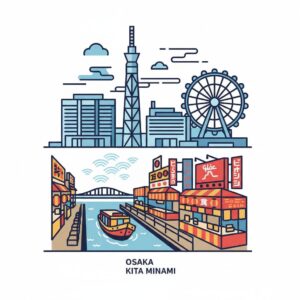
So you’ve moved to Osaka. You’ve mastered the train map, you can finally tell the difference between okonomiyaki and monjayaki, and you’ve learned to stand on the right side of the escalator. You think you’ve got this city figured out. But then you start noticing something. A conversation with a colleague about where to go for dinner on Friday night sparks a surprisingly intense debate. One person insists on a chic new Italian place with skyline views in Umeda. Another scoffs, championing a loud, cramped, but legendary yakitori joint tucked under the tracks in Namba. They’re not just talking about restaurants; they’re talking about identity. They’re talking about Kita versus Minami. For a tourist, Umeda (Kita) and Namba (Minami) are just two major stops on the Midosuji subway line, two massive hubs of shopping and entertainment. For anyone living here, they represent two fundamentally different ways of life, two distinct urban philosophies, two warring halves of Osaka’s soul. This isn’t a guide about where to see the Glico Running Man or which department store has the best sales. This is the deep dive, the real talk for residents. Understanding the Kita-Minami divide is the key to understanding how Osaka truly operates, how its people think, and ultimately, where you, a long-term resident, might find your place in this magnificent, maddening city.
Residents might find that examining the subtleties of everyday interactions, like local neighborhood communication, offers a revealing glimpse into Osaka’s evolving urban identity.
The Vibe Check: Kita’s Polished Professionalism vs. Minami’s Raw Energy
Your first true encounter with the North-South divide isn’t something you read about; it’s something you feel deep in your bones the moment you step off the train. The very air seems to shift. It’s a fundamental contrast in atmosphere, a Tale of Two Cities unfolding across just a few kilometers of subway track. One side offers a symphony of curated elegance; the other erupts in a riotous blast of rock and roll. Choosing where to hang out means choosing your energy for the day, and for long-term residents, it often reveals a deeper personal alignment.
Kita (Umeda): The Suit and Tie, the Department Store, the Calculated Calm
Stepping into the vast, cathedral-like Osaka Station places you firmly in Kita. The first thing that grabs your attention is the scale and the shine. Everything here is large, new, and immaculately clean. Grand Front Osaka—a sprawling complex of shops and corporate offices—radiates modern architectural confidence. The Umeda Sky Building soars into the clouds, a monument to ambition. This is Osaka’s official face, the one it shows to the global business community. It feels structured, organized, and strikingly efficient. It’s the city dressed in a freshly pressed suit.
The pace of people here follows a different beat. It’s a brisk, purposeful stride. Office workers, salarymen and women in sharp, dark suits, wear expressions focused on a day full of meetings and deadlines. Shoppers glide through the spotless halls of the Hankyu and Hanshin department stores, carrying branded paper bags with quiet satisfaction. Conversations are hushed, suited to the reserved atmosphere of a high-end café or corporate lobby. There’s an unspoken pressure to project success and sophistication. It’s not unfriendly—far from it—but more restrained. The vibe is reminiscent of Tokyo’s Marunouchi or Shinjuku business districts, a comparison that some Osakans from the South might find deeply insulting.
A daily ritual here tells the tale. Grabbing coffee in Kita isn’t about a quick caffeine fix. It’s an experience. You might visit a minimalist, design-forward café inside Lucua 1100, where the barista prepares your single-origin pour-over with surgical precision. You sit at a spotless white counter, surrounded by people quietly typing on MacBooks. The coffee is excellent, though its price reflects the ambiance, branding, and prime location. The mindset in Kita is aspirational. It’s about looking ahead, climbing the corporate ladder, and savoring the finer things. It embraces global trends, luxury brands, and a lifestyle carefully curated and displayed—much like the exquisite food presentations in the basement of the Hankyu department store.
Minami (Namba, Shinsaibashi, Dotonbori): The Open Collar, the Market Stall, the Beautiful Chaos
Now, take the Midosuji Line eight minutes south to Namba. The instant the subway doors open, the difference is palpable. The air thickens, heavy with the scent of grilled octopus and savory broth. The volume bursts to eleven. You’re hit by a wall of sound: the clang of pachinko balls, the lively shouts of street vendors, the overlapping jingles from a thousand shops, and the constant, roaring flood of human voices. This is Minami. It’s Osaka with sleeves rolled up, collar loosened, and a cheap beer in hand.
There’s no single grand organizing principle here. It’s a glorious, sprawling chaos. Exiting the station, you enter a labyrinth of covered shopping arcades (shotengai), narrow alleys, and streets ablaze with buzzing, flashing, gloriously tacky neon signs. The crowd is a different breed entirely—young, loud, and infinitely more diverse in style. You see teenagers in cutting-edge streetwear from Amerikamura, wide-eyed tourists with selfie sticks, and old ladies in leopard print (an Osaka cliché for good reason) haggling over fruit. People don’t move in straight lines; they flow and swirl like a human river. The energy is kinetic, spontaneous, and unapologetically alive.
Let’s revisit that coffee break, Minami-style. You might duck into a tiny, decades-old kissaten tucked in a back alley behind the Namba Grand Kagetsu theater. The air is thick with faint cigarette smoke and fresh coffee aromas, the velvet seats worn, and the elderly owner might grunt a welcome before quietly setting a glass of water on your table. Or you might just grab a canned coffee from a vending machine and stand on Ebisubashi Bridge, sipping while watching the glorious chaos of Dotonbori below. The experience isn’t about minimalist aesthetics; it’s about character, authenticity, and a practical approach to life. The Minami mindset is grounded. It’s about the here and now. It values a good laugh, a cheap and tasty meal, and genuine, unpretentious connections with those around you. It’s the city’s beating, boisterous heart—and it couldn’t care less if its suit is wrinkled.
Where You Shop Defines Who You Are: The Consumer Culture Divide
In Osaka, a city shaped by merchants, shopping transcends mere errands to become a means of self-expression. The most pronounced contrasts between the Kita and Minami mindsets reveal themselves in how their inhabitants engage with the art of consumption. It’s a tension between carefully curated elegance and the exhilaration of the hunt. Where you decide to spend your money speaks volumes about the values you cherish.
Kita’s Curated Consumption
Shopping in Umeda is a refined, almost theatrical affair. The major department stores—Hankyu, Hanshin, Daimaru, and Isetan—stand as the sanctuaries of this approach. Entering the Hankyu Umeda Main Store feels like stepping into another world. Soft lighting, subtle fragrances in the air, and staff embodying Japanese omotenashi with deep bows and polite, honorific speech set the tone. Products are displayed not merely on shelves but in artfully curated arrangements. You don’t just buy a handbag; you are guided through an entire collection. You don’t simply pick up a cake; you appreciate it as an edible masterpiece before it is placed in an impeccably designed box with a chilled gel pack to preserve its perfect condition on your way home.
The value system here centers on brand prestige, guaranteed quality, and the pleasure derived from the environment itself. People come to Kita to purchase items that are “proper” (chanto shiteru). This is the place to buy a gift for your boss, a suit for a critical interview, or a luxury watch to commemorate a milestone. Price takes a back seat to quality assurance and the status conveyed by the brand’s signature paper bag. Grand Front Osaka and Lucua cater to a somewhat more modern yet equally discerning clientele. Here, you’ll find upscale lifestyle brands, international fashion labels, and showrooms showcasing the latest technology. The focus is on innovation and a sophisticated, global sense of style. Shopping in Kita is calm, intentional, and reassuring—it’s about purchasing into a complete, polished lifestyle.
Minami’s Thrifty Thrills and Street Style
If Kita is a curated museum, Minami is a sprawling, chaotic bazaar. Its main artery is the Shinsaibashi-suji Shopping Arcade, an endless covered street that bombards the senses. J-pop blasts from shops, discount cosmetic stores have staff shouting deals through megaphones, and the sheer crowd density feels like you’re swept along by a current. This is the realm of the bargain.
The guiding principle in Minami is cost performance, or “cos-pa” as it’s called in Japanese. An Osakan from the Minami tradition doesn’t want merely something cheap; they seek excellent quality at an unexpectedly low price. Scoring a great deal is worn as a badge of honor. A conversation might go, “You like this jacket? I got it for 3,000 yen in Amemura! Can you believe it?” The price becomes part of the story, a testament to their savvy as a shopper. This mindset pervades all commerce here. In the Sennichimae Doguyasuji Shopping Street, restaurateurs haggle for the best prices on kitchen tools. At Kuromon Ichiba Market, shoppers trade banter with vendors to secure the freshest fish at a fair cost. In Amerikamura, the youth fashion hub, teenagers sift through racks of vintage clothing to uncover a unique piece expressing their individuality without breaking the bank.
Shopping here is an adventure, not a ritual. It’s about plunging into chaos and emerging with a treasure. It values personality over prestige. You might find a quirky Engrish t-shirt that becomes your favorite item or a handcrafted pottery piece from a tiny Horie backstreet shop. The worth lies not in a brand name but in the story, the uniqueness, and the satisfaction of the find. This is Osaka’s merchant spirit in its purest, most unfiltered form.
The Social Scene: After-Work Drinks and Weekend Hangouts
Nowhere is the cultural divide more evident than after nightfall. The ways Osakans socialize, drink, and eat reveal their fundamental values. Choosing between a night out in Kita or Minami is essentially picking between two completely different social frameworks. One emphasizes sophistication and impression-making; the other focuses on letting go and enjoying the moment.
Kita by Night: Refined Drinks and Cityscape Views
The nightlife in Kita is, like everything else, more polished and upscale. Kitashinchi serves as the main hub for high-end entertainment, boasting elegant restaurants, exclusive clubs, and hostess bars often likened to Tokyo’s Ginza. Here, company executives entertain important clients in private rooms of traditional ryotei restaurants, where impeccable service and sky-high bills are the norm. It’s a realm of discreet expense accounts and subtle power plays.
For the typical professional, an evening in Kita remains a more formal affair. It might involve dinner at a trendy restaurant in Grand Front Osaka, offering sweeping views of the city lights. This is the spot for special occasions — anniversaries, promotion celebrations, or a third date meant to impress. Afterward, you might head to a sophisticated cocktail bar in luxury hotels like the Ritz-Carlton or InterContinental. The music is soft, lighting low, and the mixologist crafts your drink with artistic precision. The social atmosphere is more reserved: you dress well, speak quietly, and focus on quality conversation and savoring the refined ambiance. It’s a controlled, elegant, and often pricey way to relax.
Minami After Dark: Dive Bars, Street Food, and Spontaneous Connections
Minami after dark is the city’s id unleashed. Reservations are often joked about, and plans are merely suggestions. A night out here is a spontaneous journey of discovery. The heart of this energy lies around Namba and Dotonbori. You don’t stick to one place; you embark on a multi-stage adventure.
Your evening may begin at a tachinomi (standing bar) in Ura Namba. You find yourself squeezed in shoulder-to-shoulder with locals from all backgrounds, shouting your order for cheap beer and skewers to the staff at the center. Social barriers quickly dissolve. Within minutes, you could be laughing with the construction worker on one side and the office worker on the other. There’s an instant camaraderie fueled by good food and affordable drinks.
From there, the night transforms into a choose-your-own-adventure. Maybe you pick up some takoyaki from a popular street vendor and eat it on the canal steps, watching neon reflections ripple on the water. Maybe you venture into the Misono Building, a wonderfully quirky, semi-derelict space filled with dozens of tiny, eccentric, themed bars seating no more than eight people each. You might find a horror movie bar, another dedicated to 8-bit video games, or one run by a master magician. The night is about hopping from bar to bar, following the vibe, and embracing unpredictability. You could end up in a karaoke box at 3 AM with strangers you just met. It’s loud, messy, and utterly liberating. Here, Osaka’s famous friendliness isn’t just an idea; it’s a vivid, lived experience.
Living the Life: Choosing Your Neighborhood
For a traveler, this is an intriguing cultural exploration. But for a local, this is the most vital question: where do you put down roots? The decision of which side of the city to live on will deeply influence your daily routine, commute, weekend activities, and the community you cultivate around you. It’s a choice that extends far beyond just the cost of rent.
Life in the North: Convenience, Calm, and Connections
Choosing to live in the Kita area doesn’t necessarily mean residing in a skyscraper apartment right above Umeda Station. It means opting to live within the sphere of this northern hub. Neighborhoods like Nakazakicho, known for its bohemian atmosphere and quiet, artsy cafés, or Tenma, home to one of Japan’s longest and liveliest shopping arcades, offer a more residential vibe while still being firmly within Kita’s reach. Further afield, the residential zones along the Hankyu railway lines toward Kobe and Kyoto are highly favored by professionals and families.
Life here is grounded in supreme convenience. Umeda Station is a transportation hub like no other in western Japan. Living in the north grants you effortless access to Kyoto, Kobe, and the Shinkansen without the chaos of the southern hub. Daily life tends to feel calmer and more orderly. Streets are often wider, parks meticulously maintained, and there’s an overall sense of suburban peace, even in central areas. This lifestyle lets you engage with the city’s professional and commercial core on your own terms, then retreat to a quieter, more stable home. It’s often unfairly labeled as “sterile” or “boring” by Minami enthusiasts, but that’s a vast oversimplification. The culture exists—it’s just subtler. It lives in the small, independent coffee roasters, specialty bakeries, and the intensely local atmosphere of the Tenjinbashisuji Shotengai, which feels worlds apart from the tourist-packed arcades of the south.
Life in the South: Immersion, Grit, and Community
Choosing to live in the south means embracing a life of full immersion. It means accepting, and even celebrating, the city’s raw, gritty reality around the clock. Neighborhoods near Namba, like Daikokucho or Ashiharabashi, form a dense fabric of old apartment blocks, small factories, and bustling local shopping streets. Areas such as Shinsekai, with its nostalgic Showa-era charm and the iconic Tsutenkaku Tower, offer a glimpse into a version of Osaka seemingly untouched by time. It’s definitely less polished. Streets can be narrower, buildings older, and noise levels higher. But what you receive in return is an extraordinary sense of character and community.
Living here means your local tofu shop owner remembers your order. It means the elderly couple running the corner okonomiyaki joint asks about your day. It means belonging to a living, breathing neighborhood ecosystem that often feels lost in the more transient, professional north. The cost of living is frequently lower, and access to affordable, exceptional food is unmatched. Many misunderstand the south as merely a tourist zone or unsafe. While it has its rougher edges, for residents it’s a place filled with warmth and communal spirit. It’s a lifestyle for those who don’t just want to observe Osaka—they want to feel its heartbeat daily, to be part of the chaotic symphony rather than just an onlooker.
So, Are You Kita or Minami?
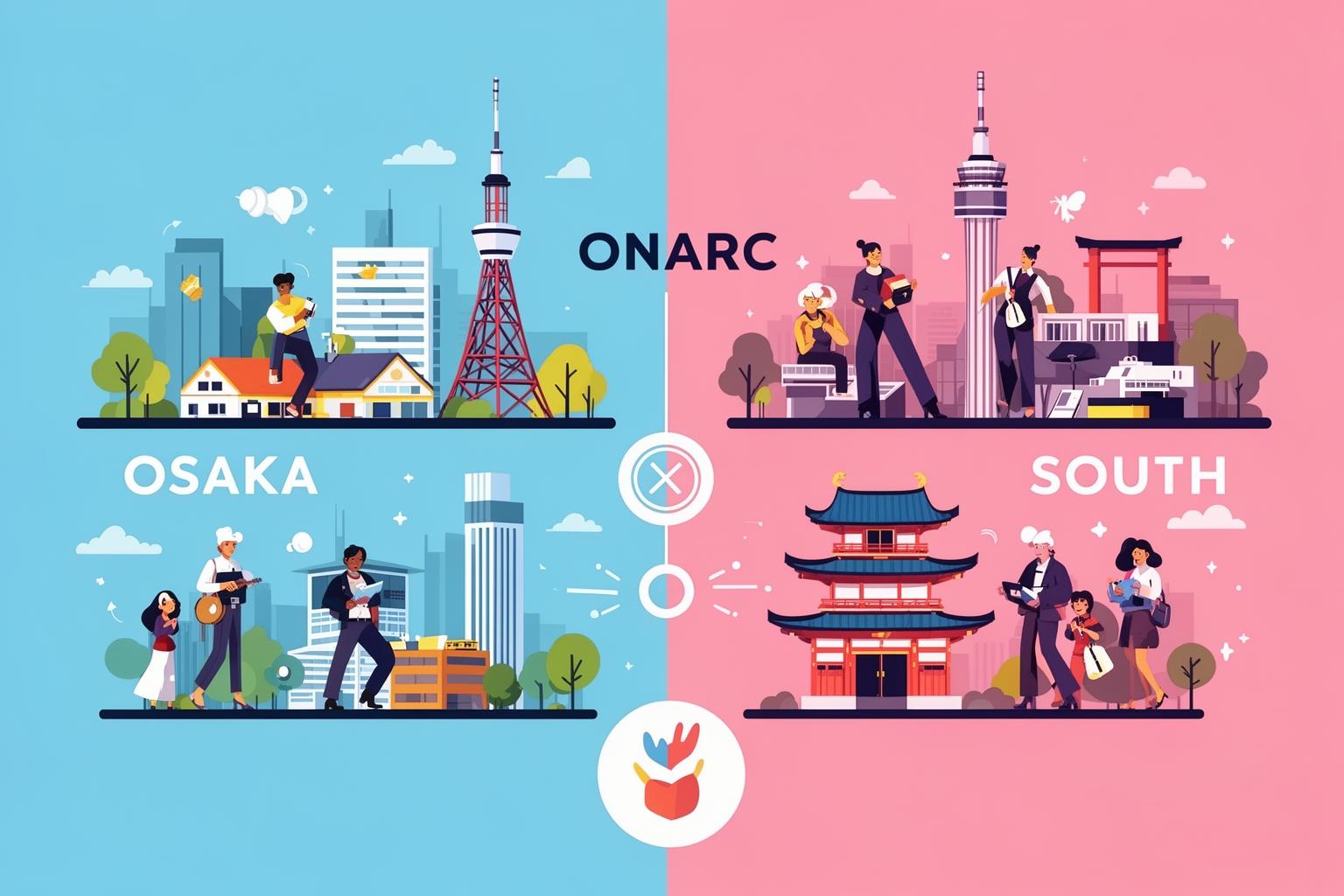
Ultimately, this isn’t a contest. There is no “better” Osaka—only the Osaka that suits you best. The Kita-Minami divide serves as a fascinating Rorschach test, revealing your personality and priorities. It encourages you to reflect on what you genuinely seek from life in this city.
If you thrive on order and efficiency, value modern design and refined experiences, and view your time in Japan as part of a clear professional path, Kita’s polished and ambitious environment will likely feel like home. It’s Osaka’s global face, a city that can compete with any major metropolis worldwide, offering comfort, convenience, and carefully curated elegance.
On the other hand, if spontaneity fuels you, if you find charm in the grit and chaos of urban life, if you prefer a good bargain and hearty laughter over prestigious brands, and crave immersion in the raw, unfiltered culture that defines this city, then your soul belongs to Minami. It is Osaka’s unmistakable heart, a place bursting with energy, warmth, and genuine humanity.
The best part? This spectacular cultural contrast exists within just a 15-minute, 240-yen subway ride. You can reside in a tranquil, orderly northern neighborhood and, whenever you feel like it, dive into the vibrant chaos of the south for an evening. You can work in a sleek Kita skyscraper and enjoy lunch at a century-old udon shop tucked away in a Minami alley. You don’t have to pick a side forever. You can embrace both. Perhaps learning to navigate and appreciate these two opposing yet complementary forces is the true essence of understanding and loving Osaka.