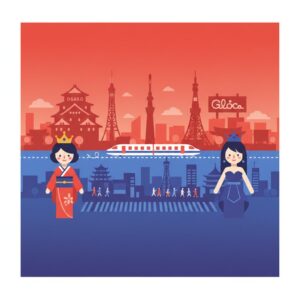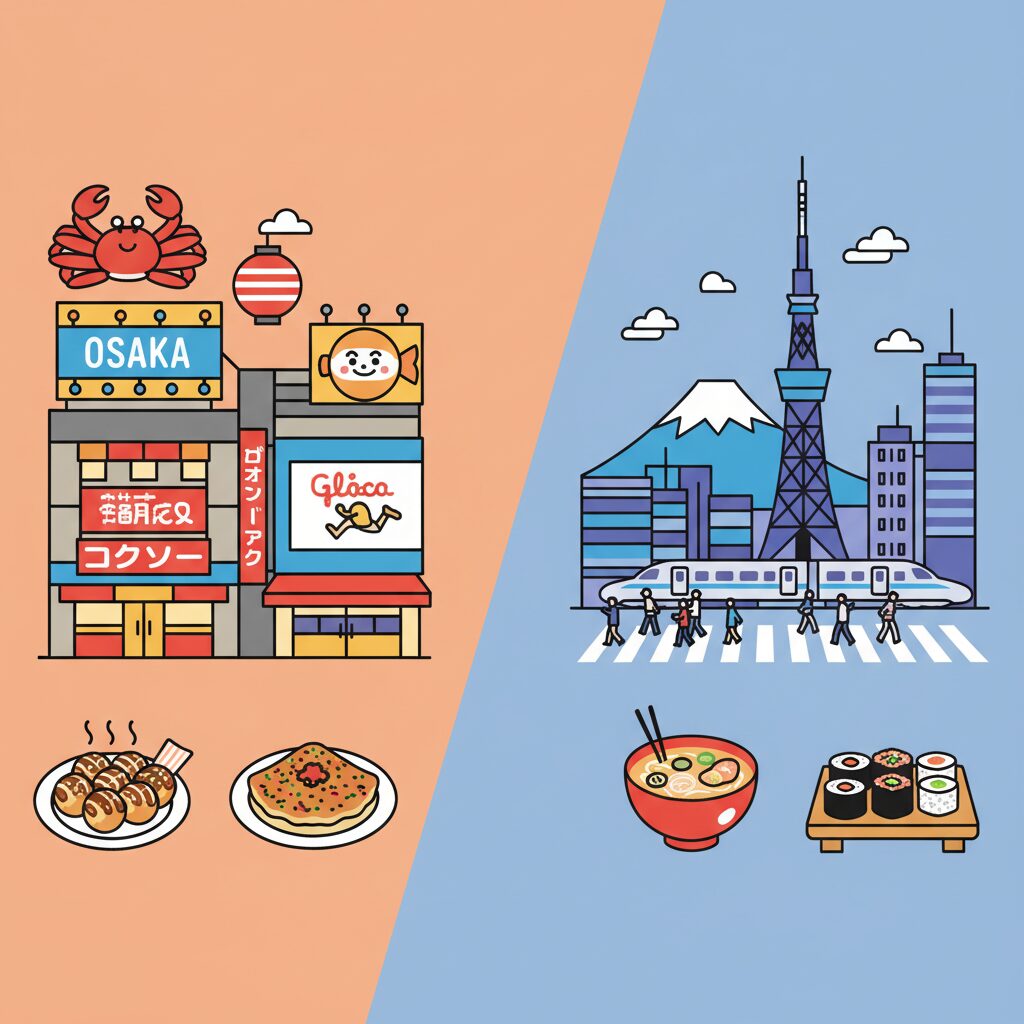
Step off the Shinkansen in Tokyo, and you enter a world of quiet efficiency. People move with a shared, unspoken purpose. Conversations are muted, interactions are polite, and public space is treated with a kind of collective reverence. It’s a city that operates on the principle of minimizing friction. Then, you arrive in Osaka. The volume goes up. The colors seem brighter. And within an hour, a shopkeeper might playfully roast your fashion sense, a stranger on the train might comment on the book you’re reading, and the person next to you at a ramen counter might launch into an exaggerated tale about their terrible boss. The initial culture shock isn’t just about the dialect or the food; it’s about the fundamental software of social interaction. You’ve left the land of the respectful bow and entered the territory of the well-timed punchline. For many foreigners, this raises a crucial question: Is Tokyo just formal and cold? Is Osaka simply friendly and chaotic? The truth is far more interesting. What you’re experiencing is a deep cultural divide rooted in centuries of history, where Tokyo’s social currency is harmony, and Osaka’s is humor. This isn’t just about professional comedians on TV; it’s about Owarai (comedy) as a daily communication tool, a philosophy woven into the very fabric of life. Understanding this difference is the key to truly unlocking the city and its people, to moving beyond the clichés and seeing the brilliant, complex logic behind the laughter. Welcome to Osaka, where the quickest way to the heart is through a shared joke.
Osaka’s vibrant everyday humor is vividly captured in the distinctive obachan culture, which offers an insightful contrast to Tokyo’s reserved mannerisms.
The Unspoken Language of Laughter: Owarai in Everyday Osaka
In Osaka, a simple transaction is seldom just a straightforward exchange. It’s a performance, a small stage for human connection, and the script is almost always comedic. The core concept here is the dynamic between boke and tsukkomi. In traditional manzai comedy, the boke plays the silly, air-headed character who says something absurd, while the tsukkomi is the quick-witted, logical straight man who corrects the boke, often with a light tap from a paper fan. This dynamic permeates daily life in Osaka, where you are constantly, and often implicitly, invited to take on one of these roles. It’s a conversational dance that prizes wit over politeness and engagement over restraint.
The Anatomy of an Osaka Interaction
Step into a small clothing shop in the Shinsaibashi-suji shopping arcade. In Tokyo, you’d typically be greeted with a polite, almost whispered “Irasshaimase” (Welcome) and then left alone until you ask for help. In Osaka, the shop owner, a woman in her sixties with brightly colored hair, might glance at the T-shirt you’re holding and say, “That one? It’s nice, but it will make your face look bigger. This one over here is better.” This isn’t meant as an insult. It’s an opening move. It’s the boke—an unexpectedly blunt and slightly absurd remark. Your role is to be the tsukkomi. A timid response would be to quietly put the shirt down. A better response is a playful comeback: “My face is already big, so it doesn’t matter!” or the classic “Nande ya nen!” (roughly, “Why would you say that?!” or “No way!”). Nail this, and her face will light up with a wide grin. You’ve passed the test—you’ve shown you understand the language. This banter acts as social bonding; it builds a brief, warm connection that makes the transactional aspect of your visit secondary. It’s about creating a memorable, human moment.
The Currency of a Good Story
Listen to a group of friends chatting in an Osaka izakaya and compare it to a similar situation in Tokyo. In Tokyo, conversations tend to be more measured, centered on exchanging information, making plans, or sharing feelings in a relatively straightforward way. The aim is often consensus and mutual understanding. In Osaka, however, the aim is entertainment. A story is not merely a recounting of events; it’s raw material to be shaped into a captivating narrative, complete with exaggeration, sound effects, and a killer punchline. The truth becomes flexible if it serves the story. If someone is five minutes late for a meeting, they won’t just say, “Sorry, traffic was bad.” Instead, they’ll deliver a mini-monologue: “The old lady in front of me on the escalator—I swear she was moving backward. A snail passed her. I thought I’d been trapped in a time warp!” Listeners aren’t expecting a factual report; they expect to be entertained. Being a good storyteller, someone who can find humor in the mundane, is a highly prized social skill. It’s how you earn your place at the table, both literally and figuratively. This performative aspect of communication is central to Osaka’s identity, making everyday life feel more like a series of improvisational sketches than a string of formal routines.
Tokyo’s Code of Conduct: The Art of Quiet Harmony
To fully appreciate Osaka’s distinctiveness, you need to understand its contrast: Tokyo. The capital’s social etiquette is a masterclass in managing high population density. With nearly 14 million people navigating crowded public areas, a different set of rules applies. The guiding principle is wa (和), or group harmony, which is maintained by prioritizing collective comfort over individual expression. This results in a culture that may seem reserved or distant to outsiders but is, in truth, a highly refined system of non-verbal respect. While Osaka uses humor to create connections, Tokyo relies on consideration and restraint.
The Unspoken Agreement on the Yamanote Line
Board a train on the JR Yamanote Line during rush hour. The car is packed shoulder-to-shoulder, yet it remains remarkably quiet. People focus on their phones, books, or gaze into the middle distance. Eye contact is avoided. Phone calls are prohibited. Even conversations among friends are whispered. This is not because Tokyo residents are unfriendly; rather, it reflects an unspoken social contract. Each person voluntarily minimizes their presence—their noise, physical space, and emotional expression—as a courtesy to others sharing the highly limited space. It’s a collective, silent effort to make an uncomfortable situation more bearable. Now, picture this scene on the Osaka Loop Line. The ambient noise is noticeably louder. An obachan (middle-aged or older woman) might loudly exclaim, “Atsui ne!” (It’s hot, isn’t it!) to no particular person, with someone else joining in agreement. Friends will laugh heartily. The idea of public space is different; it’s less of a neutral zone to pass through quietly and more a communal area where life unfolds. In Tokyo, harmony is the absence of disruption. In Osaka, harmony emerges from shared, lively experiences.
Tatemae and Honne: Two Sides of Communication
This contrast is perfectly illustrated by the concepts of tatemae and honne. Tatemae (建前) is the public facade, the opinions and behaviors shown in public to preserve harmony and meet social expectations. Honne (本音) reflects one’s true, private feelings. In Tokyo’s business and social environments, tatemae is vital. You learn to read between the lines, understanding that “I will think about your proposal” often means “no,” but this phrasing avoids offense. A direct refusal is perceived as disruptive. Osaka, though not free from this dynamic, operates with a much thinner barrier between honne and tatemae. People are more likely to express their true thoughts, but soften criticism with humor. A Tokyo boss might critique a report by saying, “This is a good start, but let’s examine the data from another perspective.” An Osaka boss might say, “What is this, a novel? I fell asleep by page two! Get to the point faster next time, but the graphs on page five were good.” The Tokyo version is polite yet ambiguous. The Osaka version is blunt but includes a clear compliment, and the humorous tone signals the criticism isn’t personal. It’s feedback meant to be efficient and memorable, not necessarily gentle.
When Cultures Collide: Common Misunderstandings for Foreigners
Navigating these two deeply rooted yet distinctly different communication styles can be challenging for non-Japanese residents. What is meant as friendly banter in Osaka might come across as a personal attack, while Tokyo’s polite restraint can be misread as aloofness or indifference. Understanding this requires letting go of your own cultural assumptions and learning to interpret the intent behind the words.
Is It a Joke or an Insult? Reading the Room in Kansai
The biggest challenge in Osaka is distinguishing between teasing (ijiri) and genuine criticism. Ijiri is a core aspect of Kansai communication and, importantly, it often signifies affection. When people feel at ease with you, they begin to playfully tease you. It’s their way of saying, “I acknowledge you, and I’m comfortable enough to joke with you.” A coworker might poke fun at your loud tie, or a cashier might comment on your habit of buying the same brand of beer. This can be surprising at first. However, the key is to pay attention to the context. Is there a smile? Is the tone lighthearted? Are others laughing too? If so, you are being included. The worst reaction is to become defensive or offended. The best response is to gently joke back. This exchange is what strengthens the social connection. In Tokyo, unsolicited personal remarks from acquaintances or strangers would be almost unthinkable and considered a serious breach of etiquette.
“Friendly” vs. “Nosy”: The Osaka Take on Personal Space
Osaka’s version of “friendliness” often appears as “nosiness” to many Westerners. People might ask questions deemed too personal elsewhere: “Are you married?” “How much is your rent?” “Why are you still single?” An elderly woman might stop you on the street to adjust your collar or suggest you wear a hat in the sun. From their perspective, this isn’t an invasion of privacy. It comes from a community-focused mindset where everyone looks out for each other. It’s the sense of a village mentality expanded to city scale. They treat you not as a stranger but as a neighbor, a member of the local group. The polite, distant boundaries typical of Tokyo, which align more with Western ideas of personal space, are often perceived in Osaka as cold or standoffish (tsumetai). In Osaka, showing interest—even if blunt—is a way of showing you care. They are engaging with your life, not merely ignoring it politely.
The Historical Roots: Why Are They So Different?
These cultural attitudes are not random; they are the natural results of centuries of divergent history. The characters of Osaka and Tokyo were shaped by the vastly different economic and political circumstances of feudal Japan, and those influences resonate in every conversation today.
The Merchants of Naniwa vs. The Samurai of Edo
Osaka, historically known as Naniwa, was Japan’s commercial center, the tenka no daidokoro (the nation’s kitchen). It was a city of merchants (shonin), artisans, and traders. Success depended on the ability to build rapport quickly, negotiate cleverly, and stand out in a crowded marketplace. Status was fluid, based on wealth and cleverness rather than birthright. Humor became an essential business tool—a way to disarm rivals, charm customers, and forge lasting relationships. A witty phrase could close a deal. This fostered a practical, egalitarian, and expressive culture that valued results and personality over strict formality. Meanwhile, Tokyo, then Edo, was the seat of the Tokugawa shogunate—a military government. It was a city of samurai, bureaucrats, and feudal lords. Society was rigidly hierarchical and governed by strict codes of conduct. Preserving face, showing respect to superiors, and mastering elaborate etiquette were crucial for survival and advancement. Bluntness could be dangerous. This environment produced a culture that prized order, discipline, and the suppression of personal feelings for the sake of a smooth, predictable social order.
Language as a Reflection of Culture
The dialects themselves tell the story. Kansai-ben, the dialect of Osaka and its surrounding region, is known for its distinctive melodic intonation, punchy rhythm, and rich vocabulary filled with expressive, often humorous words. Its grammar and flow are perfectly suited for the rapid-fire exchange of boke and tsukkomi. It’s a language that feels vibrant and energetic. Standard Japanese, or hyojungo, is based on the dialect of the Yamanote high-class district of old Tokyo. By comparison, it is flatter in intonation and more formal in structure. It is a precise and polite language, ideally designed for clear, unambiguous communication within a bureaucracy and for maintaining respectful distance. One is the language of the marketplace; the other, the language of the court.
Living the Difference: Practical Takeaways for Residents
Understanding the theory is one thing; putting it into practice is another. For foreigners, successfully integrating means mastering the art of code-switching—adjusting your communication style to fit your location and audience. Thriving in Japan means realizing there isn’t a single “Japanese way,” but many.
How to Thrive in Osaka’s Social Scene
To truly enjoy life in Osaka, you have to lean in. When a shopkeeper teases you, take it as a warm welcome. Respond with a simple tsukkomi. You don’t need to be a comedy expert; a casual “Nande ya nen!” or “Meccha iu ya anata!” (You’ve got a lot of nerve!) said with a smile goes a long way. It shows you understand the local rhythm. Also, embrace vulnerability in your stories. Don’t just share the polished highlights of your life. Talk about your mistakes, silly blunders, and frustrations. In Osaka, self-deprecation isn’t a sign of weakness; it’s a mark of confidence and a powerful way to connect. People aren’t interested in your flawless resume; they want the funny tale about how you got lost on the way to an interview. Release the pressure to impress and focus on being relatable.
Navigating Tokyo as an “Osaka-fied” Foreigner
If you move from Osaka to Tokyo, or even visit for business, you must consciously adjust your approach. The social skills that made you popular in Osaka can backfire in Tokyo. That friendly joke at a new colleague’s expense might come off as aggressive or rude. That loud, self-deprecating story in a quiet bar might be seen as attention-seeking and disruptive. In Tokyo, it’s safer to err on the side of caution. Listen more than you speak. Observe group dynamics before asserting yourself. Prioritize politeness and indirectness, especially in professional settings. Show respect through quiet attentiveness instead of boisterous engagement. This isn’t about losing your personality; it’s about respecting the local “operating system” and understanding that definitions of “good communication” aren’t universal, even within the same country.
Ultimately, choosing between punchline and bow is choosing between two brilliant ways to coexist. Tokyo’s formality is a mass-scale empathy that creates predictability and peace for millions. Osaka’s humor is mass-scale intimacy, breaking down barriers and finding joy in human chaos. Neither is better. They are simply different answers to how to build a world. Living in Osaka teaches you a laugh can be as meaningful as a promise, a shared joke can build bridges faster than formal introductions, and sometimes, the most honest thing you say is also the funniest. The city reminds you not to take life too seriously—because the punchline is always just around the corner.