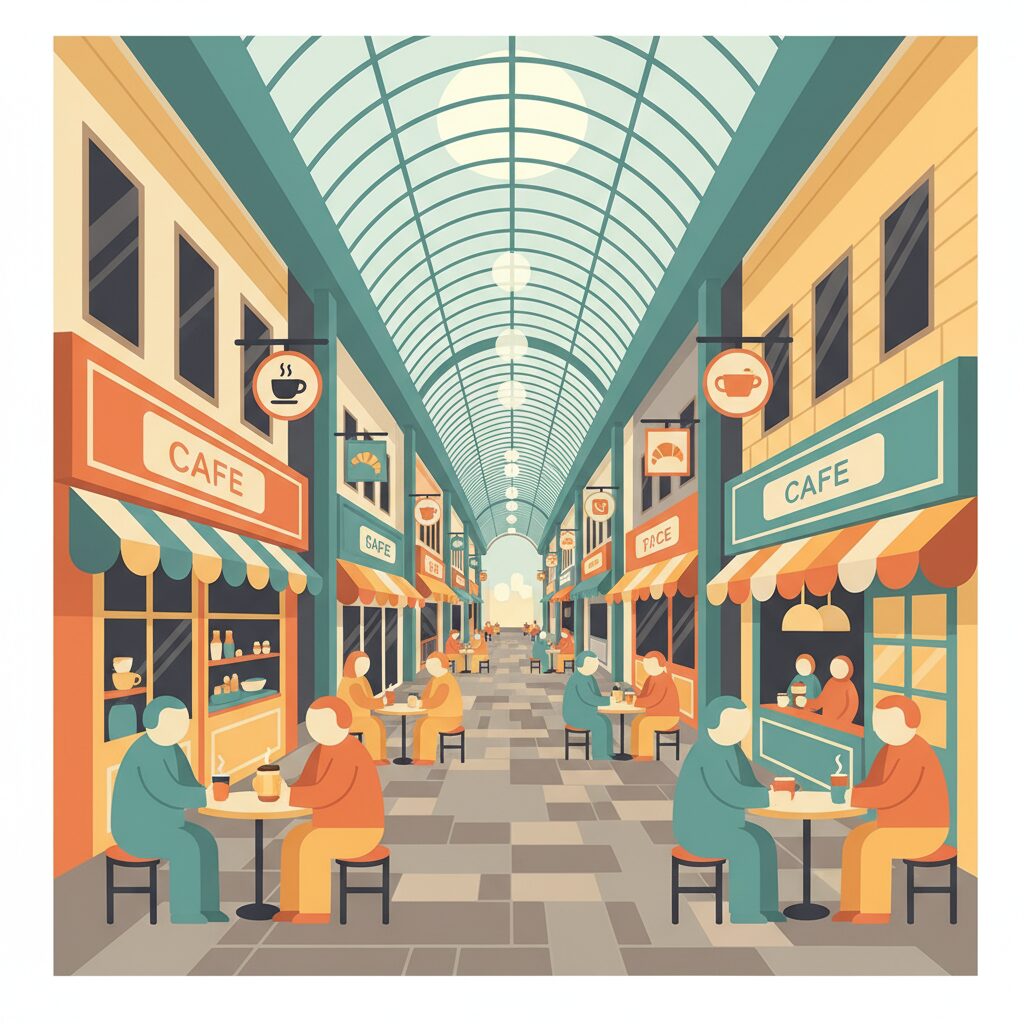
The laptop lifestyle. We’ve all seen the pictures: a sleek MacBook perched next to a perfect latte in a sun-drenched, minimalist cafe. It’s a clean, curated vision of remote work, a global aesthetic of productivity. And you can find it in Osaka, of course. The city has its share of polished, international-style coffee shops where you can plug in, tune out, and tap away in comfortable, predictable silence. But to really understand Osaka, to plug into its unique current, you have to close that laptop for a second, walk past the pristine glass storefronts, and dive into the controlled chaos of the shōtengai.
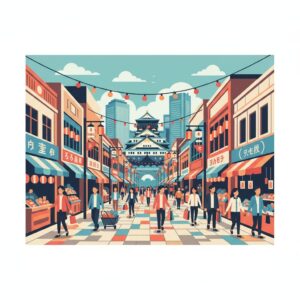
These covered shopping arcades are the arteries of Osaka’s neighborhoods. They’re not just commercial corridors; they are ecosystems, public squares sheltered from the rain and summer sun, echoing with the calls of vendors, the rumble of delivery bikes, and the chatter of generations. For the remote worker willing to look beyond the obvious, the shōtengai offers something far more valuable than free Wi-Fi. It offers a workspace that is alive, a place to work not just in the city, but with it. This isn’t about finding a sterile office-away-from-office. It’s about discovering the city’s shared living room, a place where business, community, and daily life blur into one vibrant, unpredictable, and profoundly Osakan rhythm. Forget the quiet focus of a library; this is about finding your flow in the middle of the river.
Stepping beyond the shōtengai’s hustle, you can also immerse yourself in Osaka’s vibrant community by visiting a local Tachinomi bar where the city’s social glue comes to life.
The Shōtengai Workspace: More Than Just Wi-Fi and a Power Outlet
Your first attempt to work in a shōtengai might feel like a misstep. You’ll be searching for signs, for permission. You’ll look for familiar indicators of a work-friendly environment: ample power outlets, a discreet sign with a Wi-Fi password, the soft hum of others typing. You won’t find them. Instead, you’ll discover places that were never designed for you, the remote worker. And that’s exactly where their charm lies. These spaces call for a different kind of awareness, a shift from a consumer mentality to that of an active participant.
Reading the Air: The Unspoken Rules of the Kissaten
Let’s begin with a classic shōtengai fixture: the kissaten. This is not Starbucks. A kissaten is a neighborhood coffee house, often decades old, permeated by the faint, sweet aroma of lingering cigarette smoke (many still allow it), dark wood, and coffee brewed with painstaking care via siphons or flannel drip. The owner, the “Master,” is no youthful barista; he’s a lifelong veteran who knows every regular by name and order. The soundscape here is vital. It’s not the hushed reverence of a study hall. It’s the gentle clink of ceramic on saucer, the rustle of a newspaper, the quiet murmur of friends who have met at the same table every Tuesday for twenty years.
Bringing a laptop into this setting can feel like pulling out a synthesizer at a classical concert. The key is grasping the implicit contract. In Tokyo, the rules are often explicit: “Maximum stay 90 minutes,” “No laptops during lunch hour.” The exchange is straightforward. You pay for a drink and a slice of time. In an Osaka kissaten, the rules are spoken in silence. The concept of nagai, or lingering for a long time, is the norm among regulars. You might spot an elderly gentleman carefully marking up a horse racing form, nursing a single cup of “blend coffee” all morning. He’s not just a customer; he’s part of the furniture, an essential layer of the room’s atmosphere.
Your one-drink purchase doesn’t buy you 90 minutes; it grants you entry into this social space. How long you stay depends on your sensitivity to the setting. Is the Master beginning to look stressed? Is a line forming at the door? Is every table occupied? These are your signals. No sign will tell you to leave. No one will ask you to go. But a subtle shift in the room’s energy will indicate that it’s time to pack up. This calls for active observation, a skill often lost in the noise-cancelled bubble of modern work. You must become a temporary regular, attuned to the rhythm of the permanent ones. Your rent is paid not only with yen but with social awareness.
The “Accidental” Workspace: Where Productivity Meets Chaos
Beyond the kissaten, the shōtengai offers an even more radical vision of the impromptu workspace. This is the authentic Osaka, a city grounded in pragmatism. An empty space is wasted space. This philosophy creates what I call the “accidental workspace.” Picture the small, slightly worn table and chairs in the corner of a tofu shop, nominally for customers to rest their bags. During a quiet afternoon, that’s a desk. Consider the wide, bench-lined section of the arcade near the community bulletin board. That’s a standing desk overlooking the city’s lifeblood. I’ve answered urgent emails while seated at a tiny table in an old okonomiyaki restaurant at 3 PM, the air thick with the savory aroma of bonito flakes and sauce, the only other sound the clang of the chef’s spatulas prepping for the evening rush.
This is worlds apart from the curated productivity of a Tokyo co-working space, where every surface is optimized for ergonomic comfort and minimal distraction. Working in the shōtengai is an act of immersion. The sensory input can be overwhelming at first. The fishmonger’s booming call of “Irasshai!” The sizzle of takoyaki on the griddle. The tinny tune of the butcher shop’s theme song. The rumble of a granny’s souped-up electric shopping cart. It’s the opposite of a sterile, focus-engineered setting. Yet, for a certain mindset, this chaos fosters a unique kind of focus. It forces you to concentrate, carving out your own bubble of productivity amid the storm. It’s also a constant reminder that your work, whatever it may be, is just one small part of a much larger, messier, and more fascinating human endeavor. It keeps your ego in check.
The Osaka Mindset: Business, Banter, and Blurring Boundaries
To grasp why these impromptu workspaces are so effective, you need to understand the Osaka mindset. In Tokyo, roles are distinctly defined: you are the customer, and they are the service provider. The interaction is impeccably polite, professional, and essentially distant. In Osaka, those boundaries are beautifully and wonderfully blurred. Commerce here is not merely a transaction; it’s a conversation. It’s a relationship, no matter how brief.
The Transactional Friendship of the Shōtengai
Set up your laptop at the same shōtengai kissaten three days running, and on the fourth day, the Master will probably greet you with “Maido!” This goes beyond a simple “welcome.” It literally means “every time,” implying, “thanks for your ongoing patronage.” It’s an acknowledgment. You’re no longer a random stranger; you’re becoming part of the pattern. He might ask you, in a straightforward but friendly manner, what has you typing so intensely. This isn’t an invasion of privacy but rather an invitation to engage. He’s curious. He’s involved. In Osaka, good business is personal business.
This creates a form of transactional friendship—a relationship based simply on your frequent visits to their establishment. Yet it can develop into genuine warmth. I once spent a week working on a frustrating project at a small café’s corner table. The owner, a woman in her late sixties, observed me sighing and rubbing my temples over several days. On the fifth day, she placed a small plate of freshly cut fruit on my table. “You look tired. Eat this,” she said without waiting for thanks, then returned to polishing glasses. She didn’t charge me. It was an act of community care, a small gesture toward the well-being of someone occupying a corner of her world. It was also brilliant business—I became a customer for life.
Why the “Rules” Are More Like Guidelines
This social adaptability often confuses foreigners, especially those from Tokyo or Western countries. Japan is known for its rules, but Osaka is known for its exceptions. You might see a sign in a café that says, “One Drink Per Person, 90 Minute Limit.” In Tokyo, that’s taken as gospel; a staff member will politely but firmly remind you when your time is up. In Osaka, the sign is more a defensive tool than an absolute law. It’s there for the shopkeeper to use if the café becomes crowded and a line forms.
If you visit on a quiet Tuesday afternoon and the place is half empty, that sign is practically invisible. The owner would find it absurd and rude to kick out a paying customer when seats are available. The unwritten rule is jōkyō handan—judging the situation. The onus is on you, the customer, to use good judgment. Is the place packed? Then honor the sign and move on. Is it quiet? Feel free to order another coffee and settle in. The rule is not a rigid command from an unseen authority but a flexible guideline in a social contract between you and the shop owner. This pragmatism, this belief that context outweighs dogma, drives daily life in Osaka. It demands that you stay present, observant, and considerate rather than simply compliant.
Navigating the Urban Topography: A Practical Guide
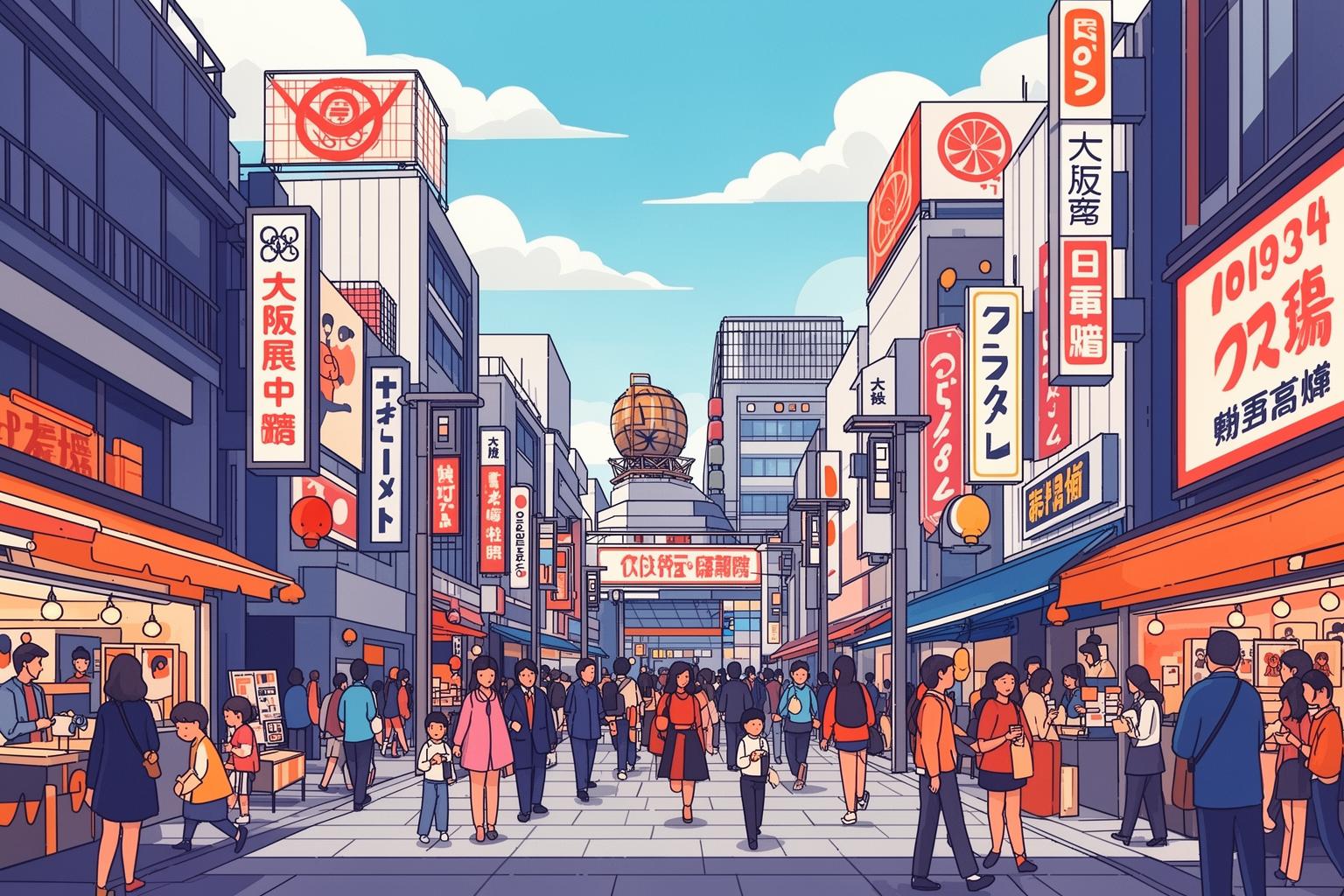
Adopting the shōtengai as your office requires some practical adjustments. It’s like transitioning from a paved road to a mountain trail—the terrain is less predictable, but the journey is much more fulfilling. You need to adjust both your equipment and your expectations.
Choosing Your Basecamp: Shōtengai Archetypes
Not all shōtengai are alike. Each has its own distinct character and offers a different work environment. Learning to read them is essential.
The Major Artery
Consider places like Tenjinbashisuji, Japan’s longest shopping arcade, or Shinsaibashisuji. These are the superhighways of shōtengai—long, wide, and continuously bustling. The benefits here include variety and anonymity. You’ll find everything from old kissaten to modern chain cafés, fast-food outlets, and more. You can blend into the crowd, and no one will notice or mind if you’ve been working on a spreadsheet for hours. The downside is the noise and the sheer volume of people. It can be overwhelming, a constant source of distraction requiring serious mental focus or a solid pair of noise-canceling headphones.
The Neighborhood Vein
These are smaller, quieter arcades that branch off the main streets, serving specific residential districts. Examples include the Karahori Shopping Street or numerous unnamed arcades in neighborhoods like Fukushima or Tenma. Here, choices are limited—you might find just one or two old coffee shops—but the experience is richer. These arcades function as genuine community hubs. After a few visits, you become recognized. Shop owners know each other, customers know each other, and soon enough, they know you. This is the place to cultivate transactional friendships. It’s ideal for deep, focused work interspersed with moments of real human connection. Your presence becomes woven into the local tapestry.
The Remote Worker’s Toolkit: Osaka Edition
Your usual digital nomad setup needs a few local tweaks to thrive in the shōtengai.
Power and Connectivity
First, forget the assumption that power outlets will be readily available—they’re a rare privilege in older establishments. A fully charged laptop and, crucially, a powerful portable battery bank aren’t optional; they’re essential. Requesting to use an outlet is a significant ask—it signals a long stay and shifts you from a casual customer to someone demanding resources. If you must ask, do so politely after ordering, and don’t be surprised if the answer is no.
Likewise, Wi-Fi isn’t guaranteed. Many traditional kissaten intentionally operate without it, fostering conversation and relaxation. A reliable mobile hotspot or ample phone tethering plan is critical. The few older places that do offer Wi-Fi are gems, perfectly blending traditional ambiance with modern convenience.
Noise and Language
The ambient noise is an unavoidable element of the experience. While noise-canceling headphones can help, I recommend a different approach: learn to embrace it. The rhythmic chatter, the clinking dishes, the distant train rumble—all can merge into a distinctive form of ambient white noise. It’s the sound of a city at work, and it can be oddly inspiring.
Making a small linguistic effort can also improve your experience. Most interactions can be managed with standard Japanese, but sprinkling in a little Osaka-ben demonstrates a willingness to connect locally. Saying ōkini instead of arigatō for “thank you” or hona instead of ja for “well then” when leaving often brings a smile. It’s a small gesture showing you’re more than a tourist or transient—you’re someone attentive to the local culture.
The Soul of the City’s Office
Ultimately, choosing to work from a shōtengai goes beyond simply finding a place to sit. It is a deliberate decision to engage with the city on its own terms. It represents a rejection of the sanitized, globalized version of remote work in favor of something messier, more genuine, and more deeply rooted in the local environment. Your workday no longer exists separately from the city’s life; instead, it is intricately woven into it. The vague frustration of a challenging email is softened by the sight of a shopkeeper patiently explaining the difference between two types of miso to a young couple. A moment of creative block can be relieved by the simple joy of watching a child gaze, captivated, at a display of colorful sweets.
This illustrates the fundamental contrast between the public spaces of Osaka and Tokyo. Tokyo is a city of specialization, with distinct areas for work, dining, and relaxation, where boundaries are clearly observed. Osaka, on the other hand, is a city of joyful, chaotic integration. A restaurant can serve as an office, a shopping street can double as a meeting room, a coffee shop can become a living room. This flexibility and pragmatism form the essence of the city.
Working from a shōtengai may not always be the most efficient or comfortable choice. It can be noisy, cramped, and unpredictable. Yet, it offers a profound sense of connection. You stop being an anonymous digital nomad drifting through a foreign city; instead, you become, even if only in a small way, a jōren-san, a regular. You become the person sitting at the corner table in the kissaten, the familiar face on the bench near the butcher shop. You’re not merely using a service; you’re taking part in the daily, unfolding drama of neighborhood life. You are working from the very heart of the city itself.