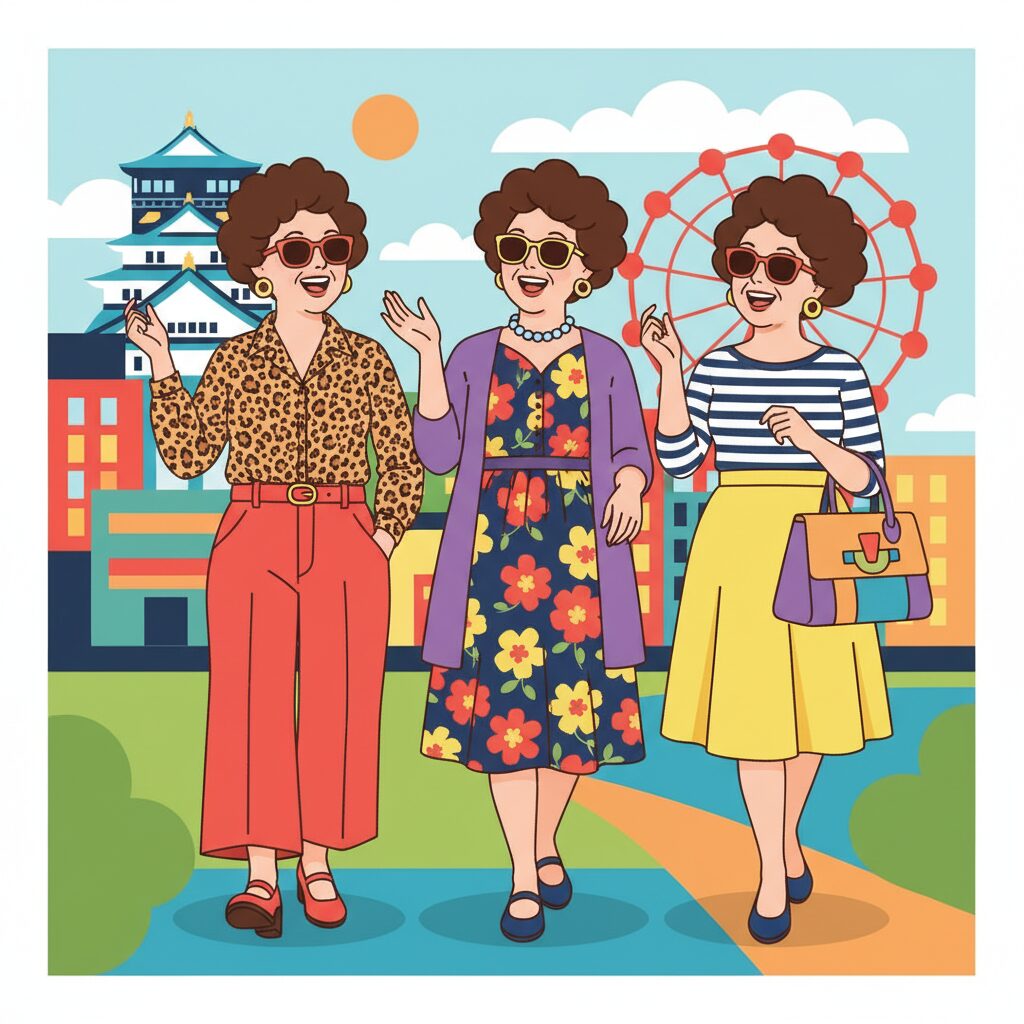
Walk through any shotengai, one of Osaka’s covered shopping arcades, and you’ll feel a certain energy. It’s not just the sizzle of takoyaki or the call of a vendor selling fresh fish. It’s a human energy, a vibrant, unapologetic hum. And at the center of that hum, you’ll often find her: the “Osaka Obachan.” The image is burned into the Japanese national consciousness, a caricature as famous as Tokyo Tower. She’s a woman of a certain age, rocking a tight perm and a blouse that screams leopard print. She’s probably cycling down the middle of the street, a basket full of leeks, moving with a purpose that borders on aggression. In her purse, a stash of “ame-chan” (little candies) is ready to be deployed to friends, strangers, and crying children with tactical precision. She speaks loud, laughs louder, and isn’t afraid to haggle for a ten-yen discount on her daikon radish. This is the stereotype, a figure of both affectionate fun and mild terror. But for anyone living here, moving here, or trying to understand the real pulse of this city, a crucial question arises: How much of this vibrant, wild caricature is a joke, and how much is a window into the soul of Osaka? The truth is, the Osaka obachan is not just a stereotype; she is a symbol. To understand her—beyond the leopard print and the loud chatter—is to unlock the operating system of Osaka itself. She represents a code of conduct, a set of social rules, and a philosophy of life that makes this city profoundly different from the quiet, reserved elegance of Tokyo. She is the guardian of a culture built on commerce, community, and radical honesty. So, let’s peel back the layers of the legend and meet the real women who are the beating, candy-sharing heart of this metropolis.
Embracing a value-first mindset reveals how Osaka’s robust merchant spirit not only powers everyday transactions but also breathes authentic life into its culturally rich landscape.
The Birth of a Legend: Deconstructing the “Osaka Obachan” Stereotype
Before we can truly understand the reality, we must first unravel the myth. The image of the Osaka obachan didn’t emerge spontaneously. It was shaped by the media, reinforced by comedians, and, to some extent, embraced by the women themselves. It serves as a powerful shorthand, but like all caricatures, it reduces a complex reality to a handful of memorable, and often misleading, traits. Recognizing the origins of these stereotypes is the first step toward seeing the real person behind them.
The Visual Uniform: Leopard Print and Perms
Let’s begin with the most obvious feature: the fashion. Leopard print, bright purples, glittering fabrics—this style stands out like a neon sign in a society that often values subtlety and conformity. But where did it originate? The answer lies in Osaka’s history as a city of merchants and entertainers. Unlike Tokyo (then Edo), which was defined by samurai and bureaucrats, Osaka’s influence was built on money, trade, and personality. To thrive, you had to be visible; you had to be unforgettable. This fostered a culture where boldness was not just accepted but beneficial.
The iconic animal print fashion isn’t about mimicking a jungle cat. It’s a statement—visual noise rejecting the wabi-sabi ideal of quiet, understated beauty. It declares, “I am here. I am not invisible.” In a society that can sometimes marginalize middle-aged and older women, this is a powerful declaration of self. While not every woman over fifty dresses this way, the spirit of it is widespread. It’s the freedom to wear what brings joy, regardless of trends or what people in Tokyo might deem “appropriate.” The perm, or “panchi paama,” plays a similar role. It’s a low-maintenance, voluminous style projecting no-nonsense confidence. Practical for a busy lifestyle, it makes a clear statement. Although the stereotype clings to the most extreme examples, the underlying idea—a functional, confident style prioritizing personality over conformity—is genuinely woven into Osaka’s culture.
The Candy Connection: “Ame-chan” as a Social Tool
The second cornerstone of the stereotype is the ever-present “ame-chan.” Outsiders and people from other parts of Japan are often puzzled when a stranger—a middle-aged woman on a bus or in line—silently offers a small hard candy. Is it a random act of kindness? A quirky local custom? It’s both, yet also much more. The “ame-chan” is a refined social tool, a way to navigate urban life with a touch of humanity.
Think of it as a small exchange of goodwill. In Osaka’s merchant culture, relationships are everything. A good deal isn’t just about the lowest price; it’s about the bond you build with the other person. The candy physically embodies this ethos. It serves to break the ice, ease tension, express gratitude, or simply acknowledge a shared moment. A child starts crying on the train? An ame-chan appears from a nearby obachan, a silent gesture of sympathy to the stressed parent. Help someone pick up fallen groceries? You might receive a piece of candy in return. It’s a gesture with minimal cost but a powerful message: “I see you. We’re in this together.” It lubricates daily interactions, transforming anonymous urban encounters into brief moments of human connection. It’s not just friendliness; it’s a deeply rooted cultural practice that maintains social harmony in a tangible, straightforward way.
The Volume and the Vernacular: Why So Loud?
Lastly, there’s the sound. The stereotype depicts the Osaka obachan as loud, brash, and speaking a dialect that can seem almost aggressive to outsiders. There’s some truth to the perception of loudness. Conversations in Osaka frequently occur at a higher volume than those in Tokyo—but this isn’t about hostility; it’s about expressiveness. Osaka-ben, the local dialect, is rich with colorful expressions, emphatic sentence endings, and a musical intonation that invites a livelier style of speech. It’s a language designed for storytelling, bargaining, and conveying emotion clearly and directly.
Directness is key. In Tokyo, communication often hinges on tatemae (public face) and honne (true feelings), with much left unsaid. In Osaka, the gap between the two is much smaller. People tend to say what they mean. This can seem blunt, but it stems from a deep cultural emphasis on honesty and efficiency. Why waste time with polite fluff when you can get straight to the point? This applies equally to compliments, criticisms, and questions. An obachan might ask a question that feels intensely personal by Western or Tokyo standards—not out of nosiness, but because she’s genuinely curious and sees no reason to hide it. The volume simply amplifies this philosophy of sincere, heartfelt communication. It’s the sound of a culture that values authenticity, even if it’s a bit raw, over polished insincerity.
Beyond the Caricature: The Reality of Osaka’s Matriarchs
Once you look beyond the leopard print and the volume, the true role these women play in the city becomes clear. They are not merely walking stereotypes; they are the architects and caretakers of Osaka’s famously resilient communities. They are business owners, neighborhood watchdogs, and keepers of local wisdom. Their “obachan” traits, when understood in context, are not quirks but powerful strengths that hold the social fabric of the city together.
The Pillars of the Community: Shopkeepers and Neighbors
Spend any time in a non-touristy neighborhood and you’ll encounter the local shotengai. These shopping arcades are the heartbeat of residential Osaka, predominantly managed by middle-aged and older women. They represent the local tofu shop, the vegetable stall, the tiny pharmacy. They are far from anonymous clerks; they are institutions. The woman at the fruit stand doesn’t just sell you apples; she knows you recently moved in, asks how you’re settling, and recommends which apples are best for baking versus eating raw. The fish shop owner will tell you exactly how to prepare the mackerel you purchased because her mother taught her, and her grandmother taught her mother.
This sharply contrasts the depersonalized, convenience-store culture dominating many modern Japanese cities. In these Osaka neighborhoods, commerce is deeply woven into the community. These women serve as central nodes in the local social network. They know who is ill, whose children are applying to which schools, and who might need a little extra care. Their perceived nosiness is, in reality, a form of informal community guardianship. They keep watch. They are the reason many Osaka neighborhoods feel so safe and maintain such a strong local identity. They are the glue.
Masters of Negotiation: The Art of the “Makete”
The stereotype of the Osaka obachan haggling over a few yen often serves as comic relief, painting her as stingy or pushy. But this misses the essence entirely. Bargaining in Osaka is not just about saving money. It is a ritual—a form of communication, a game, and a way to build relationships. The phrase “chotto makete?” (“can you give me a little discount?”) is an opening line, not a confrontational demand.
For women running market stalls and those shopping there, this exchange is a crucial part of the transaction. It recognizes the human element in commerce. Engaging in this dance confirms their relationship. The seller shows goodwill by reducing the price slightly, and the buyer shows respect by treating the seller as a person, not just a price tag. It’s a performance that strengthens community bonds. Declining to participate, or simply paying the sticker price without a word, can feel cold and distant. For these women, who likely have managed household finances with great shrewdness throughout their lives, value is vital. But the value of the human connection formed during the haggle is often equally important as saving a hundred yen. It’s a legacy of a merchant city where reputation and relationships were the most valuable assets.
Unspoken Kindness and Fierce Loyalty
Beneath their sometimes-gruff exterior lies a deep and fiercely protective kindness. This often appears as osekkai, a word roughly translating to a “meddlesome busybody.” To outsiders, it can seem intrusive. An obachan on the street might stop you to say your shoelace is untied, your baby isn’t dressed warmly enough, or you’re sorting your recycling incorrectly. Her tone might not be soft; it could be a sharp, direct command.
The instinct for foreigners, or even people from Tokyo, may be to feel judged or annoyed. But the intent behind osekkai is almost always caring. It stems from a mindset where the community’s well-being is a collective responsibility. She is not correcting you to assert authority; she does so because, in her world, allowing a neighbor to make a mistake in silence is a form of unkindness. It’s a safety net. It means someone is watching out for you, even if you don’t know them. This loyalty extends fiercely to their neighborhoods and their people. If you become a regular at their shop or a familiar face around the neighborhood, you come under this protective umbrella. They will defend you, assist you, and feed you, expecting nothing in return but your participation in the community. This tough, practical, and deeply rooted kindness is the true essence of the Osaka obachan.
The Osaka Obachan vs. The Tokyo Madam: A Tale of Two Cities
To truly understand the unique character of Osaka’s women, it is crucial to compare them with their counterparts in Tokyo. The “Tokyo Madam” embodies a distinct set of cultural values, shaped by a different history. While both are Japanese women, their attitudes toward public space, communication, and self-expression highlight the profound cultural divide between Japan’s two largest cities.
Public Space and Social Boundaries
In Tokyo, public space is often regarded as an extension of private space. On the famously crowded trains, a strong, unspoken rule of silence and non-interaction dominates. People create invisible bubbles around themselves, avoiding eye contact, speaking quietly, and generally acting as though the hundreds of others packed around them do not exist. The Tokyo Madam excels at this art. She moves through the city with quiet, reserved grace—her presence felt but seldom heard.
In contrast, Osaka’s concept of public space is inherently more, well, public. Boundaries are more permeable. An Osaka obachan treats shared spaces like train carriages or supermarket aisles as opportunities for social interaction. She will casually strike up a conversation with those nearby, commenting on the weather, your groceries, or the book you’re reading. This isn’t considered an invasion of privacy but rather normal human behavior. The invisible bubble of personal space so fiercely guarded in Tokyo is much smaller and more easily crossed in Osaka. This explains why Osaka is often described as “friendly” or “warm.” However, to those used to the anonymity of other large cities, it can also feel overwhelming or intrusive. The obachan isn’t being rude; she’s operating with a different social script—one that defaults to “community” rather than “individual.”
Expressing Opinions: The Difference in Directness
The communication gap is even broader. In Tokyo, social harmony is typically preserved through indirectness and ambiguity. Opinions, particularly critical ones, are wrapped in layers of polite language. A Tokyo Madam might dislike your new haircut but would never say so outright. Instead, she might remark, “Oh, that’s a very bold choice,” leaving you to read between the lines. The focus is on avoiding confrontation and saving face.
The Osaka obachan discards this entire approach. If she thinks your new haircut looks terrible, she will likely say, “That haircut doesn’t suit you at all.” This bluntness is not meant to hurt. From her point of view, it’s a form of help. True friends, true neighbors, are honest with one another. Letting you go around with a bad haircut without saying anything would feel insincere. This unfiltered honesty is a hallmark of Osaka culture. It values practical truth over delicate social nuance. While this directness can be startling, once the intention is understood, it can also be deeply refreshing. You rarely have to guess what an Osaka obachan is thinking. What you see is what you get, and in a world full of social masks, this straightforwardness holds a unique appeal.
The Concept of “Kihaku”: Spirit and Guts
Underlying these differences lies a key concept: kihaku. It’s a term that is difficult to translate, encompassing spirit, energy, guts, and a distinctive powerful presence. The ideal Tokyo woman is often admired for her elegance (hin), refinement, and quiet strength. The Osaka obachan, by contrast, is defined by her kihaku. She is seen as gutsy, resilient, and utterly unflappable—a fighter, a survivor.
This reputation stems from centuries living in a city founded on the high-stakes, high-risk world of commerce. Osaka has endured fires, earthquakes, and economic downturns. Its people have always had to be tough and resourceful to survive. Women, traditionally responsible for household finances (saifu), needed to be especially shrewd and strong-willed. This history has fostered a culture that cherishes strength over softness and practicality over propriety. The leopard print, loud voice, and direct manner are all outward expressions of this inner kihaku. It’s a bold declaration that she’s not to be underestimated, capable of handling whatever life throws her way. This vibrant, spirited energy stands as perhaps the most defining—and most misunderstood—characteristic of Osaka’s women.
Navigating Daily Life: How to Understand and Appreciate Osaka’s Leading Ladies
For a foreigner living in Osaka, interacting with the city’s matriarchs is not merely optional; it is an essential part of everyday life. Learning how to navigate these interactions is crucial to feeling at home here. It demands a shift in perspective, moving beyond a literal interpretation of their behavior to grasp the cultural meaning behind it. Embrace this approach, and you’ll discover a city far warmer and more supportive than you ever expected.
Reading the Intent, Not Just the Words
The first and most important principle is to seek the “why” behind the “what.” When an obachan stops you to adjust your scarf, her words might be, “You’ll catch a cold like that!” which may sound like a rebuke. Yet the real intent is, “I care about your well-being.” When she inquires about your rent, a question that might feel intrusive in many cultures, her goal is often to determine if you’re getting a fair deal and to offer advice if you’re not. She isn’t being nosy; she’s serving as a helpful resource.
This calls for a conscious effort to depersonalize the interaction. Her straightforwardness is not a personal attack. It’s her typical way of communicating with everyone in her community. By looking past the bluntness to the caring intent, you can turn what might be an awkward or uncomfortable encounter into a meaningful connection. Understanding osekkai as a form of community care is the key to building positive relationships with the women who maintain this city’s neighborhoods.
The Power of a Smile and a Bit of Banter
The second rule is to engage. Don’t retreat into a shell of reserved foreign politeness. Osaka’s social currency is not quiet deference; it’s warm, open engagement. When you pass local shopkeepers, don’t simply nod. Greet them with a cheerful “Maido!” (a classic Osaka merchant greeting) or “Ohayo gozaimasu!” A smile and a simple greeting can transform the interaction. It shows that you’re open to being part of the community.
If an obachan offers you an “ame-chan,” accept it with a heartfelt “arigato.” This small gesture completes a social circle and acknowledges her inclusion. If you’re at a market and feel confident, try a little friendly banter. You don’t need to be a skilled haggler. Just asking, “Is this the tastiest one?” or “Chotto dake makete kureru?” with a playful smile demonstrates your understanding of the social dance. Even if she refuses, she’ll appreciate your effort. They respect those who participate and aren’t afraid to engage in the back-and-forth of daily life. Your willingness to join in matters far more than your skill at it.
Seeing the Obachan as a Key to Osaka
Ultimately, the best way to thrive in Osaka is to change how you view the “obachan.” She is not a comical stereotype to avoid or laugh at from afar. She is the living, breathing embodiment of the city’s core values: pragmatism, resilience, community spirit, and a deep, unsentimental kind of love. She is a walking, talking lesson in Osaka culture.
Her directness teaches you the importance of honesty. Her osekkai reveals what a community that truly cares for its members looks like. Her haggling shows that transactions are about relationships, not just figures. Her candy is a reminder that small acts of kindness form the foundation of a good society. By learning her language—both spoken and unspoken—you gain access to the authentic Osaka, the one found in bustling shotengai and quiet residential alleys, far from tourist hotspots. She is not an obstacle to overcome; she is a guide. Befriend the Osaka obachan, and you will find the heart of the city itself.