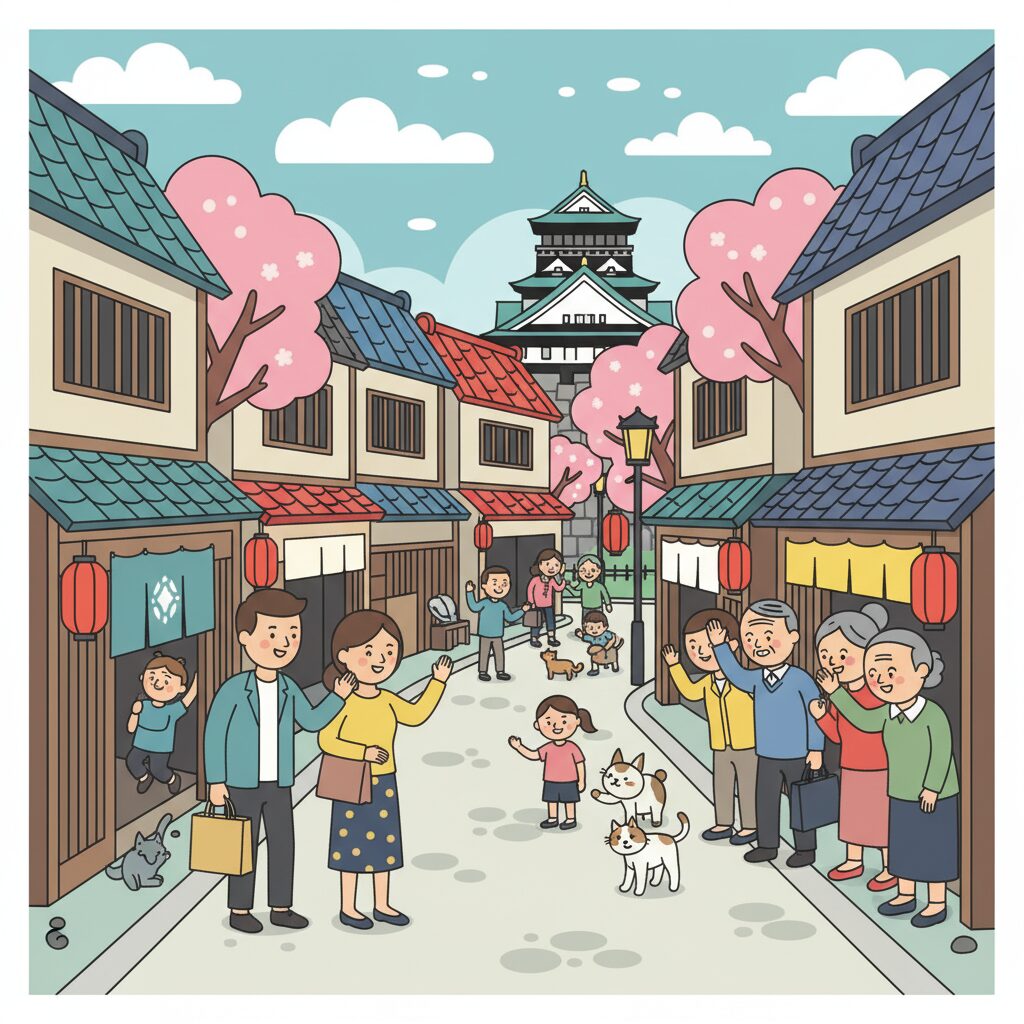
You’re standing in the elevator of your new apartment building in Osaka. The doors slide open on the fifth floor and a woman you vaguely recognize from the mailboxes steps in. A sudden, quiet tension fills the small space. Your eyes meet for a split second. Should you say something? Should you wait for her? Is a nod enough? Do you look at your phone? Do you stare at the slowly ascending floor numbers? This tiny, ten-second interaction is a daily test for anyone new to living in Japan, a miniature drama of unspoken social rules. And in Osaka, a city that prides itself on being different, the script for this drama is unique. People will tell you “Osaka is friendly,” but what does that friendliness actually look like in the silent, shared spaces of daily life? It’s not about random strangers hugging you on the street. It’s about something much more subtle and, frankly, more important: the culture of ‘aisatsu,’ or greetings. This isn’t just about saying hello. It’s a complex dance of acknowledgment, respect, and community maintenance. It’s the invisible thread that stitches a neighborhood together, and learning the steps is one of the most crucial things you can do to feel truly at home here. Forget the tourist guides for a moment. We’re going deep into the heart of Osaka’s residential rhythm, exploring the who, when, and why of the daily greeting, and figuring out exactly who is supposed to make the first move.
To truly understand this unique social fabric, it’s helpful to explore how the city’s famous merchant spirit influences interactions far beyond the marketplace.
The Fundamental Rule: Proximity and Repetition
The entire universe of Osaka’s greeting culture can be summarized by two key ideas: how close someone is to your daily life and how often you see their face. It’s a system rooted in familiarity, a gradual transition from “complete stranger” to “part of the scenery.” It’s not about an instant burst of friendship but a slow, steady recognition of shared space. Mastering this rhythm is the first step in evolving from an anonymous resident to a recognized neighbor—a change that profoundly shapes how you experience the city.
Your Building is Your Bubble
Think of your apartment building, or ‘mansion’ as they’re called here, as the most intense greeting zone. This is your home turf, your inner circle. Within these walls, the rules of engagement are at their strongest. The elevator, the lobby, the shared hallways, the bicycle parking area, the garbage disposal spot—all serve as stages for the daily aisatsu performance. The main rule here is simple and democratic: if you make eye contact, you greet. It doesn’t matter whether you’re younger, older, male, female, Japanese, or foreign. The person who notices the other first often initiates. Waiting for the other to go first can create an awkward silence that, in Osaka, feels heavier than in other cities. The goal is to make the shared space comfortable, and a quick, simple greeting is the most effective way to do so. The greeting itself need not be grand; a simple “Ohayo gozaimasu” in the morning suffices. A “Konnichiwa” in the afternoon works well. But the true MVP of the Osaka apartment building is the versatile, all-purpose head nod paired with a quiet “Doumo.” “Doumo” is a magic word, meaning hello, thanks, sorry, or simply “I acknowledge your presence.” It’s the perfect, low-effort social lubricant for moments when you’re juggling keys or carrying groceries. This steady, low-level flow of acknowledgment transforms a building from a collection of concrete blocks into a vertical neighborhood.
The “Three-Timer” Rule on the Street
Once you step outside your building, the rules loosen considerably. Greeting every single person you pass on the street would be exhausting and, frankly, quite unusual even by Osaka’s standards. The city’s energy is lively, but it’s not without boundaries. Here, the informal “Three-Timer” rule applies. This unwritten social contract guides interactions within your immediate neighborhood—the streets you walk daily to the station or supermarket. The first time you see a new face on your route—say, a man walking his Shiba Inu as you head for the train—you probably do nothing. You acknowledge his existence, but he remains a stranger. The second time, a flicker of recognition might pass between you. A brief eye contact, a subtle expression saying, “Ah, you again.” This is the important second step. By the third encounter, the social threshold is crossed. He moves from “stranger” to “familiar face.” Now is the moment to act. A simple nod, a slight bow, or a quiet “Konnichiwa” is fitting. This gradual process is beautiful because it’s natural, not forced. It results from sharing a routine and space. You acknowledge that you are both part of the same local ecosystem. This gentle progression builds neighborhood trust, one repeated familiar face at a time. It’s a delicate dance of mutual recognition that defines the invisible boundaries of your community.
Hierarchy and Context: Reading the Room
While the basic principles of proximity and repetition form your foundation, Osaka’s greeting culture is layered with nuances that heavily depend on who you’re interacting with and the context of the situation. It’s not a one-size-fits-all system. Grasping these subtleties elevates your neighborhood interactions from merely correct to culturally fluent. It involves reading social cues and adjusting your approach accordingly, demonstrating not just politeness but a deeper understanding of the local social fabric.
The Elder Equation: Respect is Automatic
In Japanese society, age commands inherent respect, which is clearly seen in neighborhood greetings. While the “whoever sees first greets first” rule generally applies, it’s always wise and respectful to take the initiative when greeting an elderly person. They are regarded as pillars of the community, guardians of its history and stability. Offering a clear and slightly more formal “Ohayo gozaimasu” or “Konnichiwa” is a small gesture with significant meaning. You’ll often notice neighborhood ‘obaa-chan’ or ‘ojiichan’ (grandmothers and grandfathers) tending potted plants on the sidewalk, sweeping the street in front of their homes, or heading to the local ‘shotengai’ (shopping arcade) with their carts. They are the unofficial custodians of the neighborhood’s atmosphere. Greeting them is more than polite; it acknowledges their role and shows you care about the community too. Their response is almost always warm and appreciative. This simple act can open the door to small conversations and make you a familiar, welcome presence. It’s a key difference from the more anonymous experience in a city like Tokyo, where intergenerational daily interactions tend to be far less common.
Kids Change Everything: The Parent Network
When you have children, the entire dynamic of neighborhood greetings shifts dramatically. The moment you’re seen with a child, you’re no longer just an individual—you become a parent and are immediately introduced into a complex and highly active social network. The usual “Three-Timer” waiting rule is discarded. Parents who meet at the local park, near the kindergarten, or on the way to elementary school will greet each other instantly and without hesitation, even if they’ve never formally met. The children serve as social bridges. A glimpse of a local school uniform or a daycare’s brightly colored hat instantly signals a greeting. This network is grounded in shared experience and mutual responsibility. The greetings—“Otsukaresama desu” (a phrase acknowledging each other’s hard work) passed on the street, or a “Konnichiwa” at the playground—are more than mere pleasantries. They form the threads of an informal safety net. Knowing the faces of other parents and their children means more eyes watching out for everyone. If a child falls in the park, several adults will likely come running to help. This spontaneous, child-centered community-building is a powerful force in Osaka neighborhoods, creating a tangible sense of collective well-being.
The Dog Walker’s Code
A distinct and fascinating sub-community with its own greeting protocols is that of dog walkers. Similar to the parent network, having a dog grants instant entry into a particular social circle. When walking your dog, it’s customary to greet other dog walkers you meet on your route. The dogs themselves often break the ice, sniffing and interacting with each other, which naturally opens the way for their owners to greet one another. These interactions are often accompanied by comments about the dogs—“Kawaii desu ne!” (How cute!)—or questions about their breed or age. This shared identity as “dog people” transcends usual barriers between strangers. You are connected by a common routine, a mutual love for your pets, and the daily care rituals. Regular morning and evening encounters quickly foster a strong sense of camaraderie. You learn the dogs’ names first, and their owners’ next. It’s a friendly, low-pressure social scene where ‘aisatsu’ is the expected and easy first step to conversation and connection.
Osaka vs. Tokyo: A Tale of Two Corridors
To truly understand the texture of Osaka’s greeting culture, it’s important to compare it with its prominent rival to the east, Tokyo. The common stereotype is that Osaka is warm and open, while Tokyo is cold and distant, but this oversimplifies the reality. The difference isn’t about warmth versus coldness; it’s about two distinct, highly functional social contracts shaped for two different urban settings. How greetings are exchanged, or withheld, in an apartment corridor reveals a profound truth about each city’s underlying philosophy regarding public and private spaces.
The Tokyo Silence: Anonymity as a Virtue
In a typical Tokyo apartment building, especially in central wards, anonymity is often the default and even preferred state. The elevator ride exemplifies what social scientists term “civil inattention.” People stand as far apart as possible, carefully avoiding eye contact, focusing on their smartphones, the floor display, or a fixed point on the door. A spontaneous greeting to a stranger can feel slightly startling, even a minor breach of an unspoken understanding to respect each other’s privacy. This isn’t due to unfriendliness or coldness; rather, it’s a coping strategy for living in one of the world’s most densely populated areas. In a city of millions, carving out a small, fiercely guarded personal space is essential for mental well-being. The social contract in Tokyo values non-interference. By choosing not to greet, you are signaling, “I respect your privacy and won’t impose on you.” For many Tokyo residents, this quiet, predictable anonymity offers comfort—a way to relieve the intense social pressures at work.
The Osaka Connection: Community as a Default
Now, imagine entering that same elevator in Osaka. The silence here feels different. It’s not a comfortable, mutually accepted quiet; instead, it’s a void waiting to be filled. More often than not, someone will break the silence with a simple “Doumo,” a remark about the humid weather (“Mushiatsui desu ne”), or an “Okaerinasai” (welcome home) if it’s the end of the day. The social contract in Osaka favors connection by default. Anonymity is not the aim; a basic level of mutual recognition is. This attitude stems from Osaka’s history as Japan’s merchant capital. For centuries, business thrived on ‘ningen kankei’—human relationships. You needed to know your suppliers, customers, and neighbors. Trust and communication were the foundation of commerce. This philosophy, born from bustling marketplaces and ‘shotengai’, has permeated the city’s residential life. A greeting isn’t an imposition; it is the smallest unit of community upkeep. It’s a way of saying, “We’re in this together.” In Osaka, the absence of a greeting can be seen not as respectful distance, but as possible aloofness or dislike. Osakans prefer to know their social standing, and the daily ‘aisatsu’ is a simple, effective way to continually affirm a positive—or at least neutral—relationship with those around them.
Common Misunderstandings and How to Navigate Them
For non-Japanese residents, navigating the subtle etiquette of greetings in Osaka’s neighborhoods can be a source of anxiety. You want to fit in and be a good neighbor, but cultural misunderstandings can easily occur. Knowing the common pitfalls and the true meaning behind certain interactions can save you a lot of stress and help you connect with your community more confidently.
“Am I Being Too Forward?” – The Concern of Overstepping Boundaries
Many foreigners come to Japan aware that it is generally a reserved society. This awareness can create a fear of being perceived as loud, pushy, or “too forward” when initiating a greeting with a neighbor. In an Osaka residential area, however, you should mostly set aside this fear. A simple, polite greeting is almost never inappropriate. In fact, the opposite is often true: remaining silent may be misunderstood. If you frequently avoid eye contact and never offer a greeting, your neighbors might not interpret this as shyness or respect for their privacy; instead, they may think you are unfriendly, arrogant, or uninterested in being part of the community. The key is to match the energy and context. A cheerful “Konnichiwa!” as you pass someone in the hallway is ideal. But launching into a lengthy, complex conversation in English while in the elevator might overwhelm someone heading to work. Start small. A nod is good. A “Doumo” is better. A “Konnichiwa” is great. These small gestures are seen as positive signs of goodwill, not as intrusions.
The Unreturned Greeting: What Does It Mean?
At some point, this will happen. You’ll offer a well-timed “Konnichiwa” to a neighbor, only to be met with… silence. They’ll walk right past you as if you’re invisible. Your first reaction might be embarrassment, offense, or worry that you’ve made a mistake. It’s important to realize that in 99% of cases, it’s not about you. There are many reasons a greeting might go unreturned. The person could be wearing earbuds and truly didn’t hear you. They might be lost in thought, preoccupied with work stress or family concerns, and your greeting simply didn’t register. They could be extremely shy or unfamiliar with interacting with foreigners, causing them to freeze. Or, quite commonly in a transient city, they may be from another part of Japan—like Tokyo—where greeting neighbors is not customary. The worst thing you can do is take it personally or stop greeting them. The best approach is to let it go and try again the next day with the same simple nod or hello. Consistency matters. By continuing to offer the greeting, you demonstrate your friendly intentions. Over time, most people will warm up and begin to reciprocate.
Beyond a Simple “Hello”: The Art of Small Talk
A greeting in Osaka often marks the beginning—not the end—of an interaction. It can open the door to light small talk, especially with older residents who may have the time and desire to connect. This is how you start to build stronger neighborhood ties. You don’t need to speak fluent Japanese to join in. The topics are universal and predictable. Weather is the number one go-to subject. A simple “Atsui desu ne” (It’s hot, isn’t it?) on a scorching summer day or “Samui desu ne” in winter is a classic for a reason. It’s a shared experience everyone understands. You can also comment on your surroundings. If a neighbor is tending to their flowers, a “Kirei desu ne” (It’s beautiful, isn’t it?) is a lovely compliment. If you’re both waiting at a crosswalk, a light sigh about how long the light is taking can create a shared moment of minor frustration. For foreigners, any effort to engage in this kind of small talk in Japanese, no matter how imperfect, is usually met with great appreciation. It shows you are making an effort to connect on their terms. This is the social lubricant that keeps the community spirit in Osaka running smoothly.
The ‘Why’ Behind the ‘Aisatsu’: Unpacking the Osaka Mindset
To genuinely grasp the greeting culture in Osaka, you need to look beyond the simplistic notion of “friendliness.” The everyday practice of ‘aisatsu’ is more than just a courteous gesture; it’s a deeply embedded social mechanism fulfilling several important roles. It is founded on pragmatism, a unique sense of personal space, and the specific physical layout of the city’s neighborhoods. It provides insight into Osaka’s collective mindset.
It’s More Than Friendliness—It’s Practicality
While Osakans appreciate warmth and human connection, their approach to neighborhood greetings is also highly practical. It’s an easy, effective strategy for community safety and mutual assistance. By greeting neighbors daily, you recognize familiar faces and know who belongs on your street or in your building. This creates a powerful, informal surveillance network. When an unfamiliar person loiters nearby, you’re more likely to notice and sense something is wrong. This collective sense of ownership helps deter crime. Additionally, these daily greetings build a social safety net. The memory of the 1995 Great Hanshin Earthquake remains vivid throughout Kansai. After the disaster, stories circulated of neighbors rescuing one another, sharing limited resources, and offering emotional support. Communities where people knew each other coped far better. A daily “Konnichiwa” might seem minor, but it forms a critical lifeline. It means that in times of disaster or minor emergencies—such as being locked out—you are surrounded not by strangers but by familiar faces ready to help.
‘Kekkai’: Crossing Personal Boundaries
In Japanese culture, there is the concept of a ‘kekkai,’ an invisible personal boundary encircling an individual. In many parts of Japan, especially more formal or reserved areas, this boundary is strong, and people hesitate to cross it without proper introductions or cause. In Osaka, however, this boundary tends to be more flexible. People are generally more willing to allow brief, low-stakes social interactions within their personal space. A greeting is essentially a polite invitation to temporarily lower that barrier, and in Osaka, this invitation is almost always accepted. This reflects the renowned directness of Osaka’s communication style. Osakans usually prefer clarity over uncertainty in their social exchanges. A silent encounter with a neighbor generates ambiguity: “Do they like me? Did I offend them?” A simple greeting instantly clears up this uncertainty. It establishes a clear, positive baseline: “We are neighbors. We are on good terms.” This wish to maintain open, even if simple, lines of communication is a defining feature of the Osaka mindset.
The Influence of the ‘Shotengai’ (Shopping Arcade)
The physical arrangement of many Osaka neighborhoods naturally supports this culture of greeting. At the core of countless communities stands the ‘shotengai,’ a covered shopping arcade. Unlike large, impersonal malls or station complexes, the ‘shotengai’ is built for human-scale, face-to-face interaction. When you stroll through your local ‘shotengai’ to shop, you are not just an anonymous shopper—you are a regular customer. The butcher calls out a greeting, the tofu vendor inquires about your day, the fruit seller knows your favorites. This continuous daily immersion in casual ‘aisatsu’ and conversation reinforces the habit, making it second nature. You carry this same spirit and expectation back to your residential street and apartment building. The ‘shotengai’ serves as a social training ground, reminding everyone that commerce and community are interconnected. This stands in contrast to many modern Tokyo neighborhoods, where life centers around the impersonal efficiency of train stations and convenience stores, reducing opportunities for spontaneous, relationship-building interactions.
Practical Aisatsu Guide for Your Osaka Life
Theory is valuable, but at the end of the day, you need a practical set of tools to navigate your everyday life. Overanalyzing can cause hesitation. The key is to have a few simple, dependable tools at hand that you can use without complex social calculations in the moment. Here are the essentials for your Osaka greeting toolkit.
Your Greeting Toolkit
Master these few words and gestures, and you’ll handle 95% of neighborhood interactions with grace and confidence. Remember, your tone and friendly expression are just as important as the words themselves.
- The Nod: Your universal, go-to gesture. It’s the simplest form of acknowledgment—perfect when you’re at a distance, your hands are full of groceries, you’re rushing for the train, or you’ve already said hello once that day. A simple, deliberate dip of the head is a complete and acceptable social interaction.
- “Ohayo gozaimasu”: The Morning Workhorse. Use this from the moment you wake up until about 10 or 11 AM. It’s a bright, positive way to start the day and can be used with everyone—neighbors, building staff, shopkeepers.
- “Konnichiwa”: The Daytime Default. Your go-to greeting from late morning until sunset. It’s neutral, polite, and always appropriate. If you’re unsure what to say in the afternoon, “Konnichiwa” is always the right choice.
- “Konbanwa”: The Evening Standard. Once it gets dark, switch to this. It serves the same function as “Konnichiwa” but for evening hours.
- “Doumo”: The Swiss Army Knife. Possibly the most useful word for apartment living. As mentioned, it’s a versatile multi-tool. Use it with a nod when passing someone in a tight corridor, when someone holds the elevator door for you, or as a quick, unobtrusive hello. It’s the perfect blend of polite and efficient.
- “Otsukaresama desu”: The Pro-Level Greeting. This phrase literally means “You are tired,” but its true meaning is closer to “Thank you for your hard work” or “I recognize your effort.” It conveys empathy. Use it when you see a neighbor coming home late or building staff cleaning common areas. It shows a high level of social awareness and is deeply appreciated.
When NOT to Greet
Equally important as knowing when to greet is knowing when not to. The rules of ‘aisatsu’ are highly context-dependent, and applying them incorrectly can come across as odd. Remember, these are rules for your micro-community.
- Crowded Public Spaces: Avoid greeting strangers on a crowded subway, busy platforms like Umeda Station, or busy shopping streets such as Shinsaibashi-suji. In these anonymous, transient places, the Tokyo rule of “civil inattention” applies. Everyone stays in their own bubble.
- When Someone is Rushed or Busy: Pay attention to cues. If a person is clearly in a hurry, on the phone, or deep in conversation, a full verbal greeting might be intrusive. In these cases, a simple nod suffices. The goal is to acknowledge, not disrupt.
- Don’t Force It: A greeting is an offering, not a demand. If someone seems unreceptive to small talk and responds with a brief nod, accept it as a complete interaction. Don’t press for a longer conversation. Match their energy.
Ultimately, the question of “Who should say hello first?” in Osaka has a simple, freeing answer: you should. Taking the initiative and offering that small gesture of connection is rarely wrong. It’s a vote of confidence in community, a way of saying, “I see you, fellow resident. We share this space.” It transforms you from a passive occupant into an active participant in your neighborhood’s life. So don’t wait or overthink the silent elevator ride. Just look up, offer a small nod and a quiet “Doumo.” It’s the first and most important step to not just living in Osaka, but truly belonging.