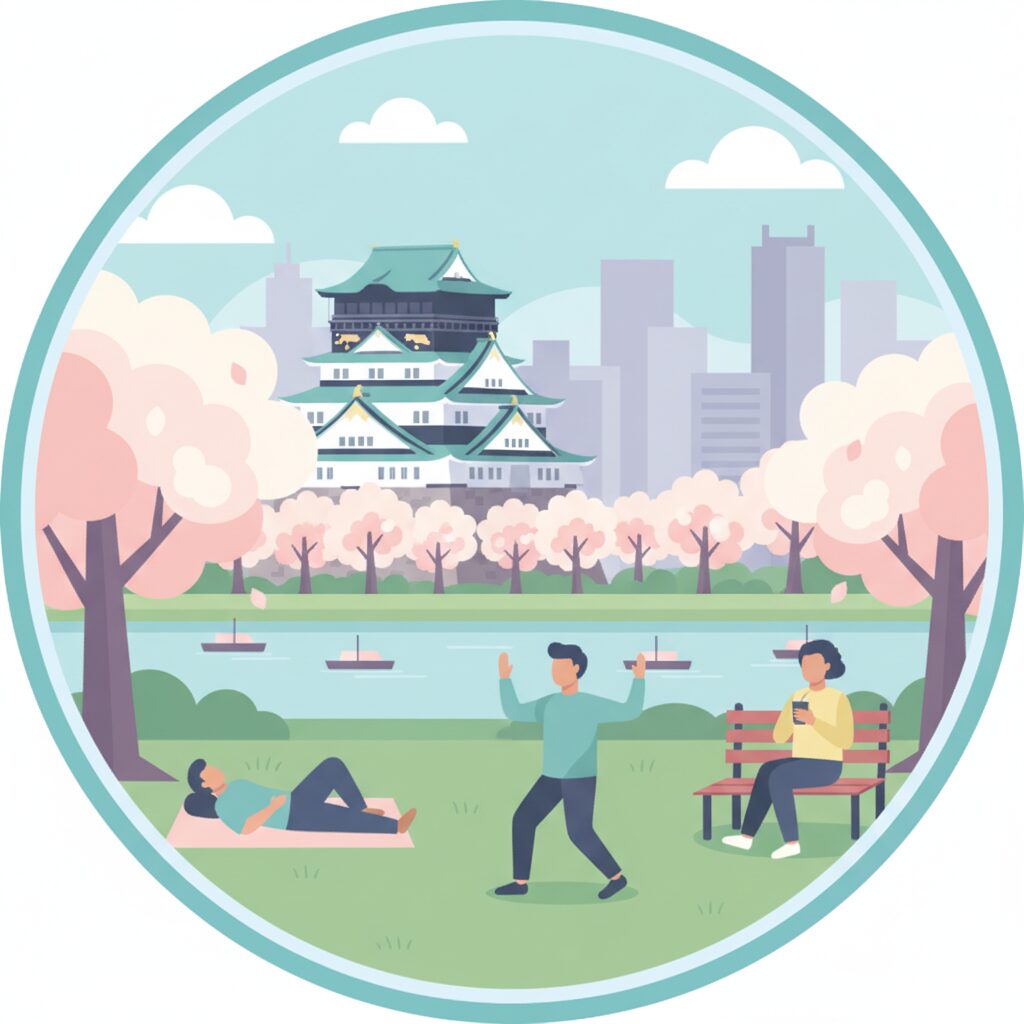
When you first tell people you’re moving to Osaka, their minds conjure a very specific image. They picture a relentless Blade Runner-esque cityscape, a sensory explosion of neon signs crawling up skyscrapers, the sizzle of takoyaki on a thousand street-corner grills, and a river of humanity flowing through covered shopping arcades. They think of noise, commerce, energy. And they’re not wrong. That is Osaka. But it’s only one frame of a much larger, more nuanced film. What they don’t picture, what you might not even realize you’re missing until you live here, is the quiet, humming heart of the city: its public parks. You might think a park is just a park—a patch of green with some trees and a bench. But in Osaka, a park is a living room. It’s a gymnasium. It’s a daycare, a therapist’s office, and a community hall all rolled into one. To understand Osaka’s parks is to understand the city’s very soul—its pragmatism, its unspoken social contracts, and its fundamental difference from the polished, reserved posture of its eastern rival, Tokyo. Forget the tourist guides for a moment. Let’s talk about where life in Osaka actually happens.
After exploring the city’s green spaces, you might also want to learn about eating affordably in Osaka by navigating its local supermarkets and convenience stores.
The Unspoken Rules of the Urban Oasis
Your initial visits to a park in Osaka can feel disorienting. Coming from a Western background, where parks are often spaces for quiet reflection or organized sports, or comparing it to Tokyo’s public spaces, which are filled with a subtle, orderly tension aimed at minimizing one’s presence, an Osaka park runs on a completely different wavelength. It’s a lively symphony—or sometimes a cacophony—of life expressed openly, and learning to embrace this vibrant atmosphere is your first lesson in becoming a local.
More Than Just Cherry Blossoms: The Year-Round Pulse of Park Life
The most common image foreigners have of Japanese parks is the intense, two-week hanami cherry blossom viewing season. And yes, Osaka celebrates it enthusiastically. Blue tarps blanket every inch of grass, the air is heavy with the scent of grilled meat and cheap beer, and the joyful noise of office parties and family get-togethers fills the cool spring evenings. But that’s only the peak. The true story lies in the steady, rhythmic pulse of the park throughout the rest of the year. Life here isn’t a series of events; it’s a constant, gentle hum that shifts with the seasons.
When summer arrives, the atmosphere changes. The oppressive humidity sets in, and the parks become a refuge, though a steamy one. The air vibrates with the deafening chorus of cicadas, a noise so persistent it turns into a kind of silence. This is the season of children. You’ll find them armed with long-handled nets and plastic bug cages, on relentless hunts for beetles and dragonflies—a rite of passage. Later in the day, neighborhood groups might be setting up small matsuri festivals, stringing paper lanterns between trees with promises of shaved ice and ring toss games. Families gather to try suikawari, the watermelon-smashing blindfolded game, their laughter ringing across the fields. The summer park is no quiet retreat; it’s a pressure release for a city confined to air-conditioned homes.
As the heat fades and autumn sets in, a different mood emerges. The ginkgo and maple leaves turn brilliant hues of yellow and red. This is koyo, or leaf viewing season, but without the formal, pilgrimage-like feel of Kyoto’s famous temple spots. In an Osaka park, it’s more casual. You’ll see elderly couples sitting quietly on benches, sharing a thermos of green tea, watching leaves drift down. University students scatter on the grass with books, seemingly studying but mostly enjoying the crisp, perfect weather. The frenetic summer energy softens into a mellow, reflective hum.
Winter brings a stark, serene beauty. Bare trees, a sharp crystalline sky, and cold air visible in your breath set the scene. The crowds thin, but the park isn’t empty. The true regulars come out: on New Year’s Day, families fly colorful kites, their brightness vivid against the winter sky. Each morning, a devoted group of mostly elderly women gathers around a portable radio to perform rajio taiso—synchronized morning exercises. Their movements are fluid and practiced, a tribute to years of tradition. The winter park is a place of quiet ritual and lasting community, proof that life endures through the coldest months.
The Soundscape of an Osaka Park: What You Hear and Its Meaning
One of the most noticeable differences, especially if you’ve spent time in Tokyo, is the sound. Tokyo parks often feel like libraries, where there’s an unspoken rule to maintain decorum, speak softly, and avoid intruding on others’ space. Osaka parks, by contrast, resemble busy family kitchens. They’re loud. This isn’t a flaw—it’s fundamental.
The dominant noise on any weekend afternoon is the crack of a baseball bat, followed by the spirited shouts of a youth league team. “Koi, koi, koi!” (Come on, come on!). “Saa, ippon!” (Alright, let’s score!). Coaches’ booming voices, parents’ cheers, and dugout chatter merge into an energetic roar. It’s not seen as disruptive; it’s the soundtrack of a thriving community.
Amidst the baseball noise is the high-pitched joy of children at play. Their screams are happy ones. Nearby, groups of mothers talk—and talk loudly. The Osaka dialect, or Osaka-ben, is naturally more expressive and tonal than standard Japanese, and when spoken in the conversational volume of friendly chatter, it carries well. They aren’t being impolite; they’re connecting. In Tokyo, mothers might sit apart, whispering cautiously, but in Osaka, they cluster together, their conversations a lively mix of laughter and advice. The notion of meiwaku—being a nuisance to others—exists here as well, but the standard for what counts as a nuisance is very different. Sharing public space means sharing the sounds of life, and in Osaka, the noise of children playing and friends laughing is not pollution; it’s the city’s breathing.
The Park as a Social Hub: Who You’ll Meet and What They’re Doing
To truly grasp the role of an Osaka park, you must see the people who use it not as visitors, but as relying on it as an essential part of their everyday infrastructure. It acts as a third space arguably more valuable than any café or community center. It’s where the city’s varied demographics come together in a surprisingly harmonious manner.
The Gateball Masters and the Shogi Players
Step into any moderately sized neighborhood park on a weekday morning, and you’re almost certain to find them: the senior citizens. They are the park’s most dedicated visitors, its daytime stewards. Groups of men and women, impeccably dressed in tracksuits and visors, are engrossed in a fiercely competitive game of gateball, a croquet-like sport taken very seriously. The gentle thwack of the mallet striking the ball is accompanied by intense strategic conversations and the occasional groan or cheer. This isn’t simply a pastime; it’s their league, their social club, their motivation to get outdoors.
Nearby, often shaded by a large tree, there’s a quieter but equally intense scene. Clusters of older men lean over portable shogi (Japanese chess) boards, the silence broken only by the sharp click of wooden pieces being placed. The mood is one of deep focus, yet it’s also highly social. Spectators gather, offering silent commentary with their eyes, and games frequently end with a quick post-game analysis. For these men, the park serves as their clubhouse—a place to nurture friendships, keep their minds sharp, and affirm a sense of purpose and identity in retirement. It’s a potent antidote to the social isolation that can affect the elderly everywhere, occurring organically without any formal program, day after day.
The Salaryman’s Refuge
Another figure you’ll often see is the salaryman, seemingly out of place in his dark suit and tie, sitting on a park bench at mid-afternoon. A foreigner might assume he’s slacking off or skipping work. But more often, you’re witnessing a vital act of self-care. The Japanese workplace is famously high-pressure, and the park functions as a neutral decompression space.
He might be eating a quick lunch from a convenience store bento box, saving money and avoiding crowded eateries. He might be on his phone, but not for business—perhaps playing a game or browsing the news, taking a brief mental break before the afternoon’s challenges. Or he might simply be staring blankly at the pigeons, enjoying the rare luxury of an empty mind for ten precious minutes. In Tokyo, there’s often a stronger sense of being watched, the need to appear busy constantly. In Osaka, pragmatism rules: if a ten-minute park break helps you work better the rest of the day, it’s not slacking—it’s sound business. The park bench isn’t a symbol of laziness; it’s a survival tool in the urban jungle.
The After-School Rush
Then, around 3:30 PM, the park’s whole atmosphere shifts instantly. A flood of children, released from the structure of elementary school, swarms the space. Backpacks are dropped to the ground, and the playground, which may have been quiet moments before, bursts into a storm of movement and noise. They climb, swing, chase each other in inventive games, their pent-up energy exploding with joy.
Accompanying the younger kids are their mothers, who often gather in established groups. For new mothers especially, this is a vital social arena. The so-called “park debut” (koen debyu) is a real, if informal, social milestone where a mother and her young child join the local park community for the first time. It can feel daunting, but it’s where crucial support networks are forged. Information is exchanged—recommendations for pediatricians, where to buy affordable diapers, how to manage picky eaters. Friendships grow over shared snacks and the collective experience of parenting. The park is their office, their water cooler, their support group. It shows how, even in a city of millions, life often unfolds on a hyper-local, village-like scale.
Osaka vs. Tokyo: A Tale of Two Parks
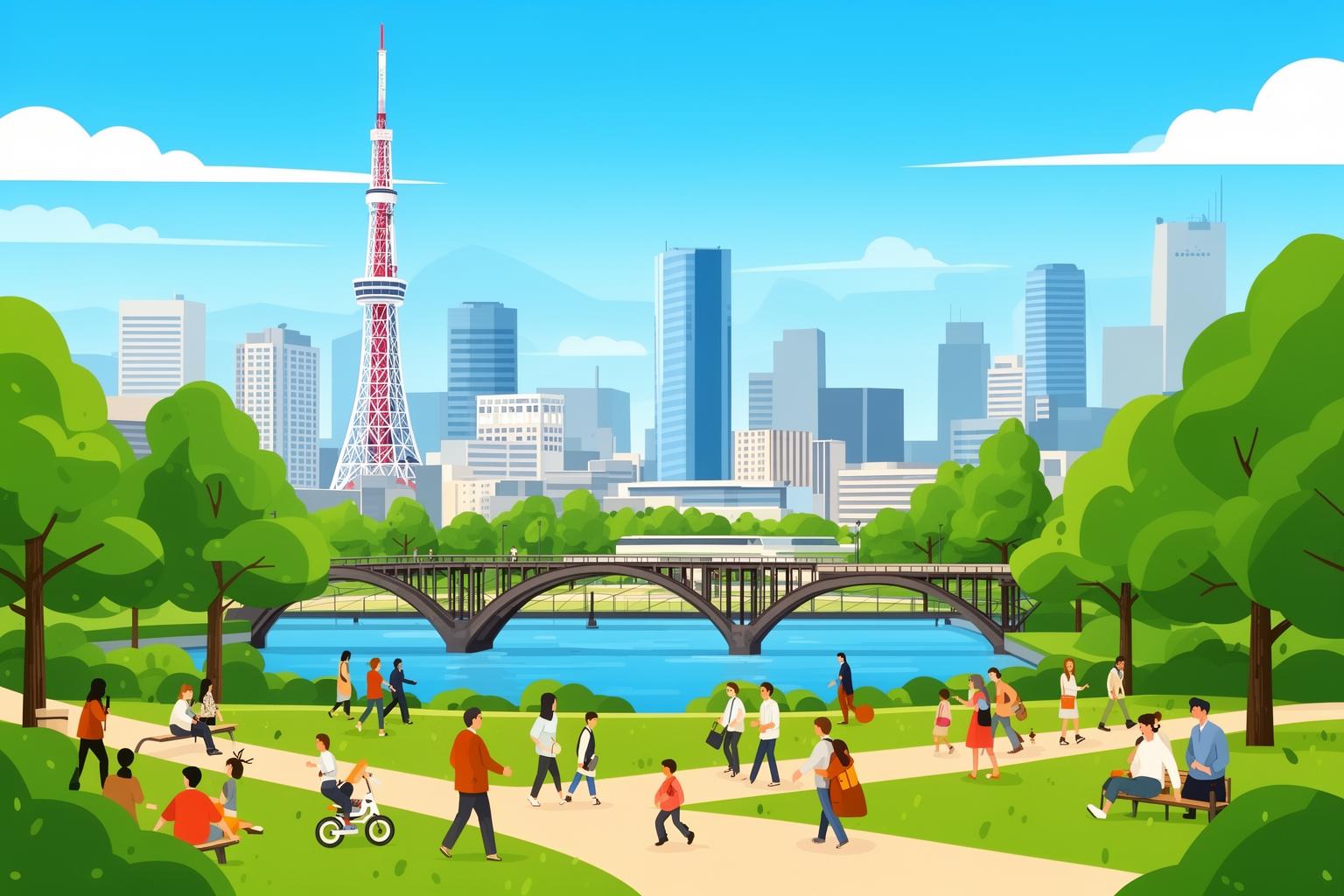
The comparison between Osaka and Tokyo is a beloved Japanese pastime, and it extends all the way to their green spaces. Simply put, Tokyo’s parks often feel like they were designed by professional landscape architects, while Osaka’s parks feel more like they were shaped by the people who actually use them. This highlights a fundamental philosophical difference between the two cities: Tokyo tends to prioritize form, aesthetics, and order, whereas Osaka values function, practicality, and a certain acceptance of beautiful disorder.
Function Over Form: The Practical Spirit of Osaka’s Parks
Many of Tokyo’s most renowned parks, such as Shinjuku Gyoen or the Imperial Palace East Garden, are breathtakingly beautiful, carefully maintained areas that often require an entrance fee and have a set of rules to follow. They are destinations you visit to admire. While undeniably wonderful, they can sometimes feel like outdoor museums. You follow designated paths, appreciate the scenery, and speak quietly. It feels like you are a guest in a delicate, exquisite place.
In contrast, Osaka’s parks, even the large ones, operate on a different principle. Take Utsubo Park, for instance. It’s a long, rectangular green space tucked between business and residential areas. At one end lies a stunning rose garden with thousands of bushes maintained to international standards. But walk just a hundred meters, and that polished elegance gives way to numerous hard-court tennis courts in constant use, filled with the sharp sounds of bouncing balls. Further along is a sprawling, modern playground. In the open areas, you might see a group of dancers rehearsing their routine with a portable speaker, amateur photographers aiming for the perfect shot, and a young couple enjoying a picnic from a nearby bakery. Utsubo Park is beautiful, but its main purpose isn’t beauty; it’s utility. This encapsulates Osaka’s mindset perfectly: “Kore, tsukaeru ya n!” (Hey, we can use this!). There’s less respect for preserving an immaculate aesthetic and more enthusiasm for maximizing the space’s usefulness to the community. The idea of charging an entrance fee for a public park would be met with disbelief by most Osakans. A park is a right, not a privilege.
“Ah, Soko Ee Yo”: The Adaptable Rules of Engagement
The social dynamics around park usage further underscore the cultural differences. During hanami season in Tokyo parks like Ueno or Yoyogi, securing a good spot is a serious and often stressful affair. Tarps are spread with military precision, clearly marking strict and inviolable boundaries. There’s a palpable tension, a sense of guarded territoriality wrapped in Japanese politeness.
By contrast, during hanami in Osaka Castle Park, the vibe resembles a huge, friendly block party. The boundaries between groups are blurred. It’s perfectly normal for a stranger to approach your group, point to a small empty space at the edge of your tarp, and ask, “Chotto gomen ya kedo, koko ee ka?” (Sorry to bother you, but is this spot okay?). The typical, almost automatic response is a cheerful “A, ee yo, ee yo! Dozo!” (Oh, sure, sure! Please go ahead!). This isn’t because Osakans are inherently “friendlier”—that’s a cliché without value. It’s because the social contract is different: it’s based on direct communication and a flexible, accommodating attitude. The unspoken rule is that public space is a shared resource to be negotiated, not territory to be defended. You ask, they agree, and life continues. This directness, which some outsiders interpret as brash, actually reflects a form of social efficiency and warmth.
This flexibility applies to other activities too. While drinking alcohol in public is technically frowned upon in certain settings, the reality in an Osaka park is very relaxed. As long as you’re not being loud, obnoxious, or leaving a mess, no one will mind if you enjoy a can of beer with your bento. The focus is on the outcome—are you disturbing anyone?—rather than rigidly enforcing rules. This pragmatic, results-oriented approach is a hallmark of Osaka’s culture.
A Neighborhood Deep Dive: Parks as Local Identity
Not all parks in Osaka are created equal. Just as neighborhoods have unique personalities, so do their green spaces. The park you frequent can reveal much about your lifestyle, and exploring various parks is an excellent way to discover the city’s diverse subcultures.
Utsubo Koen: The Urban Professional’s Backyard
As noted earlier, Utsubo Park caters to the stylish, professional, and increasingly international communities of Kyomachibori and Utsubo-Hommachi. Being close to the business hubs of Yodoyabashi and Honmachi, its benches fill up with office workers during weekdays. It’s also surrounded by high-rise condos inhabited by young families and couples, creating a distinctive mix of visitors. You’ll spot parents pushing trendy strollers, groups of young women practicing yoga on the grass, and people holding casual business meetings over coffee from one of the many fashionable cafes around the park. The atmosphere is a bit more cosmopolitan, a touch more deliberately cool than other parks, yet it maintains Osaka’s welcoming come-as-you-are spirit. It represents the new, modern face of central Osaka.
Osaka Castle Park: The Grand Stage
Osaka Castle Park is, naturally, the city’s crown jewel and biggest tourist attraction. However, seeing it merely as a tourist trap misses the point entirely. For locals, the castle serves as a stunning backdrop to everyday life. For many Osakans, the park is primarily the city’s premier running track. The loop around the outer moat is a serious course where runners of all ages and skill levels can be seen at all hours of the day, faces set with determination as they pass beneath the imposing stone walls.
It’s also a platform for the city’s subcultures. On weekends, you can find groups of teenagers and university students practicing dance routines in wide-open plazas. With a Bluetooth speaker and a patch of concrete, they turn the space into their outdoor studio, blasting the thumping bass of K-pop, intricate hip-hop rhythms, and performing styles ranging from breakdancing to ballroom. Nearby, an aspiring singer-songwriter may be playing an acoustic set for a small circle of friends, their voice blending with the distant echoes of a tour guide’s megaphone. This encapsulates Osaka’s connection to its history: it’s not something to be cordoned off and admired from afar, but something to live in, on, and around. The grand and the everyday, the historic and the modern, coexist here effortlessly.
Nagai Park: The Family and Sports Powerhouse
Heading south from the city center, Nagai Park reveals a different facet of Osaka life. Home to two professional sports stadiums—Yanmar Stadium Nagai and Yodoko Sakura Stadium, where the J-League football team Cerezo Osaka plays—the park buzzes with athletic energy. Yet its true character shines as the ultimate family day destination.
On sunny weekends, Nagai Park’s expansive lawns become a tent city. Families arrive not just with picnic blankets but with full pop-up tents, portable tables and chairs, and large coolers packed with food and drinks. This isn’t a quick break—it’s a full-day outing. They establish a base camp and spend hours playing badminton, tossing frisbees, and letting their kids run free in the vast open spaces. The park’s size offers a level of freedom unmatched by the more compact parks in the city center. It serves the suburban, family-focused communities of southern Osaka, acting as their weekend backyard—a grand place to unwind and relax.
Navigating the Green: Practical Tips for a Foreign Resident
So, you’re ready to immerse yourself in Osaka’s park life. How do you do it without feeling like an outsider or accidentally breaking some unspoken rule? The good news is, it’s much easier than you might expect. The Osaka park philosophy is quite forgiving.
Reading the Air (Without Overthinking It)
The Japanese idea of “reading the air” (kuuki wo yomu) can be daunting for foreigners. It’s the skill of grasping a social situation without explicit verbal hints. In a Tokyo park, the atmosphere can be heavy with unspoken expectations of quiet and order. In Osaka, however, the vibe is much lighter, and the message is simpler: just don’t be a meiwaku (a nuisance). The rule is refreshingly clear. Are you causing an unreasonable mess? Playing music so loud that a family fifty feet away can’t converse? Endangering anyone physically or stopping a large group from enjoying the space? If the answer is no, you’re almost certainly fine.
Your best guide is observation. Notice how the local families and groups behave—they are your benchmark. If they are enjoying a quiet picnic, it might not be the best moment to start your drum solo. But if the air is already filled with the cheerful sounds of kids and chatting groups, your friendly conversation or soft music will fit right in. The golden rule is to stay aware of your immediate surroundings. Osakans aren’t looking for reasons to be offended. For the most part, they just want to enjoy their day and are happy for you to do the same.
Trash, Toilets, and Other Realities
There is, however, one rule that is ironclad and non-negotiable throughout Japan, and it fully applies in Osaka’s parks: you are responsible for your own trash. While some larger parks have garbage and recycling bins, they are often few and far between and can quickly overflow, especially on busy days. The social contract requires you to bring a bag and take out everything you brought in. Leaving behind a pile of garbage is the fastest way to earn everyone’s disapproval. This is a basic sign of respect for the shared space, and following it is absolute.
Regarding park facilities, be ready for variety. Public toilets can range from sparkling, high-tech marvels to very basic, old-fashioned squat-style restrooms. It’s always a good idea to carry a small packet of tissues and some hand sanitizer, just in case. And finally, embrace the vending machine. They are the unsung heroes of park life, strategically placed to offer a cold drink on a hot day or a warm coffee in winter. They are a reliable, essential part of the park experience.
Beyond the Bench: What Osaka’s Parks Say About Its Soul
After living here for some time, you come to realize that Osaka’s parks are not escapes from the city. They are the city in miniature. They are not polished illusions of nature meant to make you forget you’re in a sprawling metropolis of millions. Instead, they are practical, lively, sometimes chaotic spaces designed to make life in that metropolis more manageable, connected, and human.
They perfectly reflect the character of Osaka itself: pragmatic, unpretentious, and deeply communal. There’s a preference for utility over ornate aesthetics, an acceptance of a reasonable level of noise, and an emphasis on cooperation through directness and mutual accommodation rather than strict rules. A park bench here is more than a place for quiet reflection; it serves as an office, a dining table, a social club. A patch of grass is more than something to look at; it’s a baseball field, a dance studio, a playground.
Living in Osaka means learning to view the city’s spaces through this perspective. The moment you stop walking through a park on your way somewhere else and begin to see it as a destination in itself—a place to eat, talk, play, or simply be—is when you truly start to grasp the rhythm of this city. You’ll discover that the green oases scattered across the concrete jungle are not merely empty spots on a map. They are the connective tissue that binds the entire vibrant, chaotic, and wonderfully human city together.