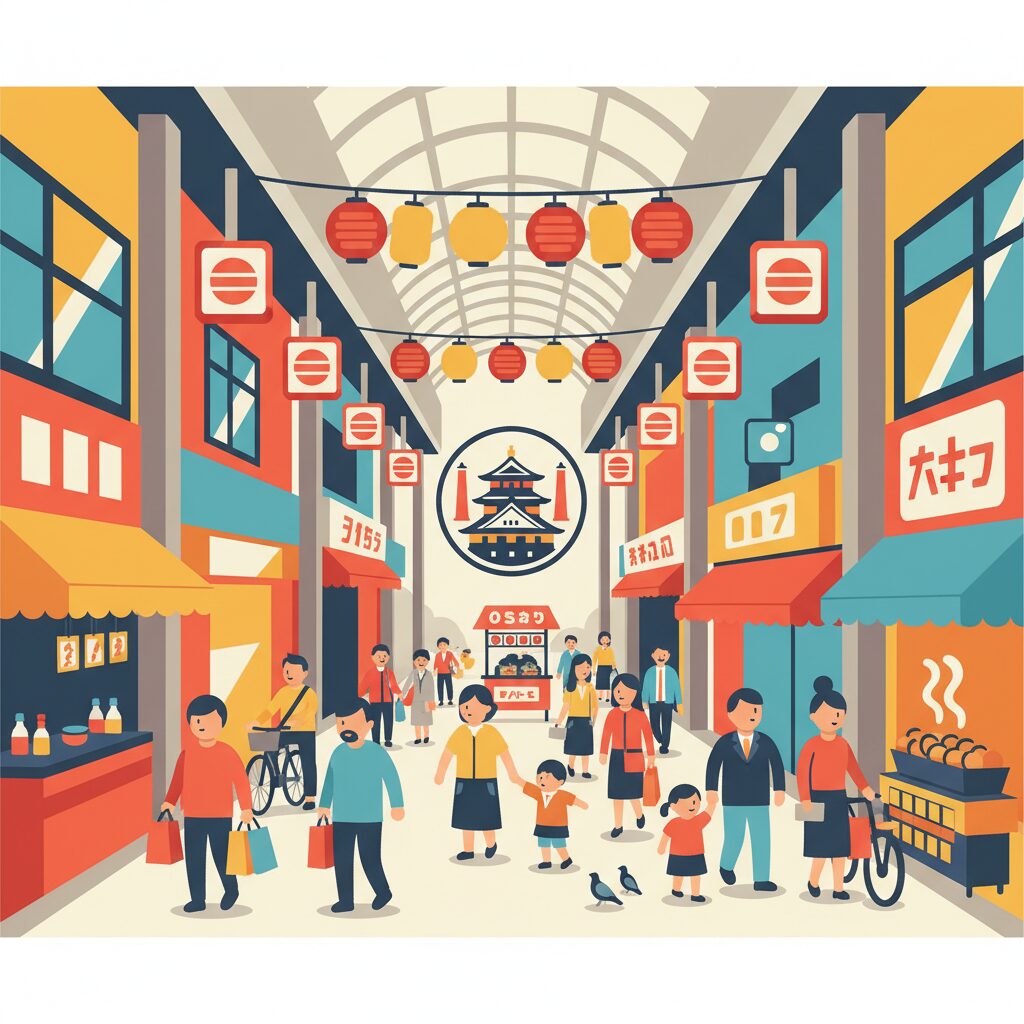
You see them everywhere in Osaka. They slice through neighborhoods, long covered avenues of commerce and chatter, buzzing under fluorescent lights or glowing with the warm light of paper lanterns. They are the shotengai, the covered shopping arcades. Your first impression, as a newcomer, might be one of nostalgic curiosity, or maybe even a little dismissal. You see the aging storefronts, the hand-painted signs, the seemingly random collection of shops selling everything from pickled radishes to cheap socks, and you might mistake it for a tourist attraction, a living museum, or simply a relic from a bygone era, soon to be swept away by gleaming shopping malls and the silent efficiency of online retailers. But to think that is to fundamentally misunderstand Osaka. These are not just places to buy things. They are the city’s arteries, its public squares, its sprawling, chaotic, and intensely human living rooms. To walk through a shotengai is to feel the city’s pulse, to hear its true voice, and to understand that in Osaka, community isn’t an abstract concept—it’s a daily, lived-in reality, negotiated over countertops and sealed with a boisterous laugh. The real life of the city doesn’t happen in the high-rise office buildings of Umeda or the silent, manicured residential streets; it happens here, under these weathered plastic roofs.
This spontaneous, daily connection is a hallmark of the city’s character, much like the friendly, sometimes direct, conversations you might have with locals at a bus stop.
The Shotengai as a Social Thermometer
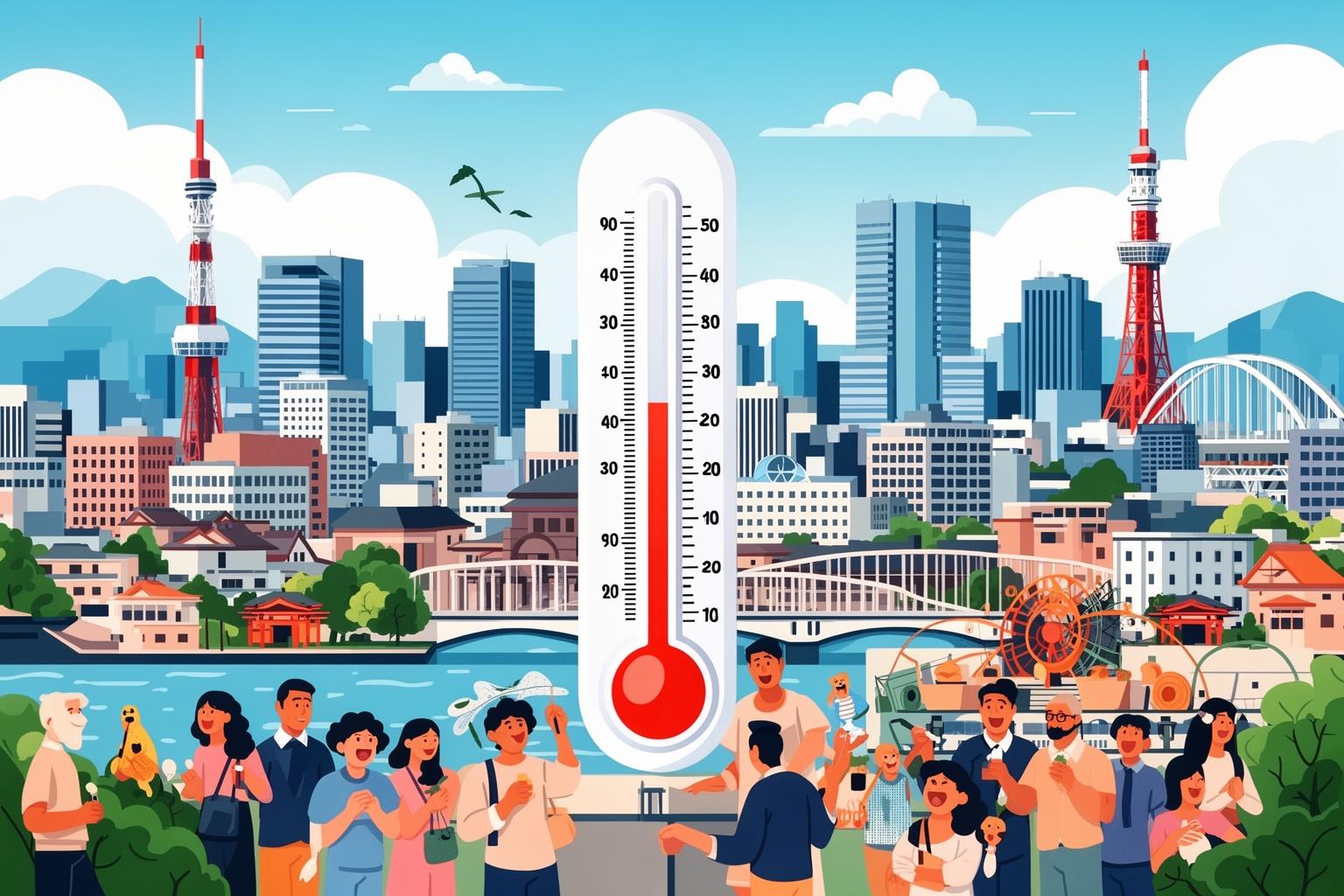
Step away from the tourist-filled streets of Shinsaibashi or Dotonbori and explore any neighborhood shotengai. What you enter is a live gauge of the community’s well-being—a social thermometer more precise and immediate than any official statistic or news report. The vibrancy, sounds, and even the smells of the arcade reveal everything you need to understand about the people who live and work there. You come to interpret the signs not on the signs themselves, but in the atmosphere itself.
Reading the City’s Mood
Is the arcade bustling with activity at four in the afternoon? Are grandmothers, their bicycle baskets brimming with daikon and green onions, pausing mid-lane to exchange gossip? Are children in school uniforms chasing one another, their laughter echoing beneath the high ceilings, while shopkeepers watch on with amused tolerance? If so, you’re in a thriving, healthy neighborhood. This flow of people, this casual, unhurried mingling, is the community’s lifeblood. It means people have both the time and the desire to connect. It also suggests the local economy, no matter how small, is self-sustaining. The Tenjinbashisuji Shotengai, Japan’s longest, exemplifies this dynamic energy—a 2.6-kilometer-long river of humanity that feels like an entire city compressed into a single street. Its energy is contagious, a continuous, roaring hum of commerce and conversation.
On the other hand, a quiet shotengai tells a different tale. The sight of metal shutters permanently rolled down on storefronts is a common and poignant sight throughout Japan. These streets are known as shattā-gai, or shutter streets. When there are more shutters than open shops, it signals challenges for the neighborhood. Perhaps the population is aging, with no younger generation stepping in to run family businesses. Maybe a new, massive Aeon Mall opened nearby, drawing customers away with its vast parking and air-conditioned comfort. This quietness is not peaceful; it is a void. It speaks of economic struggle and a fraying social fabric. The shotengai does not hide its condition. It wears its fortunes, good or bad, openly for all to see. This raw honesty sets it apart from the carefully curated, artificial perfection of modern shopping centers.
The Unspoken Language of Greetings
In Tokyo, a trip to the store is often a practice in polite anonymity. You’re met with a flawlessly executed, yet impersonal, `irasshaimase` (welcome). The transaction is smooth, efficient, and easily forgotten. You are a customer, playing the expected role opposite the clerk. In an Osaka shotengai, the dynamic is completely different. The currency of interaction is not formal politeness, but familiar recognition.
The gold standard greeting here is `Maido!`. Literally meaning “every time,” its true sense is closer to “Thanks for your continued patronage,” or simply, “Hey, it’s you again!” It’s a verbal nod that transforms you from a faceless shopper into a known quantity—a regular, a neighbor. When the butcher looks up from his block and says `Maido!`, he’s acknowledging the handful of times you’ve bought your pork cutlets from him. He’s placing you on his mental map of the neighborhood. The first time you hear it directed at you, it feels like a small rite of passage. You’ve been noticed. You belong.
This is the real source of the famous “Osaka friendliness.” It’s not an abstract, bubbly warmth. It’s a practical, functional friendliness rooted in the repetition of encounters within the shared space of the arcade. It’s the fishmonger asking about your week, the fruit stand lady remembering you like your oranges sweet, the tofu maker giving your child a small piece of fried tofu to snack on while you shop. These are not grand gestures but tiny, daily affirmations of mutual existence. This contrasts sharply with the Kanto region, where maintaining respectful distance tends to be the norm. In the Osaka shotengai, the aim is to close that distance, to weave you into the everyday tapestry.
A Stage for the Osaka Character
If the shotengai serves as the city’s living room, then its residents are the performers in a long-running, unscripted play. On this stage, the quintessential Osaka character—direct, pragmatic, humorous, and deeply invested in human connection—comes to life most vividly. Foreigners often witness behaviors here that would be unimaginable in Tokyo, and it is through interpreting these actions that one begins to grasp the local mindset.
The Art of the Haggle: More Than Just Saving Money
Let’s discuss price. Across most of Japan, the tag’s price is final. To question it or ask for a discount would be seen as extremely impolite, a breach of social norms. Yet, in Osaka’s shotengai, a different set of rules applies. The haggle, the nebiki kōshō, isn’t merely alive; it is a cherished form of communication.
A foreigner might assume this is about being cheap. It is not. The goal isn’t necessarily to save a significant sum. Instead, the goal is the interaction itself—it’s a game, a performance. It begins with a phrase like, `Chotto makete-ya!` (“C’mon, give me a little discount!”) or `Mou chottoなんとかならへん?` (“Can’t you do a little something about the price?”). This is not a demand but an invitation to a playful verbal exchange.
The shop owner might respond with mock surprise, `Ehhh, mou genkai ya de!` (“Whoa, that’s already the lowest price!”), explaining all the reasons the price is fair. The customer might feign slight disappointment. A little more back-and-forth, some laughs, and perhaps they knock 50 yen off the price or, more likely, toss in an extra potato or a handful of green onions as `omake` (a small bonus). The transaction concludes, and both sides leave smiling. The minimal discount is irrelevant. What’s been built is a relationship. You’ve engaged, shared a moment, and affirmed your shared humanity. This ritual reinforces that commerce is a social activity—not just a cold, sterile exchange of money for goods.
“Akan” and “Ee de”: The Directness of Osaka-ben
The shotengai is the primary conservatory for Osaka-ben, the local dialect. Unlike the subtle and often indirect standard Japanese taught in textbooks, Osaka-ben is known for its directness, expressiveness, and brutal honesty. This can be surprising initially, but it stems from practicality and sincere care.
Imagine you’re at a fish stall, eyeing a piece of tuna. In Tokyo, if it’s not the freshest, the vendor would likely remain silent, letting you decide. In Osaka, the elderly woman behind the counter is more apt to point at your choice and say, `Ni-chan, sore yori kocchi no hou ga zettai umai de` (“Hey kid, this one here is definitely much better than that one”). She might add, `Sore, kyou wa akan wa` (“That one’s no good today”). This isn’t an insult to your judgment; it’s her professional pride. She wants you to enjoy your meal because if you do, you’ll return. She is building trust through blunt honesty. This directness, this readiness to say `akan` (no good) or `ee de` (it’s good), cuts through the layers of politeness that sometimes cloud meaning in Japanese communication. It’s a shortcut to trust, and the shotengai thrives on it.
The “Obachan” Network: The Unofficial Neighborhood Watch
Overseeing this entire ecosystem are the Osaka `obachan`—middle-aged and elderly women who are the undisputed rulers of the shotengai. They are a formidable presence, often recognized by their bright clothing, practical perms, and unmatched ability to know everything about everyone. They serve as the hubs of the neighborhood’s social network.
To outsiders, their constant chatter may seem like idle gossip. But it’s much more than that. It’s a highly efficient, analog information system. They know who just had a baby, whose son is studying for university exams, and which elderly resident living alone hasn’t been seen for a day or two. This isn’t malicious snooping; it’s community care. It’s how the neighborhood looks after itself, spotting problems and mobilizing help long before any official agency could. If Mrs. Tanaka hasn’t come for her daily daikon purchase, you can bet the vegetable seller will ask the butcher, who will ask the tofu maker, and someone will be sent to check on her. For a foreigner living in the area, being noticed and occasionally questioned by this network is a sign of integration. It means you’ve been entered into the system. It means, for all practical purposes, you are home.
The Shotengai as an Economic Ecosystem
Beyond serving social purposes, the shotengai embodies a unique economic model that starkly contrasts with the uniformity of modern global retail. It functions as a complex, self-sustaining ecosystem founded on specialization, trust, and a deep, symbiotic connection with the local community. It celebrates the small, the local, and the personal.
Beyond Chain Stores: The Importance of Specialization
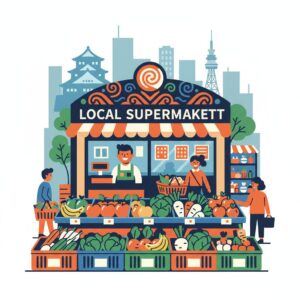
Stroll through a typical shotengai and a clear pattern emerges. Rather than a large, all-encompassing hypermarket, you encounter a sequence of small, highly specialized, often family-run shops. There’s the yaoya (greengrocer), the sakanaya (fishmonger), the nikuya (butcher), the tōfuya (tofu maker), and the okomeya (rice merchant). Each store has focused on a single specialty, frequently passed down through generations.
The philosophy underpinning this model is that expertise is invaluable. An Osaka shopper is more likely to trust the judgment of a man who has sold fish exclusively for fifty years over the anonymous, pre-packaged options offered by a national supermarket chain. The owner’s face is the brand; his reputation is his greatest asset. This system nurtures deep knowledge. The greengrocer can share not only the price of his tomatoes but also their origin, flavor profile, and the best preparation methods. The futon maker can detail the subtle differences in cotton density and its impact on sleep quality. This experience is far removed from scanning a barcode—it’s a dialogue with a craftsman. Lower overheads and the legacy ownership of properties in many arcades enable these small businesses to endure and flourish, cultivating a diversity in the commercial landscape increasingly rare in developed economies.
The Symbiotic Relationship with the Neighborhood
The shotengai is not a commercial area merely inserted into a residential zone; the two are tightly interwoven like threads in fabric. The arcade’s vitality depends entirely on the patronage of those living nearby, while the residents’ quality of life is greatly enriched by the convenience and community the arcade offers.
This link is both physical and social. Local clinics, dentists’ offices, post offices, and even small temples or shrines are often nestled within or just off the arcade. It is the place to meet everyday needs. Need a key duplicated? There’s someone for that. Bicycle with a flat tire? The repair shop is right there. Searching for a neighbor’s gift? The stationery and gift shop has you covered. The shotengai acts as a one-stop destination for the practical, mundane needs of the community.
Moreover, the arcade serves as the hub for the neighborhood’s shared rituals. It is where seasonal decorations are put up for Tanabata or New Year’s. It acts as the main venue for the local summer matsuri (festival), featuring temporary stalls with fried noodles and games for children. This central role in the community calendar solidifies the bond between merchants and residents, creating a profound sense of place often missing in the anonymous suburbs or towering apartment blocks of other major cities. Living near a lively shotengai means not just having a home, but truly having a neighborhood.
A Foreigner’s Guide to Navigating the Shotengai
For a non-Japanese resident, the shotengai can serve both as an incredible resource and a source of cultural confusion. It functions according to a set of unspoken rules and social cues that may be quite different from what you’re accustomed to. Learning to navigate this environment is essential to truly feeling at home in Osaka.
Misunderstanding the “Closeness”
One of the first things you’ll notice is the limited personal space, both physically and in conversations. The streets are narrow, shops are small, and people are comfortable with a level of closeness that might seem intrusive to someone from a culture with a larger personal bubble. This physical closeness is reflected in social interactions. Don’t be surprised if a shopkeeper, after a few visits, begins asking you questions that might feel quite personal: `Doko kara kitan?` (“Where did you come from?”), `Kekkon shiteru no?` (“Are you married?”), or `Oshigoto wa nani shiteru n?` (“What do you do for work?”).
It’s important to realize that this is not nosiness as understood in the Western sense. It’s a form of social mapping. The shopkeeper is trying to situate you within the community. They want to move you from the category of “stranger” to a more defined role: “the student from China,” “the teacher from America,” “the engineer from France who lives in that apartment on the corner.” Offering a simple, friendly answer is a way of participating. It’s an invitation to be known. Pulling back or giving vague, evasive answers can be taken as standoffish. The best approach is to embrace it. Share a bit about yourself, then return the question. Ask about their shop, their family. This is how relationships start.
How to Become a “Jōren” (Regular)
The single most important aim for a foreigner in a shotengai is to become a jōren, a regular customer. Achieving this status is the key to unlocking the full benefits of the community. The process is simple but requires dedication: consistency.
Pick your spots. Decide you will buy your vegetables from this stall, your bread from this bakery, your coffee from this small kissaten (coffee shop). Then, just keep showing up. At first, you’ll be an anonymous face. After a few visits, you might get a nod of recognition. Next comes the first `Maido!`. Then, a small chat may start. `Kyou wa atsui ne` (“It’s hot today, isn’t it?”). You respond in kind. You are beginning to build rapport. The ultimate sign of acceptance is the `omake`. One day, the fruit vendor will slip an extra mikan into your bag, or the croquette seller will hand you a freshly fried one to eat as you walk, refusing payment. This is not a financial exchange. It is a gift. It is a social contract. It says, “I see you. You are one of us. Please keep coming back.” This feeling of belonging is a powerful remedy to the loneliness and alienation that often come with living abroad.
The Shotengai as a Japanese Language Classroom
Forget expensive language schools and dull textbooks. The shotengai is the most effective, immersive, and affordable Japanese classroom you’ll ever find. The language here is real, practical, and alive. It’s where you’ll learn the natural flow of conversation and the specific vocabulary of everyday life.
The interactions are low-pressure and repetitive. You can practice asking for items (`Kore wo futatsu kudasai` — “Two of these, please”), inquiring about prices (`Ikura desu ka?` — “How much is it?”), and understanding the answers. The shopkeepers are teachers by default. They tend to be patient and used to dealing with all kinds of people. They will speak more slowly if you ask, and they often appreciate your efforts to use their language. More importantly, you’ll be exposed to the living, breathing Kansai-ben, training your ear to how people in Osaka actually speak—something no textbook can truly prepare you for.
The Future of the Shotengai: A Living Tradition, Not a Museum
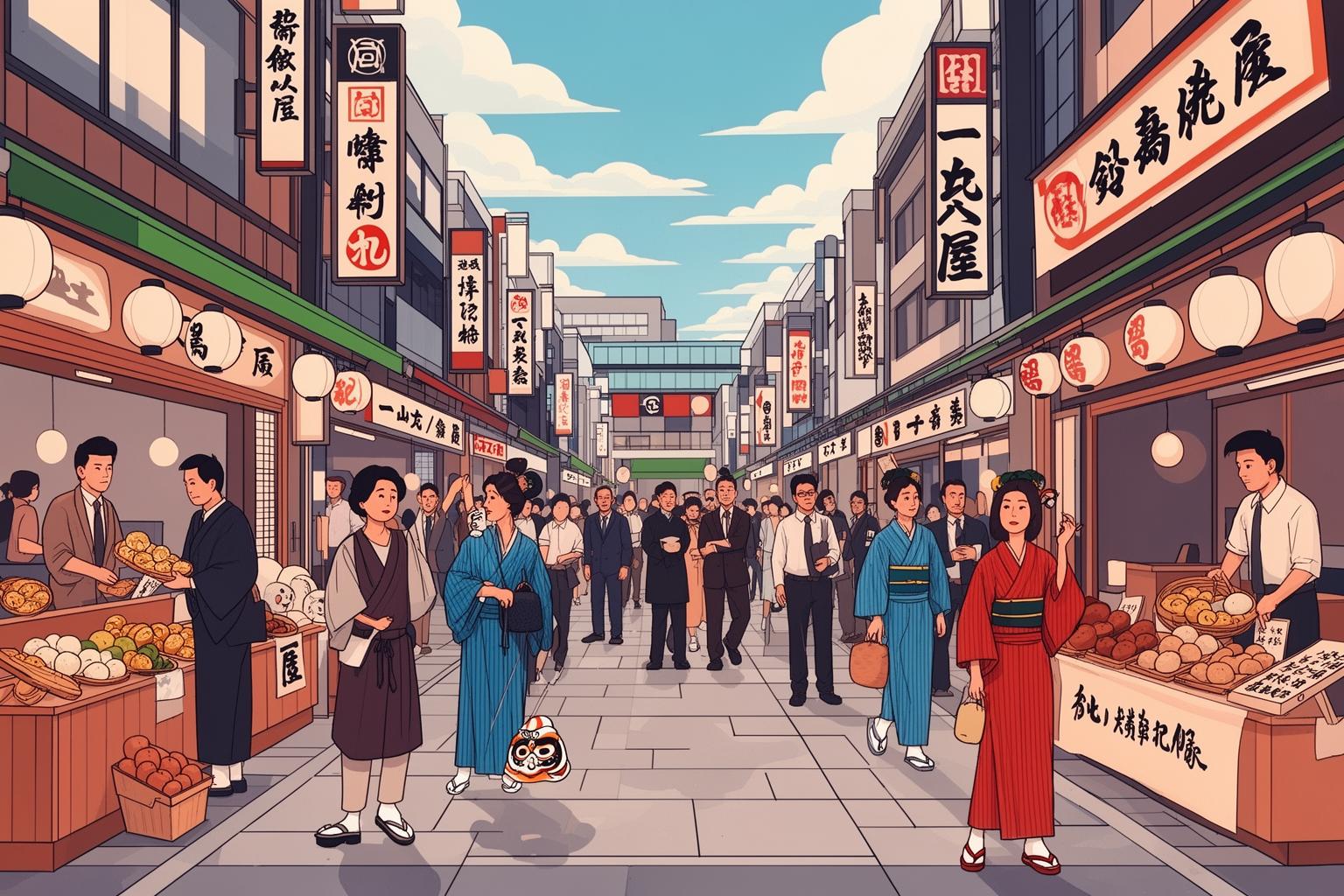
It would be misleading to depict the shotengai as universally flourishing utopias. They confront significant challenges in the 21st century. These arcades are not preserved historical theme parks; they are active commercial entities facing the tough realities of modern economics. Their future is uncertain, but their resilience and adaptability provide a distinctly Osakan form of hope.
Facing the Challenges
The most apparent threats are demographic and economic. Japan’s aging population means many multi-generational shop owners have no successors to inherit their businesses. When they retire, the shops often close permanently. This creates gaps in the arcade, like missing teeth, which can reduce its overall appeal and trigger a downward spiral.
Then there is competition. Vast, climate-controlled shopping malls, usually anchored by a supermarket and a Uniqlo, offer convenience, variety, and extensive free parking. For families with cars, it is often easier to do a single weekly shopping trip to a mall than to make multiple stops at specialized stores in the shotengai. And naturally, the steady rise of e-commerce provides nearly limitless choices delivered straight to your door. These forces are strong and have caused many arcades, especially in remote or less populated areas, to decline or vanish.
Reinvention and Resilience
But this is Osaka—a city built on commercial grit and a knack for reinvention. Many shotengai are not just surviving; they are innovating in creative ways. They recognize they cannot match malls on price or scale, so instead, they compete through experience, community, and authenticity. A new generation of entrepreneurs is revitalizing these traditional spaces.
A young couple might open a stylish third-wave coffee roaster beside an 80-year-old pickle shop. A craft beer bar with a dozen local taps might replace a former fishmonger’s stall. A trendy organic bakery or a niche bookstore may find a home in a space that once sold kimonos. This creates an intriguing blend of old and new. The Karahori Shotengai exemplifies this, with old wooden machiya townhouses preserved and transformed into chic cafés, art galleries, and boutiques, creating a unique atmosphere that attracts visitors from across the city. The retro-cool neighborhood of Nakazakicho smoothly integrates its quirky independent shops with the fabric of its traditional local shotengai.
This evolution is crucial. The successful shotengai of tomorrow will not be perfect replicas of the past. They will be vibrant, sometimes imperfect hybrids that honor their history while embracing the present. They prove commerce and community are not mutually exclusive. In fact, they show that for commerce to be truly sustainable, it must be firmly rooted in community. The shotengai is more than just a shopping destination. It is an idea—a belief that a city’s heart lies not in its tallest skyscrapers or widest boulevards but in the simple, daily face-to-face interactions among its people. And in Osaka, that heart still beats strongest beneath the long, covered roofs of its shopping arcades.