
You take the train. It’s a twenty-nine-minute ride on the Special Rapid service from Kyoto Station to Osaka Station. Twenty-nine minutes. That’s less time than it takes to watch a sitcom. In that short span, you cross an invisible border, a cultural fault line that runs deeper than the Yodo River separating the two cities. You step off the train in Kyoto, and the air itself feels different—measured, quiet, wrapped in layers of silk and history. The conversations you overhear are like muted watercolors, full of soft edges and unstated meanings. Then, you step off the train in Osaka, and it’s like walking into a live broadcast. The world is in full color, high definition, and surround sound. The language isn’t just spoken; it’s launched, it’s volleyed, it’s performed with the entire body. A shopkeeper doesn’t just give you a price; she tells you a story about it, throws in a joke, and maybe comments on your shoes. This isn’t just about different dialects; it’s about two fundamentally different philosophies of human connection, playing out side-by-side. For anyone trying to build a life here, understanding this shift isn’t just helpful—it’s essential. It’s the key to everything, from making friends at a local izakaya to navigating a business meeting. One city speaks in poetry, the other in punchlines. And here in Osaka, we believe a good laugh is the most honest thing you can share with another person. This is your guide to the rhythm, the noise, and the heart behind the way we talk.
To fully appreciate the cultural contrasts that shape life here, consider how these distinct communication styles are also influencing the region’s evolving millennial travel scene.
The Osaka Symphony: Fast, Loud, and Straight to the Point
To grasp conversation in Osaka, you first need to catch its rhythm. It’s not a gentle flow; it’s a percussive beat—fast, lively, and demanding active participation. While much of Japan values harmony and avoiding conflict, Osaka emphasizes engagement. Silence in conversation isn’t a thoughtful pause; it’s a dead zone, a vacuum that must be quickly filled with a question, comment, or, most often, a joke. The aim isn’t just exchanging information but generating shared energy, a spark between people. This approach stems from the city’s history as a merchant hub, where quickly building rapport was vital for business, and a straightforward, honest deal was preferred over a polite but vague one. This spirit remains alive in every interaction, from buying takoyaki on the street to sealing corporate contracts. It’s a communication style designed for speed, clarity, and connection—what you see is almost always what you get.
The Rhythm of Manzai in Everyday Banter
If you want a blueprint for Osaka conversation, watch manzai. This traditional style of stand-up comedy features a goofy, airheaded boke and a sharp, critical tsukkomi—and it’s not confined to the stage at the Namba Grand Kagetsu theater. It’s embedded in everyday life. The back-and-forth, the setup and punchline, the gentle absurdity followed by an immediate, sharp-witted correction—that’s the cadence of typical Osaka chat.
Step into a small, family-run electronics shop in Nipponbashi. You might ask the elderly man behind the counter, “How much for this radio?” In Tokyo, you’d get a straightforward price. In Osaka, you might get a performance. He could look at the radio, then at you, with a perfectly straight face and say, “For you? One million yen.” That’s the boke, issuing the setup. Your role, if you join in, is not to be offended or confused but to deliver the tsukkomi. You might gasp dramatically, saying, “One million yen! Does it come with a car?” or a quick, emphatic “Nande ya nen!” (No way!/Why the heck!). He’ll laugh, his wife might chuckle from the back, and then he’ll give you the real price—likely with a small discount for being a good sport. You haven’t just completed a transaction; you’ve created a moment, affirming a mutual understanding that life is a bit absurd and pointing it out is a fun way to bond. This playful teasing is a sign of affection—a way of saying, “I see you, and I’m willing to connect with you on a human level.”
“So, What’s Your Point?” – The Value of Directness
In many parts of Japan, especially in Tokyo’s business settings, conversations can feel like peeling an onion slowly and carefully. You begin with weather talk, move to vague compliments, and circle the main topic with layers of hedging and polite deference. Osaka has no patience for that. The local mindset, forged in the heat of commerce, is intensely pragmatic. The prevailing attitude is, “Let’s get to the point so we can solve the issue and move forward.”
This can be startling for newcomers. A colleague might walk up to your desk and say bluntly, “That email was confusing. The data in the third paragraph is wrong. Fix it.” There’s no “Excuse me, sorry to bother you, but I was reviewing your great email and had a small question about one of the figures…” The Osaka style isn’t meant to be rude—it’s efficient. It shows respect for your time and intelligence. The subtext is, “We’re both professionals. I see a problem, and I trust you to handle it without sugarcoating.”
This directness extends to personal relationships. If you ask an Osaka friend what they think of your new jacket, expect an unfiltered response like, “Eh, that color doesn’t really suit you.” This isn’t an insult, but honesty. True friends tell you the truth, even if it’s blunt, rather than letting you walk around looking foolish. They’re sharing their honne (true feelings), assuming you’d prefer that over a meaningless tatemae (public face). The key is understanding the good intention behind the words. Directness here is not an attack but a shortcut to genuine communication.
The Art of the “Tsukkomi” – More Than Just a Punchline
We mentioned the tsukkomi in manzai, but its role in daily life deserves deeper attention. The tsukkomi keeps conversations grounded, calling out nonsense. It represents active, engaged listening. When someone makes a tsukkomi at your expense, it’s one of the highest compliments in Osaka’s social world.
Imagine you’re at a bar with new acquaintances and tell a slightly exaggerated story about losing your way on the subway. Elsewhere, listeners might nod politely. In Osaka, someone will likely jump in, “You got on the Midosuji Line going the wrong way? Are you a child? Even my dog knows Umeda is north!” They say this with a grin, and everyone laughs. This isn’t bullying but an invitation. By playfully pointing out your story’s flaw, they signal: “I’m paying attention. I’m comfortable joking with you. You’re part of our group now.”
Learning to both give and receive a good tsukkomi is a vital social skill in Osaka. It shows you don’t take yourself too seriously and can move with the local rhythm. It’s a verbal jab that acts like a social hug. The worst reaction is defensiveness. The right response is laughter and either accepting the tease or countering with your own playful comeback. It’s a dance, and the tsukkomi keeps the energy alive.
Laughter as Social Glue
Above all, humor is Osaka’s universal currency. It builds connections, eases tension, and expresses affection. A serious demeanor, valued as professional or thoughtful in Tokyo, can seem cold, distant, or even arrogant in Osaka. People are expected to be open, expressive, and ready to laugh—especially at themselves.
Self-deprecation is key in this humorous culture. Bragging or putting on airs is a major social faux pas. Instead, people often highlight their own flaws or embarrassing stories. A successful business owner might loudly complain about how his wife controls his spending money. A beautiful woman might joke about her terrible cooking. This isn’t low self-esteem but a strategic social move. It makes them approachable, relatable, and non-threatening. It says, “Don’t worry, I’m not perfect—I’m just like you. Let’s relax and be ourselves.”
Living in Osaka, you’ll notice even tough conversations are often softened with humor. A landlord telling you to sort your garbage more carefully might start with a joke about crows having a party with your unseparated plastics. This humor lightens criticism and preserves relationships. In Osaka, a shared laugh proves your connection is strong enough to handle a little honesty.
The Kyoto Sonnet: A Dance of Subtlety and Implication
Crossing that invisible border back into Kyoto transforms the entire soundscape. The percussive rhythm of Osaka fades into the gentle hum of a string quartet. Here, communication is an art—an intricately choreographed dance of indirectness and layered meaning. For a thousand years, this was the imperial capital, a city of aristocrats, priests, and artists whose lives and social status depended on navigating a complex web of hierarchies and unspoken rules. Direct confrontation could bring ruin. Consequently, Kyoto cultivated a language of exquisite subtlety, where what is not said often carries more weight than what is.
This isn’t about dishonesty. From Kyoto’s perspective, it’s about thoughtfulness—preserving social harmony (wa) and allowing others to save face. A direct refusal can embarrass both parties. A subtle, indirect “no” enables everyone to retreat gracefully. To outsiders, this may seem maddeningly opaque, but to insiders, it is a language of profound social intelligence and respect. It requires listening with more than just ears—attending carefully to the air, the pauses, and the delicate word choices.
The Unspoken Language of “Honne” and “Tatemae”
While honne (true feelings) and tatemae (public facade) exist throughout Japan, Kyoto practices these concepts with a mastery that can feel like an entirely different language. In Osaka, the gap between honne and tatemae is often minimal or nonexistent. In Kyoto, it can be a vast divide.
Tatemae is surface-level conversation: polite, complimentary, and agreeable—the beautiful wrapping paper around a gift. Honne is the true message, often concealed within that wrapping. The challenge for outsiders lies in spotting the clues pointing to the honne, which rarely reside in the words themselves but in context, tone, and subtext.
A Kyoto native might say, “That is a very unique idea.” To a Westerner, this sounds like praise. A Tokyoite may interpret it as cautiously optimistic. But in Kyoto, it very well means, “That is a terrible idea, and I cannot believe you suggested it.” The key word “unique” is a neutral descriptor used in place of a positive one. Had they truly liked the idea, they would have said “excellent” or “fascinating.” The lack of strong positive language conveys the message. Understanding this requires a complete recalibration of one’s conversational antenna.
“Consider a Cup of Bubuzuke” — The Classic Kyoto Dismissal
No example better illustrates Kyoto’s indirect communication than the story of bubuzuke. Bubuzuke (or ochazuke) is a simple dish of rice with tea or broth poured over it. The legend goes that if you are a guest in a Kyoto home and your host asks, “Would you care for a cup of bubuzuke?”, they are not offering a snack. They are politely, yet clearly, signaling that it is time to leave.
This single example encapsulates the entire philosophy. A direct “Please go home now” would be shockingly rude, disrupting the evening’s harmony and causing embarrassment. The offer of bubuzuke is a masterpiece of social grace, enabling the guest to gracefully take their leave by saying, “Oh, you are too kind, but I mustn’t impose any further. I should be going.” Both parties understand the true meaning, but face is preserved on all sides. The ritual continues.
Though it’s unlikely a modern Kyoto resident would use this exact phrase with a foreign guest, the spirit remains alive. Notice offers that seem overly polite or come at the end of an evening. A host who says, “I’m so sorry I can’t offer you more; it must have been a long journey to get here,” might be gently hinting that you should consider the long trip home. It’s a verbal art of nudging someone toward the door while holding it open with a smile.
Compliments with a Hidden Edge
In Osaka, a compliment is usually just a compliment. In Kyoto, it can be a tool of social maneuvering—a subtle criticism or even a warning. This is perhaps the most challenging aspect for foreigners to grasp. The language is positive, yet the intention can be the exact opposite.
Consider the classic example of a neighbor and the piano. Your child practices diligently, and your Kyoto neighbor meets you in the hallway with a serene smile: “Your daughter is becoming such a wonderful pianist! We hear her practicing with such energy every evening.” On the surface, this is a kind compliment; you thank her, proud of your child’s efforts. But the subtext is lost on you. The key words “energy” and “every evening” are not praise but a polite complaint about the noise. She is saying, as kindly as possible, that your child’s piano playing is disturbing the neighborhood.
An Osaka neighbor faced with the same situation would be much more direct. They might lean out the window and yell, “Hey! That’s enough Beethoven for one night! Some of us are trying to sleep!” Or meet you in the hall and say, “Your kid’s getting good, but man, my walls are shaking. Can she wrap it up by 9?” It’s blunt, but unmistakably clear. In Kyoto, the burden is on the listener to decode the message. Responding only to the surface compliment while missing the underlying complaint would be a serious social blunder, marking you as someone who cannot “read the air” (kuuki wo yomu).
The Weight of Silence and Pauses
Lastly, the role of silence in Kyoto conversation cannot be overstated. In Osaka, silence is an empty space that must be filled and is often awkward. In Kyoto, silence is a form of communication—a space for reflection, a sign of respect, or a powerful way to express disagreement without a single negative word.
If you present an idea in a meeting and your Kyoto colleagues respond with a few seconds of thoughtful silence, don’t rush to fill it. They are not dismissive; they are granting your proposal the honor of careful consideration. A long pause before an answer often foreshadows a gentle redirection or a soft refusal. If you ask for a deadline to be moved up and the person pauses, looks away briefly, then says, “That is a possibility we could explore,” the message is almost certainly “no.” The pause signals hesitation, and the ambiguous language confirms it.
This sharply contrasts with Osaka, where a pause might be seen as confusion or disinterest. An Osaka colleague would immediately jump in with questions: “Why do you need it sooner? What’s the bottleneck? What happens if you don’t get it?” They tackle the problem head-on. In Kyoto, engagement is subtler, and silence speaks volumes.
Navigating the Kansai Communication Gap: A Foreigner’s Field Guide
Grasping these two distinct styles is one thing; mastering the ability to switch between them is another. For a foreigner living in Kansai, everyday life often involves navigating both worlds. You might work with colleagues from Kyoto, reside in an Osaka neighborhood, and have friends from both cities. This demands a certain linguistic and cultural agility—an ability to adapt your approach depending on whom you’re speaking with. The greatest challenge is avoiding common misunderstandings that can cause confusion, frustration, or even unintended offense.
Misreading Osaka’s Directness as Aggression
The most frequent stumbling block for foreigners in Osaka is interpreting directness as anger or rudeness. The volume, pace, and bluntness of the local speech can seem aggressive if you’re unaccustomed. The key is to focus on the intent and observe non-verbal cues.
An elderly woman on the bus might poke you and loudly say, “Your bag is in the way!” She isn’t upset. She’s simply stating a fact in the most efficient manner. Her tone may be sharp, but if you look at her expression, it’s likely neutral or even slightly concerned someone might trip. The best response is not to become defensive, but to smile, say “Ah, sumimasen!” (Ah, sorry!), move your bag, and move on. Taking it as a personal insult fundamentally misinterprets local culture.
Similarly, a shopkeeper joking about your Japanese skills isn’t mocking you. When they say, “Your Japanese is… interesting! Where did you learn that?” with a hearty laugh, they’re trying to connect. They find your effort charming and are inviting playful interaction. The Osaka way of showing warmth is not through gentle, reserved politeness but through lively, loud, and sometimes teasing engagement. They are treating you like a local, not a delicate outsider.
The Risk of Taking Kyoto’s Politeness Literally
The opposite danger lies in Kyoto. A foreigner used to direct communication can easily misinterpret the signals and leave a conversation with a completely wrong impression. Taking Kyoto’s tatemae at face value is a recipe for trouble.
If you invite someone from Kyoto to a party and they reply, “Thank you for the invitation. I will try my best to attend if my schedule allows,” don’t expect them to come. This is a very soft, very polite “no.” A firm “yes” would be more enthusiastic and specific, for example, “That sounds wonderful! I will definitely be there. What time should I arrive?” The vague, conditional phrase “I will try” is the clue. A direct follow-up like “So, are you coming or not?” would be a serious social misstep, forcing them into an outright “no” and causing embarrassment.
In business, this can be even trickier. A Kyoto business partner saying, “We will take your proposal into consideration,” is not making a commitment. They are politely ending the discussion. Pressuring them for a decision will only harm the relationship. You must learn to accept ambiguity and wait for them to signal the next step. Demanding Western-style clarity will only be met with more layers of polite evasion.
“Nande ya nen!” – Your First Step into Osaka-ben
While you don’t need to become fluent in the Osaka dialect (Osaka-ben), learning a few key phrases is more than just a party trick; it shows respect and understanding of the local culture. It’s a key that opens up a more authentic level of interaction. Words in Osaka-ben carry emotion and a distinctive local flavor that standard Japanese often lacks.
A Few Essential Phrases:
- Nande ya nen! (なんでやねん!): The quintessential Osaka phrase, meaning “Why the heck?”, “No way!”, or “What are you talking about?”. It’s the perfect tsukkomi for anything slightly absurd. Use it with energy and a laugh.
- Meccha (めっちゃ): Means “very” or “so,” but with more punch than the standard totemo. For example, “Meccha oishii!” (So delicious!) conveys genuine enthusiasm.
- Akan (あかん): Osaka’s version of “dame” (no good, not allowed). It’s direct and final. “Sore wa akan!” (That’s not going to work!).
- Honma? (ほんま?): Means “Really?” or “For real?”. It expresses surprise or disbelief and invites further explanation.
Using these words, even imperfectly, will almost always earn a smile or laughter. It signals you’re not just a passive observer but an engaged participant. It shows you “get it,” and people will be much more open and friendly as a result.
Why the Difference? A Peek into History and Identity
These distinctly different communication styles did not arise spontaneously. They are the result of centuries of unique history, economics, and social frameworks. Although Osaka and Kyoto are close neighbors geographically, they developed in completely separate environments, shaping the mindset and identity of their inhabitants in profoundly different ways. Grasping this history is essential to moving beyond stereotypes and appreciating the reasoning behind each city’s manner of speaking.
Osaka: The Merchant’s City
Osaka’s identity is rooted in commerce. During the Edo period, it was known as “tenka no daidokoro,” the Nation’s Kitchen. It served as the central hub for rice, sake, and countless other commodities. The city was governed not by samurai or aristocrats, but by a strong, pragmatic merchant class. In the Osaka merchant world, there was no room for ambiguity. A deal was a deal. Credit, trust, and reputation were paramount.
This atmosphere cultivated a culture of directness, efficiency, and logic. Negotiations needed to be swift and clear. Relationships had to be founded on mutual trust, often built through straightforward, no-nonsense communication. The ornate, indirect language of the Kyoto court was ineffective in the fast-moving rice trades of Dojima. Time literally equaled money. This merchant spirit—practical, unsentimental, and focused on results—is the foundation of Osaka’s communication style. Its humor, volume, and lack of pretense all arise from a culture where being honest and clear was valued more than being elegant and refined.
Kyoto: The Imperial Capital’s Tradition
Kyoto, in contrast, was Japan’s imperial capital for over a thousand years. It was a city of the Emperor, court nobility, influential temples, and master craftsmen. In this environment, social hierarchy was strict, and a single inappropriate word could result in loss of favor, exile, or worse. Survival depended on mastering the art of subtlety—conveying meaning without stating it directly.
This is the world that perfected tatemae. Language was both a defense and a delicate weapon. Power was expressed not through loud orders, but through whispers, poetry, and gestures understood only by insiders. Preserving harmony (wa) and ensuring no one, especially a superior, lost face was the chief aim in social interactions. This legacy of courtly sophistication and caution still influences Kyoto society today. The emphasis on refinement, careful word choice, and avoidance of direct confrontation all echo an era when subtlety was essential for survival.
Not a Competition, but a Culture
It might be tempting to label one style as “honest” and the other as “insincere,” but this is a significant oversimplification. Neither style is inherently superior; they are simply different approaches to coexisting. Osaka’s directness is a form of honesty that values clarity and efficiency. Kyoto’s indirectness is a form of politeness that prioritizes harmony and social grace.
Both styles function effectively within their own settings. An Osaka merchant trying to close a deal using Kyoto-style ambiguity would likely fail. A Kyoto courtier employing Osaka-style bluntness with a noble would have suffered serious repercussions. The important thing for anyone living in Kansai is not to judge but to understand the historical and social logic underlying each style. They are two sides of the same cultural coin, each reflecting a deep and unique history.
Living the Osaka Conversation: What It Feels Like Day-to-Day
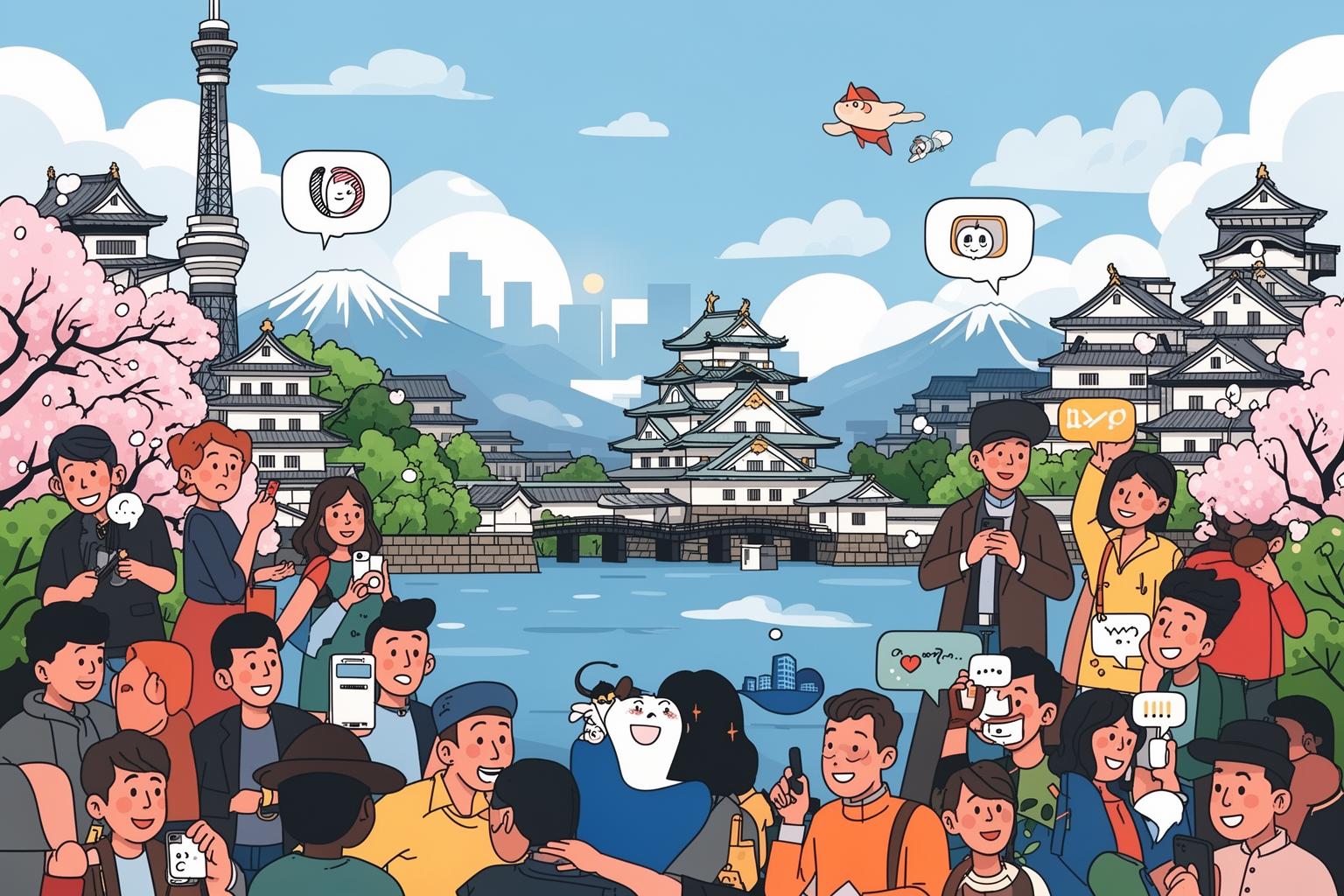
Beyond theory, what does this communication style truly feel like in everyday life? It feels like living in a city that constantly talks to itself—and to you. It’s an interactive experience. You aren’t just an anonymous face in the crowd. You’re a potential conversation partner, a future tsukkomi target, a member of the urban ensemble. Life here is lived out loud, openly, with a continuous commentary from the entire cast of characters you share the city with.
The Train Station Banter
In a Tokyo train station, commuters tend to be silent, self-contained individuals, absorbed in their phones or books. At a major Osaka hub like Umeda or Namba, the station itself seems to have a voice. Station attendants don’t merely deliver announcements; they perform them with a distinctive, melodic rhythm, often adding spontaneous advice. Strangers waiting on a crowded platform are more inclined to strike up a conversation. An elderly man might notice your puzzled expression, glance at the departure board, and say, “You’re on the wrong platform, kid. The train for Kobe is over there. Hurry up!” He’s not an official, just a fellow citizen—and in Osaka, that makes him part of your support network.
Shopping in a “Shotengai”
No place captures the Osaka spirit better than a shotengai, a covered shopping arcade. Forget the sterile, quiet aisles of a modern supermarket. A place like Tenjinbashisuji, Japan’s longest shotengai, is a full-contact experience. The fruit seller won’t just sell you apples; he’ll shout, “Come on, miss, these are the sweetest apples you’ll ever taste! Your boyfriend will love you more if you bring these home!” The butcher might see you eyeing a particular cut of meat and offer unsolicited, yet brilliant, cooking advice. The woman selling pickles will insist you sample one, then tease you for taking too small a piece. You leave not only with bags full of groceries but with a dozen small human interactions that make you feel part of a community. You aren’t merely a customer; you’re a neighbor.
The Welcome Noise of an Izakaya
An Osaka izakaya (Japanese pub) is far from a place for quiet, private conversation. It’s a communal space that’s almost always loud. Boisterous laughter, clinking glasses, the owner (the taisho) shouting orders and joking with regulars—this is the city’s nighttime soundtrack. Don’t be surprised if people at the next table overhear your conversation and chime in with their own opinions or questions. This isn’t considered eavesdropping; it’s just friendliness. The taisho will almost certainly start a chat, asking where you’re from and what you’re eating. Within an hour, you might find yourself sharing a bottle of sake with strangers who feel like old friends. The walls between tables are thin, and the atmosphere aims to create a single, lively space of shared enjoyment.
Embracing the “Akan” Attitude
A refreshing honesty defines the Osaka approach to requests and obligations. This local philosophy can be summed up as akan mon wa akan—if it’s impossible, it’s impossible. People aren’t afraid to say “no.” Though this might seem blunt, it’s actually incredibly efficient and reliable. Elsewhere in Japan, you might receive a vague, non-committal answer to a difficult request, leaving you in limbo for days. An Osakan will tell you straightforwardly, “Sorry, I’m swamped. I can’t do it.” This direct refusal lets you move on immediately to find another solution. There are no false promises, no wasted time. This bluntness is a different kind of kindness—a practical kindness rooted in reality. You always know where you stand, and in a busy life, that clarity is invaluable.
To truly thrive in Osaka, you must embrace this world of open, honest, and humorous exchange. It’s a city that rewards participation. Don’t just listen; talk back. Don’t just smile politely; laugh out loud. Learn to deliver a gentle tsukkomi when the chance arises. This isn’t about changing who you are; it’s about learning a new language of connection. In Osaka, communication isn’t a polite transaction; it’s the very fabric of daily life—a loud, chaotic, and wonderfully human symphony. To find your place here, simply find your instrument and join the band.