Step onto the Midosuji Line platform at Umeda Station around eight in the morning, and you’ll feel a shift in the city’s rhythm. The usual boisterous, freewheeling energy of Osaka, a city that wears its heart on its sleeve, seems to evaporate, replaced by a focused, almost silent intensity. This isn’t the Osaka of flashing neon signs and hearty street food vendors shouting greetings. This is the city at work. The daily commute, especially on this crimson artery that pumps life from the northern business hubs to the southern entertainment districts, is more than just a trip from A to B. It’s a live performance, a daily ritual that reveals the deep, unspoken truths about how this city functions and how its people think. For anyone moving here from abroad, or even from the more reserved confines of Tokyo, this daily journey can be a source of constant confusion and fascination. Why does a city famous for its warmth and chatter fall so silent on the train? What are the invisible rules governing every movement, from lining up on the platform to claiming a precious seat? The Midosuji Line is a microcosm of Osaka itself—a place of surprising contradictions, fierce pragmatism, and a unique brand of communal spirit that you can only understand by being swept up in its current. It’s here, in the crush of the morning rush, that you’ll find the real, unvarnished soul of the city, moving relentlessly forward.
Amid the city’s relentless morning rhythm, innovative service strategies such as faster OTA payouts are quietly reshaping the hospitality landscape in Kansai.
The Morning Ritual: A Symphony of Silent Efficiency
The air on the platform is heavy with anticipation. It’s a multi-sensory experience: the faint scent of laundered shirts, the subtle aroma of coffee drifting from a nearby kiosk, the distant rumble of the approaching train swelling into a ground-shaking roar. Yet the most striking feature is the sound of its absence. The chatter has vanished. People stand in perfect, disciplined lines, eyes fixed on their smartphones, minds already at the office. This is the overture to the daily commute, a carefully orchestrated performance in organized chaos where every participant knows their role.
The Platform Performance
At a major transit hub like Umeda, a gateway for commuters from surrounding prefectures, the platforms for the Midosuji Line are a marvel of human engineering. Yellow lines painted on the ground precisely mark where train doors will open and where passengers should line up. Two neat lines form for each door, a human equation meticulously calculated for maximum boarding efficiency. This level of order isn’t unique to Osaka; it’s a hallmark of Japanese public transport. What sets it apart here, however, is the underlying spirit. In Tokyo, queuing reflects a deep-rooted social contract, a ritual performed out of respect for societal harmony, or wa. There’s a palpable tension, a fear of being the one to break the line.
In Osaka, the atmosphere is different. It’s less about abstract social harmony and more about a shared, practical goal: let’s all board this train as quickly as possible so we can move on with our day. It’s a collective understanding grounded in pragmatism, not philosophy. “You stay in your lane, I’ll stay in mine, and we’ll all benefit.” This practical mindset gives rise to a curious, often exhilarating phenomenon: the kakekomi-josha, or last-second dash for the train. Though officially discouraged nationwide through posters and announcements, in Osaka it feels like an art form. You’ll see a salaryman sprinting full tilt, tie flying behind him, briefcase in hand, making a desperate leap through closing doors. In that split second, a stranger might reach out to hold the door just long enough. It’s a moment of unspoken solidarity, a recognition of the shared hustle. The silent message is, “I understand. Run.”
The Art of Onboarding: Personal Space is a Luxury, Not a Right
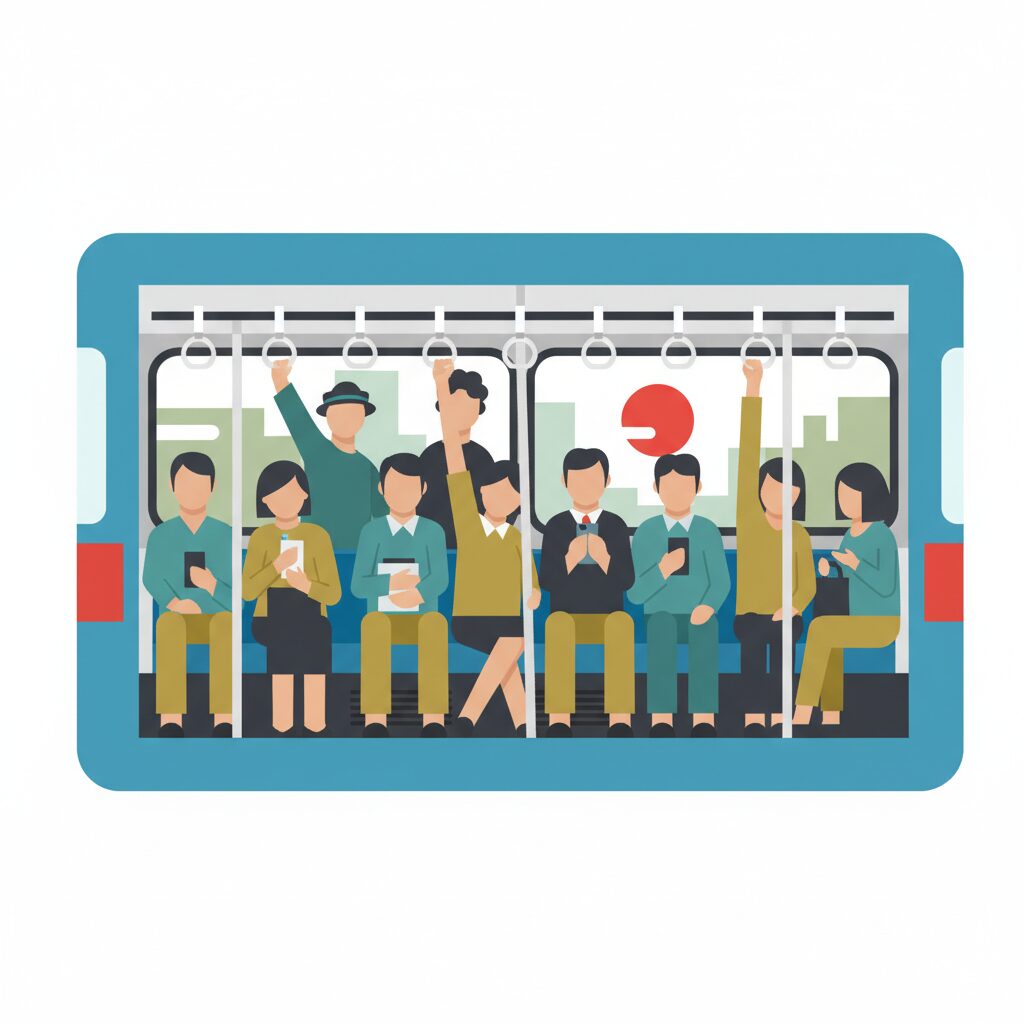
The moment the doors slide open, the symphony begins. There’s no aggressive pushing or shoving, but there is a firm, undeniable pressure as the lines of people flow into the already-packed carriage. Any Western notion of personal space is politely, yet decisively, cast aside. The crush is real — a tightly packed mass of humanity where you become intimately acquainted with the shoulders, backs, and bags of complete strangers. A Tokyo commute can feel suffocating in its own way, with people instinctively shrinking, trying to make themselves smaller, apologizing with every slight accidental touch. It’s an exercise in minimizing one’s own presence.
Osakans embrace the squeeze with a different outlook. It’s a physical problem with a physical solution. Contact is unavoidable, so why get upset? People use their bodies and belongings with strategic awareness. A bag becomes a buffer; a shoulder is angled to carve out a sliver of breathing room. A quietly muttered “suimasen” (excuse me) serves less as an apology for the contact, and more as a practical announcement: “I am moving into this space now.” There’s no malice, no offense taken. It’s a straightforward negotiation for space. As the train nears a stop, this culminates in the “Osaka shuffle.” Without a word, a path miraculously opens for passengers needing to disembark. People turn sideways, suck in their stomachs, and press against the glass in a coordinated, silent dance. It’s a beautiful, if slightly claustrophobic, demonstration of collective intelligence in motion.
The Unspoken Codes of Conduct Inside the Carriage
Once you’ve found your balance and accepted the thin air, you step into a new social environment governed by a different set of unspoken rules. The train car is a public space, but for the length of the commute, it transforms into a collection of private bubbles. Navigating this setting requires grasping the subtle codes that keep order amid the disorder.
The Sound of Silence (Mostly)
The most surprising paradox for newcomers is the quiet. Osaka is known for its loudness, with people who talk openly and laugh heartily. Yet, the morning train is a sanctuary of silence. The nationwide ban on phone calls is observed almost religiously. A ringing phone attracts a wave of disapproving stares. However, the silence here differs from Tokyo’s. In Tokyo, any conversation, even a whisper, can feel like a breach. On the Midosuji Line, you might occasionally catch a pair of friends or colleagues engaged in a brief, low-volume chat. It’s rare but not the cardinal sin it would be in the capital. The rule appears to be: don’t be a nuisance. A quiet conversation that doesn’t disturb others is a tolerable exception.
Most people, though, retreat into their own worlds. They masterfully use the commute time. Eyes glued to phone screens, thumbs darting across games, manga apps, or news sites. Others close their eyes, stealing a few extra precious minutes of sleep, their bodies swaying in sync with the train’s movement. This silence isn’t the cold, distant kind of strangers ignoring each other. It’s a functional silence, a mutual understanding that the commute is a task, a transitional phase between home and work, where distractions are inefficient.
Seating Politics: A Game of Speed and Strategy
For those fortunate enough to be on a less crowded train or board at an early stop, securing a seat is a competitive challenge. There is a clear hierarchy. The priority seats, or yusen-seki, usually located at the ends of the carriage, are reserved for the elderly, pregnant women, people with disabilities, and those with small children. Osakans generally respect this rule and will stand immediately if someone eligible boards. However, there is a pragmatic undertone. If no one who qualifies is standing, the seat is fair game. The moment someone who needs it appears, you are expected to give up the seat without being asked.
For the regular seats, it’s a test of keen eyes and quick reflexes. Experienced commuters, known as “seat hawks,” have an almost psychic ability to sense when someone is about to rise. They watch for subtle signs: a bag being gathered, a phone being put away. The moment the person stands, a nearby passenger slides into the vacant spot with practiced ease. This is not seen as aggressive or rude; it’s simply clever strategy. Hesitation means standing for another thirty minutes. This competitive, nearly mercantile approach to a public resource is quintessentially Osaka. Another interesting trend is the “one-buttock squeeze.” When a bench seems full, an Osakan will often signal to the tiny gap between two seated passengers, who will then instinctively scoot closer to create just enough space. It’s about maximizing efficiency. An empty gap, no matter how small, is a wasted opportunity.
The Bag Conundrum: Backpacks vs. Totes
Throughout Japan, train etiquette demands that in a crowded car, you wear your backpack on your front, hold it by your side, or place it on the overhead rack to avoid accidentally hitting others. In Tokyo, this rule is followed with militant strictness. Wearing a backpack on your back in a packed train invites disdainful glances. In Osaka, the rule exists but is applied more flexibly. During the intense morning crush, many backpacks remain on backs. The unwritten amendment seems to be: as long as you are mindful of your surroundings and not actively bumping someone with your bag, it’s understandable. If the train is so packed that removing your backpack is impossible, then common sense takes precedence. This reflects pragmatism in action, prioritizing practical reality over rigid enforcement of ideal etiquette.
The Midosuji Line Personality: A Tale of Two Ends
The Midosuji Line is not a uniform entity. It possesses a unique character that shifts as it travels along its north-south route. The nature of the passengers, the atmosphere inside the carriages, and the very experience of the commute vary significantly depending on which section of the line you are on. It is a journey through the city’s diverse social and economic layers.
North Side Story: The Corporate Corridor (Shin-Osaka to Yodoyabashi)
The northern section of the line, stretching from Esaka and Shin-Osaka down through Umeda, Yodoyabashi, and Honmachi, serves as the city’s corporate backbone. Here, you’ll find the headquarters of major corporations, trading firms, and financial institutions. The passengers are a sea of dark suits and conservative blouses. The atmosphere is more formal and tense. People carry themselves with a clear sense of purpose. Briefcases and serious-looking document bags are everywhere. The air is heavy with the quiet pressure of deadlines and morning meetings. The stations themselves—sleek, modern, and expansive—mirror this corporate identity. This segment of Osaka competes directly with Tokyo, and the commute here feels most like its eastern counterpart. It’s disciplined, fast-paced, and all business, yet carries a distinct Kansai ambition that comes across as confident swagger rather than Tokyo’s anxious conformity.
South Side Vibe: The Merchant’s Domain (Shinsaibashi to Tennoji)
As the train moves south past Honmachi, the city’s mood begins to change. Shinsaibashi station opens onto Osaka’s premier shopping district. Namba is the vibrant, chaotic heart of the “Minami” (south) entertainment district. Dobutsuen-mae and Tennoji lead to historic neighborhoods, the zoo, and extensive parks. The passengers reflect this shift. Dark suits gradually give way to the varied fashion of retail workers, the casual attire of students, and the more expressive styles of those in creative fields. The energy in the carriages relaxes. You’re more likely to catch the distinctive, melodic rhythm of the Osaka dialect. Conversations become livelier, and laughter grows louder. Exiting at Namba is like being shot out of a cannon into a festival. The overwhelming density of people, noise, and visual stimuli is both exhilarating and intense. This is the Osaka of popular imagination: a city shaped by merchants, entertainers, and artisans. It’s a little rough around the edges, fiercely proud, and endlessly spirited. The commute in the south is less about heading to an office and more about arriving at the center of the action.
What Foreigners Often Get Wrong
The daily commute on the Midosuji Line can serve as a challenging cultural lesson, where it’s easy to misread the signals. Many behaviors that might appear rude or cold by Western standards are actually grounded in a cultural logic that values efficiency and collective function above individual expression.
Misinterpreting Silence as Unfriendliness
Perhaps the greatest misunderstanding is thinking that the silent, expressionless passengers during the morning rush are unfriendly. Foreigners familiar with Osaka’s renowned hospitality in restaurants or shops might be taken aback by the apparent coldness on the train. The key lies in recognizing the context. The morning commute is not a social setting; it’s a functional one. People are not being discourteous by avoiding eye contact or ignoring those around them. They are in a transitional phase, mentally preparing for the workday or unwinding on the way home, enclosed in their personal space. That same person who seemed to ignore you on the train would likely change completely if you asked for directions on the platform. They’d probably smile, spend several minutes enthusiastically explaining the route, and maybe even accompany you part of the way. The famed Osaka friendliness is not constant; it’s situational. Don’t judge an Osakan by their train demeanor.
Mistaking Pragmatism for Rudeness
Osaka operates on relentless pragmatism. The most logical, efficient route is always prioritized. This can sometimes be misread as rudeness. For instance, when the train doors open, people exit swiftly and directly, which might come across as pushing. They don’t intend to be aggressive; they have mapped out the quickest path to the escalator and are following through. A brief, functional “sumimasen” is exchanged, and the interaction ends. No offense is meant or taken. This sharply contrasts with Tokyo’s culture, where a focus on group harmony (wa) can result in polite standoffs, with people waiting and bowing to one another excessively. The Osaka mindset is, “Let’s not waste time on unnecessary formalities. We all have places to be.”
Debunking the “Rule-Breaker” Myth
There is a common stereotype that people from Osaka are rebels who enjoy breaking rules, unlike their more conformist counterparts elsewhere in Japan. This is not entirely accurate. It’s not about breaking rules just for the sake of it; rather, it’s about interpreting them through practical common sense. If a rule seems illogical or inefficient in a particular situation, an Osakan is more likely to bend it to achieve a practical result. A classic example is jaywalking. In Tokyo, crowds wait patiently at crosswalks, even on empty side streets with no cars around. In Osaka, if the street is clear, many will simply cross. The reasoning is straightforward: why wait when there’s no danger? This philosophy extends to the minor negotiations of the train commute. It’s a flexible, results-driven approach to life that values personal judgment over blind obedience.
The Evening Commute: A Different Beast
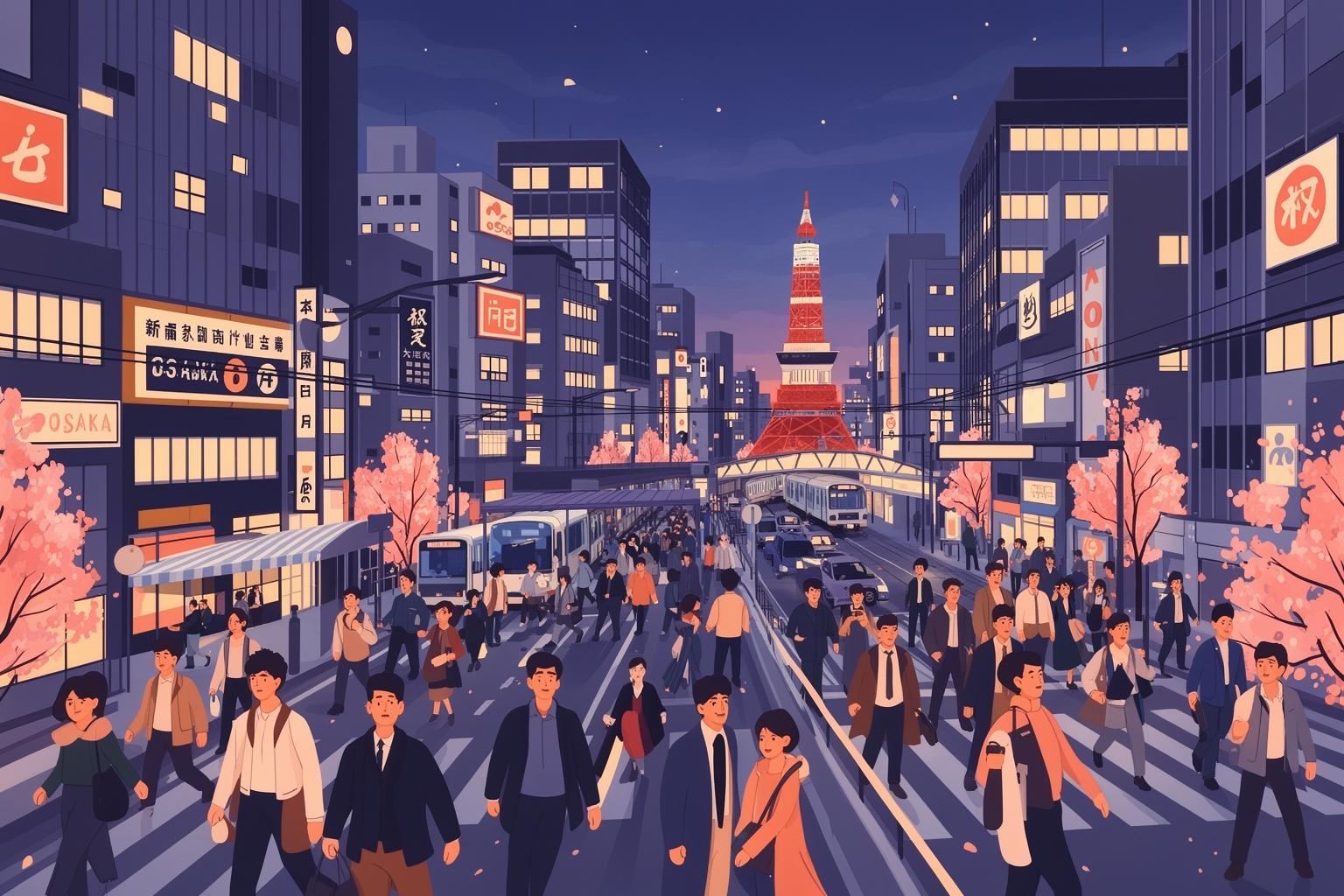
The journey home offers an entirely different experience. The tense, focused energy of the morning fades away, replaced by a collective sigh of relief. The evening train is the city unwinding, and the shift in atmosphere is immediate and tangible.
The Great Decompression
As people board the train after a long day’s work, the city seems to decompress. The silence is no longer as strict. Conversations emerge, passengers chat quietly on their phones, and the mood grows noticeably lighter. Many are not heading directly home but are on their way to meet friends for dinner and drinks in the lively districts of Umeda, Shinsaibashi, or Namba. The air often carries the tempting aromas from the depachika (department store food halls), as people bring home everything from fancy cakes to fried chicken. The train transforms into a social space once more, a prelude to the evening’s festivities.
The Drunken Salaryman and Other Characters
No portrayal of Japanese city life would be complete without the drunken salaryman, and the evening Midosuji Line does not disappoint. Men in suits, their ties loosened, sleep deeply, their heads bobbing with the train’s motion. In Osaka, this sight is met with resigned empathy rather than irritation. Fellow passengers might subtly support a sleeper to keep them upright or quietly notify a station attendant at their stop. There’s a shared understanding of the pressures of work life and the relief that follows after-work drinks. The evening train also highlights the city’s incredible diversity. You’ll see tourists carrying shopping bags from Don Quijote, students in club uniforms returning from practice, and elderly couples coming back from an afternoon outing. The train becomes a genuine cross-section of the city’s vibrant life.
The Last Train Home: A Race Against Time
The energy shifts once more for the shuden, the last train of the night. A controlled panic arises at major stations around midnight. Those who misjudged the time rush down the stairs, and a collective effort on the platform emerges to get everyone aboard. Strangers shout encouragement and hold the doors, creating a frantic yet communal push to beat the clock. Boarding that final train feels like a victory, a shared moment bonding passengers in exhaustion and relief. It’s a fitting conclusion to the day—a moment of chaotic but heartfelt cooperation, capturing the essence of Osaka’s spirit.
How the Midosuji Commute Shapes the Osaka Mindset
The daily routine of the Midosuji Line is more than simply a commute; it is an essential element of the city’s cultural identity. It both reinforces and mirrors the core values that define Osaka’s uniqueness. It serves as a daily training ground for the skills required to succeed in this vibrant city.
A Masterclass in “Akan Kedo, Maa Ee Ka”
There’s a classic Osaka phrase that perfectly captures the local mindset: “Akan kedo, maa ee ka.” It roughly means, “Technically, you’re not supposed to do that, but oh well, it’s fine.” This philosophy of flexible pragmatism is practiced on the train every day. Holding the door for a quick-moving commuter? Akan kedo, maa ee ka. Squeezing onto a packed bench? Akan kedo, maa ee ka. This approach is not about chaos; it’s about recognizing that sometimes the spirit of the rule matters more than the exact wording, especially when it results in a more efficient and humane outcome for everyone.
The Value of “Kiwotsukau” vs. “Kuki o Yomu”
In Tokyo, social navigation often involves kuki o yomu, or “reading the air.” This passive, intuitive process involves sensing the unspoken mood and expectations of a group and conforming to maintain harmony. It can be stressful and vague. Osaka, by contrast, relies more on kiwotsukau, a more active and direct form of consideration. It’s not about guessing what others want, but about taking practical, observable actions that ease shared situations. Shifting your bag, angling your body to create space, or helping someone with a heavy suitcase are all examples of kiwotsukau. It’s a straightforward, functional mindfulness toward others, born from the necessity of sharing crowded spaces.
Resilience and Humor
Ultimately, the daily ride on the Midosuji Line cultivates a distinct kind of resilience. Enduring the physical crush, the monotony, and the sensory overload day after day demands a certain toughness and a healthy sense of humor. Osakans have a remarkable ability to find humor in difficult moments and to face challenges with a stoic, no-nonsense attitude. The commute is a collective struggle, and that struggle builds a unique, unspoken bond. It constantly reminds them that they are all part of something larger—a city that is always in motion. The Midosuji Line is not just steel and electricity; it is the city’s bloodstream, with every passenger acting as a blood cell, contributing to the relentless, vibrant, and unapologetically human pulse of Osaka.