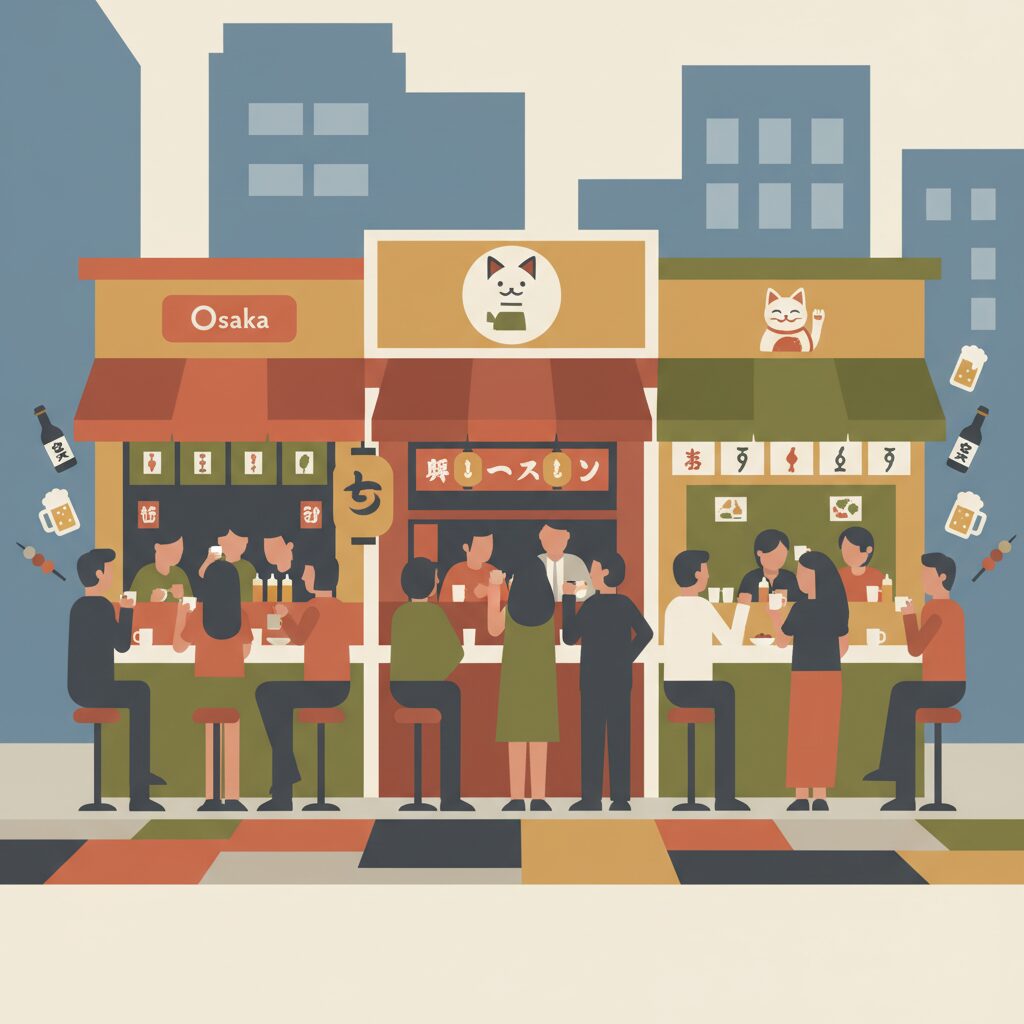
Step off the train at Tenma or Kyobashi any evening after five, and you’ll feel it. It’s not just the humidity of the Osaka air or the neon glow of the signboards. It’s a sound, a vibration. A chaotic symphony of clinking glasses, sizzling grills, and booming laughter that spills out from under faded awnings and narrow doorways. This is the sound of the tachinomi, the standing bar, and it is the true, unfiltered heartbeat of this city. Forget the grand castles and gleaming skyscrapers for a moment. If you really want to understand how Osaka thinks, breathes, and connects, you need to find a small space at a crowded counter, order a beer, and learn the art of standing your ground. For the newly arrived foreigner, these establishments can seem like an impenetrable fortress of social code. They are loud, they are cramped, and they appear to operate on a set of rules that no one ever explains. They are not the quiet, contemplative bars you might find in a Kyoto alleyway, nor are they the sleek, cavernous pubs of a global metropolis. They are something else entirely: a social arena, a community center, and a masterclass in Osaka’s peculiar brand of human interaction. As a writer who finds beauty in the structure of daily life and the aesthetics of social ritual, I was initially daunted. But I soon realized that the tachinomi isn’t just a place for a cheap drink; it’s a living blueprint of the Osakan soul, where efficiency, community, and a fierce lack of pretense collide. It’s here, shoulder-to-shoulder with strangers, that you can decode the city’s most defining characteristics.
To truly master the social dynamics of Osaka, one must also understand the local approach to price negotiation, a skill as essential as navigating a crowded tachinomi.
The Philosophy of Standing: Why No Chairs?
At first glance, the absence of seating in a tachinomi might seem like a straightforward, or even uncomfortable, design choice. However, it is no mistake; it is a deliberate statement of purpose. The lack of chairs is the foundational principle of the entire tachinomi experience, reflecting two key aspects of the Osaka mindset: radical efficiency and the breakdown of social barriers. This goes beyond merely saving space; it is about crafting a distinct social experience that is uniquely Osakan.
Efficiency as an Art Form
Osaka’s foundation as a merchant city means the spirit of the akindo—the shrewd, pragmatic businessperson—infuses everyday life. For an Osaka merchant, time is valuable, and space is a resource. A tachinomi exemplifies this philosophy perfectly. By eliminating chairs, the owner can accommodate significantly more patrons in a limited area. More customers mean faster turnover, and faster turnover means better business. Rather than being seen as greedy or unwelcoming, this is celebrated as clever, practical, and efficient. This cultural impatience, known as serakashi, is a hallmark of Osaka life. It’s evident in how people stand on the right side of escalators to allow others to pass, in the rapid-fire exchanges with shopkeepers, and in the expectation of prompt service. The tachinomi caters to this pace. It’s not a place for a long, leisurely night; it’s a transitional stop between the structured day at work and the private comfort of home. The entire setup is optimized for speed: you arrive, find a narrow spot at the counter, order a drink and a few small dishes, receive them almost immediately, eat, pay, and leave. Visits may last anywhere from fifteen minutes to an hour, but the core principle is movement. The steady stream of people flowing in and out creates an energetic atmosphere, contrasting sharply with the calm, settled vibe of seated izakayas. There’s no room for hesitation or indecision; the environment encourages you to engage in its brisk, rhythmic pace.
The Great Equalizer: Shoulder-to-Shoulder with Strangers
More deeply, standing reshapes social interactions. With no tables to form private enclaves and no chairs to mark personal space, the whole bar operates as a unified, shared zone. Everyone stands at an equal height, occupies roughly the same space, and faces the same counter. Here, typical social hierarchies of Japanese life begin to dissolve. A company president might find himself beside a junior employee, a construction worker next to a university professor, a young fashion-conscious woman standing beside a retiree who’s frequented the same bar for decades. Their suits, uniforms, and casual clothes might signal their daytime roles, but within the tachinomi’s walls, all are simply customers. This enforced closeness sparks communication. In a metropolis like Tokyo, personal space is sacred, and strangers tend to avoid contact. But in an Osaka tachinomi, proximity acts as an unspoken invitation to engage. You can’t help but overhear the conversation nearby, admire the tempting dish your neighbor ordered, or exchange glances as you watch the Hanshin Tigers game on the small TV in the corner. This setting fosters what Osakans view as a natural, comfortable social fluidity. To outsiders, it may initially feel intrusive, but it forms the very basis of the tachinomi’s role as a community hub. Physical closeness dissolves mental and social walls, making it not only possible but likely that you will leave having spoken to a complete stranger.
Decoding the Menu: More Than Just Bar Food
The food and drink at a tachinomi are as straightforward and unpretentious as its social philosophy. The menu reflects Osaka’s culinary identity as kuidaore—a city where people gladly eat until they can’t anymore, yet always remain mindful of value. The offerings focus on speed, flavor, and affordability, creating a perfect trio of quick bites and easy-to-drink beverages that form the foundation of the experience.
The Holy Trinity: Beer, Highball, and Nihonshu
The first phrase almost everyone utters upon entering a tachinomi is “Toriaezu, nama!”—which roughly means “For now, a draft beer!” It’s the universal starting signal, the social lubricant that officially kicks off the evening. The crisp, cold draft beer, typically from major Japanese brewers like Asahi or Kirin, holds undisputed dominance. It’s quick to pour, easy to drink, and serves as the ideal palate opener. Not far behind in popularity is the highball—a simple mix of Japanese whisky and sparkling water served in a tall, ice-filled glass. Its popularity has soared in recent years due to its light, refreshing, and endlessly drinkable qualities that pair beautifully with the often rich and fried fare on the menu. Its affordability also perfectly matches Osaka’s value-conscious mindset. Then there is nihonshu, or sake. While some modern tachinomi offer extensive craft sake selections, traditional neighborhood spots generally serve a few reliable, local, often unpasteurized sakes. It’s commonly presented in a small glass placed inside a square wooden box called a masu. The bartender pours until the sake spills over from the glass and pools in the box, a gesture of generosity and abundance deeply valued in Osaka. The drink menu is usually uncomplicated; it’s a set of dependable choices designed to deliver satisfaction efficiently and deliciously.
The Anatomy of a Tachinomi Counter
The food is the heart of the tachinomi. Laid out along the counter or listed on paper strips taped to the walls is a showcase of Osaka’s most beloved comfort foods. The obanzai counter dominates this scene, where large ceramic bowls hold an assortment of pre-prepared, home-style dishes. This might include staples like nikujaga (meat and potato stew), potesara (a distinctively Japanese potato salad featuring cucumber, carrot, and ham), and nanbanzuke (fried fish marinated in a sweet and sour sauce). This setup is ingenious: it’s visually appealing, letting you see your choices, and incredibly efficient, since the staff only needs to scoop a portion onto a small plate. Beyond the obanzai lies the core of Osaka’s B-grade gourmet culture. Doteyaki is a must-try— a hearty, slow-cooked stew of beef sinew, konjac, and miso. It embodies Osaka’s spirit of turning humble, inexpensive ingredients into something deeply flavorful and satisfying through time and care. Then there’s kushikatsu, the emblematic Osaka street food. These skewers of meat, vegetables, and seafood are coated in a light panko crust and deep-fried to golden perfection. They come with a communal pot of thin, dark dipping sauce, which introduces the most sacred rule in all of Osaka dining: nidozuke kinshi, or “no double-dipping.” Once dipped in the sauce, the skewer must never go back. This rule isn’t just about hygiene; it’s a social contract. Following it marks you as a thoughtful member of the community, while breaking it is the ultimate mark of an inexperienced outsider. To balance the richness of these dishes, many tachinomi, especially those near fish markets, offer surprisingly high-quality and affordable sashimi, underscoring Osaka’s reputation as a city where fresh ingredients are considered a right, not a luxury.
The Unspoken Rules: Navigating the Social Maze

For a first-timer, the chaotic energy of a crowded tachinomi can feel overwhelming. There are no written guidelines, no host to assist you, and no maitre d’ to oversee the flow. Instead, the bar relies on a complex system of unspoken rules, subtle gestures, and mutual understandings. Learning to interpret these cues is essential to fully experiencing the place. It calls for a mix of situational awareness, quiet confidence, and a willingness to adapt to the local rhythm.
Finding Your Spot: The Art of Squeezing In
Your initial task is to claim your space. There’s no line to wait in. You simply scan the counter looking for a gap—a spot, however small, between two patrons. Approach with politeness but purpose. As you move toward the space, a quiet “Sumimasen” (“Excuse me”) or a simple nod usually suffices. People will instinctively shift, drawing in their bags or turning their shoulders slightly to create a sliver of room. This is the first social agreement: everyone makes a little space for the newcomer. Once you reach the counter, plant your feet firmly. Don’t hesitate. Your presence alone asserts your claim. The key is to be mindful of your personal space. Keep your belongings compact. Hang your bag on the hook under the counter if available, or keep it between your feet. Avoid spreading your elbows or personal items widely. You are now part of a densely packed, interconnected human ecosystem, and the goal is to coexist harmoniously. Reading the atmosphere is another vital skill. Some bars are loud, lively, and filled with a transient crowd, making it easier to slip in. Others may be quieter, occupied by a close-knit group of regulars who all know one another. In these places, your entry should be gentler, showing more deference to the established social order. A nod to the owner (taisho) upon entering can go a long way.
Ordering Like a Local
Once you have your spot, the next step is placing an order. The staff are constantly on the move, and you need to catch their attention without causing disruption. This isn’t a place for timidly waiting to be noticed. Make eye contact. When you have it, raise your hand slightly and state your order clearly and concisely. “Nama hitotsu!” (“One draft beer!”) is a perfect way to start. The pace of ordering is distinctive as well. You don’t order your entire meal all at once. The tachinomi experience is a rolling, continuous process. Begin with a drink and one or two small dishes. As you finish them, you can signal the staff to add another dish or drink. This allows you to pace yourself and adjust to your appetite. A fascinating practice you’ll find in many traditional tachinomi is cash-on-counter, or kyasshu on. You receive a small tray or designated spot on the counter where you place a few thousand-yen notes. Each time you order, the staff will take the appropriate amount from your pile, giving change as needed. This is efficiency at its finest, removing the need to request a bill at the end. It operates on mutual trust and keeps the flow of people moving smoothly.
The Art of Conversation (or a Lack Thereof)
The most daunting aspect for many newcomers is the social interaction. Conversations in a tachinomi arise spontaneously, often triggered by the immediate surroundings. Someone might ask about the food you ordered. You might hear someone celebrating a sports win on the TV and join in with a cheer. These brief, low-stakes exchanges are the threads that weave the social fabric of the bar. A key feature of Osaka communication is tsukkomi, a form of playful teasing or witty retort. A stranger might good-naturedly comment on your slow drinking pace or your clumsy Japanese. This is not meant to offend. In Osaka, this kind of banter signals engagement and inclusion. It’s a way of saying, “I see you, and I’m welcoming you into our shared space.” Learning to laugh it off, or better yet, return a playful remark, shows you understand the local language of friendliness. However, it’s perfectly fine to remain quiet. If you prefer to simply drink, eat, and soak in the atmosphere, no one will pressure you to chat. The bar’s ambient noise offers a comforting cloak of anonymity. At the heart of this social ecosystem is the taisho, the owner or master of the bar. This person is more than a cook and bartender; they are the conductor of the social orchestra. They know their regulars by name, remember favorite drinks, and often serve as a social connector, introducing newcomers to established patrons. Building a warm rapport with the taisho is the quickest way to move from stranger to welcomed guest.
Tachinomi Subcultures: Not All Standing Bars Are Created Equal
While the fundamental principles of the tachinomi stay consistent, the concept itself is far from uniform. Throughout Osaka, distinct subcultures and variations can be found, each catering to different patrons and reflecting unique aspects of the city’s life. Ranging from gritty, post-work refuges to stylish, contemporary spots, the standing bar has shown itself to be an incredibly adaptable format.
The Salaryman Sanctuary: Under the Train Tracks
The most iconic and traditional type of tachinomi is located in the gaado-shita—the spaces nestled directly beneath the elevated train tracks that traverse the city. In neighborhoods such as Kyobashi, Umeda, and the retro-futuristic Shinsekai, these bars serve as unofficial decompression zones for Osaka’s white-collar workers. The air is heavy with the scent of grilled fish, simmering stew, and stale cigarette smoke. The steady rumble of trains overhead is not a disruption; rather, it forms the constant, percussive soundtrack to the evening. These are mainly male-dominated spaces, though this is gradually changing. They function as an essential “third space” between the strict office hierarchies and the domestic demands of home life. Here, salarymen can loosen their ties, vent frustrations about their bosses, and bond with colleagues over shared workplace challenges. The conversations are loud, the laughter unrestrained, and the beer flows abundantly. It offers a raw, unfiltered glimpse into the pressure-release valve of Japanese corporate culture.
The Market-Side Morning Drinkers
An entirely different tachinomi scene exists around Osaka’s major food markets, such as the Kizu Wholesale Market or the renowned Kuromon Ichiba. These bars often open just after dawn, serving not office workers but fishermen, wholesalers, and laborers whose shifts end as much of the city begins its day. It is quite common to see groups of men enjoying beer and fresh sashimi at eight in the morning. The vibe in these bars is less about unwinding from stress and more about celebrating a job well done. The food is invariably fresh, frequently sourced directly from the market stalls mere meters away. Visiting one of these market-side bars provides a glimpse into a completely different urban rhythm—one tied to tides and harvests rather than corporate schedules. It powerfully reminds visitors that Osaka is, at its core, a port city built on the foundations of food and trade.
The Neo-Tachinomi: A Modern Twist
In recent years, a new generation of standing bars has surfaced, particularly in trendy, emerging districts like Fukushima and the labyrinthine backstreets of Ura Namba. These neo-tachinomi reinvent the classic format with a modern flair. They may focus on craft beers from local microbreweries, curated selections of natural wines from around the globe, or specialize in certain cuisines, such as Italian cicchetti or Spanish tapas. With my background in fashion and art, I find these spots especially intriguing. The interiors are often thoughtfully designed, emphasizing aesthetics that traditional bars might overlook. The clientele tends to be younger, more diverse, and includes a significantly higher number of women. While the core elements—standing, quick turnover, and small plates—remain unchanged, the social atmosphere can be somewhat more subdued. Conversations might revolve more around the nuances of a dish or the tasting notes of a wine. These contemporary interpretations highlight the enduring appeal and versatility of the tachinomi model, showing it can evolve alongside the city’s tastes while still preserving its central values of conviviality and efficiency.
Osaka vs. Tokyo: A Tale of Two Bar Cultures
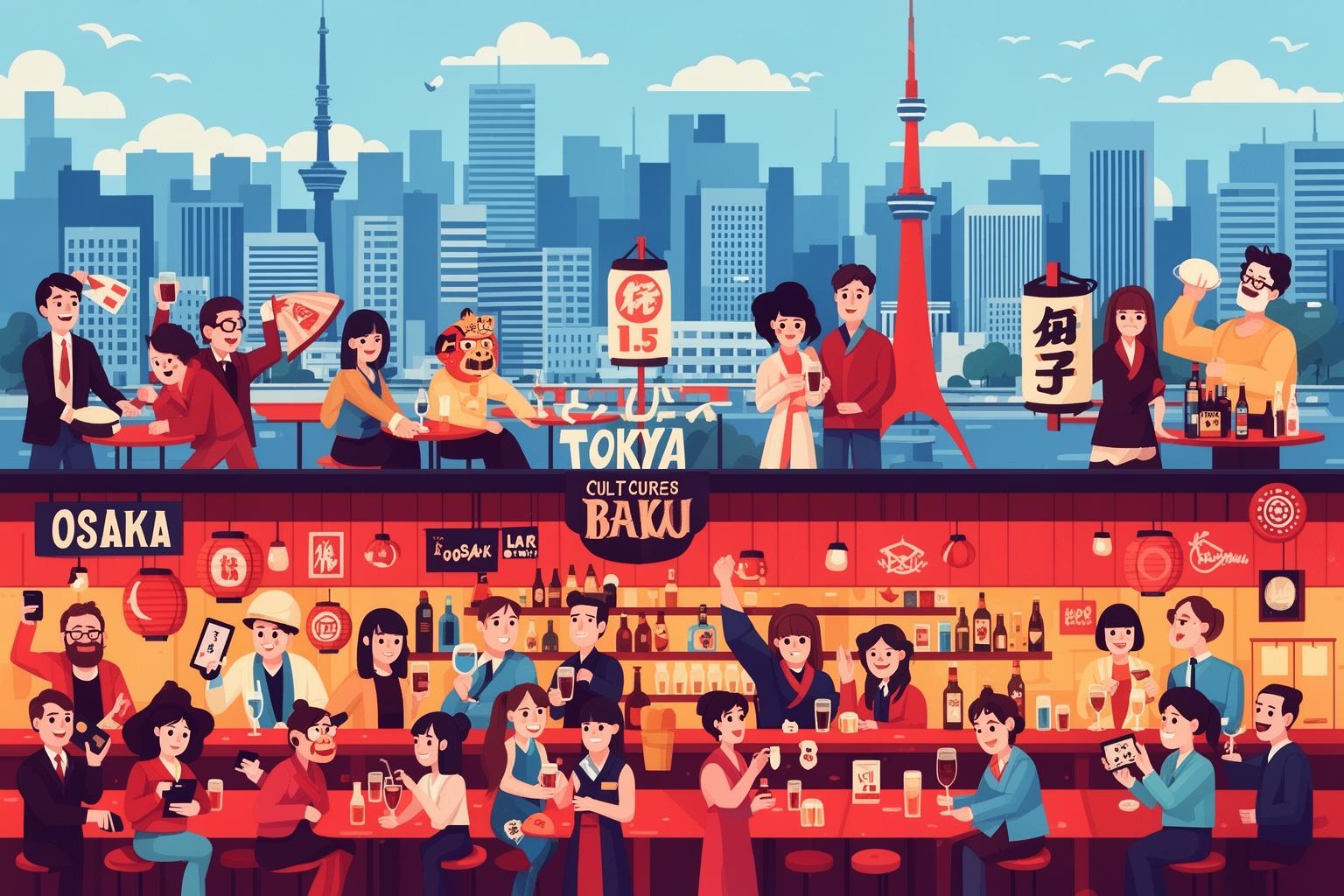
To truly grasp the uniqueness of Osaka’s tachinomi culture, it helps to compare it with Tokyo’s social environment. While the capital does have its own standing bars, the prevailing atmosphere and social expectations often differ significantly. These contrasts emphasize the deep-rooted cultural differences between the two cities, shaped by centuries of history that continue to influence daily interactions.
The Wall of Silence vs. The Communal Hum
Step into a typical standing bar in a Tokyo neighborhood like Shimbashi, and you’ll notice a subtle but meaningful difference. People tend to keep to themselves. Groups arriving together stay together, speaking in hushed tones. Individuals often face the counter, absorbed in their phones or thoughts. An invisible but tangible personal bubble surrounds each person, making it harder for strangers to start conversations. In Osaka, the situation is quite the opposite. The default is communal. The ambient hum of the bar is a collective creation, and you’re expected to add to it, even if only through your presence. The low social barrier fosters spontaneous interactions, and the local conversational style is notably more direct and curious. In a small personal experiment, when I attempted to ask a neighbor about his drink in a Tokyo bar, I received a polite but brief response that clearly shut down further talk. In a similar scenario in Osaka, the same question sparked a twenty-minute discussion about local sake, led to introductions to his friends, and an insistence that I try a bite of his doteyaki. This contrast traces back to the cities’ origins. Tokyo (formerly Edo) was the seat of the samurai government—stoic, formal, hierarchical, and indirect in communication. Osaka, as the nation’s commercial center, was a city of merchants where success depended on quick relationship-building through face-to-face negotiation, humor, and straightforward talk. These historic roles still play out nightly in the bars of each city.
Practicality Over Polish
The visual contrast is equally striking. The classic Osaka tachinomi embraces a certain roughness. The decor is functional, often unchanged for decades. Lighting may be harsh fluorescent, walls marked by years of smoke and steam. The focus is squarely on substance: the quality and value of food and drink, and the lively atmosphere. There is no pretense. Tokyo establishments, even casual ones, often show more concern for aesthetics and presentation. Lighting is moodier, interiors more carefully designed, food plated with intention. This isn’t a judgment of one being superior; it reflects different priorities. Osaka culture leans toward hon-ne, one’s true feelings and intentions, rather than tatemae, the socially expected facade. Osakans take pride in this down-to-earth authenticity, valuing what is real over what is polished. This “what you see is what you get” philosophy is the heart of tachinomi. It’s a space unapologetically itself and invites you to be the same.
A Guide for the First-Timer: Your Tachinomi Debut
Stepping into a tachinomi for the first time might feel intimidating, but with some preparation and the right mindset, it can be an exceptionally rewarding experience. It offers a chance to connect with the city on a deeper, more genuine level. The key is to start modestly, observe attentively, and embrace the lively charm of the environment.
Choosing Your First Bar
For your first visit, set yourself up for success. Instead of jumping into a dark, smoky bar frequented only by regulars beneath the train tracks, seek out a spot that feels more welcoming. A tachinomi located within a covered shopping arcade (shotengai) is often an excellent choice, as these tend to draw a more varied crowd, including shoppers and families. Look for places that are well-lit with large windows or an open front so you can gauge the atmosphere from outside. If you spot a mixed group of men and women, young and old, who appear to be laughing and enjoying themselves, that’s a very positive sign. A bar with a clearly visible menu—ideally with pictures or English—is also a helpful bonus. Additionally, the newer, more modern neo-tachinomi in neighborhoods like Fukushima or Tenma can be great starting points, as their staff are often more experienced in serving non-Japanese customers.
The First Ten Minutes: A Step-by-Step
After selecting your spot, take a deep breath and follow these simple steps. First, find your place at the counter. Enter with quiet confidence and look for an opening. Approaching those next to you, a polite and effective way to start is by saying, “Koko ii desu ka?” (“Is here okay?”). Second, order your drink—classic choices are always safe. Make eye contact with the staff and say clearly, “Nama kudasai” (“A draft beer, please”) or “Haibouru kudasai” (“A highball, please”). Third, order a simple food item; pointing is perfectly fine. Indicate one of the enticing obanzai bowls on the counter or something easy to identify on the wall menu like edamame or yakitori. Fourth, figure out the payment system. Notice if other customers have trays with cash on the counter; if they do, place a ¥1000 or ¥2000 note there. If not, assume you’ll settle the bill at the end. When ready to leave, catch the staff’s eye and say, “Okanjo onegaishimasu” (“Check, please”). Finally, make a graceful exit by saying a loud and cheerful “Gochisousama deshita!” (“Thank you for the meal!”) to the staff—a polite gesture that’s always warmly received.
What to Do if Someone Talks to You
It’s not a question of if someone will strike up a conversation, but when. When it happens, the most important thing is to relax and smile. The interaction will almost certainly stem from friendly curiosity. Expect standard questions like “Where are you from?” (“Doko kara kitan?”), “Do you live in Osaka?”, or “How long have you been in Japan?”. Answer with simple words and enthusiasm. Even broken Japanese is met with encouragement and appreciation. This isn’t a formal language test—it’s about human connection. Don’t be surprised if the conversation turns playful; you might be teased about your chopstick skills or your drink choice. Embrace it and laugh along. This is the Osaka way of breaking the ice and welcoming you in. A tachinomi is the best language school you could ask for—an immersive, real-world classroom where lessons come with fried chicken and a cold beer.
The tachinomi is much more than just a place to eat and drink. It’s a living, vibrant theater of Osaka’s culture—a manifestation of the city’s core values: deep respect for efficiency and value, a love for straightforward and honest communication, and an unwavering belief in the power of community. Here you learn that in Osaka, “friendly” doesn’t mean polite and reserved; it means boisterous, curious, and inclusive. It’s about a stranger buying you a drink just to hear your story, or a group of old men cheering you on as you try a dish you’ve never seen before. This culture strives to break down barriers, not build them up. The initial intimidation of that packed, noisy room is a small price for the reward on the other side. Ordering your first beer at a crowded counter, sharing a laugh with the person next to you, is a rite of passage. It marks the moment you stop being a mere observer of Osaka and become, even if just briefly, part of its relentless, beautiful, and deeply human rhythm. To me, these spaces are the ultimate expression of a city’s style—not one defined by luxury brands or fine art, but by the unscripted choreography of everyday life. It is raw, authentic, and stylish in its complete lack of pretense, teaching a profound lesson: the true character of a place is revealed not in its monuments, but in the small, crowded, shoulder-to-shoulder spaces where people truly connect.