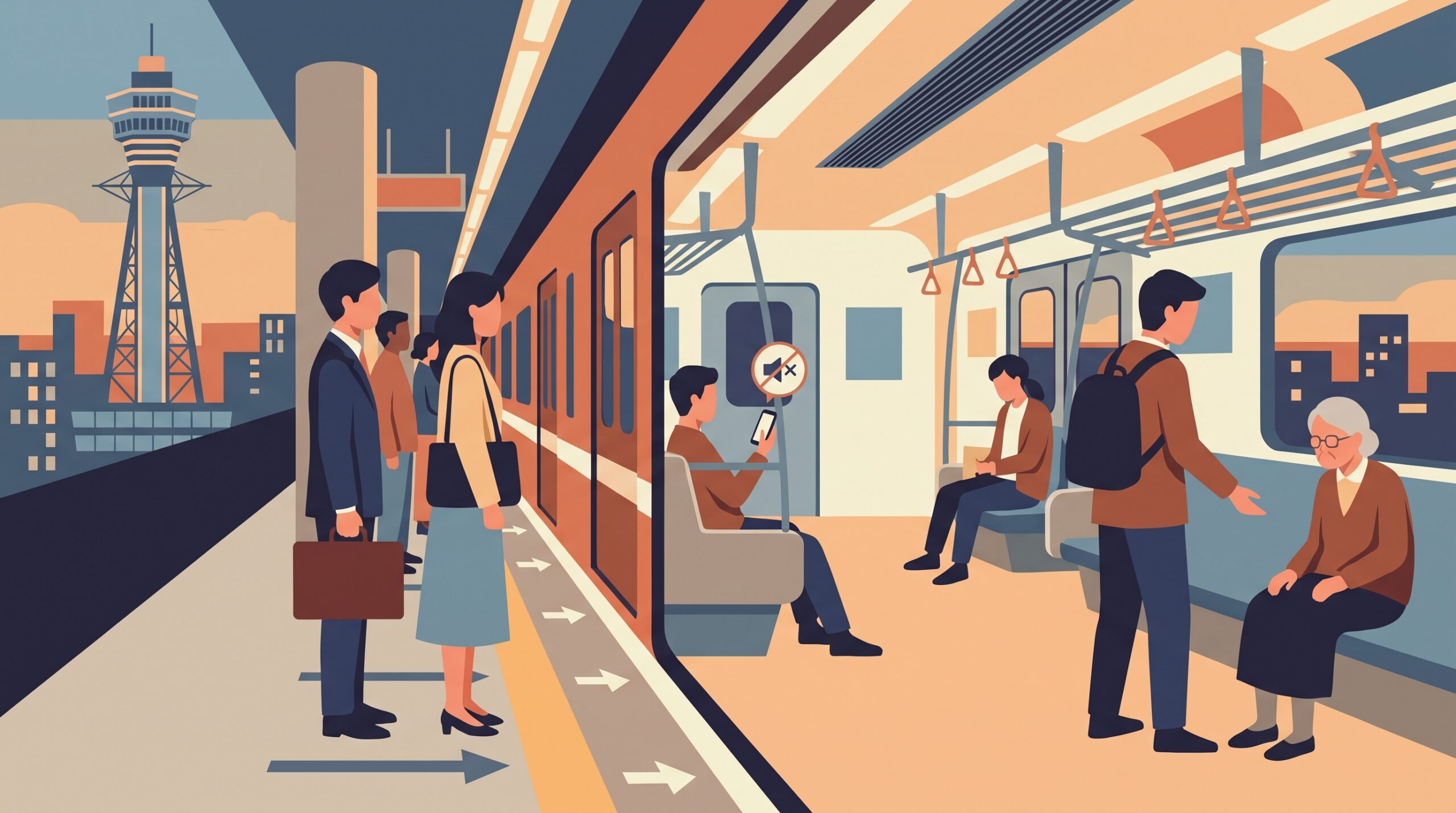
You feel it in the soles of your feet before you hear it. The low, guttural hum of the Midosuji Line vibrating through the subterranean bedrock of Umeda. It is a rhythm, a heartbeat, a syncopated drumline that sets the pace for millions of lives moving across the sprawling concrete canvas of Kansai. You swipe your IC card at the glowing blue gate, a sharp digital chirp confirming your entry, and step into a world governed by rules that are entirely invisible yet absolute in their authority. To ride the trains in Japan is to participate in a grand, silent choreography. But to ride the trains in Osaka after living in or visiting Tokyo is to realize that the choreography changes the moment you cross regional lines.
Japan is so often painted with a broad, monolithic brush by the outside world. Foreign visitors and even prospective residents tend to imagine a singular, uniform culture stretching from the snowy peaks of Hokkaido to the subtropical beaches of Okinawa. They imagine that the rules of polite society learned in the quiet, hyper-organized corridors of Shinjuku Station will perfectly map onto the neon-soaked, chaotic energy of Namba. This is the first and most fundamental misunderstanding of Japanese daily life. Tokyo and Osaka are not merely different cities; they are different frequencies. They operate on distinct cultural wavelengths, shaped by centuries of historical divergence, economic rivalry, and deeply ingrained civic mentalities. Tokyo is the city of the samurai, the bureaucrat, the meticulous planner. Osaka is the city of the merchant, the pragmatist, the hustler who values human connection over rigid protocol.
When you step onto public transport, these historical mindsets manifest in the way people stand, the way they hold their bags, the way they negotiate the fiercely limited physical space of a crowded carriage. Understanding these nuances is not about avoiding a scolding—Japanese people are far too polite to openly reprimand a confused foreigner. Rather, understanding these rules is about earning your place in the city. It is about shifting from a wide-eyed spectator to a functional participant in the daily rhythm of Kansai life. It is about reading the air, a concept known here as kuuki wo yomu, and adjusting your own frequency to match the deep, resonant bassline of Osaka.
We are going to peel back the layers of this subterranean world. We will look beyond the simple dos and don’ts found in every generic travel pamphlet and examine the psychology of the Japanese commute. We will explore the stark, sometimes jarring contrasts between Kanto and Kansai transit culture, uncovering why the rules exist, how they are enforced through silent social pressure, and what they reveal about the very soul of the people who ride these trains every single day.
Tokyo vs. Osaka: The Golden Rule of Escalators
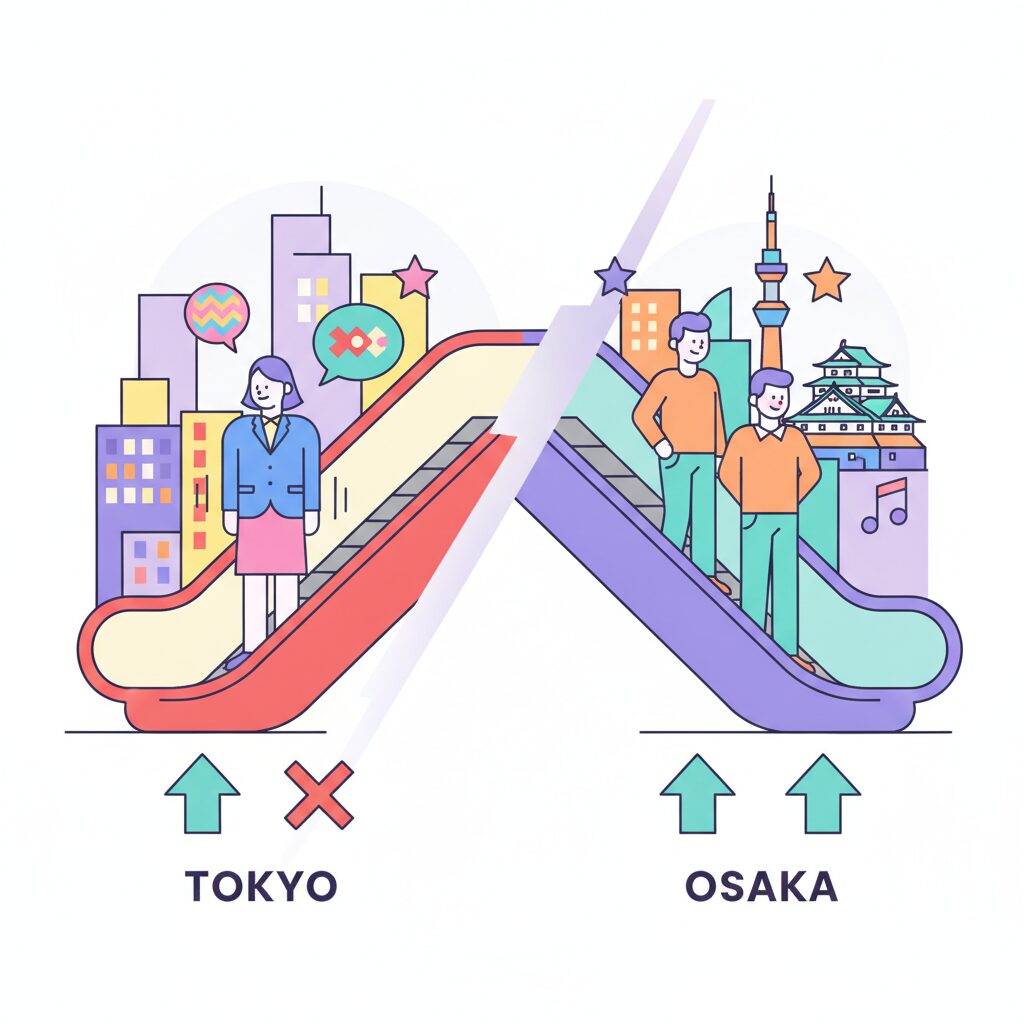
If there is one singular piece of cultural trivia that every visitor to Japan seems to know even before boarding their flight, it is the escalator rule. It serves as the most visible, undeniable evidence of an invisible cultural fault line dividing the country. In Tokyo, you stand on the left and walk on the right. In Osaka, you stand on the right and walk on the left. Though it sounds like a simple logistical quirk on paper, in reality, it is a visceral, deeply ingrained habit that can cause genuine panic for a newcomer navigating the commuter rush.
Picture the scene: you have just arrived on the Shinkansen from Tokyo, where you spent a week diligently standing on the left side of every moving staircase, letting the hurried crowds pass on your right. Now at Shin-Osaka Station, you drag your suitcase toward the subway transfer and step onto a descending escalator. Guided by muscle memory, you place your feet firmly on the left side. Within seconds, you sense a presence behind you—a subtle shift in the air, a looming shadow of impatience. You glance back to see a businessman in a sharp navy suit, clutching his briefcase tightly, his gaze fixed on the back of your head. He says nothing, does not sigh, but the pressure emanating from him is absolute. You are blocking the passing lane, a boulder in a rushing stream. Suddenly realizing this, you scramble to the right, allowing the businessman to pass by with the silent, ruthless efficiency of a shark cutting through water.
This commitment to standing on the right is the defining trait of the Osaka commuter. But why does it exist? The division is not random; it stems from a fascinating blend of history, international ambition, and regional pride.
The Tokyo custom of standing on the left is often traced back to the Edo period. Tokyo, then called Edo, was a city built by and for the samurai class. Samurai wore their swords on their left hip to allow quick, fluid drawing with their dominant right hand. To avoid their scabbards clashing in the narrow streets and bridges of the crowded capital—a deeply offensive accident that could lead to deadly duels—the samurai naturally kept to the left side of the path. This left-sided traffic pattern seeped into the foundation of Kanto culture, ultimately becoming the official rule for both pedestrian and vehicular traffic.
Osaka, on the other hand, was never a samurai stronghold. It was the nation’s kitchen, a bustling, vibrant hub of merchants, traders, and commoners. The merchant class carried no swords but ledgers, abacuses, and coin purses, so they had no historical reason to favor the left side. However, the true trigger for Osaka’s right-side escalator custom arrived much later, in the late mid-twentieth century.
In 1970, Osaka hosted the World Expo, a monumental event that placed the city on the global stage. Expecting a huge influx of international visitors, city planners looked to the global standard for pedestrian traffic. In much of the Western world, including the United States and Europe, the convention was to stand on the right and pass on the left. Eager to showcase Osaka as a modern, cosmopolitan metropolis ready for the future, local transit authorities actively encouraged citizens to adopt this international right-side standard. Hankyu Railway, one of the massive private transit companies operating out of Umeda, even made official announcements urging passengers to stand on the right. The Osakans, pragmatic and keen to distinguish themselves from Tokyo’s bureaucratic rigidity, embraced the rule enthusiastically.
The result is a permanent, physical manifestation of the Kanto-Kansai rivalry. The border between these two conflicting systems is generally agreed to be near Maibara or Kyoto, creating a confusing transition zone where commuters sometimes hesitate, looking around to decide which unwritten rule applies that day. But in the heart of Osaka, the rule is ironclad. Standing on the right is not merely polite etiquette; it is an assertion of civic identity. It is a silent rebellion against the Tokyo-centric narrative of Japan. When you stand on the right side of the escalator descending into Namba Station, you are not just stepping aside—you are declaring your understanding of where you are. You are tuned into the Kansai frequency.
Universal Japanese Public Transport Etiquette
While the great escalator divide underscores the regional tension between East and West, the moment you step off the escalator and onto the train itself, a different set of rules comes into play. These are the universal mandates of Japanese public transport—a strict code of conduct that applies equally to the sleek silver cars of Tokyo’s Yamanote Line and the crimson-striped carriages of Osaka’s Midosuji Line. These rules are shaped by the reality of extreme population density. When millions of people must share a tightly confined, rapidly moving metal tube, basic survival depends on a collective agreement to minimize personal impact. In Japan, public space is regarded as a delicate, shared resource that must be shielded from individual disruption.
Keep Noise to an Absolute Minimum
The first and most striking sensory experience of riding a Japanese train is the profound, unnatural silence. You can enter a carriage packed with two hundred people, pressed shoulder-to-shoulder in the sweltering August heat, and the loudest sound you’ll hear is the rhythmic click-clack of steel wheels on rails and the high-pitched hum of the electric motor. The atmosphere is thick with unspoken restraint.
This silence is zealously maintained, primarily through the strict enforcement of what the Japanese call Manner Mode. In English, it’s simply putting your phone on silent. But in Japan, Manner Mode is more than a setting on your device; it’s a civic philosophy. Upon entering a train station, you step into a zone where electronic noise is regarded as a serious social offense. If your phone rings loudly in a crowded carriage, the reaction is immediate. People won’t shout, but dozens of sharp side-eye glances will hit you like a physical blow. The intended shame is intense. You are expected to immediately mute your device and assume a posture of deep apology.
Talking on the phone is strictly forbidden. Signs featuring stern cartoon animals frequently remind passengers not to make calls. If a Japanese commuter receives an urgent call they absolutely must take, they typically cover their mouth with their hand, whisper harshly and briefly—no more than three seconds—to explain they are on a train, and then hang up immediately. The rationale is that a one-sided conversation intrudes mentally on others, forcing them to passively follow an incomplete narrative they cannot avoid.
Conversations between travel companions are allowed but must be kept very quiet. This is where a subtle difference between Tokyo and Osaka arises. In Tokyo’s hyper-formal commuter trains, even whispering can feel inappropriate. The silence is often total, heavy, and impenetrable. In Osaka, however, the merchant spirit grants some leniency. You might hear two elderly women, affectionately known as Osaka obachan, quietly discussing the price of daikon radishes at Kuromon Market, or the muffled laughter of high school students returning from club activities. Osakans are naturally more talkative, lively, and willing to puncture the silence with small sparks of human connection. Yet the volume remains strictly controlled. It’s a hushed, localized murmur that refuses to dominate the entire carriage. If your voice carries across the aisle, you’re too loud—whether in Shinjuku or Shinsaibashi.
Mind Your Backpacks and Luggage
In a city where space is the ultimate luxury, how you carry your belongings becomes a matter of public concern. The way you manage your bags signals your spatial awareness and respect for fellow passengers.
The cardinal sin of modern commuting is the oblivious backpack wearer. In many Western cities, carrying a large backpack strapped on your shoulders is normal subway etiquette. In Japan, it is a catastrophic breach of manners. A backpack worn on the back creates an invisible protrusion, a rigid, unpredictable bump that the wearer can’t see but which continuously bumps, scrapes, and crushes the people behind them. When the train jerks, the backpack becomes a weapon.
To prevent this, a universal choreography has emerged. The moment commuters board, they perform a practiced maneuver: slipping the backpack off their shoulders, holding it low by their knees resting against their legs, or wearing it reversed, clutching it tightly to their chest. This transforms the unpredictable back-hump into a controlled, visible mass the owner can manage. Transit authorities run ongoing, sometimes humorous poster campaigns urging passengers to adopt this front-carry method, often depicting errant backpackers as thoughtless monsters or clumsy bears.
For larger items, the unspoken rule is to use the overhead luggage racks. These sturdy metal shelves run along each carriage, hovering just above seated passengers. Placing your briefcase, shopping bags, or small suitcase there frees up contested floor space, allowing more people to stand comfortably in the aisles. Although it requires trust to leave valuables out of reach, theft on Japanese trains is exceedingly rare. The bigger worry is simply forgetting the bag when you rush off at your stop.
Handling large, rolling suitcases introduces a more complex issue. Japan is currently experiencing an unprecedented boom in international tourism, and massive four-wheeled luggage on crowded commuter trains has become a significant point of friction. While there’s no official ban on bringing large suitcases onto subways, doing so during morning or evening rush hour is seen as highly inconsiderate. A bulky suitcase occupies the space of two people and blocks traffic flow near the doors. If you must carry heavy luggage, the unspoken expectation is to stand flush against doors that won’t open at upcoming stations, holding the bag tightly against your legs to prevent it from rolling while the train accelerates. In Osaka, where platform crowds at Namba and Umeda can be fast and aggressive, a poorly positioned suitcase will definitely be stepped on, pushed, or loudly sighed at. Spatial awareness here isn’t just polite; it’s a defensive strategy.
Priority Seating and Courtesy
Every Japanese train car reserves specific sections, usually at either end, marked as priority seating. These areas have distinctive upholstery—sometimes silver, bright blue, or red—and pictograms indicating they are for the elderly, pregnant women, people with disabilities, and those with small children. The etiquette surrounding these seats reveals a fascinating insight into Japanese social dynamics, passive communication, and the fear of causing offense.
In many cultures, offering your seat to someone in need is a straightforward, spoken exchange: making eye contact, smiling, and saying, “Please, take my seat.” In Japan, direct verbal offers can be socially risky. Asking an elderly person to accept a seat requires them to admit frailty, which can hurt their pride. It also draws the entire silent carriage’s attention to the interaction. Many Japanese people, deeply averse to being a burden or the center of attention, will often decline the offer, leading to an awkward, bowing standoff in the aisle.
To avoid this awkwardness, a uniquely Japanese invisible ritual has developed, especially in Tokyo. If a young, able-bodied person occupies a priority seat and an elderly passenger boards, the young person avoids eye contact and saying anything. Instead, they simply stand up, turn away, and move to another part of the carriage, creating a vacuum. They leave the seat empty and unclaimed, allowing the older person to sit naturally without feeling grateful or pitied. It’s a ghost-like act of courtesy, a silent relinquishing of comfort.
This is where Osaka’s mindset sharply contrasts with Tokyo’s. Osakans are more direct, less paralyzed by social awkwardness, and more willing to engage with spontaneous human interaction. On Osaka’s busy loop line, if an elderly woman boards, a seated Osakan is more likely to tap her on the arm, firmly gesture to the empty seat, and loudly insist, “Here, sit down, sit down!” Though Tokyoites might see this as forward, in Osaka it’s seen as genuine warmth—a community care expression, stripping away over-politeness to deliver immediate, practical help.
For pregnant women, this dynamic is supported by the Maternity Mark, a small pink and blue badge distributed by transit authorities that expects mothers can attach to their bags. This visual cue eliminates the uncertainty of guessing pregnancy, removing hesitation in offering seats. If you see this badge, the rule is clear: stand up, whether in a priority or regular seat.
The Art of Queuing on the Platform
Before boarding, your adherence to these unwritten codes is tested on the station platform’s concrete expanses. The Japanese platform queue is a marvel of civic engineering, demonstrating a societal belief that order creates efficiency.
Look down at any major platform in Tokyo or Osaka. The ground is painted with a complex, overlapping geometry of lines, circles, and triangles. These markings correspond to different train types—local, rapid, express—and show exactly where the doors will stop. Commuters don’t just wander waiting for the train; they form precise, organized lines behind these markings, often two or three people deep, long before the train arrives.
When the train pulls in and the doors open, the queue doesn’t immediately surge forward. The fundamental law of transit physics dictates that outgoing passengers must exit first before incoming passengers board. Waiting passengers part sharply, creating a channel that allows those disembarking to flow out smoothly. Only once the last exiting passenger has cleared the doorway do the waiting passengers begin moving forward in orderly, rapid succession.
The difference between Kanto and Kansai queuing is subtle but observable. In Tokyo, queues are militaristic—lines are perfectly straight, adherence to the painted marks is rigid, and people stand with a defensive posture, protecting their place in line. In Osaka, queues are a bit looser and more fluid. Lines may curve or bow slightly, and people might shuffle sideways to chat with a colleague. When doors open, Osaka boarding is somewhat more aggressive and opportunistic. The merchant city’s instinct to secure the best available spot—a coveted corner seat—takes over. There is a faint scramble but the core rule remains: never block exiting passengers and never cut the line blatantly.
Eating and Drinking on Trains: When is it Okay?
Food culture is the vibrant core of Japan, and nowhere does that core beat louder, greasier, and more jubilantly than in Osaka. The city’s unofficial motto, kuidaore, literally means “eat until you drop” or “eat yourself into ruin.” From the sizzling takoyaki griddles in Dotonbori to the deep-fried, sauce-laden skewers of Kushikatsu in Shinsekai, Osaka is a city meant to be savored. Yet despite this fervent passion for food, the rules about eating on public transport are strictly defined, often contradictory, and utterly perplexing to the uninitiated foreigner. Whether eating on a train is allowed depends entirely on the type of train you’re on. A sharp division exists between the ordinary, localized commute and the romanticized, long-distance journey.
Local Subways and Commuter Trains
On local subways, municipal buses, and standard commuter rail lines—the ones with long bench seats facing inward—eating is a strict, non-negotiable taboo. You do not eat a sandwich. You do not nibble on a rice ball. You do not aggressively chew gum.
This prohibition stems from the sensory environment within the carriage. Commuter trains are sealed, crowded spaces. Unwrapping a steaming pork bun from a convenience store sends its aroma spreading throughout the entire car, invading the personal space of a hundred already cramped strangers. It imposes your personal desires on the shared atmosphere. Moreover, there’s the danger of spills. Dropped food or spilled coffee creates sticky, unhygienic messes that disrupt the cleanliness of the communal space.
Drinking is a bit more nuanced. Taking a quick, discreet sip from a plastic bottle of green tea or water is generally tolerated, especially during Japan’s sweltering summer, when the risk of heatstroke is a known public health concern. But the act must be swift and practical. You do not linger over a thermos of coffee. You certainly do not drink alcohol. You hydrate to survive, then promptly recap the bottle and put it away.
The contrast between Osaka’s lively streets and the trains below is striking. You can stroll through Namba’s arcades clutching a paper tray of piping hot takoyaki, mayonnaise dripping down your wrist, fully embracing the chaotic, indulgent spirit of kuidaore. Yet the moment you swipe your IC card and descend onto the platform of the Sennichimae Line, you must sever that connection. You leave your culinary indulgence behind at the ticket gate. Inside the train, you become a silent, scentless participant in the sterile mechanics of mass transit.
The Shinkansen (Bullet Train) Exception
As soon as you leave a local commuter train and board the Shinkansen, the bullet train linking Tokyo and Osaka at high speed, the rules dramatically reverse. The taboo against eating disappears completely, replaced by a deeply cherished tradition of dining on the go.
The Shinkansen is not viewed as a commuter space but a traveler’s space. Its physical layout mirrors this difference. Seats face forwards, arranged in rows like an airplane, fostering a sense of privacy and forward motion. Each seat has a fold-down tray table—an explicit, tangible invitation to dine.
This shift from restriction to indulgence is symbolized by the Ekiben, the station bento box. Ekiben culture is a vast multi-million dollar industry in Japan. Every major station boasts boutiques selling hundreds of varieties of carefully crafted, regionally distinctive lunch boxes. When boarding the Shinkansen at Tokyo Station, purchasing a beautifully packaged Ekiben—perhaps with thinly sliced Wagyu beef, simmered root vegetables, and perfectly molded rice—alongside a cold can of Asahi beer or refreshing green tea is almost a cultural obligation.
As the train speeds out of the capital, rushing past the sprawling concrete suburbs of Kanto toward the majestic, snow-capped outline of Mount Fuji, the carriage transforms into a rolling dining room. The air fills with the crinkle of plastic wrappers, the snap of wooden chopsticks, and the savory scents of soy sauce, grilled fish, and pickled plums. It becomes a shared, communal moment of relaxation. Even at ten in the morning, cracking open a beer and enjoying a feast while the Japanese countryside blurs past at three hundred kilometers per hour is perfectly acceptable.
For a foreigner living in Osaka, the Shinkansen ride back from Tokyo offers both physical and psychological decompression. You eat your Ekiben, watch the landscape shift, and prepare to readjust to the Kansai vibe. You shed the strict, hyper-formal armor demanded in the capital and get ready to embrace the louder, warmer, more direct energy of your adopted home. But you must never forget that the instant you arrive at Shin-Osaka, step off the bullet train, and transfer to the local Midosuji subway line, the invisible switch flips once more. The remaining rice ball goes back in your bag. The bottle is recapped. The silence returns.
Navigating Rush Hour in Japan’s Biggest Cities
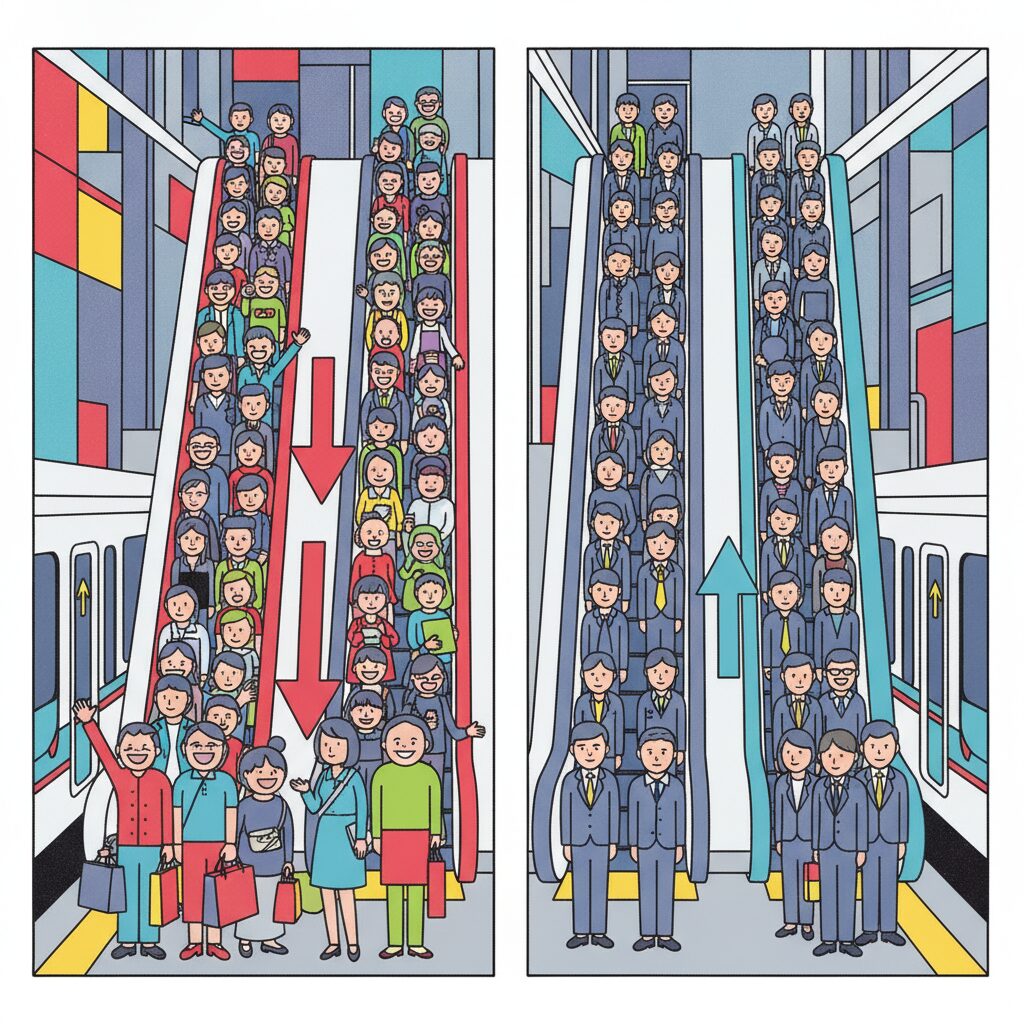
All the subtle rules of etiquette and the nuanced distinctions between Kanto and Kansai cultures are rigorously tested during the crucible of the Japanese rush hour. Between 7:30 AM and 9:00 AM, the public transport systems of Tokyo and Osaka transform into machines of overwhelming, almost terrifying human density. For a newly arrived foreigner, the physical reality of a packed Japanese train is a shock to the system, an experience bordering on the surreal.
You stand on the platform as the train arrives. You peer through the windows and see a solid mass of human bodies, pressed against the glass, eyes closed, swaying in unison. It seems physically impossible for more people to fit inside. Yet, the doors slide open, and the crowd on the platform begins to push forward. There is no anger, no shouting, no visible hostility. Instead, it is a slow, relentless, hydraulic pressure. You step backward into the carriage, allowing the bodies behind you to press you further inside. You lose the ability to move your arms. You are pinned against the chest of a salaryman and the shoulder of a high school student. The air grows thick, hot, and damp with collective breath.
In Tokyo, rush hour is marked by grim, enduring stoicism. It is a daily ordeal that millions endure with absolute, terrifying silence. The legendary oshiya, white-gloved station attendants who physically shove passengers into the carriages so the doors can close, are most well-known on the Tokyo network. The Tokyo commuter faces the crush as an unavoidable natural force, retreating inward, burying their face in their smartphone, disconnecting their mind from the physical invasion of their personal space.
In Osaka, the physical pressure is just as intense on major lines like the Midosuji Line or the JR Loop Line, but the psychological atmosphere differs slightly. Osakan pragmatism takes hold. Though it remains a miserable experience, there is a notable absence of the icy, detached silence found in Tokyo. You might hear a heavy, exaggerated sigh or a quiet, muttered curse in the local Kansai dialect. If someone is pushing too forcefully, an older Osaka resident won’t hesitate to express their displeasure, snapping a sharp reprimand that cuts through the tension. It is a subtle but important difference. The Tokyo commuter survives by ignoring the humanity of those crushing them; the Osaka commuter survives by acknowledging the shared misery, even if only through a muttered complaint or a shared glance of exhaustion.
To endure rush hour, you must adopt the Zen-like physical posture of the seasoned commuter. You keep your feet planted wide for balance, as there are no handrails to hold. You keep your arms pinned to your sides, ensuring your elbows don’t jab into your neighbors. You fix your eyes on a neutral spot—the advertisements hanging from the ceiling, the scrolling digital display above the door, or simply your own shoes. You breathe shallowly. You surrender your physical autonomy to the train’s movement.
When the train finally arrives at your station, a new challenge appears: escaping the crush. If you are pinned in the center of the carriage, you cannot simply say “excuse me” and expect a path to clear; there is nowhere for the people blocking you to move. Instead, you must use the accepted vocal cue, a polite but firm “Orimasu!” (I am getting off!). This triggers a coordinated maneuver. Those blocking the door step out onto the platform, temporarily vacating the carriage to allow exiting passengers to flow out, then squeeze back inside before the doors close.
To live in Osaka is to eventually master this grueling, unspoken ballet. It is to learn when to push, when to yield, when to stand on the right, and when to keep your voice low. It is to recognize that public transport rules are not arbitrary restrictions designed to limit freedom, but essential survival tools in a hyper-dense society. Etiquette is the lubricant that keeps the city’s immense, roaring machinery from grinding to a halt.
When you finally emerge from the subway’s subterranean depths, stepping out into the blinding sunlight and the chaotic, neon-lit streets of Namba or Umeda, the contrast is exhilarating. You leave behind the silent, ordered geometry of the train carriage and return to the loud, aromatic, aggressively vibrant world of Osaka. But you carry the unwritten codes with you. You have learned to read the air. You have learned the city’s rhythm. You are no longer just a visitor passing through the ticket gates; you are a resident, riding the frequency, understanding the soul of Kansai one silent commute at a time.