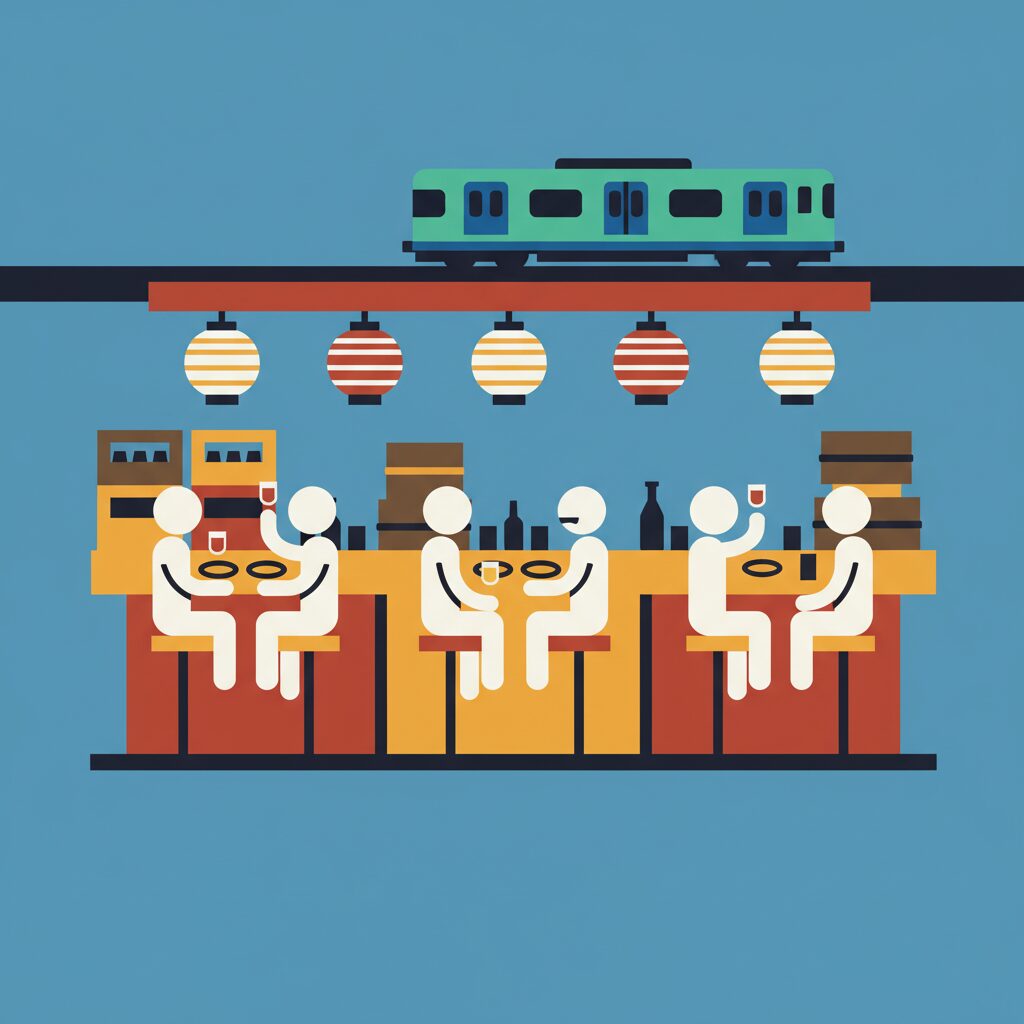
You feel it before you see it. A wave of warm, savory air hits you as you walk down a narrow shotengai arcade. It’s a mix of grilled meat, dashi broth, and stale beer—the unofficial perfume of Osaka after 5 PM. You follow the sound, a cheerful, chaotic rumble of laughter and chatter that spills out from under a faded noren curtain. You peek inside. It’s packed. A dozen people are crammed into a space the size of a walk-in closet, standing shoulder-to-shoulder around a scarred wooden counter. There are no chairs, no tables, just a sea of heads and a symphony of clinking glasses. This is a tachinomi, a standing bar, and it’s the key to understanding the raw, beating heart of Osaka.
For many foreigners arriving from the quiet politeness of other Japanese cities, the tachinomi is a culture shock. Strangers don’t just make eye contact; they talk to you. They ask what you’re drinking, where you’re from, and whether you think the Hanshin Tigers have a shot this year. In a country often stereotyped for its reserve and indirectness, this unfiltered, spontaneous social interaction feels like a glitch in the system. But it’s not a glitch. It’s the system. In Osaka, the tachinomi isn’t just a place to get a cheap drink. It’s a social engine, a community center, and a nightly crash course in the city’s unwritten rules. It’s where the famous Osakan friendliness stops being an abstract concept and becomes a tangible, noisy, and often hilarious reality. Forget what you think you know about Japanese social etiquette. To truly grasp what makes this city tick, you need to find a spot at the counter and learn the art of standing your ground, making a friend, and ordering another round.
To truly understand this unique social culture, it’s helpful to explore the broader Osaka mindset that shapes life in the city.
The Architecture of Spontaneity: Why Standing Changes Everything
Step into a typical bar in Tokyo, and you’ll encounter an environment crafted for containment. Tables form islands. Booths create walls. Private rooms (koshitsu) provide complete seclusion. The entire space is designed to preserve the sanctity of the group you arrived with. The aim is to establish a private bubble within a public setting. An Osaka tachinomi, however, reverses this idea entirely. Its design isn’t about separation; it’s about interaction. The absence of chairs is the key element. It’s not merely a space-saving measure; it’s a bold social statement. Without a designated seat, you have no territory to claim. You aren’t fixed in one place. Instead, you become part of a fluid, constantly shifting crowd. This tangible reality creates a psychological one. You’re not a customer seated at a table; you’re an active participant in a shared experience.
No Chairs, No Walls
The central counter serves as the stage. It’s a communal resource, a shared trough where everyone gathers. You might reach for the soy sauce and your elbow lightly touches a construction worker on your left. On your right, a salaryman in a sharp suit laughs at a joke from the bar master, the taisho. This enforced closeness breaks down the personal space bubbles carefully maintained elsewhere in Japan. In most settings, this would feel uncomfortable—a breach of privacy. Here, it’s intentional. The cramped quarters act as a social lubricant. You can’t ignore those beside you, so you might as well start a conversation. Physical barriers vanish, and along with them, social ones begin to fall away. A chat that begins between two people can quickly include the two next to them, and before long, half the bar is debating the best way to prepare kushikatsu. This open, permeable social atmosphere is what makes the tachinomi a place of endless possibility.
The Economics of a Quick Drink
Another important factor is the price. Tachinomi are almost always incredibly affordable. A beer might cost just a few hundred yen, a plate of grilled skewers even less. This low entry cost profoundly shapes the social dynamics. A visit to the tachinomi isn’t a big, planned occasion. It’s not a destination; it’s a brief stop. People drop by for a single drink on their way home from work, a quick bite before catching a train, or a nightcap after a formal dinner. This low-commitment approach eliminates social pressure. You don’t worry about having a good time for two hours because you might be there for just fifteen minutes. This fleeting nature fosters a “why not?” mindset. Why not chat with the person next to you? You’ll likely never see them again. Why not try that unusual dish everyone’s ordering? It only costs 200 yen. This financial accessibility makes the tachinomi a democratic space—a place where anyone can take part in the city’s social life for the price of a cup of coffee.
A Merchant City’s Mindset
This entire model perfectly reflects Osaka’s historical identity as Japan’s merchant capital. The city was built on principles of practicality, efficiency, and great value—akindo精神 (the merchant spirit). A tachinomi embodies this fully. No frills, no fuss. You get your drink, your food, have a chat, and move on. It’s a transaction, but a deeply human one. The focus is on substance, not presentation. There are no elaborate decorations, no extensive menus, no overly attentive service. Just good, affordable food and drink served quickly. This pragmatism carries over into social interaction. Osakans are known for being straightforward. They prefer to get right to the point, whether in business or conversation. The tachinomi is the arena where this directness is practiced and honed every night. It’s a place for quick connections, honest opinions, and unvarnished humanity—a social life founded on the principles of a bustling marketplace.
Cracking the Code: The Unspoken Rules of Tachinomi Talk
For someone unfamiliar, the lively and chaotic conversations at a tachinomi can feel intimidating. It appears to have no rules—a free-for-all of inside jokes and rapid-fire Osaka-ben. Yet, there is a method to the madness, a set of unspoken guidelines that shape the flow of interaction. Grasping this social grammar is essential not only for surviving but for thriving. The first thing to understand is that you’re not merely a passive observer; you’re expected to engage at some level. Silence isn’t golden here; it’s simply awkward. But how do you join a conversation already moving at a breakneck speed? You begin with what’s right in front of you.
The Opening Move: “Nani Tanonden?” (What Did You Order?)
In many cultures, asking a stranger about their food might seem intrusive. In an Osaka tachinomi, it’s the customary opener. Phrases like “Sore, oishii?” (Is that good?) or “Nani tanonden?” (What did you order?) aren’t just simple questions—they’re invitations to connect. The shared context of the bar—the limited menu, the visible kitchen, the dishes sliding down the counter—offers an endless supply of neutral, low-stakes topics. This sharply contrasts with, say, a Tokyo bar, where striking up a conversation with a stranger typically requires a more compelling reason. In Osaka, the mere fact that you’re both standing in the same cramped space eating the same food is enough. Responding to these questions is straightforward: you can talk about your meal, ask for a tip, or even offer a taste. The food and drink act as a bridge and a pretext to start chatting. The deeper conversation comes afterward.
Mastering “Nori”: Going with the Conversational Flow
To understand Osaka, you must understand nori (ノリ). Often translated as “vibe” or “mood,” these words don’t quite capture its active, participatory spirit. Nori ga ii (good nori) means being able to sense the energy in the room and contribute positively to it. It’s about syncing with everyone’s wavelength and riding the conversational wave. In a tachinomi, nori is everything. It’s the collective energy that builds as the evening progresses. Someone might crack a self-deprecating joke, and the expectation is that others will playfully join in. The taisho might grumble about the Tigers losing again, and everyone responds with performative groans. Mastering nori isn’t about being the loudest voice; it’s about timing—knowing when to listen, when to laugh, and when to add your own input. It’s a collective improvisation where your role is to keep the rhythm alive. Foreigners who just stand silently and watch are often seen not as polite, but as having nori ga warui (bad nori)—a social dead end. A simple smile, a nod, or an attempt to laugh at a joke, even if you don’t fully get it, shows you’re engaged and part of the experience.
The Art of “Tsukkomi”
At the heart of this conversational rhythm is the dynamic of manzai, Japan’s traditional two-person stand-up comedy, perfected in Osaka. The act features a boke (the funny, absurd one) and a tsukkomi (the straight man who corrects, often with a light slap or sharp retort). In Osaka, this dynamic isn’t confined to the stage; it underpins everyday conversation. People constantly set up jokes (boke) for others to knock down (tsukkomi). This is one of the biggest challenges for foreigners. A quick, witty comeback that might seem rude or harsh elsewhere is, in Osaka, a sign of affection and engagement. It shows you’re listening and sharp enough to play along. For instance, if you mention you’re from New York, someone might act the boke and say, “Wow, you must be a movie star!” A classic tsukkomi reply from another customer would be, “Nande ya nen!” (No way!/What the heck!), followed by a playful jab like, “Look at him, he can’t even hold his chopsticks properly!” This isn’t an insult—it’s a welcome. It signals that you’ve been embraced by the bar’s comedic rhythm.
Osaka vs. Tokyo: A Tale of Two Bar Cultures
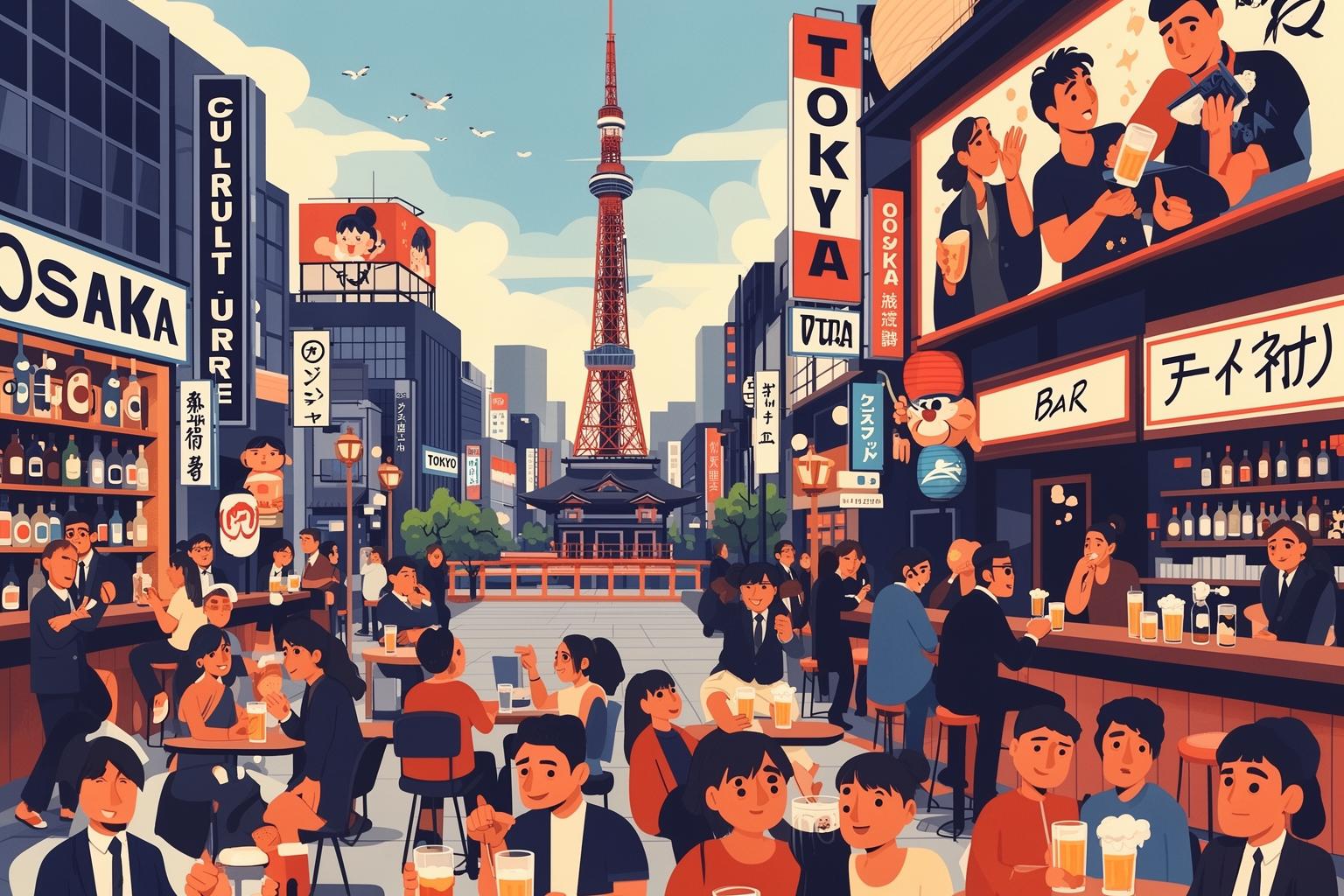
The contrast between Osaka and Tokyo is most vividly experienced in their distinct bar scenes. This difference extends far beyond preferences in alcohol; it reflects a fundamental divergence in how public spaces are valued and how social interactions are conducted. Spending an evening drinking in Tokyo followed by one in Osaka is like visiting two completely different countries, each operating under its own assumptions about appropriate behavior when people gather. One culture values curated privacy; the other embraces communal chaos.
The Tokyo Izakaya: A Private World
A typical night out in Tokyo exemplifies social precision. You go with a predetermined group—coworkers, classmates, or longtime friends. Reservations are common. You are guided to a specific table or, for an extra charge, a private room. The aim is to shield your group from the rest of the venue. Conversations are inward-focused, directed solely at your companions. Interaction with strangers is infrequent and usually accidental. The staff are professional, efficient, and keep a polite distance. The entire experience is crafted to be predictable and controlled. The space serves only your group; other patrons exist merely as background noise—separate islands in a calm archipelago. While exceptions exist, the prevailing culture emphasizes social containment.
The Osaka Tachinomi: A Public Stage
By contrast, an Osaka tachinomi is inherently spontaneous and uncontrolled. People often go solo, with the unspoken expectation that they won’t remain alone for long. Reservations don’t exist. You squeeze into whatever spot you can find. The goal is not to form a private bubble but to merge with the public atmosphere. Conversations are expected to spill over between neighbors, blending together. The bar master isn’t just a server—they act as the ringleader, the social conductor. They often introduce patrons to each other (“This guy is also a Tigers fan!”) or spark a topic for the entire bar to debate. The space is a shared stage where everyone is both performer and audience. The evening’s entertainment isn’t limited to your original company; it’s the spontaneous, unscripted performance created by the whole room.
Personal Space: A Cultural Recalibration
This core difference is reflected in attitudes toward personal space. In Tokyo, maintaining respectful distance is a fundamental public norm. Accidentally bumping into someone, whether on the train or in a bar, is a small transgression that warrants a sincere apology. In a crowded Osaka tachinomi, physical contact is unavoidable and largely unremarkable. The constant jostling is simply part of the experience. The chorus of “sumimasen” (excuse me) you hear functions less as a genuine apology and more as background noise—a way of acknowledging the shared, cramped environment. This isn’t because Osakans are impolite; rather, they have a more fluid conception of personal territory. The space doesn’t belong to you or me; it belongs to all of us. This communal approach to physical space mirrors a similarly communal attitude toward social space. A willingness to share an armrest naturally extends to a willingness to share conversation.
Finding Your Place: A Practical Guide for the Foreign Resident
Grasping the concept of tachinomi culture is one thing; immersing yourself in it is quite another. For someone not native to Japan, taking that first step inside can be intimidating. The noise, the smoke, the rapid-fire local dialect—it can seem like a secret club requiring a password you don’t have. But the charm of tachinomi is that there is no password. The only condition is a willingness to show up and be open. With a few tips, you can navigate this uniquely Osakan tradition and claim your own spot at the counter.
Where to Go: Beyond the Tourist Spots
Location matters. While tachinomi bars are scattered all over Osaka, the densest clusters thrive in vibrant, local neighborhoods. Tenma, with its maze-like covered market and endless side streets, stands supreme. Kyobashi, a gritty transit hub, is another classic area, packed with straightforward bars catering to railway workers and office employees. Behind Namba’s flashy front and amid the maze of old buildings beneath the Umeda tracks, you’ll find countless hidden gems. A good rule is to follow the locals—look for simple red lanterns (akachochin), hand-written menus taped to windows, and the genuine sound of laughter. If a place is bustling with Japanese patrons on a random Tuesday night, that’s usually a strong endorsement. Steer clear of spots with glossy English menus out front; they often target tourists and miss the authentic, lively spirit you’re seeking.
What to Expect: Your First Visit
Your initial visit should mostly be about observing. Don’t feel obliged to be the center of attention. Find a small space at the counter, catch the taisho’s eye, and order something straightforward. A bottle of beer (bin biru) or a highball is always a safe choice. Point at a dish that looks good or ask for the osusume (recommendation). Once your drink and food arrive, simply take it all in. Watch how others order. Notice the payment system—many places operate cash-on-delivery, where you leave payment on a small tray before you. Listen to the flow of conversations. Eventually, someone will probably start chatting with you. The questions tend to be predictable: “Where are you from?” “How long have you been in Japan?” “Can you use chopsticks?” Respond with a smile. Don’t worry about grammatical errors. Enthusiasm always wins over perfection. They’re not testing your Japanese skills; they’re just being curious and friendly.
The Language of Connection
Fluency isn’t necessary, but picking up a few key phrases in the local Osaka dialect, Osaka-ben, works wonders. Speaking standard Japanese is fine, but dropping in an Osaka-ben phrase shows you’ve made an effort to engage with the local culture. Instead of “totemo oishii” (very delicious), say “meccha umai!” Instead of “hontou desu ka?” (really?), try “honma ni?” And the all-purpose, fun phrase is “nande ya nen!” (roughly, “what the heck!” or “no way!”), which you can use playfully in response to almost any outrageous comment. Using these expressions, even imperfectly, almost always brings laughter and surprise. It signals you’re not just a passing tourist; you’re someone who “gets” Osaka. It’s an instant bond, a shibboleth that marks you as an insider—even if just for one night.
The Deeper Meaning: Tachinomi as a Social Safety Net
It might be easy to write off the tachinomi as merely a spot for cheap, rowdy entertainment. However, doing so overlooks its deeper role in the fabric of city life. These standing bars are more than just places to grab a drink; they serve as vital elements of Osaka’s social structure. Amid the often impersonal nature of a modern city, they offer a venue for authentic human connection, standing as a defense against urban isolation and preserving a more communal lifestyle. In many ways, they act as the city’s living rooms, where the usual divides of class and background vanish at the bar.
A Remedy for Urban Loneliness
Living in a Japanese city can feel isolating, especially for those on their own. Days tend to be busy and regimented, leaving little room for spontaneous socializing. The tachinomi provides a strong remedy for this. It’s a place designed to welcome and even encourage solo visits. Unlike restaurants or formal bars, coming alone isn’t frowned upon—in fact, it’s often the preferred way to experience the place. You can drop in, enjoy a drink, chat briefly with others, and leave without any obligations. It offers a low-pressure, high-reward form of human interaction. For many regulars, their local tachinomi serves as an essential third place—neither home nor work—where they can unwind, express themselves, and feel part of a community, even if only temporarily.
The Great Leveler
One of the most striking features of a tachinomi is the incredible mix of patrons. Within the same bar, you’ll find a university student, a retired elder, a suited business executive, and a freelance artist all standing together. In Japan’s highly stratified society, where rank, age, and employer matter deeply, the tachinomi acts as a powerful equalizer. At the counter, your job title and salary don’t define you; you are simply another person seeking a drink and good conversation. This removal of social status encourages a raw and sincere form of interaction. People bond over shared interests—baseball, fishing, or the quality of the sake—not social rank. This informal democracy is central to the tachinomi’s charm. It offers a temporary respite from the rigid societal order, a place where a CEO can receive friendly advice from a plumber without it seeming out of place.
Safeguarding a Piece of Old Osaka
In an era of unending modernization, where old buildings are frequently replaced by gleaming towers and chain outlets, the tachinomi stands as an act of cultural defiance. Many have been in operation for decades, often within the same family for generations. They serve as living archives of the city’s history. The faded posters on the walls, the worn marks on the counter, and the unique recipe for doteyaki (beef sinew stew) all link the present to a tougher, more communal past. They embody a firm resistance to the impersonal efficiency of contemporary life. By choosing to spend their time and money in these establishments, patrons actively help preserve this culture. They cast a vote—with their yen—for a vision of the city that prioritizes human connection over corporate shine.
Entering a tachinomi is like stepping into Osaka’s soul. It reflects the city’s core values: pragmatism, humor, and the deep conviction that a stranger is merely a friend you haven’t shared a drink with yet. It may be loud, chaotic, and sometimes overwhelming, but it is undeniably genuine. It reveals that Osakans’ friendliness is not just polite smiling but an active, engaging, and occasionally challenging exchange. It invites you to lower your defenses, join the humor, and connect on a deeply human level. For anyone seeking to understand life in this city, the insights gained while leaning on a sticky counter and sharing grilled food with a new acquaintance are far more meaningful than any guidebook. This is where Osaka truly happens, one inexpensive highball at a time.