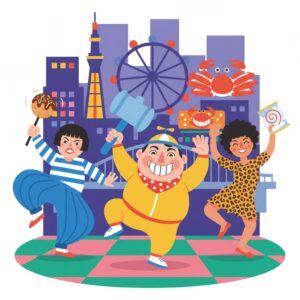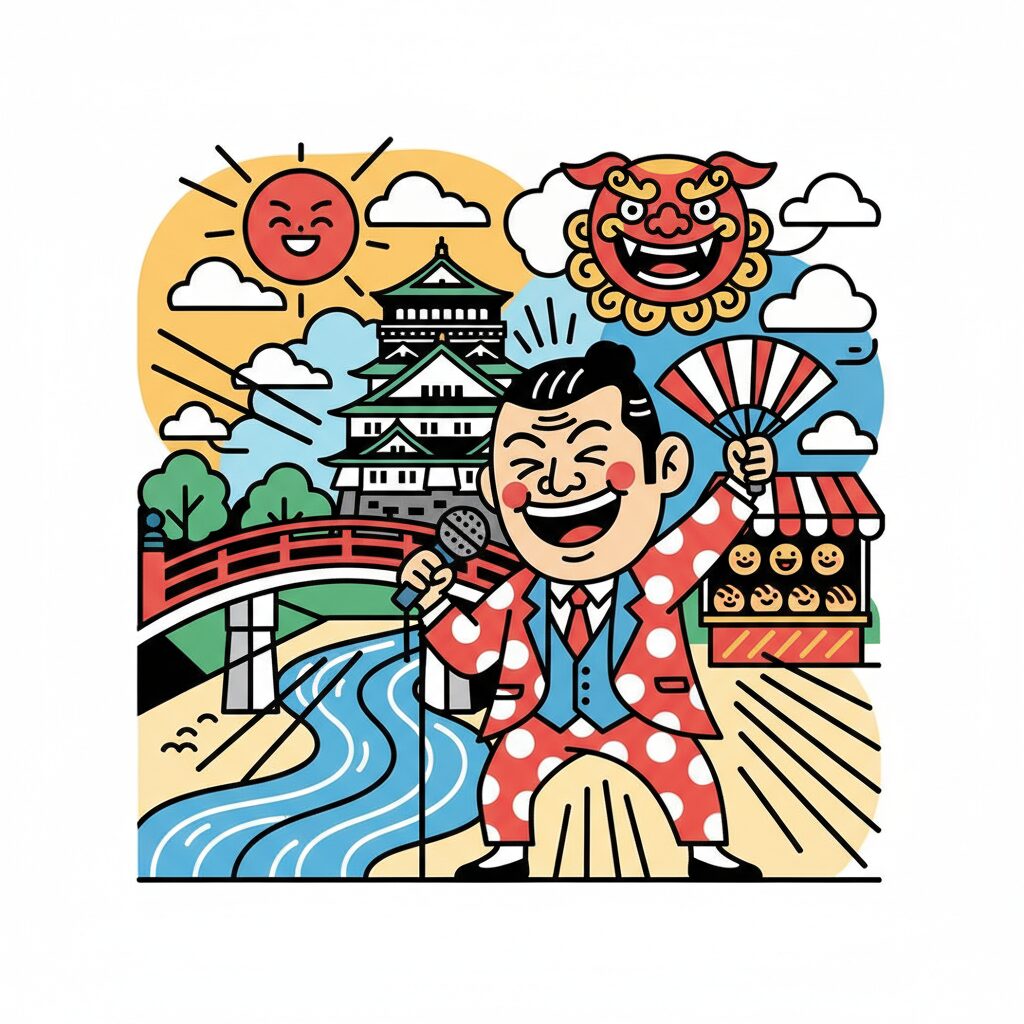
Walk into any conversation about Japan’s great cities, and a certain image of Osaka quickly emerges. Tokyo is the sleek, polished titan of industry and politics. Kyoto is the serene, elegant custodian of tradition. And Osaka? Osaka is the funny one. It’s the loud, brash, endlessly entertaining cousin who shows up to the family gathering with a back pocket full of jokes and a booming laugh. The stereotype is so pervasive, so deeply embedded in the national consciousness, that it feels less like an observation and more like a fundamental law of Japanese social physics: if you are from Osaka, you are funny. It’s a reputation the city wears with a certain swagger, a badge of honor that distinguishes it from the perceived stiffness of the capital. Newcomers and visitors are often told to expect a city where every shopkeeper has the timing of a stand-up comic and every casual conversation is a masterclass in comedic banter. The air itself seems to crackle with a unique, energetic wit that you just don’t find anywhere else.
But as anyone who has spent more than a fleeting week in this city knows, reality is always more nuanced than the caricature. Living here, you begin to see the seams in this comedic costume. You notice the quiet moments, the serious conversations, and the people who don’t fit the boisterous mold. You start to wonder about the weight of that reputation. What does it mean to be born into a culture where humor is not just an asset, but an expectation? Is it a joyful expression of a collective personality, or is it a social pressure, a performance that everyone is tacitly expected to master? This isn’t just about jokes and laughter. It’s about communication, identity, and the unspoken rules that govern daily life in Japan’s vibrant second city. To truly understand Osaka, we have to look behind the punchline and explore the complex, fascinating machinery of its famous humor. It’s a journey that reveals not just what makes Osakans laugh, but who they truly are.
To truly understand the unspoken rules that govern daily life in this city, one must also consider practical aspects like the neighborhood association fees that come with renting a home here.
The Commercial Roots of a Comedic Culture
To understand why Osaka is regarded as the comedy capital of Japan, you need to go back in time, well before the advent of television and comedy troupes. You must travel to an era when the city was known not for its humor, but for its industriousness. Osaka was, and in many ways remains, the `shonin no machi`—the merchant’s town. During the Edo period, while Tokyo (then Edo) served as the strict, hierarchical center of the samurai government, Osaka was known as the nation’s kitchen, `tenka no daidokoro`. It was a vibrant center of commerce where rice, sake, and countless other products were traded. A person’s value was measured not by bloodline or social rank, but by their skill in closing deals, understanding customers, and nurturing relationships. In this world, communication was the true currency.
The Merchant’s Wit
A samurai in Edo could afford to be stern, silent, and formal because his power was inherent. An Osaka merchant, however, had to earn respect with every interaction. He needed to be sharp, persuasive, and above all, personable. Humor became a vital business tool—a way to break the ice, establish rapport with new clients, and smooth out difficult negotiations. A well-timed joke could defuse tension, turning a customer into a friend rather than a mere target. This business style was grounded in human connection rather than strict protocol. The playful banter you still hear today in the city’s bustling `shotengai` (shopping arcades) is a direct continuation of this tradition. When an elderly shopkeeper jokes about you buying just one apple—`“Just one? Are you on a diet or feeling lonely?”`—she’s not being rude. She’s practicing an age-old art of commercial interaction, transforming a simple purchase into a memorable, human exchange. This fundamental difference in social nature is a major reason for the cultural divide between Osaka and Tokyo. Tokyo’s culture was shaped by the top-down, formal samurai society where manners and saving face were crucial. Osaka’s culture, by contrast, was forged from the pragmatic, bottom-up world of the marketplace, where wit, quick thinking, and a bit of playful boldness got results.
The Birth of Manzai and the Yoshimoto Empire
This merchant spirit created the fertile environment for Osaka’s most famous cultural export: professional comedy. In the early 20th century, a new entertainment style called `manzai` emerged, featuring fast-paced, two-person acts filled with rapid-fire jokes, puns, and slapstick. It perfectly embodied Osaka’s conversational style. Central to this rise was an entertainment company named Yoshimoto Kogyo. Established in Osaka in 1912, Yoshimoto professionalized and industrialized laughter. They built theaters, discovered talent, and transformed local comedians into national stars.
The Namba Grand Kagetsu theater, situated in the lively Namba district, became known as the Carnegie Hall of Japanese comedy. Aspiring comedians from across the nation headed to Osaka, eager to succeed on the Yoshimoto stage. As television became widespread during the postwar era, it was comedians from Yoshimoto’s Osaka base who dominated the airwaves. Their thick Kansai dialect (`Kansai-ben`), rapid banter, and relatable, down-to-earth humor became the national sound of comedy. For generations of Japanese growing up outside the region, television forged an unbreakable association: the Kansai dialect, especially the Osaka accent, was synonymous with laughter. This constant media presence cemented a stereotype in the national imagination. Osaka wasn’t merely a city where funny people lived; it was the factory that produced and shipped “funny” throughout Japan.
The Anatomy of Osaka Banter: A Two-Part Harmony
Step away from the history books and television screens and simply listen. Stand on a street corner in Tenma, sit at a counter in an Umeda izakaya, or wander through the stalls at Kuromon Market. You’ll quickly notice that Osaka humor isn’t about delivering structured jokes with a clear setup and punchline like Western stand-up comedy. It’s something more fluid, woven into the very fabric of everyday conversation. It’s a participatory rhythm, a linguistic dance involving two key roles that everyone naturally understands: the `boke` and the `tsukkomi`.
The Fool and the Straight Man: Boke and Tsukkomi
This dynamic duo, the foundation of `manzai` comedy, plays out in countless small interactions throughout the city every day. Grasping this is essential to understanding how Osakans communicate.
The `boke` (from the verb `bokeru`, meaning to be senile or air-headed) is the fool, the humorous figure. They say something absurd, nonsensical, or obviously incorrect. It’s not necessarily about being dumb but about deliberately playing the role to set up a comedic moment. For example, pointing at the famous Glico running man poster in Dotonbori and deadpan saying, “Wow, that guy must be really late for work.” This is a classic `boke` line.
The `tsukkomi` (from the verb `tsukkomu`, meaning to thrust or poke in) is the straight man. Their role is to promptly and sharply call out the absurdity of the `boke`’s remark. They are the voice of reason, grounding the conversation but in a way that provokes laughter. The `tsukkomi`’s comeback to the Glico man joke might be, “He’s been running for ninety years! Where would he even be going?!” Often this is accompanied by a light, symbolic slap on the arm or shoulder. The signature phrase of the `tsukkomi` is the ubiquitous “Nandeyanen!” which translates roughly to “Why the heck?!” or “What are you talking about?!”
This interaction isn’t confined to the stage. It’s the default mode of casual conversation. A friend might complain about being broke, and the `boke` friend will quip, “Just print some more money.” The `tsukkomi` friend immediately responds, “That’s illegal, you idiot! Nandeyanen!” It’s a call and response that keeps the energy lively. Being a good conversationalist in Osaka isn’t just about having something to say; it’s about knowing when to play the `boke` and when to deliver the `tsukkomi`. This is a deeply ingrained social skill.
The Punchline Mandate: `Ochi wa?`
Another important aspect of Osaka conversation is the concept of the `ochi`, or punchline. There’s an unspoken rule that a story, especially a long one, must have a point. It should build to something—a funny conclusion, a surprising twist, or a satisfying ending. If a story meanders and fizzles out, you might hear the slightly impatient question: “De, ochi wa?” (“So, what’s the punchline?”).
This can be intimidating for outsiders, especially those from cultures where storytelling tends to be more descriptive or atmospheric. In Osaka, a story is like a product you present to your audience. It’s expected to entertain. This pressure to find the `ochi` in everyday anecdotes shapes how people communicate. They learn to structure their narratives for maximum effect, cutting dull details and emphasizing the absurd or humorous parts. It’s another reason conversations feel so energetic and purposeful here. There’s a constant, collective effort to avoid conversational dead ends and ensure every story delivers a payoff. Even the most mundane tale about a supermarket trip can transform into a mini-performance.
The `Aho` vs. `Baka` Divide
Nowhere is the cultural difference in humor more evident than in a single word: `aho`. Both `aho` and `baka` mean “idiot” or “fool,” but their usage and connotations vary drastically. In Tokyo and much of eastern Japan, `baka` is the common term and can range from playful to genuinely offensive depending on tone. The word `aho`, however, sounds much harsher to Tokyo ears, bordering on a mean-spirited insult.
In Osaka, the situation is completely reversed. `Aho` is the preferred term, overwhelmingly used affectionately. It’s a core part of the `tsukkomi`’s toolkit. When someone says something silly (`boke`), the natural retort is “Aho ya na~” (“You’re such a goofball~”). It’s a term of endearment, a verbal pat on the back that acknowledges and celebrates the other’s successful `boke`. It signals camaraderie. Calling an Osakan friend `baka`, however, can seem cold and humorless. It lacks the warmth and rhythm of `aho`. It’s as if you’re not playing the game right. This linguistic subtlety encapsulates the broader cultural divide. For Osakans, playful insults reflect intimacy; for many Tokyoites, they breach polite distance.
The Weight of Wit: When Laughter Becomes a Liability
The image of a city united by laughter is both powerful and appealing. It conveys warmth, openness, and a joyful outlook on life. However, for many Osakans, this reputation carries a significant, often unspoken, burden. The expectation to be funny can shift from a cultural characteristic into a social obligation, generating a distinctive form of performance anxiety that affects many areas of life.
“You’re from Osaka? Say Something Funny!”
This phrase often makes Osakans cringe, especially when they visit other parts of Japan. Upon revealing their origin, they are frequently put on the spot, treated not as individuals but as representatives of a comedic stereotype. They become humor ambassadors, expected to produce a joke on demand as if they were walking vending machines for laughs. A friend from Sakai, a city just south of Osaka, recalled moving to Tokyo for university: “In my first week, every time I introduced myself, someone would inevitably say, ‘Oh, from Osaka! Hit me with your best joke!’ It was exhausting. I’m not a comedian. I’m just a person. I felt like a zoo exhibit.”
This pressure simplifies a complex identity into a single, flattened trait. It overlooks the fact that Osaka, like any large metropolis, is home to millions of diverse individuals—shy people, serious scholars, quiet artists, and thoughtful engineers. For those who don’t naturally possess a boisterous, comedic personality, this expectation can feel like a judgment. They may be seen as failing to be a “proper” Osakan. They might be labeled as `otsumashi` (prim and proper) or, even worse, `Tokyo-ppoi` (Tokyo-like), a subtle yet stinging critique within their community.
The Pressure to Perform
This pressure is not only external but also deeply internalized. From a young age, Osakans learn that humor is a form of social currency. In school, the funny kid is often the popular one. In business meetings, a well-timed witty remark can lighten the atmosphere and signal confidence and competence. In social situations, being an entertaining storyteller is highly valued. As a result, many feel a constant, low-level pressure to always be “on.” They feel compelled to find the `ochi` in their stories, to deliver a sharp `tsukkomi` when a friend plays the `boke`, and to maintain a certain level of playful banter in daily interactions.
This can be especially challenging in professional environments where Osaka’s communication style may clash with the more formal, standardized business etiquette typical of the rest of Japan. An Osaka salesperson’s attempt to build rapport through friendly teasing with a Tokyo client might be seen as unprofessional or even rude. Conversely, a Tokyo-based company sending an employee to Osaka may find that their reserved communication style is perceived as cold, distant, and untrustworthy. Navigating these cultural nuances is a delicate balancing act. Osakans face the challenge of knowing when to unleash their comedic instincts and when to tone them down to fit different social contexts—a skill that is often difficult to master.
Gendered Humor: The Role of the `Osaka Obachan`
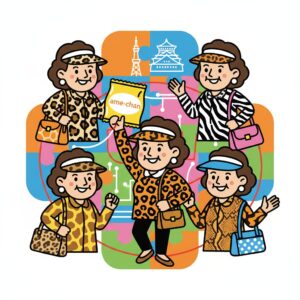
The expectation to be humorous also varies by gender. While wit is expected of both men and women, the stereotypical loud, slapstick comedian is usually male. The iconic female figure in Osaka humor is the `Osaka no obachan` (the middle-aged Osaka lady). She is a formidable presence, instantly recognizable by her vibrant, often animal-print clothing, her practical bicycle, and her unapologetic directness.
Her humor differs from the `boke`/`tsukkomi` style of `manzai`. It’s a sharp, observational, and pragmatic humor. She excels at friendly teasing and delivering unsolicited but often surprisingly insightful advice. She might comment on the price of your groceries at checkout (“You paid that much for tomatoes?!”), critique your outfit, or haggle with shopkeepers with theatrical flair. Her humor serves as both a tool of endearment and an instrument of efficiency. It cuts through social formalities and gets straight to the point, almost always carrying an undertone of warmth and care. For younger women, this archetype can be both an inspiration and a source of pressure, representing a distinct brand of assertive, witty femininity unique to Osaka.
A Foreigner’s Field Guide to Osaka Humor
For a non-Japanese resident, entering this intricately coded world of banter can feel daunting. You want to connect and join in, but you worry about misinterpreting cues, accidentally offending when you mean to be friendly, or appearing foolish by trying too hard. The good news is that no one expects you to become a `manzai` expert overnight. The goal isn’t to be funny in the Osaka style, but to understand and appreciate it. Learning to read the atmosphere is far more important than attempting to deliver a punchline.
Don’t Force It: The Value of a Genuine Laugh
The most important advice is to relax. You’re under no obligation to perform. When a shopkeeper teases you or a friend launches into a `boke`-filled story, often the best response is the simplest: a sincere laugh. Laughter is the universal signal that you get it, appreciate the effort, and are enjoying the exchange. A warm smile and a hearty chuckle are worth a thousand awkward `tsukkomi`. Trying to force a joke when you’re not comfortable will likely fall flat and create more awkwardness than simply being an engaged audience. Osakans are experts at reading people and will value your genuine amusement far more than a clumsy attempt at humor.
Start Small: Gentle Pushback
If you ever feel comfortable enough to join in, start small. Think of it as light conversational sparring. If the `obachan` at the fruit stand teases you for buying the pricey strawberries—`“Feeling like a celebrity today, are we?”`—you don’t need a sharp comeback. A simple, playful reply works perfectly. You might smile and say, `“Only the best for me!”` (`“Watashi ni wa ne!”`) or a self-deprecating, `“My once-a-year treat!”` (`“Ichinen ni ikkai no zeitaku ya wa!”`). This shows you understand the game and can play along without turning it into a full comedy act. The aim is to return the tease, not to win the exchange.
Decoding Affectionate Insults
One of the biggest cultural challenges for foreigners is recognizing that in Osaka, teasing often signifies affection. A coworker might glance at your bright, new sweater and say, `“Wow, that’s… loud. I can see you from a kilometer away.”` In many cultures, this would be taken as a rude, unwelcome remark. In Osaka, it usually means the barrier of formal politeness (`tatemae`) has been lowered. It’s a way of saying, `“We’re close enough that I can drop the formality and be more direct and playful.”` The intent isn’t to hurt, but to include. Learning to tell the difference between this friendly teasing and genuine criticism is crucial for navigating social life here. Context, the sparkle in their eyes, and the tone of the interaction will reveal everything you need to know.
Beyond the Laughter: The True Meaning of Osaka Humor
It would be wrong to view Osaka’s humor as simply a series of jokes and conversational quirks. When examined more closely, it reveals the city’s fundamental values: pragmatism, resilience, and a strong desire for human connection. The laughter itself isn’t the goal; it’s the means.
Humor as a Social Lubricant
At its core, Osaka’s humor acts as a tool for building community. In a society that can often feel socially reserved and hierarchical, Osaka’s comedic culture serves as a powerful way to break down barriers. Laughter becomes a shortcut to closeness. The `boke`/`tsukkomi` interplay, for example, is fundamentally collaborative. It needs at least two participants working in harmony, listening to each other, and creating something together. This fosters a sense of equality and shared experience. When a stranger on a train makes a clever remark about a delay and everyone nearby laughs, a brief moment of community emerges. Humor here conveys, “We’re all in this together.” This is why Osakans are often seen as friendly and approachable; their main mode of communication is designed to quickly bridge gaps between people.
A Shield of Resilience
Osaka has long been a city of merchants and laborers, built on determination and practicality. It has endured earthquakes, wartime destruction, and economic hardships. Its humor reflects this resilience, serving as a way to cope with life’s challenges. There is a deeply rooted belief in the power of laughing things off (`waraitobasu`). Being able to recognize the absurdity in tough situations and make self-deprecating jokes about one’s misfortune is regarded as a strength. It’s an outlook that refuses to be beaten by circumstances. This practical, slightly cynical, yet ultimately hopeful perspective is woven into the city’s comedic identity. It’s a way of confronting life head-on and choosing laughter over despair.
The Real Punchline
So, is every Osakan funny? The answer, naturally, is no. That’s the misconception. But the reality is far more fascinating. The truth is that nearly every Osakan, regardless of their individual nature, has grown up immersed in a culture where humor serves as the primary language of connection. They are fluent in its grammar, its rhythms, and its unspoken rules, even if they themselves aren’t standout performers.
For anyone living in or thinking about moving to this vibrant city, the challenge isn’t in learning how to tell jokes. It’s in learning how to listen. It means understanding that a landlord’s teasing is a sign of affection, that an absurd comment from a colleague is an invitation to engage, and that a story capped with a perfectly timed `ochi` is a true gift. The ongoing banter is the city’s heartbeat. You don’t have to contribute to the noise, but by appreciating its rhythm, you’ll be able to sense the real pulse of Osaka. The ultimate punchline here is that the humor isn’t really about being funny at all—it’s about being human, together.