There’s a certain kind of magic that hums in the air of Sakai City, a low thrum you can feel in the soles of your feet. It’s not the electric buzz of downtown Osaka, just a short train ride away. This is something older, more resonant. It’s the echo of a hammer striking steel, a sound that has defined this city for over six hundred years. Sakai, a port town cradled by Osaka Bay, is the undisputed soul of Japanese cutlery. It’s where legendary blacksmiths forged samurai swords and, as peace settled over the nation, turned their unparalleled skill to crafting the world’s most coveted kitchen knives. And where there are perfect knives, there is, inevitably, perfect sushi. To come to Sakai is to understand a fundamental truth of Japanese cuisine: the blade is not merely a tool; it is the first ingredient. It’s the silent partner to the chef, the instrument that unlocks the soul of the fish. This isn’t just a story about food; it’s a story about an ancient craft that elevates a simple meal into an art form. It’s about chasing flavor to its very source, to a place where the sharpness of the steel is matched only by the freshness of the sea.
While the city is famous for its blades and sushi, the wider Osaka area also offers unique culinary adventures, such as discovering unexpected kushi-katsu in Little Okinawa.
The Soul of the Blade: Why Sakai Knives Carve a Different Reality
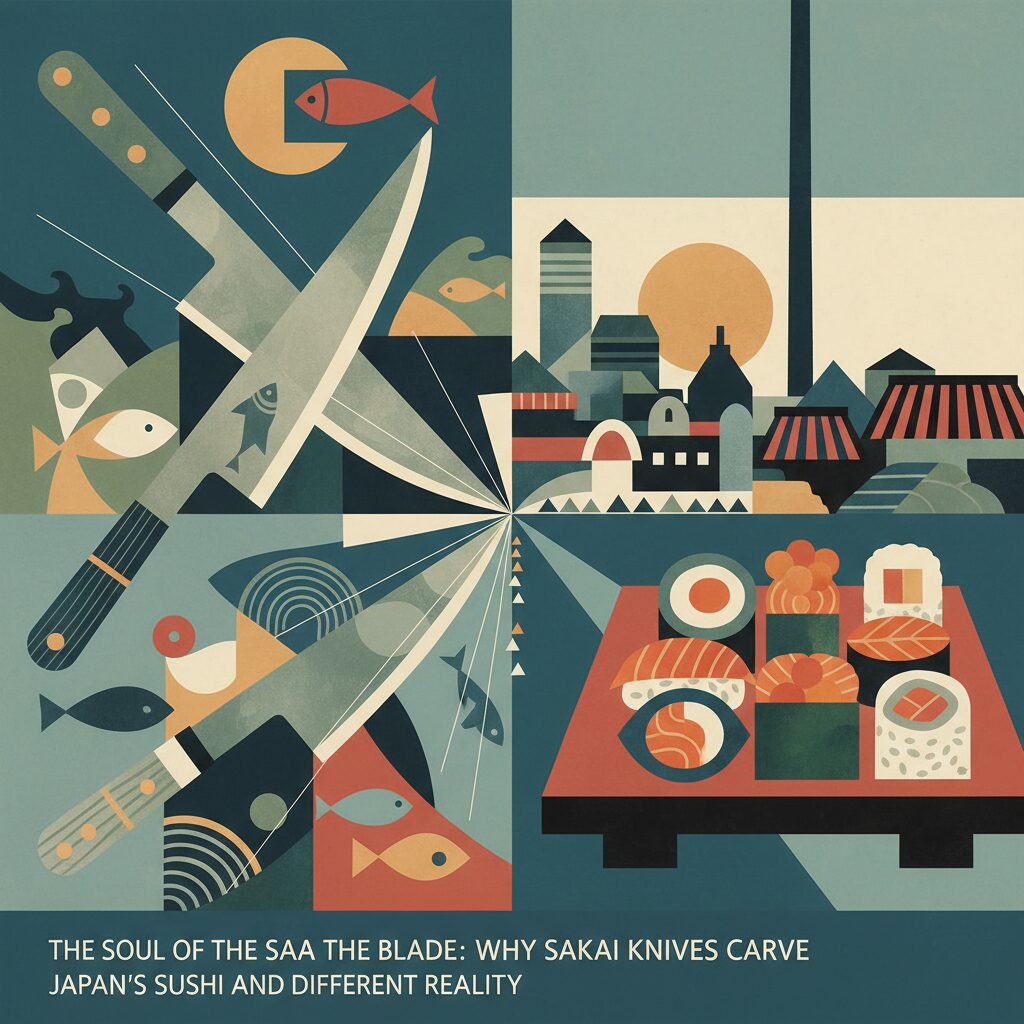
Before stepping into a sushi restaurant in Sakai, you must first grasp the city’s heartbeat, found in its forges. The legacy of Sakai `hamono`, or edged tools, is not a forgotten page in history; it remains a vibrant, living craft. As you wander through the older neighborhoods, you might hear the rhythmic clang of a hammer or the sizzling sound of hot metal being quenched in water. This is the origin of knives that sushi chefs worldwide mention in hushed, respectful tones. But what sets them apart? It’s more than just sharpness. It’s a philosophy of slicing.
Most Western knives are sharpened on both sides, forming a V-shaped edge. Sakai knives, especially those made for sushi like the long, slender `yanagiba`, have a single bevel. Sharpened on only one side, they create an incredibly fine, chisel-like edge. This design is no accident; it’s a masterstroke. When a chef slices through tuna with this blade, it doesn’t crush or tear the delicate muscle fibers. Instead, it glides with surgical precision, leaving a cross-section as smooth and glossy as polished silk. This single, clean cut keeps the cells intact, preserving the fish’s natural umami, texture, and vibrant color. The difference is striking. It’s the contrast between a blurry photo and a high-definition image of flavor. Fish cut with a lesser knife might taste dull or watery; fish cut with a Sakai `yanagiba` tastes purely of itself and the clean, cold waters it came from.
Visiting a knife maker’s workshop is almost a spiritual experience. These are not factories but small, often family-run studios where skills have been handed down through generations. You’ll see masters, their hands gnarled and wise, bent over blazing fires and spinning grindstones, completely focused. They forge, hammer, and laminate different steels—a hard, brittle carbon steel for the cutting edge and a softer iron for the spine. This process, called `kasumi` or “mist,” produces a blade that is both incredibly sharp and durable. The final sharpening is an art form, a delicate dance between blade and progressively finer water stones until the edge is razor keen, able to split a human hair. Holding one of these knives is to grasp the weight of centuries of wisdom in your hand. It feels alive, an extension of the chef’s intent, poised to fulfill its singular, perfect purpose.
The Sakai Sushi Counter: A Theater of Precision and Taste
With this knowledge of the blade in hand, eating sushi in Sakai becomes a transcendent experience. The city’s sushi establishments may not be as flashy or as numerous as those in central Osaka, but they exude a quiet confidence, a certainty that comes from being at the origin. The ambiance can vary from austere, temple-like `sushi-ya` with counters carved from single slabs of fragrant cypress wood, to warm, lively neighborhood spots where laughter blends with the chef’s sharp calls. Yet, all share a common thread: an obsessive dedication to the quality of the cut.
Picture yourself seated at one such counter, a traditional Edomae-style restaurant hidden on a quiet street. The `taisho`, or master chef, moves with an economical grace that captivates. His hands perform a fluid, continuous dance. He lifts a block of glistening `maguro` (tuna) from a wooden icebox. His `yanagiba`, nearly a foot long and gleaming under soft lighting, is his trusted partner. The pull-cut is a single, uninterrupted stroke, beginning at the heel of the blade and flowing smoothly to the tip. There is no sawing, no hesitation. The slice of fish that separates is flawless—its edges razor-sharp, its surface shimmering. He places it onto a small, warm bed of `shari`—vinegared rice, an equally obsessive element here, with each grain distinct yet cohesive. He anoints it with a whisper of wasabi and a delicate brush of `nikiri` soy sauce. The piece of `nigiri` set before you is more than just food; it is a miniature sculpture, a perfect union of sea and land, brought to life by the perfect cut.
The `omakase` experience, where you entrust your entire meal to the chef, offers the ultimate way to savor this artistry in Sakai. The meal unfolds as a narrative, a journey through Japan’s seasons and waters. It might begin with a delicate piece of `hirame` (flounder), its subtle sweetness enhanced by a pinch of sea salt and a drop of sudachi citrus. This can be followed by `ika` (squid), scored with a lattice of impossibly fine cuts from another specialized knife, the `kiri-bashi`, rendering its texture tender and creamy as it melts on the tongue. Then arrives the crescendo of the tuna flight: the lean, ruby-red `akami`; the marbled, buttery `chutoro`; and the king, the impossibly rich and fatty `otoro`, which seems to dissolve into pure umami bliss. Each piece testifies to the chef’s skill and the blade’s perfection. You begin to notice the subtle details: how the silvery skin of the `kohada` (gizzard shad) glistens, how the translucent flesh of the `tai` (sea bream) seems to glow from within. This is the magic the Sakai edge makes possible.
Beyond Edomae: The Diverse Flavors of Sakai
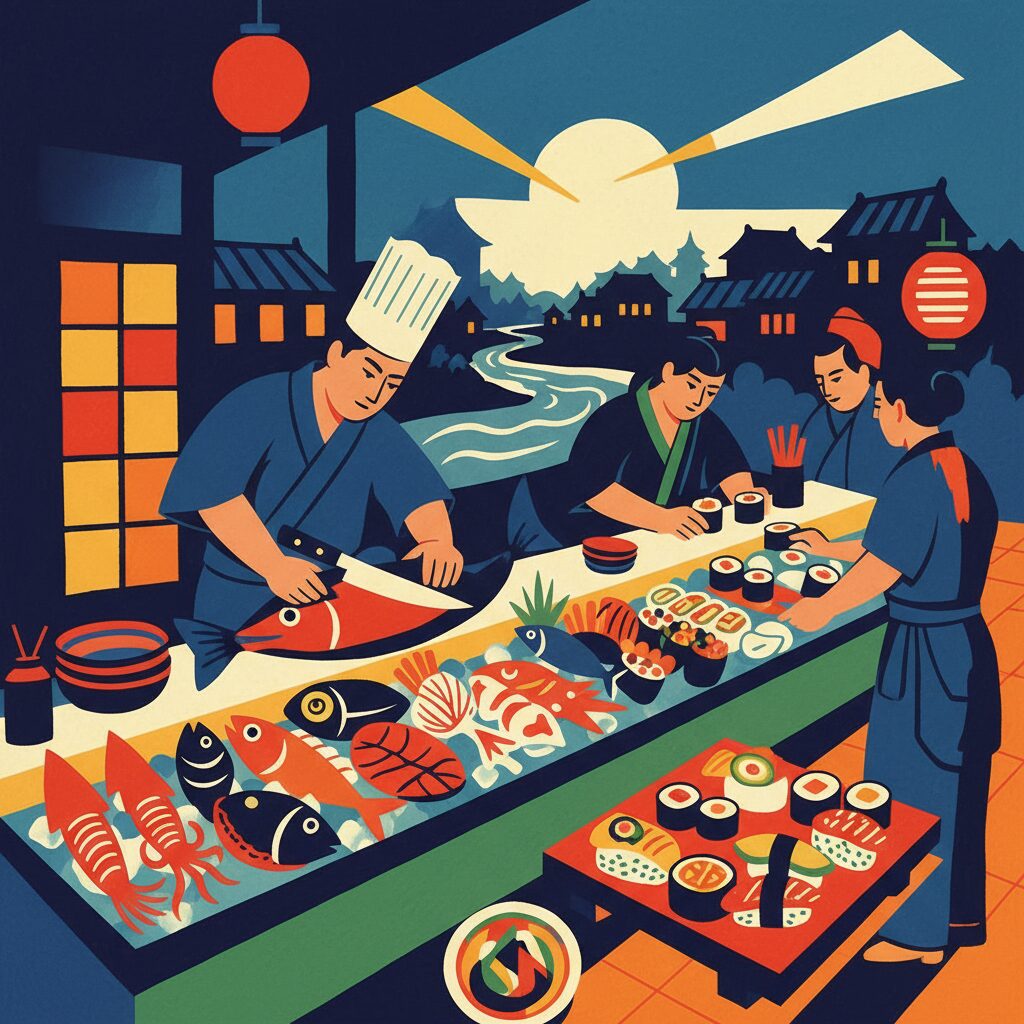
While the high-end `omakase` experience is a must for any dedicated foodie, Sakai’s sushi scene is wonderfully diverse and approachable. This is a working city where people genuinely enjoy good food without any pretension. You’ll discover excellent `kaiten-zushi` (conveyor belt sushi) spots where families gather, and the quality of the fish—even at these budget-friendly prices—is noticeably superior to what you might find elsewhere. The secret lies in the same factors: proximity to the bay and a profound respect for proper preparation, which is inseparable from the culture of knives.
Additionally, there are numerous neighborhood eateries, often run by husband-and-wife teams, offering spectacular lunch sets at very reasonable prices. These `jizakana` establishments pride themselves on using local fish caught fresh that very morning in Osaka Bay. Here, you might enjoy `anago` (sea eel), simmered until tender as a cloud and glazed with a sweet, dark sauce. Or perhaps you’ll sample `gashira` (scorpion fish), a local delicacy which, despite its intimidating appearance, boasts wonderfully firm and flavorful white flesh. The atmosphere in these spots is warm and welcoming—you’ll hear the clatter of dishes, the friendly chatter between chef and regulars, and a genuine appreciation for a simple, perfectly prepared meal. This is where the real heart of Sakai’s food culture shines. It’s not only for connoisseurs but for everyone who values freshness, skill, and the joy of eating well.
For a truly distinctive experience, seek out a restaurant specializing in `hakozushi`, or box-pressed sushi, an Osaka specialty. Unlike the hand-pressed `nigiri` of Tokyo, this style involves layering cured fish and rice in a wooden box, pressing it, then slicing it into perfect rectangles. The visual presentation is stunning, resembling a mosaic of flavors. Preparing the fish for `hakozushi` is highly demanding, often involving salting and curing, and the final slicing requires an exceptionally sharp knife to create clean, flawless edges. It represents a different expression of sushi artistry, deeply rooted in the Kansai region’s history, and Sakai is among the best places to experience its refined elegance.
A Deeper Cut: Exploring Sakai’s Historic Soul
To fully appreciate the sushi, you need to explore the streets of the city. Sakai’s story is inscribed in its landscape, a captivating mix of industrial heritage and rich history. A great place to begin is the Sakai City Traditional Crafts Museum (Sakai Hamono Museum), where the entire knife-making process is displayed, and you can admire an impressive range of blades, from enormous tuna-filleting swords to delicate vegetable knives. It offers invaluable insight, linking the meal you just enjoyed to centuries of innovation that made it possible. Many knife shops, such as the renowned Jikko and Ichimonji Chuki, feature showrooms where you can not only buy a knife but also interact with artisans, feel the balance of various blades in your hand, and even have your name engraved on your purchase—a truly personal and enduring memento.
However, Sakai’s history runs even deeper than its forges. This region is home to the Mozu-Furuichi Kofun Group, a collection of ancient burial mounds designated as a UNESCO World Heritage site. The largest mound, the Daisen Kofun, is believed to be the tomb of Emperor Nintoku and ranks among the world’s largest tombs by area, even larger than the Great Pyramid of Giza. Renting a bicycle to ride around this keyhole-shaped, forest-covered mound is a surreal experience and a powerful reminder of the deep roots of Japanese civilization in this very land. The presence of these imperial tombs points to the region’s significance long before the first knife was ever crafted here.
Sakai was also home to one of the most influential figures in Japanese culture, the tea master Sen no Rikyu. His philosophy of `wabi-sabi`—appreciating beauty in simplicity, imperfection, and transience—shapes much of Japanese aesthetics, including its cuisine. This philosophy is evident in the minimalist elegance of a traditional tea house and can be tasted in the purity of a single piece of `nigiri`. It emphasizes the essential, highlighting the natural beauty of an ingredient without needless decoration. In Sakai, you can visit tea houses and gardens that celebrate his legacy, offering moments of quiet reflection and another perspective on the city’s refined culture of craftsmanship.
Practical Wisdom for the Sakai Explorer
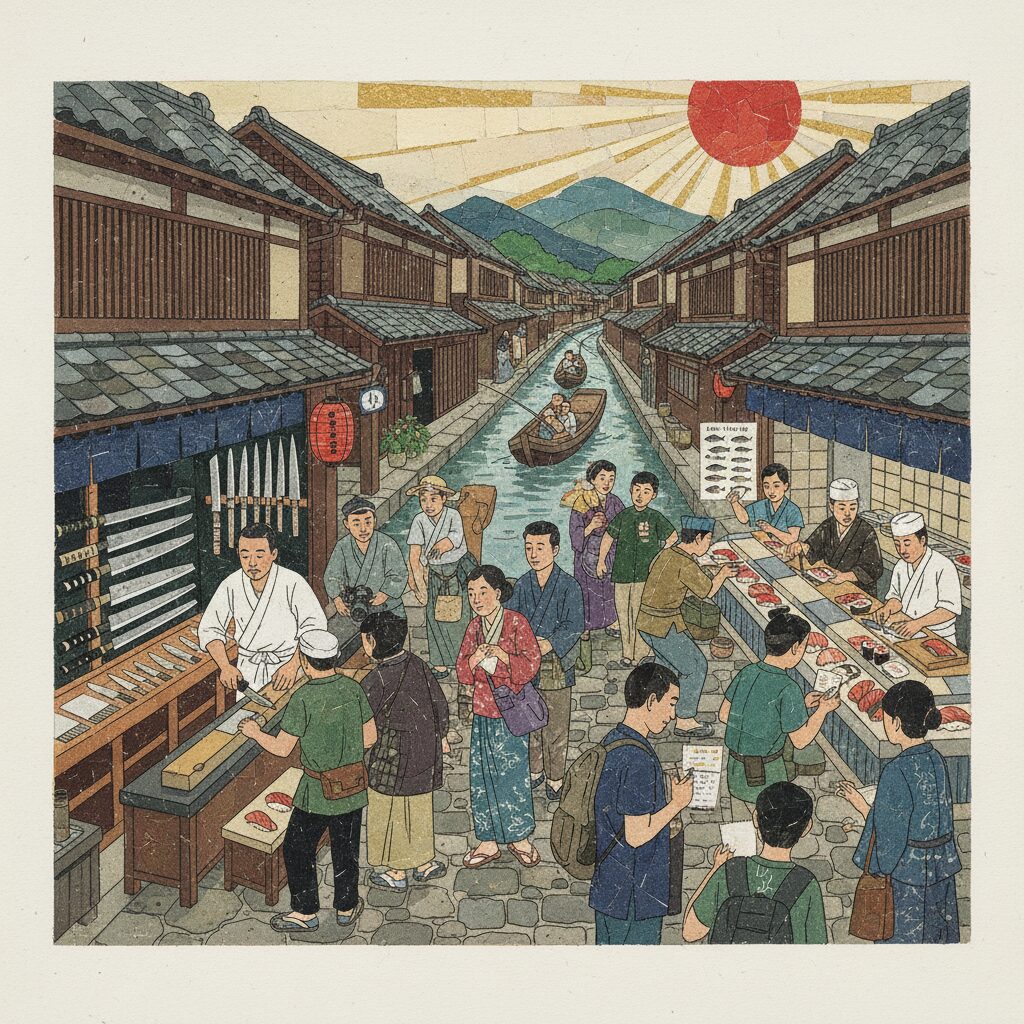
Reaching Sakai is remarkably simple, which is surprising given how different its atmosphere is from central Osaka. From Namba Station, the vibrant center of southern Osaka, the Nankai Main Line will carry you to Sakai Station in about ten minutes, placing you close to the old port area. To explore the historical sites and traditional craft districts, taking the Hankai Tramway, one of Japan’s few remaining streetcar lines, is essential. Its slow pace and charming, rumbling cars provide a wonderfully nostalgic way to experience the city, connecting the main train stations to key attractions.
When dining at a sushi restaurant, especially a traditional one, observing a bit of etiquette makes a big difference. If you’re seated at the counter, it’s best to order directly from the chef. The `omakase` selection is always an excellent choice for first-timers, as it removes the guesswork and allows the chef to showcase their best creations. When eating `nigiri`, it is considered more refined to use your fingers rather than chopsticks, though both are acceptable. The important thing is to dip the fish side, not the rice side, into the soy sauce to prevent the rice from absorbing too much and falling apart. The pickled ginger, or `gari`, is intended as a palate cleanser between different fish varieties, not as a topping.
Here’s a useful tip for buying knives: don’t be intimidated. The artisans and shopkeepers are passionate about their craft and usually happy to explain the differences between various steels and knife types, even with limited English. Carbon steel (`hagane`) knives become sharper and are easier to re-sharpen but can rust if not properly maintained. Stainless steel is more forgiving for home cooks. Consider what you plan to use the knife for, and they will help you find the perfect blade. A simple `santoku` (a general-purpose knife) or a `gyuto` (a chef’s knife) from Sakai will transform your cooking and serve as a beautiful, functional keepsake of your trip.
Sakai is a city that unveils itself gradually. It doesn’t demand your attention but rewards your curiosity. Wander its side streets, peek into workshop doorways, follow the aroma of grilled eel, and listen to the streetcar’s clatter. This is a place to slow down and appreciate the deep connection between a master’s skill, a perfect tool, and an ideal bite. It’s a culinary pilgrimage that will not only delight your palate but also deepen your appreciation for the subtle artistry behind Japan’s most celebrated cuisine. Here, in the city of blades, you’ll find the sharpest edge is the one that links history, craft, and flavor in one unforgettable taste.