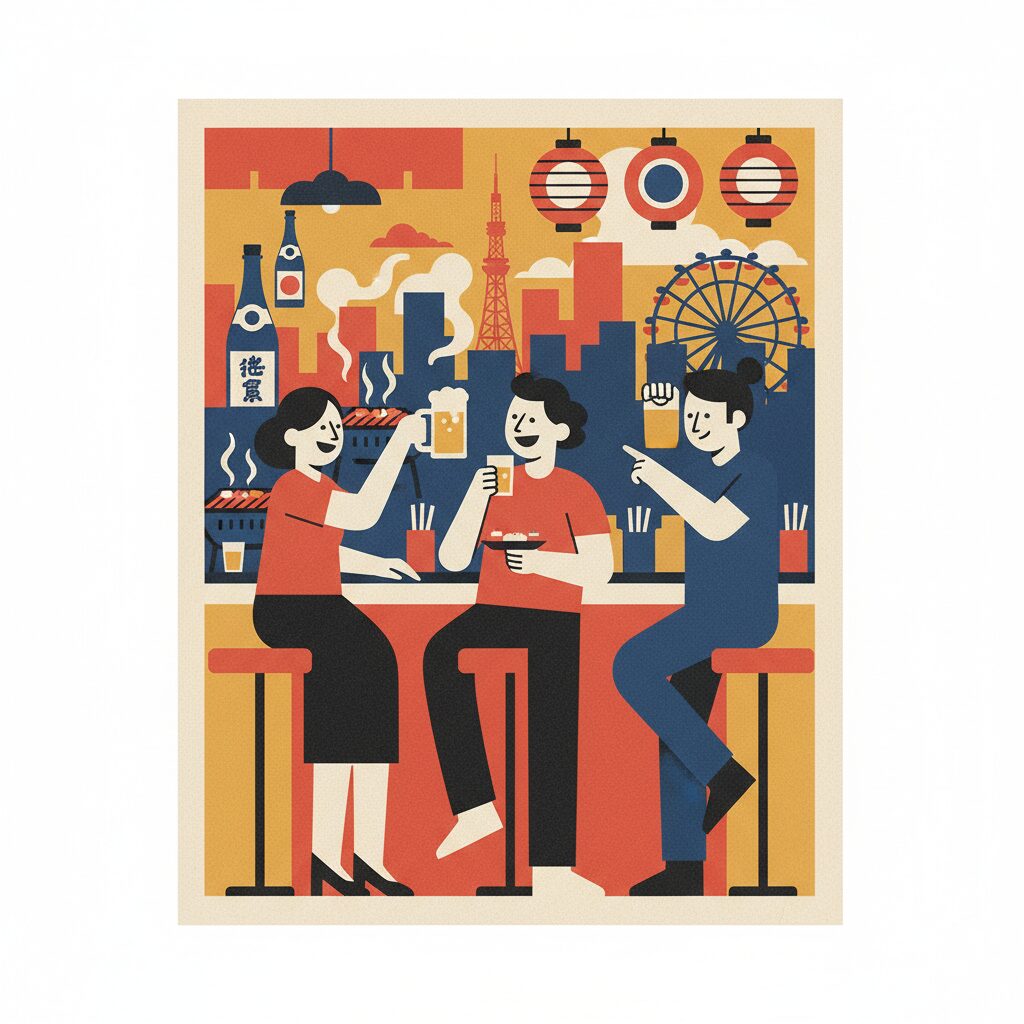
You’ve heard the stories. Maybe you’ve even lived them. Osaka is friendly, they say. People will talk to anyone. It’s a city of merchants and comedians, where the social barriers feel lower, the conversations louder, and the laughter more frequent than in the reserved corridors of Tokyo. Armed with this knowledge, you decide to dive into the deep end of local culture: the Tachinomi. The standing bar. You picture a scene of instant camaraderie, a festival of cheap beer and spontaneous friendships. You push aside the stained noren curtain, step into a room thick with the smell of fried skewers and stale cigarette smoke, and… silence. The chatter doesn’t stop, but it deflects around you, an invisible shield protecting a tight-knit ecosystem. The regulars, hunched over the worn wooden counter, glance at you for a nanosecond before turning back to their conversations. The master, the Taisho, gives you a curt nod, his eyes already scanning the rest of his domain. You order a beer, find a sliver of space, and stand there, feeling more foreign than you have in months. This isn’t the party you were promised. This is a private club, and you don’t have a membership. This is the Tachinomi paradox, a core misunderstanding for so many non-Japanese residents trying to connect with the real Osaka. The friendliness is real, but it’s not a welcome mat. It’s a locked door with a key hidden in plain sight, and learning to find it means learning to see the city not as a tourist, but as an observer of its intricate, unwritten social contracts. It’s a world away from the curated politeness of Kyoto or the professional distance of Tokyo; it’s a social proving ground where your ability to read the air is your only currency. The journey into the heart of Osaka begins right here, in the awkward, silent space between you and the local nursing his highball.
To truly understand the intricate social codes of Osaka, one must also learn to appreciate the city’s unique forms of casual connection, such as the spontaneous sidewalk conversations known as Tachibanashi.
Deconstructing the “Friendly” Myth: The Tachinomi as a Social Proving Ground
The word “friendly” is perhaps the most overused and misunderstood way to describe Osaka. It evokes images of open arms and effortless inclusion, which is a misleading oversimplification. Osaka’s friendliness is not passive; it’s conditional and performative. It’s an openness to engagement, a willingness to banter, and a shared appreciation for breaking the solemnity of public life. However, this is not an open invitation to enter a private world. Think of it less as a welcoming party and more as a stage where anyone can perform, but only after understanding the play, knowing your lines, and waiting for your cue. In Tokyo, the default social mode is a polite, impenetrable bubble. Ignoring strangers is standard; it’s a way of respecting privacy in a densely packed environment. In Osaka, that bubble is more permeable. Acknowledging another person’s existence happens more often, but that acknowledgment—a nod or a brief comment about the weather—is usually where the agreement ends. It’s a social gesture, not an invitation.
The Tachinomi embodies this principle perfectly. It’s a classic “third space,” a liminal zone between the rigid structures of work and the private refuge of home. For the regulars, the jouren-san, it’s not a place for adventure or meeting new people. It’s a ritual. It’s a place to unwind among familiar faces, perform a comfortable social role, and engage in easy, low-stakes conversation with the Taisho and fellow regulars. They’re not seeking new friends; they want the comfort of their established circle. When you, the newcomer, walk in, you are not seen as a potential friend. You are viewed as a variable, an unknown factor that might disrupt the delicate balance of this finely tuned social machine. Your presence briefly shifts the atmosphere. The regulars are not hostile when they ignore you; they’re simply watching to see how you behave. Will you respect the space? Do you understand the rules? Their initial silence is not rejection but assessment. Osaka’s friendliness is earned, not given, and the Tachinomi is the testing ground.
Reading the Room: The Unspoken Choreography of the Standing Bar
Before a single word is uttered, a complex social dance is already in motion in any Tachinomi that prides itself. This is a place where non-verbal communication holds sway. The ability to kuuki wo yomu, or “read the air,” is more than a helpful skill; it is the essential prerequisite for acceptance. Foreigners often stumble here, confusing physical closeness with social intimacy and misreading the subtle signals that govern the space. Success depends on grasping this unspoken choreography from the moment you enter.
The Importance of Personal Space (Even When There Is None)
The first striking feature of a classic Tachinomi is the total absence of physical space. Patrons stand shoulder-to-shoulder, elbows barely apart, the backs of jackets touching one another. To Western sensibilities, this degree of contact would suggest familiarity. This is a crucial misjudgment. In the Tachinomi, a strict yet invisible personal boundary is maintained. Each person claims a small slice of the counter, a sacred spot just large enough for their drink and a small dish. The entire experience serves as a masterclass in negotiating spatial boundaries.
Observe how a regular moves through the room. They slide in sideways, a soft “sumimasen” (excuse me) barely audible. They order their drink from the Taisho, receive it, and find their place without displacing others. They don’t stand firmly and spread out. Instead, they contract, making themselves small to honor others’ space. Their movements are purposeful and restrained. Newcomers often err by behaving as if they were in a spacious Western bar: placing bags on the counter, speaking loudly across the room, or gesturing broadly, inadvertently invading others’ personal zones. This is viewed not merely as awkward but as a fundamental lack of respect for the shared environment. The first challenge is to prove you can exist within this compressed space without causing disruption. Your aim is to be a quiet, efficient user of space—a ghost who leaves no trace.
The Role of the Taisho (The Master)
Within the Tachinomi universe, the Taisho, or Mama-san, is the sun around which all other elements revolve. They are not just a bartender; they serve as gatekeeper, social conductor, memory bank, and ultimate arbiter of the bar’s atmosphere. Your relationship with the entire room passes through your initial interaction with them. They are your first point of contact, and how you engage sets the tone for your entire visit.
When you enter, your first glance should be toward the Taisho. A slight nod suffices. When ready to order, catch their eye—do not shout or wave. Speak clearly and simply. If your Japanese is limited, pointing at something on the menu is fine. The key is to be low-maintenance. Avoid complicated substitutions or detailed menu explanations. Order something straightforward—a beer, a highball, a plate of doteyaki (stewed beef sinew). The Taisho is extraordinarily busy, juggling dozens of orders and conversations simultaneously. Your goal is to be a smooth, efficient customer.
The Taisho’s reaction to you is a public signal to the regulars. If they respond tersely and transactionally, the regulars will mirror that distance. However, if the Taisho offers a small, unsolicited comment—“It’s cold today, isn’t it?”—or asks a simple question, it’s a sign. It signals to the room that you are acceptable, that you have passed the initial screening. This small gesture grants you a kind of temporary social visa. The regulars may not start a conversation with you just yet, but they will acknowledge you as a non-threat. Building even a minimal rapport with the Taisho is the foundational step on which all other social interactions depend.
The “Regulars” (Jouren-san): A Closed Circle with an Open Door
The jouren-san are the heart of the Tachinomi. They are men and women who have been coming to this same spot, standing in this same place, drinking the same drink for years, even decades. They share an unspoken understanding with the Taisho and with each other. Their conversations form a long, uninterrupted thread picked up from the night before. They are not in a public bar as understood in the West; they are in a shared living room, and you are an unexpected guest.
The common misunderstanding is to interpret their lively chatter and laughter as an open invitation. A foreigner hearing the boisterous energy typical of Osaka might assume it’s a party they can casually join. Trying to insert yourself into a conversation among regulars is the gravest social faux pas. It’s like walking into a family dinner uninvited and pulling up a chair. Their circle is closed, founded on shared history, inside jokes, and deep mutual knowledge. You, as a stranger, have none of this context.
That said, the circle is not hermetically sealed. It resembles a closed circle with a lightly unlocked door. The key to that door is not force but patience and observation. The regulars watch you, even when it seems they do not. They observe your interaction with the Taisho. They note how you respect the space. They assess whether you grasp the rhythm of the bar. They aren’t there to entertain you or satisfy your curiosity about Japanese culture. But if you show that you understand and honor their culture—the culture of this unique, tiny room—the door may slowly swing open. The initial approach must never target the group as a whole, but rather a single individual, and only when the moment feels unmistakably right.
The Art of the Approach: How to Actually Break the Ice
So, you’ve managed to make your presence known. You’ve ordered your drink, found a sliver of counter space, and skillfully avoided being a spatial nuisance. You’ve set a baseline of neutral respect with the Taisho. Now comes the challenging part: shifting from a silent observer to an active participant. This is a delicate process, demanding surgical precision and a deep well of patience. A clumsy approach will undo all the goodwill you’ve earned, while a successful one can feel like a genuine breakthrough—a small but meaningful moment of cultural connection.
Step One: Patience and Observation (The “Three Visit” Rule)
This cannot be emphasized enough: don’t expect a meaningful conversation on your first visit. The initial visit is strictly for reconnaissance. Your goal is to establish yourself as a harmless, respectful presence. Have one drink and one small plate of food. Nurse them slowly over twenty to thirty minutes. Watch everything. Notice how people order, how they pay, how they interact with the Taisho. Absorb the atmosphere. Then settle your bill, give a slight nod to the Taisho, and leave. You are planting a seed.
On your second visit, perhaps a few days or a week later, you might be met with a flicker of recognition. The Taisho could greet you with an “Ah, maido” (a casual Osaka welcome meaning loosely “welcome back”). This is a big milestone. It means you’ve moved from being a random stranger to a recognizable face. Repeat the first visit’s routine: one drink, one dish, quiet observation. You’re reinforcing the message that you’re not a demanding tourist but someone who appreciates the establishment for what it is. You’re showing consistency and respect for the routine.
By your third visit, you’ve become a semi-regular. You’re no longer an unknown variable. You’ve demonstrated through your actions that you understand the unspoken rules. At this point, the social dynamics may start to shift. The invisible barrier around you becomes more permeable. You may get the chance for a brief interaction. The “Three Visit Rule” reflects the Japanese—and especially Osakan—value placed on consistency and demonstrated respect over fleeting charm.
The Conversational Opening: Finding the Right “Hook”
When the opportunity presents itself, your opening line is crucial. The worst approach is to fall into the typical foreigner-in-Japan script. Avoid leading with “Do you speak English?” or “Where are you from?” These questions immediately frame the exchange as a cultural interview, placing the communication burden on the other person and highlighting your otherness. Instead, look for a natural, organic conversational hook rooted in the shared context of the bar.
One of the safest and most effective openings is to comment on the food. If the person next to you is eating something that looks interesting, you can lean over slightly and say, “Sumimasen, sore oishisou desu ne. Nan desu ka?” (Excuse me, that looks delicious. What is it?). This is a brilliant move for several reasons. It compliments both their choice and the establishment’s cuisine. It’s a simple, low-pressure question that can be answered with a single word. It shows interest in the bar’s culture, not just in practicing your Japanese. It creates an immediate, positive connection based on a shared sensory experience.
Another excellent icebreaker is the television. Many Tachinomi bars have a small TV mounted in the corner, often tuned to a baseball game or variety show. A shared groan over a Hanshin Tigers’ missed play or a laugh at a comedian’s antics can serve as powerful social glue. It’s a neutral experience that transcends language barriers. A simple remark like, “Ah, zannen!” (Ah, what a shame!) during a bad play signals that you’re on the same team, both literally and figuratively.
Finally, listen carefully. Pay attention to nearby conversations. If you catch a keyword or topic you can genuinely and briefly comment on, try to join in. This is a high-risk, high-reward tactic. Misjudging the tone or interrupting a private moment will be met with polite silence. But if you hear them discussing a place you’ve recently visited, a brief, respectful interjection like, “Ah, Kobe! I was just there. It was beautiful,” can sometimes work. The key is to offer your comment then step back, allowing them to decide whether to respond. You’re providing a conversational thread, not forcing them to pick it up.
The Osaka Rules of Banter (Tsukkomi and Boke)
If you’re fortunate enough to enter a conversation, you’ll quickly realize that dialogue in Osaka runs on a different wavelength. It often resembles a performance—a rapid-fire exchange based on the comedic principles of manzai comedy. This involves two roles: the boke, who makes a silly or absurd remark, and the tsukkomi, who responds with a sharp, witty retort. While you’re not expected to be a professional comedian, grasping this dynamic is essential to navigating conversations.
Osakans frequently use teasing and light insults as expressions of affection and social bonding. Someone might joke about your clothes, your Japanese skills, or your drink choice. The absolute worst reaction is to become defensive or take the comment literally. This immediately halts the interaction and brands you as someone who doesn’t “get it.” The right response is to play along. A self-deprecating laugh is your strongest tool. If someone says, “Wow, you can use chopsticks! Amazing!” with a playful grin, don’t just say “Thank you.” A better reply is to laugh and say, “Mada heta desu kedo ne!” (But I’m still bad at it!). This shows humility and signals your participation in the lighthearted exchange.
This banter rhythm tests social agility. It’s a back-and-forth that builds rapport through shared laughter. It’s fundamentally different from the more earnest, information-driven conversations common in Tokyo. In Osaka, the content of the chat often matters less than the rhythm and energy of the exchange. Learning to not take things too seriously, laugh at yourself, and return playful jabs with a smile is key to unlocking the social warmth just beneath the surface.
Tachinomi Etiquette: The Dos and Don’ts for Survival
Beyond the overarching strategies of social engagement, many smaller, practical etiquette rules govern the Tachinomi. Breaching these can label you as a novice and negate all your careful observation. These are the fundamental elements of the social contract, and mastering them is crucial for smooth functioning within this unique setting.
Ordering and Paying
Efficiency is key. Before attempting to catch the Taisho’s attention, be sure of what you want. Menus are often simple wooden or paper slips displayed on the wall. Take a moment to understand them before ordering. When you do order, be quick and clear. Don’t hesitate. The Taisho is managing multiple tasks simultaneously, and causing delays is a serious faux pas.
Payment methods differ, so observe others to learn the house rules. The most typical system is kyasshu-on, or cash on delivery. Here, a small tray or bowl sits before you; when you order, place your money in the tray. The Taisho collects it and returns your change to the same tray, which you leave there to use for future orders. It’s an efficient system that reduces transaction time. Some bars may keep a tab that you settle at the end. The worst mistake is interrupting the Taisho during a busy moment to ask, “How do I pay?” Watch first; the answer is always evident in the regulars’ actions.
Time and Turnover
A Tachinomi is not a place to linger for hours. Its business model relies on quick turnover and slim margins. The aim is to enjoy a few inexpensive drinks and a couple of small dishes, then move on. The idea of senbero—getting tipsy for 1000 yen (about ten dollars)—reflects this mindset. It’s about a brief, affordable buzz rather than a long, leisurely drinking session. Most regulars come and go within an hour, often less. Staying for hours nursing one drink is a major breach of etiquette, as it occupies space that could be used by another customer. Be considerate of time. When you finish a drink, promptly order another or settle your bill and leave. The Tachinomi is a pit stop, not a destination.
The Social Contract
A few unwritten rules make up the core of the social contract. Don’t monopolize the Taisho’s time; they serve everyone, and brief chats are shared among regulars. Long, detailed personal stories from you impose on their attention. Similarly, the bar is a shared conversational space. Avoid loud, personal phone calls; if you must answer, step outside. Don’t force your way into conversations—wait for an opening. Most importantly, recognize when a conversation has ended. If the person you are speaking with turns their body slightly away, breaks eye contact, and focuses on their drink or the TV, these non-verbal cues indicate the interaction is over. Respect that. Thank them for the chat and return to your own space. Ignoring this is seen as socially awkward. The whole experience is a lesson in social awareness. Your skill in reading these subtle signals of welcome and dismissal will determine whether you are regarded as a welcome guest or an oblivious intruder.
Case Studies: Contrasting Tachinomi Scenes in Osaka
Referring to “the” Tachinomi is an oversimplification. Osaka is a patchwork of neighborhoods, each possessing its own unique character, and its standing bars directly mirror this diversity. While the unspoken rules remain consistent, the atmosphere, clientele, and particular social dynamics can differ greatly from one train station area to another. Appreciating these subtleties can guide you in selecting the ideal setting for your social ventures.
Tenma: The Maze of Choices
Tenma, with its extensive covered shopping arcade and an almost endless network of side streets, represents both the paradise and the challenge of Tachinomi. The sheer concentration of bars can be overwhelming. Here, you can find everything imaginable. There are newer, brightly lit spots with English menus and young staff eager to engage with foreigners. These serve as starter zones—a safe space to practice the basics without the pressure of a tough local scene. They offer a glimpse of the experience, though often in a watered-down, tourist-friendly form.
Venture further into the maze, down narrow alleys lit by lanterns, and you’ll discover the real treasures: small ten-person bars that have been operating for fifty years, run by a quiet old man or a formidable Mama-san. Here, the regulars tend to be older, the rules more stringent, and the air heavy with decades of history. Entering one is like stepping onto a stage mid-performance—every gaze fixed on you. In Tenma, the challenge isn’t just finding a bar, but locating the right bar for your level of experience. It perfectly reflects Osaka’s layered nature: the accessible, welcoming surface is always visible, but the deeper, more intricate core demands intentional exploration.
Kyobashi: The Salaryman’s Refuge
If Tenma is a lively festival, Kyobashi is a finely tuned system. Situated at a major commuter hub, the Tachinomi scene here is a gritty, straightforward refuge for the city’s working class, especially older salarymen. The bars cluster beneath the train tracks, rumbling as trains roar by every few minutes. The mood is less about showy entertainment and more about collective unwind. This is where workers shed their corporate personas, vent frustrations about bosses, celebrate small wins, and bond over their shared passion for the Hanshin Tigers baseball team.
Gaining acceptance in a Kyobashi Tachinomi requires a distinct skill set. Knowing baseball, or at least showing a willingness to support the local team, serves as a valuable social ticket. Conversations center on the realities of working life in Japan. The humor is dry, complaints genuine, and camaraderie rooted in shared hardship. This is no place for trivial small talk. To fit in here, you must exude quiet solidarity—you are simply another worker at the close of a long day. Your presence should soothe, not excite. Successfully navigating Kyobashi feels like a true milestone; it shows you have been embraced not as a curious outsider, but as a fellow traveler on life’s exhausting journey.
Namba/Ura-Namba: The Vibrant Youth Scene
South of the main Dotonbori thoroughfare lies a network of backstreets called Ura-Namba, or “Back Namba.” This area has emerged as a hub for a new generation of Tachinomi enthusiasts. They tend to be somewhat more stylish, often with a focus on sake, craft beer, or wine. The crowd is younger—students, creative professionals, and service industry workers. The vibe is generally more laid-back and eclectic than the old-school salaryman haunts.
Though social rules persist, the barriers to entry seem lower. The younger crowd often has more exposure to foreigners and may display greater outward curiosity. Conversations may spark more quickly here. However, this brings a different challenge. Interactions can sometimes remain superficial. The atmosphere is more transient, with less emphasis on the deep-rooted community found in jouren-san. Ura-Namba Tachinomi is a great spot for casual, enjoyable chats, but it might not provide the same profound sense of penetrating a hidden world. It represents a more modern, fluid Osaka—one that is more openly inviting on the surface but potentially harder to engage with on a deeper, more meaningful level.
What It All Means: The Tachinomi as a Microcosm of Osaka Society
The unassuming Tachinomi is much more than just a spot for an inexpensive drink. It serves as a living museum of Osakan social dynamics, encapsulating the city’s intricate character. Here, all the abstract notions about Osaka—its practicality, its love of banter, its subtle hierarchies, and its conditional warmth—come to life every single night.
It demonstrates that Osaka’s social fabric is founded on a deep appreciation for community, but a particular kind of community: one shaped by consistency, shared experiences, and mutual respect. The jouren-san are more than mere customers; they are members of a tribe, with the Taisho as their leader. This tribe cherishes directness and humor, but within a strict, unspoken code that honors the establishment and its head. Outsiders are welcomed, but only if they are willing to learn the tribe’s customs.
The stereotype of the “friendly Osakan” is true, but incomplete. It represents potential, not certainty. The Tachinomi teaches that this friendliness is an invitation to engage with the culture, not to consume it passively. It requires effort, demanding that you observe before acting, listen before speaking, and respect the unspoken rules of a space that isn’t yours. It challenges you to move beyond clichés and connect with the city on its own terms.
For any foreigner genuinely seeking to understand what it means to live in Osaka, mastering the Tachinomi is a rite of passage. It is a long, sometimes frustrating apprenticeship in social subtlety. But one day, you will push aside the noren curtain, the Taisho will look up from wiping the counter and offer you a genuine smile and a hearty, “Maido!” The regular beside you will nod and say, “Been a while,” sliding a small plate of pickled radish your way. In that moment, you will no longer be a foreigner in a Japanese bar. You will be part of the room, and you will realize you have begun to understand the heart of this beautifully complex, challenging, and rewarding city.