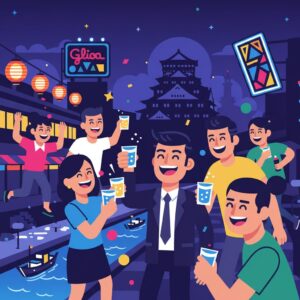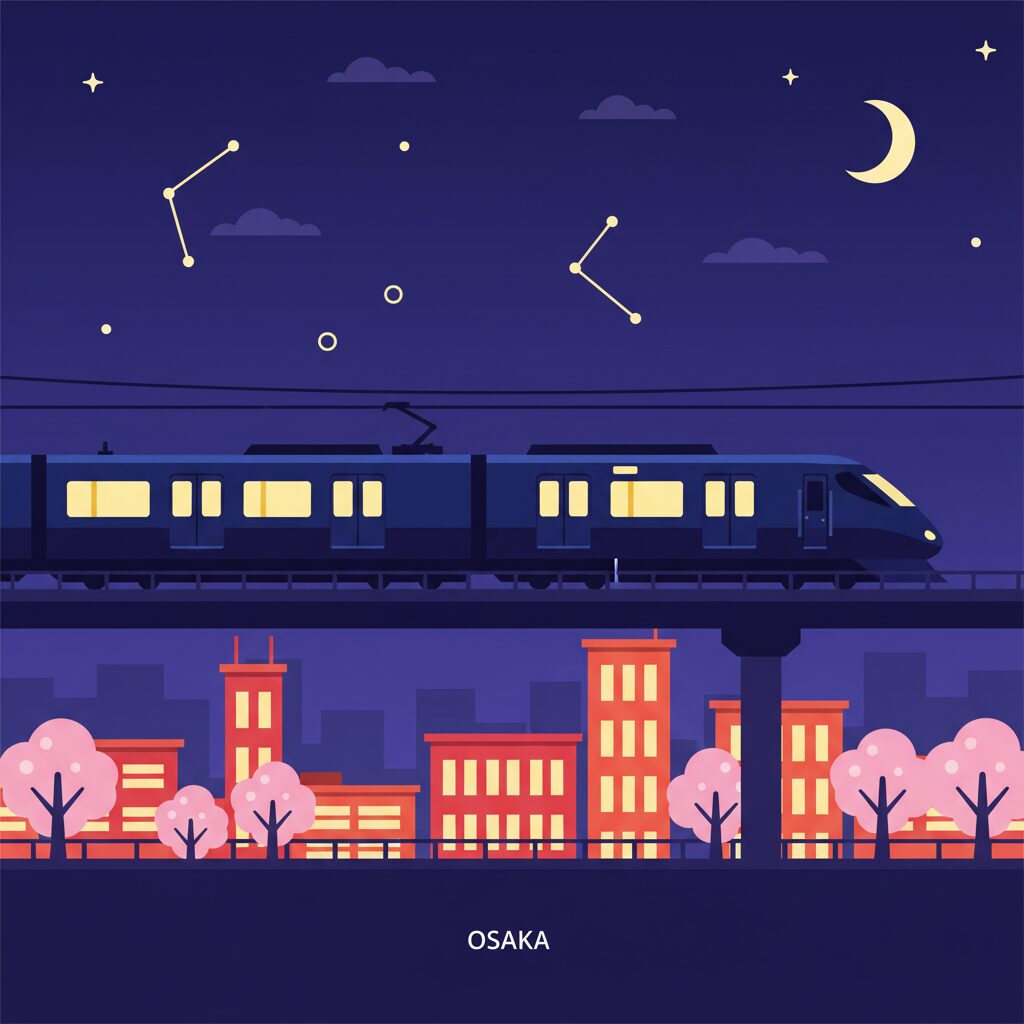
It happens like a switch being flipped. One minute, the izakaya is a warm, roaring sea of laughter, clinking glasses, and the sizzle of something delicious hitting a grill. The air is thick with smoke and stories, a comfortable chaos that feels like it could last forever. You’re deep in conversation, finally breaking through the pleasantries, getting to the good stuff, the real talk. Then, someone glances at their phone. A subtle shift in their posture. A flicker of anxiety in their eyes. A moment later, another phone is checked. A quiet murmur ripples through the group: “Nankai, nanji made?” (What time’s the last Nankai train?). Suddenly, the forever party has a very firm expiration date. The relaxed, sprawling energy of an Osaka evening snaps into a sharp, focused point. The ticking clock, which was silent moments ago, is now screaming. This is the prelude to the shuuden—the last train—and for anyone living in Osaka, this nightly drama is as fundamental to the city’s rhythm as the Dotonbori Glico sign is to its skyline.
For a newcomer, this sudden transformation is baffling. It feels abrupt, almost rude. Why is everyone suddenly obsessed with the time? Can’t we just get a taxi? The easy answer is no, not really. The real answer, however, is a window into the very soul of this city. The nightly rush for the last train isn’t just a commute. It’s a high-stakes economic decision, a social contract, and a nightly performance of Osaka’s most defining characteristics: its pragmatism, its communal spirit, and its unpretentious, get-it-done attitude. It’s a moment of truth where the city’s laid-back façade peels away to reveal the intricate, unwritten rules that govern life here. Understanding the shuuden is understanding Osaka itself, far more than any temple or castle ever could. It’s the city, stripped of its daytime courtesies, running on pure, unadulterated instinct.
This nightly rhythm is a world away from the city’s growing reputation as a luxury destination, highlighted by developments like the new Four Seasons hotel in Kyoto.
The Anatomy of the Rush: More Than Just a Commute
The last train is not just a singular event; it represents the climax of a story that starts hours earlier. Every social plan in Osaka is crafted with the final chapter—the shuuden—already in mind. It shapes the entire arc of the night, from the first beer to the last, frantic farewell.
The Ticking Clock: How the Shuuden Shapes Social Rhythms
In many Western cities, a night out is fluid, ending when the fun ends or when bars close. In Osaka, the night runs like a precisely tuned machine, timed down to the second by Japan Rail and private train schedules. When planning dinner or drinks, the first logistical question isn’t “Where should we go?” but “Which station do you use? And when is your last train?” This information dictates the entire geography and timing of the evening. Someone living on the Nankai Line can’t linger in Umeda as long as someone who only has a few stops on the Midosuji subway. An unspoken social calculus is always at work. Who has the earliest shuuden? They set the pace for the group. Honoring their departure time is a fundamental, tacit social rule.
This creates a unique social dynamic. Groups often engage in a series of frantic, staggered farewells. The first person bolts around 11:20 PM to catch a train to Nara. The next wave leaves at 11:40 PM for Kobe and Kyoto. Locals on the Osaka Loop Line might push it until midnight. The goodbyes aren’t a single drawn-out event, but a series of urgent departures. It’s a form of social triage. This reverse-engineering of the evening stems from deep-rooted pragmatism. It’s a shared understanding that everyone has a home, a bed to sleep in, and a budget to maintain. The fun is important but exists within the strict framework of public transport. There’s no point in one more drink if it costs an extra 8,000 yen and three hours of sleep. Every Osakan, from university students to department managers, makes this calculation nightly.
The Sprint Through the Labyrinth: Navigating Osaka’s Mega-Stations
The physical experience of the last train rush assaults the senses. Take Umeda Station, a place that feels less like a transportation hub and more like a subterranean city-state designed by someone with a cruel fondness for confusing signage. By day, it’s a bustling but manageable system. In the fifteen minutes before the last train, it turns into a rushing human river. The leisurely Osaka pace—the slow walk on the left side of escalators, the willingness to pause and chat—disappears entirely. It’s replaced by a singular, focused mission: reach the platform.
The soundscape shifts first. Ambient chatter is drowned out by the rhythmic pounding of thousands of leather-soled shoes and sneakers on polished granite. It’s an unrelenting, accelerating beat—the city’s frantic heartbeat before sleep. You learn to navigate with your whole body, sensing the crowd’s flow, anticipating eddies and currents around pillars and ticket gates. You weave, dodge, and make countless micro-adjustments to avoid collisions, all without breaking stride. Eye contact is a liability; you look ahead—to the gate, to the platform sign—your destination etched firmly in your mind. The air is a curious mix of department store perfume, stale cigarette smoke from a nearby喫茶店 (kissaten), and the sweet, greasy aroma of a takoyaki stand working overtime to catch the last wave of hungry commuters. It’s a frantic, desperate ballet, and every dancer knows their part.
Platform Politics: The Unspoken Rules of Engagement
Once through the ticket gates and on the platform, the energy shifts again. The mad dash becomes a tense, compressed wait. Here, the unspoken rules of Japanese society reveal themselves under pressure. People still try to form orderly lines, even if those lines bulge and warp. Yet there is subtle jockeying for position—a slight lean, a strategic bag placement to claim a few extra inches. This isn’t the time for typical Osaka friendliness. The man who offered you candy on the train earlier is now your silent rival for a spot on the impossibly crowded last car.
Still, there’s an odd solidarity in the tension. Everyone on the platform shares the same enemy—the relentless ticking clock—and the same goal. When the train finally arrives, doors opening with a pneumatic hiss, politeness briefly evaporates. There’s a surge, a compression of bodies both alarming and remarkably efficient. Gentle but firm pressure from behind propels you forward. A quiet “Sumimasen” (Excuse me) is the sole verbal exchange, a versatile word meaning anything from “Sorry for bumping you” to “Please let me through, or I’ll be spending the night in a manga café.” Packed tighter than you imagined possible once inside, a collective sigh runs through the car. The doors close, sealing you in. The battle is over. The train lurches forward, and the city’s tension finally begins to dissipate.
Osaka vs. Tokyo: Two Cities, Two Final Dashes
Every major city in Japan experiences a last train rush, but its flavor, texture, and very essence vary dramatically. This nightly sprint acts as a cultural Rorschach test, with the differences most striking between Osaka and Tokyo. How these two cities journey home at night reveals everything about how they live during the day.
The Energy of the Escape: Osaka’s Communal Panic
Osaka’s shuuden rush is, for lack of a better term, loud. It’s a performance brimming with sound and movement. As people run, silence is rare. You’ll hear frustrated grunts, shouted apologies, and breathless calls to friends urging, “Hurry up!” There’s a palpable sense of shared public drama. It feels less like millions of individual struggles and more like a singular, collective organism trying to get home. The panic is tangible but tinged with dark humor. You might spot a salaryman, tie askew, sprinting with his briefcase flailing, catching another commuter’s eye to share a wry grin. It’s a moment of connection amid the chaos, an acknowledgment of the situation’s absurdity. “Look at us, what a mess,” the glance says. “Let’s do it again tomorrow.”
This communal energy extends to interactions. Although pushing occurs, it feels less aggressive and more… pastoral. It resembles a farmer herding sheep, not an angry shove from a rival. If someone trips or drops their bag, hands immediately reach out to assist. The aim is to get everyone on the train because everyone on the platform is a fellow Osakan—a comrade in this nightly battle. An undercurrent of “We’re all in this together” prevails, a pragmatic solidarity that defines much of life here. The city’s renowned friendliness isn’t erased by panic; it simply takes on a more urgent, practical form.
Tokyo’s Silent Sprint: A Symphony of Efficiency
Tokyo’s last train rush is an entirely different spectacle. It is a masterpiece of silent, terrifying efficiency. If Osaka’s rush resembles a chaotic rock concert, Tokyo’s is a complex, high-stakes ballet performed in a library. The speed is often quicker, the focus sharper. But the defining trait is silence. The only noises are the squeak of shoes on the floor and the rapid electronic beeps of ticket gates opening and closing. No shouting, no grunting, no shared laughter. Each individual is an island of pure purpose, their movements economical and precise. They flow through the station like a school of fish—perfectly synchronized yet utterly disconnected.
This mirrors Tokyo’s broader social landscape. It’s a city that values polish, order, and the preservation of personal space (tatemae), even when that space is reduced to mere centimeters. The pushing is subtler—firm, unyielding pressure rather than chaotic surges. Eye contact is carefully avoided. Helping a fallen commuter feels like disrupting the system, breaking the flow. The mission is individual: I must board my train. The feeling is one of intense, private anxiety rather than shared public drama. It’s a colder, more isolating experience but, in its way, deeply impressive. It embodies a city governed by precision and unspoken rules, where individual responsibility rules supreme.
The Post-Rush Atmosphere
The moments following the closing of train doors reveal much as well. On an Osaka train, as it departs the station, the compressed tension immediately begins to ease. Someone might crack a joke about the crush. Sighs of relief ripple through the car. People adjust their clothes, check their phones, and the hum of conversation gradually returns. The shared ordeal has ended, replaced by camaraderie born of survival. In Tokyo, silence persists. The tension remains but shifts—from the anxiety of pursuit to the discomfort of forced proximity. Each person retreats into their own world, eyes fixed on their phones or the floor, meticulously rebuilding the personal bubble just breached. The ordeal concludes, yet the sense of isolation lingers until their stop. It’s a small detail, but one that speaks volumes about these two cities’ contrasting approaches to public and private life.
The Point of No Return: When You Miss the Last Train
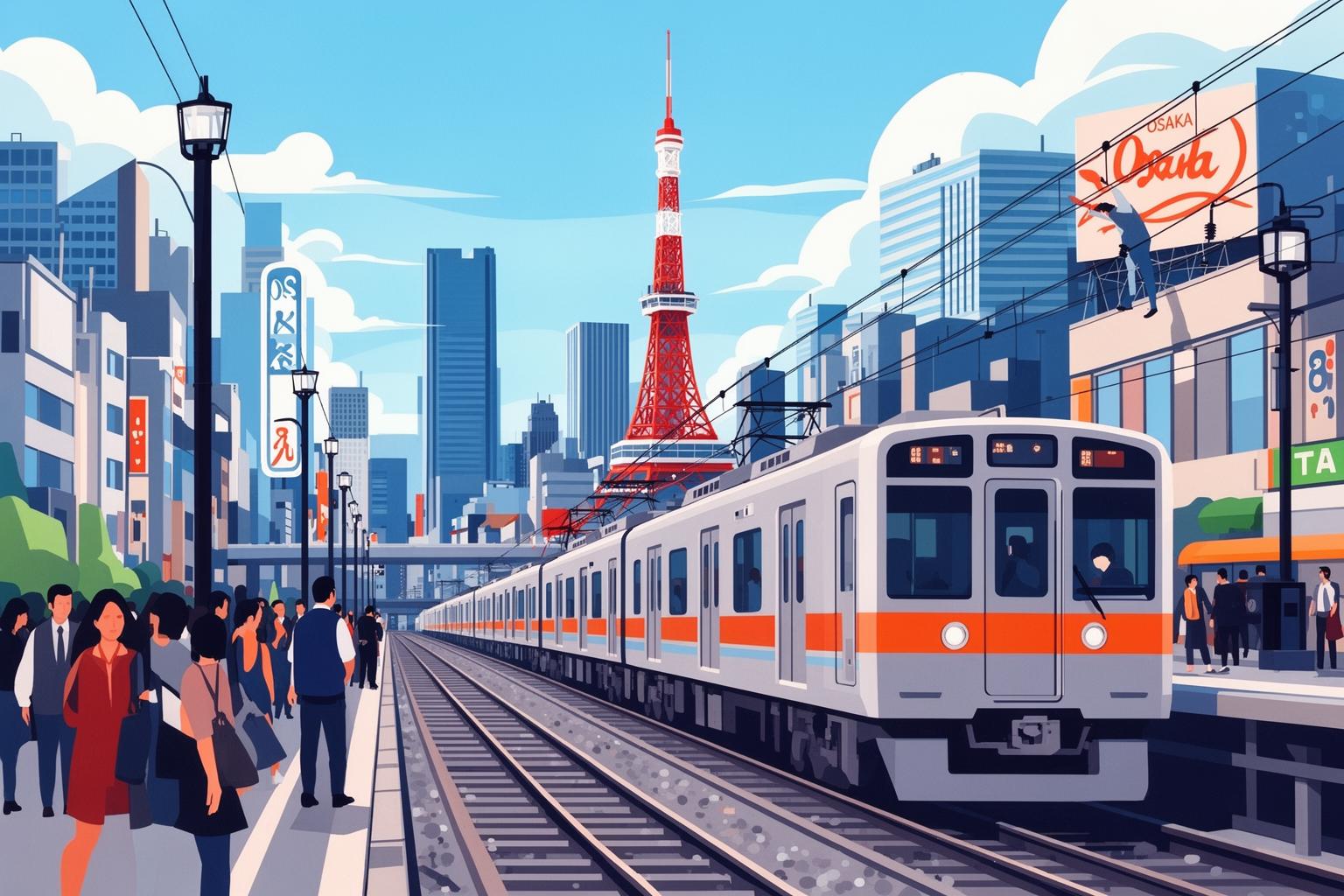
The entire frantic ritual of the shuuden rush exists for one simple reason: to avoid the dreaded alternative. Missing the last train isn’t just a minor inconvenience; it’s a logistical and financial disaster that throws you into a strange, nocturnal limbo. The city you knew just an hour earlier ceases to exist, and you become a refugee in a familiar place, forced to navigate a new set of rules and options.
The Financial Cliff: Why Missing the Shuuden is Such a Big Deal
To grasp the panic, you need to understand the cost of failure. Let’s be brutally practical. A train ride from Namba to a suburb like Sakai might cost 400 yen. A taxi covering the same distance after midnight, with the late-night surcharge, can easily run 10,000 yen or more. That’s not just an occasional expense. For most people, that’s a large portion of their weekly budget for food or entertainment. It’s the price of a very nice dinner for two, a new pair of shoes, or a weekend day trip. Wasting that amount of money because you misjudged the time by two minutes is, for the famously money-conscious Osaka sensibility, a cardinal sin. It’s simply bad business.
This isn’t about being cheap, a common and lazy stereotype about Osakans. It’s about being kenjitsu—practical and grounded. People here work hard for their money and want to spend it on things that bring value and joy: good food, good drinks, good times with friends. A taxi ride home is dead money. It’s a failure of planning, a penalty for carelessness. This economic reality is the engine behind the entire nightly drama. The sprint through Umeda station isn’t just about getting home to sleep; it’s about protecting one’s hard-earned yen from the black hole of a late-night taxi meter.
The Archipelago of the Stranded: Your Options After Midnight
So, you’ve missed it. You stand on the empty platform, the final red tail lights of your train disappearing into the tunnel. The cheerful station melody signaling departure now sounds like a funeral dirge. What next? Welcome to the archipelago of the stranded. Your task is to find a safe, affordable haven to wait on until the first train—the shihatsu—starts running around 5 AM.
The Capsule Hotel Experience: The classic, almost cliché option for the stranded salaryman. It’s not a fun tourist adventure; it’s a pragmatic solution. You pay a few thousand yen for a locker, a set of pajamas that never quite fit, and a fiberglass sleeping pod that feels like a cross between a bunk bed and an MRI machine. You share a communal bathroom and lounge with other men in the same predicament, all silently watching late-night TV. It’s clean, safe, and provides a horizontal surface to lie on for a few hours. But it’s also deeply anonymous and somewhat dehumanizing—a reminder that you’re no longer a person with a home, but human cargo being stored for the night.
The All-Night Izakaya or Karaoke Box: The path of denial, the “double down” strategy. The thinking is: “If I’m already stuck and failed to get home, I might as well keep the party going.” Many izakayas and karaoke spots offer all-night packages for a flat fee. You shift from someone trying to get home to someone committed to staying out. The atmosphere after 1 AM is surreal: a mix of genuinely energetic partiers and weary groups renting tables with drink bars as makeshift living rooms until dawn. In one karaoke room, you might hear a heartfelt, drunken 90s power ballad; in the next, dead silence as office workers try to nap on vinyl benches.
The Manga Kissa/Internet Cafe Sanctuary: Perhaps the most ingenious Japanese solution to this dilemma. For a relatively low price, you get a small private booth with a reclining chair, a computer, a blanket, access to a library of manga, and a free drink machine. It’s the budget option—less comfortable than a capsule hotel but better than sleeping on a park bench. The manga kissa after midnight is a fascinating cross-section of society: stranded commuters, students pulling all-nighters, freelancers working odd hours, and people who treat this as semi-permanent housing. It’s a quiet, private, surprisingly comfortable refuge where you can catch a few hours of broken sleep, charge your phone, and drink melon soda until sunrise. It serves as a crucial piece of social infrastructure—a safety net for the nocturnal city.
The Long Walk Home: The most ascetic choice—the path of the penitent. If you don’t live too far—say, within ten kilometers—you might decide to walk. This journey takes you into a different Osaka. The bustling, noisy metropolis you know vanishes, replaced by a silent, beautifully lit stage set. The only sounds are your footsteps, the hum of vending machines, and the rumble of occasional delivery trucks. The streets are empty except for a few other walkers, with whom you exchange silent nods, and taxi drivers circling like sharks. Convenience stores glow as beacons of warmth and life, offering hot coffee or a nikuman (pork bun) to fuel your steps. A long walk home at 3 AM is a strange and intimate experience. It lets you see the bones of the city, trace its arteries, and feel its scale in ways impossible from a train window. It’s a terrible way to end a night out—but an unforgettable way to experience Osaka.
What the Shuuden Reveals About the Osaka Mindset
This entire nightly ritual—from the pre-emptive planning to the frantic sprint and the potential overnight exile—is more than simply a transportation issue. It serves as a powerful lens through which to understand Osaka’s core values and unwritten social codes. It acts as a stress test that reveals the city’s true character.
Pragmatism over Polish: The “Shikata ga nai” Mindset
At the heart of Osaka’s mindset lies a deep-rooted pragmatism. It’s a city that prioritizes what works over what appears refined. While Tokyo may focus on elegance, order, and maintaining a polished surface (tatemae), Osaka is all about results. This attitude is perfectly exemplified in the approach to the last train. The rush is messy, chaotic, and undignified—but it’s efficient. It gets the job done. This reality is widely accepted with a collective shrug summarized by the phrase shikata ga nai—it can’t be helped. This is how the system works, these are the rules, so we adapt and make it work.
This pragmatic approach extends to what happens after missing the train. There’s less shame or frustration and more a practical acceptance: “Well, that happened. What’s the most logical next step?” Choosing to stay in a capsule hotel or manga kissa isn’t seen as a personal failure, but a practical solution to a logistical challenge. This is the renowned Osaka rationalism—a mindset that seeks the most direct and efficient path, whether in business negotiations or finding a place to sleep for a few hours. There’s no room for pretense when the alternative is a 10,000 yen taxi fare. This blunt honesty, focused on the bottom line, can sometimes be misunderstood by outsiders as harsh or rude, but it stems from practicality, not ill will.
Community in Chaos: The “We’re All in This Together” Spirit
There’s a cliché that people from Osaka are friendly. Like all clichés, it’s an oversimplification. The friendliness isn’t constant or effusive; rather, it’s a practical camaraderie that arises when people share a common goal or struggle. The shuuden rush is a perfect example. Amid the chaos, the pushing, and the running, there is an undercurrent of community. It’s the shared exasperated glance, the helping hand when you fall, the collective hold of breath as the doors close. It’s a temporary suspension of personal boundaries for the sake of a common objective.
This contrasts with Tokyo, where the struggle often feels more individualistic. In Osaka, there is a feeling that the city is a living entity and its inhabitants are all on the same team, even while competing for a spot on the train. This attitude stems from Osaka’s long history as a merchant city, where reputation and cooperation were invaluable assets. You might haggle fiercely over price, but with respect and understanding. Similarly, you might push past someone to board the Hankyu line, knowing they would do the same to you, with no hard feelings. It’s simply part of the game.
The Calculation of Fun: Balancing Work, Play, and Economics
The drama of the last train embodies a constant, complex calculation that shapes daily life for many Osakans: balancing enjoyment and economic reality. Osakans are known for loving a good time—they are loud, enthusiastic eaters and drinkers, and their city boasts a lively nightlife. Yet they also have a reputation for being savvy with money. The shuuden serves as the nightly crossroads of these defining traits.
Every decision to have one more beer, to share one more story, is measured against the clock. “How much is this extra 15 minutes of fun worth to me?” “Is this conversation worth risking a 5,000 yen taxi fare?” This is not a cynical mindset, but a practical one focused on maximizing value. The goal is to get the most fun and social connection possible while staying within the limits of the transportation budget. It’s a nightly game of brinkmanship played out in thousands of bars and restaurants across the city. Catching the train at the last possible moment is a victory—it means you’ve perfectly balanced the equation. This constant, near-subconscious cost-benefit analysis is a core aspect of the Osaka worldview, influencing everything from grocery shopping to closing business deals.
A Foreigner’s Guide to Surviving (and Understanding) the Midnight Run
For a non-Japanese resident, the last train rush can be an intimidating, confusing, and stressful experience. The unspoken rules, physical intensity, and sudden social shifts can feel alienating. However, understanding the context behind the chaos can turn it from an ordeal into a fascinating cultural lesson.
Common Misunderstandings: It’s Not Rude, It’s Necessary
The biggest misunderstanding foreigners have about the shuuden is interpreting the behavior as personal. When your friend suddenly says, “I have to go, now!” and rushes away without a lengthy goodbye, it’s not because they are bored or upset with you. They are simply responding to a strict logistical deadline. The abruptness signals urgency, not rudeness. Likewise, the pushing in the station is not aggression. It’s a necessary, if unpleasant, part of moving a massive crowd through a confined space in a short time. It’s a physical expression of the collective shikata ga nai.
To live here means accepting that your social life is tied to the train schedule. It’s a structural reality of the city. Complaining about it is like complaining about the rain. Locals don’t see it as a flaw in the system; they see it as a condition within which they live. Learning to view it this way is crucial to acculturating to life in Osaka. It’s not bad or good—it just is.
How to Navigate Like a Local
Surviving the shuuden rush is a skill that can be learned. The first rule is preparation. Before leaving your apartment, know the time of your last train home. Not only the last train on the main line but also on any connecting local lines you need to take. Use apps like Jorudan or Google Maps to plan your route in reverse. Let the people you’re with know when you need to leave. This isn’t rude; it’s responsible.
When the time comes, move with purpose. Walk briskly, keep left, and stay aware of your surroundings. In the station, follow the main flow of traffic. Don’t stop suddenly in a crowded corridor to check your phone. On the platform, read signs to ensure you’re in the right spot for your car type (e.g., Express, Local). Have your IC card or ticket ready—fumbling at the gate wastes precious seconds. Most importantly, don’t take it personally. You are a fish in a vast river; your job is simply to keep swimming in the right direction.
Embracing the Aftermath: The Zen of Missing the Train
Eventually, it will happen. Despite your best efforts, you will miss the last train. It’s a rite of passage for every city resident. While your first response might be panic and frustration, try to reframe the experience. Missing the shuuden is not failure; it’s an opportunity. It offers a chance to see the city in a way day-trippers and casual tourists never will.
It grants you a temporary passport to the nocturnal city. You’ll discover the quiet charm of the Shotengai (shopping arcade) after the shutters close. You might have a meaningful conversation with a stranger at 3 AM in a 24-hour ramen shop, united by your stranded situation. You’ll learn the simple, profound comfort of a warm can of coffee from a vending machine on a deserted street. Missing the train forces you to slow down, improvise, and engage with the city on its own terms. It’s a story you’ll share for years. It’s the night you stopped being just a visitor and began to understand what it truly means to live in Osaka—a city that runs on a tight schedule but always has a backup plan for those left behind.