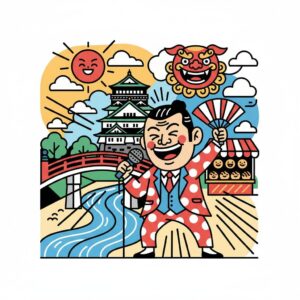
So, you’ve moved to Osaka. You’ve found an apartment in a quiet neighborhood, maybe somewhere in Tennoji or a leafy side street in Kita-ku. You’re navigating the grocery store, figuring out the labyrinthine train system, and generally feeling pretty good about your new life. Then, one morning, as you’re fumbling with your keys, a woman with a tight perm and a brightly colored blouse slows her squeaky mamachari bicycle to a halt. She looks you up and down, not unkindly, but with an intensity that feels like a full-body scan. “You’re the new person in 302, right?” she states, not asks. “From America?” Before you can fully process the question, she continues, “Make sure you put your burnable trash out on Tuesday and Friday mornings. Not the night before. The crows will get it. And the little shop at the corner has the best daikon today. Only 90 yen.” She then hands you a small, hard candy from a seemingly bottomless pocket, gives a decisive nod, and pedals away, leaving you blinking in the sunlight, a piece of pineapple-flavored candy in your palm and a profound sense of bewilderment. Welcome to Osaka. You’ve just had your first encounter with the Obachan Network.
For anyone coming from the polite, measured distance of Tokyo, or the individualistic societies of the West, this experience can be jarring. Who was that woman? How did she know your apartment number? Why does she care about your trash habits and vegetable shopping? This isn’t just a nosy neighbor. This is your induction, whether you know it or not, into one of the most powerful and misunderstood social structures in urban Japan. The Obachan Network is the city’s unofficial operating system, an invisible web of information, social control, and mutual support run by the middle-aged and elderly women of Osaka. They are the gatekeepers of neighborhood knowledge, the enforcers of local customs, and the guardians of a community spirit that feels like a relic from a different era. To dismiss them as just loud, leopard-print-clad ladies is to fundamentally misunderstand the city you’ve chosen to live in. They are the living, breathing soul of Osaka’s residential streets, and learning to decode their language and behavior is the key to truly living here, not just residing. This network is the deep tissue that holds the city’s neighborhoods together, a stark contrast to the more anonymous, transient feel of many Tokyo districts. Understanding this system is understanding the real Osaka, far from the tourist-trodden paths of Dotonbori. It’s the difference between being a temporary guest and becoming part of the local fabric.
This intricate social fabric, where a simple piece of candy can forge a connection, is a perfect example of the “Ame-chan” philosophy that weaves together neighborhood life in Osaka.
Beyond the Leopard Print: Defining the Osaka Obachan

Before analyzing the network, we must first understand its agents. The term ‘obachan’ (おばちゃん) literally means ‘auntie’ or ‘middle-aged woman,’ but in Osaka, it signifies much more. It’s less about age and more about social rank, attitude, and a fully formed identity. A woman in her late thirties can be an obachan, while a shy seventy-year-old might never attain the status. It is earned, not given, through a powerful mix of confidence, pragmatism, and a total disregard for the polished social pretenses, or tatemae, that dominate much of life elsewhere in Japan, especially Tokyo. The quintessential Osaka obachan operates on a level of pure honne—genuine feelings and straightforward speech. She says what she means and expects you to do the same.
The Uniform of a Social General
The common image of the Osaka obachan—the leopard print, vivid purples and reds, the practical yet stylishly coiffed perm—is often played for humor. But to see it merely as a caricature misses the point. This isn’t a fashion mistake; it’s a uniform. It is a bold, unapologetic declaration of presence. In a society where women, particularly as they age, are often encouraged to fade into the background, the Osaka obachan refuses to go unnoticed. The leopard print isn’t just a pattern; it’s a statement of vitality and a subtle sign of a sharp instinct for bargains. The bright colors make sure she’s seen and acknowledged on the street, in the market, everywhere. It’s a visual reflection of her personality: impossible to overlook and full of energy.
Her accessories are selected not just for looks but as practical tools for managing her territory. The trusty mamachari—the ubiquitous, sturdy Japanese bicycle with a front basket—is her chariot. It’s more than transportation; it’s a mobile command center, enabling quick trips to the supermarket during sales, casual neighborhood patrols, and carrying large loads of groceries, gossip, and sometimes a grandchild. The rolling shopping cart, often in cheerful plaid, serves a similar function, acting both as storage and a portable seat for spontaneous chats with fellow network members. Every part of her appearance and gear is designed for efficiency, presence, and a life lived on the front lines of community management.
The Currency of Connection: Ame-chan
Arguably the obachan’s most iconic tool is the ame-chan, or candy. Outsiders are often surprised when a total stranger, after a brief exchange, hands them a small wrapped candy. It can seem random, even childlike. But the ame-chan is a sophisticated social tool. It serves as a conversation starter, a de-escalation device, and a gesture of goodwill all at once. Offering an ame-chan immediately breaks down barriers. It’s a small, harmless gift that says, “We’re connected now. We belong to the same community.” It softens the bluntness of their questions, sweetening what might otherwise feel like an intrusive interaction. When an obachan gives you an ame-chan, she’s not just giving candy. She’s giving a token of acceptance, a small gateway into the local network. It’s a deeply Osakan gesture, blending practicality (a little sugar boost) with a profound desire to build and sustain human connections in the most direct way possible. To refuse it is not just to decline candy; it is to reject the connection itself.
The Network in Action: Information is Power
The Obachan Network operates as a hyper-local, analog counterpart to the internet. It is a peer-to-peer system for exchanging crucial information with remarkable speed and accuracy. The currency of this network isn’t money; it’s data. Who has moved into the vacant apartment on the third floor? What time does the new bakery open, and are its melon pans worth the price? Why was there an ambulance outside the Tanaka residence last night? Is the Suzuki family’s son studying adequately for his exams? This information isn’t typically gathered for malicious gossip but is collected, organized, and shared to maintain community stability and provide support where needed.
The Human Google: Unmatched Local Expertise
For any practical questions about daily life in Osaka, this network is a more dependable source than any search engine. If you need to find a doctor who speaks some English, a plumber who charges fairly, or a place that can repair your worn-out shoes, your first step should not be to pull out your phone. It should be to locate the nearest obachan. They possess a deep, nuanced understanding of the local economy built over decades of experience. They know which butcher might give you a little extra for free if you chat with him, which vegetable stand offers the freshest produce on certain days, and which dry cleaner can actually remove a stubborn stain. Their recommendations aren’t based on paid reviews or flashy advertising but on years of empirical testing and word-of-mouth validation from other trusted obachan.
A positive review from the network can make a small, family-run business flourish. A negative consensus can quietly doom it. This influence makes them the de facto arbiters of quality and trust in the neighborhood. For newcomers, tapping into this knowledge base is an invaluable shortcut. Asking for advice shows respect and acknowledges their expertise. When you ask an obachan, “Where can I get the best takoyaki around here?” you aren’t just asking about food—you’re requesting access to the local knowledge loop. The detailed, layered response you get will likely include not only the best place but also the second-best, the cheapest, the one that’s open late, and a personal story about the owner.
Nodes and Hubs: The Network’s Points of Connection
This rapid flow of information doesn’t occur in isolation. It takes place in specific physical locations that act as the network’s servers and routers. The primary hub is the shotengai, the covered shopping arcade that forms the commercial and social backbone of many Osaka neighborhoods. Here, during their daily shopping rounds, obachan meet, pause for spontaneous conversations, and exchange vital intelligence. A quick chat while picking tomatoes at the greengrocer’s, a longer discussion over tea at a dusty kissaten, or a shouted exchange from across the arcade—these are the moments when data packets are shared.
Other important nodes include the local sento (public bath), where conversations flow freely in the steam-filled rooms; the supermarket, especially during timed sales (taimu seru); and even benches in the local park. These are the stages of community life. By simply observing interactions in places like the Tenjinbashisuji Shopping Street, you can see the network in action. You’ll witness rapid-fire exchanges in thick, expressive Osaka-ben, knowing nods, and animated hand gestures. It’s a highly efficient system, built over decades of familiarity and trust. Within these public yet intimate spaces, the neighborhood’s collective consciousness is formed and updated, one conversation at a time.
The Social Fabric: Keepers of the Community Flame
The Obachan Network’s role goes well beyond simply acting as information brokers. They serve as the main weavers and menders of the local social fabric. In a world that is becoming increasingly transient and digital, they offer a strong, grounding source of analog connection. They carry out many vital community functions—often without recognition or any official title—that are crucial for transforming a neighborhood from just a group of buildings into a true home.
The Unspoken Rules and Their Enforcers
Every community has its rules, but in Japan, many of the most important ones remain unspoken. In Osaka, the obachan are the ones who vocalize them. Loudly. They are the frontline enforcers of neighborhood norms, especially when it comes to the intricate practice of garbage disposal. If you put your plastic bottles out on a burnable trash day, unlike in Tokyo where you might receive a polite, anonymous note in your mailbox, in Osaka you will get a direct, face-to-face lecture from an obachan who noticed your mistake from her kitchen window. She will explain your error, show you the correct method, and check on you again the following week. Though it might feel embarrassing, it’s remarkably effective.
This hands-on intervention extends to various minor social missteps: parking your bicycle in a way that blocks the pathway, playing music too loudly, or neglecting to trim the weeds in front of your home. This isn’t about exerting control; it reflects a deeply held belief in shared responsibility for the community’s well-being and appearance. They uphold the wa (harmony), but with a distinctly Osakan straightforwardness. When they spot a problem, they address it immediately and personally. Their vigilance ensures that the unwritten social contract of living in close proximity is respected by all, fostering a safer, cleaner, and more predictable environment for everyone.
The Neighborhood’s First Responders
In everyday small crises, obachan are often the first to appear. If a child trips and scrapes a knee, an obachan will suddenly show up, equipped with a bandage, a disinfectant wipe, and, naturally, a soothing ame-chan. If someone looks lost or struggles with heavy bags, an obachan is most likely to stop and help—often offering directions that quickly turn into a warm conversation about where you’re from and what brought you to Osaka. They act as the neighborhood’s eyes and ears, an informal watch program.
This protective instinct is a strong source of ambient safety. They understand the neighborhood’s rhythms and notice when something is off—a newspaper left untouched, a stranger lingering unusually. They take collective responsibility for the neighborhood’s children, keeping close watch as they play or walk home from school. This gives a tangible sense of security. While Tokyo’s safety may stem from strict orderliness and public surveillance, Osaka neighborhoods feel secure because you know, on a deeply personal level, that someone is always looking out for you. It’s a distinct, more human-centered approach to community safety.
Navigating the Network: A Guide for the Foreign Resident
For a foreigner moving into an Osaka neighborhood, the Obachan Network can feel intimidating. Their directness may be mistaken for rudeness, and their intense curiosity might come across as an invasion of privacy. However, understanding their intentions and learning how to interact with them is one of the most valuable skills you can develop for a happy and integrated life in the city. Aligning yourself with the network can provide a support system you never realized you needed.
Your Initiation and the Art of the Greeting
Your first meaningful encounter with the network will probably resemble an interrogation disguised as a friendly conversation. You’ll be asked questions that might seem shockingly personal by Western standards: “Are you married?” “What do you do for work?” “How much is your rent?” “Why are you living alone?” It’s important to recognize that this is not mere nosiness. It’s a data-gathering process. The obachan is trying to locate you on the neighborhood’s social map. She needs to understand your situation to determine your role in the community and what kind of support, or oversight, you might require. Respond honestly and cheerfully. This openness is the first step to building trust.
The most crucial thing you can do is master the neighborhood greeting. A clear, confident “Ohayo gozaimasu” (Good morning) or “Konnichiwa” (Hello) when you see an obachan on the street is essential. In Tokyo, it’s common to simply nod or pass by silently. In Osaka, this behavior is seen as cold and suspicious. A proper greeting acknowledges their presence and affirms your place in the community. It costs nothing but carries great social value. It signals that you are approachable, friendly, and willing to engage in local customs. It’s the daily password that keeps you in good standing with the network.
Earning Your Place and Reaping the Rewards
Once you’ve passed the initial screening, you can strengthen your position by showing respect for their role. Ask for their advice. It can be something simple: “Where can I buy a good kitchen knife?” or “Do you know when the cherry blossoms will be at their best in the local park?” This gesture of deference affirms their expertise and deepens your connection. Listen to their advice, and if possible, follow it and report back. “Thank you for telling me about that butcher! The pork was delicious.” This completes the exchange and shows that their knowledge is appreciated.
Once accepted, the benefits are real and deeply gratifying. Your obachan allies will watch over your apartment when you’re away. They might share extra stew they made (osusowake), or drop off vegetables from their small garden. They will help you avoid social missteps and guide you through the complexities of neighborhood life. You gain a fierce protector and a source of invaluable local wisdom. You are no longer the anonymous foreigner in apartment 302 but become “that nice young person who always says good morning.” In a city of millions, this shift from anonymity to belonging is a truly remarkable gift.
The Roots of the Network: An Osakan Legacy
The Osaka obachan and the network she leads are not a recent development. They represent the living history and culture of the city, shaped by commerce, resilience, and a profound distrust of centralized authority. Grasping these historical foundations is essential to understanding why this social system flourishes in Osaka but not in Tokyo.
The Merchant’s DNA: Pragmatism and People Skills
From its earliest days, Osaka was Japan’s commercial hub, known as the “nation’s kitchen.” While Edo (Tokyo) served as the rigid, hierarchical seat of the samurai government, Osaka thrived as a city of merchants, artisans, and negotiators. Success here was based not on birth or status, but on shrewdness, practicality, and strong relationship-building. Women in merchant families often played a key role, managing finances and dealing directly with customers. They cultivated a culture of straightforward communication, tough bargaining (nedogiri), and an emphasis on genuine, tangible value.
This legacy is clearly seen in the modern obachan. Her drive to secure the best price, her pragmatic, no-nonsense attitude toward problems, and her expertise in managing relationships all trace back to this merchant heritage. She values honesty, good value, and warmth over pretense or elegance. From an Osakan viewpoint, Tokyo’s focus on formality and subtlety can feel inefficient and insincere. The obachan’s directness embodies efficiency and honesty—a tradition born in a city shaped by trade rather than protocol.
Resilience in the Face of Hardship
Osaka has been devastated several times throughout its history, most notably during the World War II firebombings. In the recovery period, tight-knit communities, bound by the strength of their women, led the rebuilding efforts. With resources limited and official aid slow, survival relied on mutual support and local organization. Neighbors shared food, cared for each other’s children, and exchanged information to locate scarce goods. Networking, resource management, and community care were vital survival skills, not merely social niceties.
Today’s Obachan Network is a peacetime evolution of this post-war survival system. The strong focus on neighborhood welfare, the instinct to assist during crises, and the shared belief that everyone must work together all reflect those tougher times. The women who lead these networks are the heirs of a tradition of remarkable resilience. They carry forward a community spirit forged in adversity and handed down through generations. Although the challenges have evolved, the core principle remains unchanged: a united community is the best safeguard against life’s uncertainties.