When I first moved from Tokyo to Osaka for a long-term event planning project, I packed my assumptions right alongside my sweaters. Tokyo life had hardwired my brain for a certain kind of rhythm. Weekends were for decompression, sure, but that decompression was a scheduled event. It was a reservation at a chic café in Omotesando, a solo trip to a gallery in Roppongi, or a meticulously planned day trip to Hakone to escape the city entirely. It was about curating an experience, about carving out a pocket of serene, Instagrammable silence from the urban cacophony. My goal was always to get away, to disconnect, to recharge in a space I had chosen for its specific aesthetic or purpose. The city was something to be consumed in curated bites or escaped altogether.
Then I saw my Osaka colleagues doing something… different. Friday would roll around, and the talk wasn’t about reservations or train tickets. It was simpler. Someone would say, “Right, I’m off to the bath,” with the same casual finality as someone announcing they were going home. Later, I’d see a photo on their social media—not of a pristine art installation, but of a glistening glass bottle of fruit milk and a plate of gyoza at a place with fluorescent lights and a greasy menu taped to the wall. They called this their “mini-trip.” A trip? It looked like they’d walked three blocks. This wasn’t escape. This was a deep dive right back into the heart of the neighborhood they lived in. It was a ritual I couldn’t initially parse: a public bath, a sentō, followed by a meal at a neighborhood diner, a shokudō. This simple, almost mundane combination, they insisted, was the ultimate weekend reset. It was confusing. It lacked the ambition of a Tokyo weekend. It felt too… ordinary. But as I soon learned, in Osaka, the ordinary is where the magic is stored. This ritual isn’t just about getting clean and getting fed. It’s a social sacrament, a psychological reset button, and the clearest window I’ve ever found into the true soul of this city. It’s the key to understanding why life in Osaka feels fundamentally different, more grounded, and in many ways, more connected than anywhere else in Japan.
This grounded, connected feeling is a hallmark of Osakan life, much like the city’s unique approach to spiritual weekend retreats.
Deconstructing the “Weekend Trip”: Why a Bath and a Meal is More Than It Seems
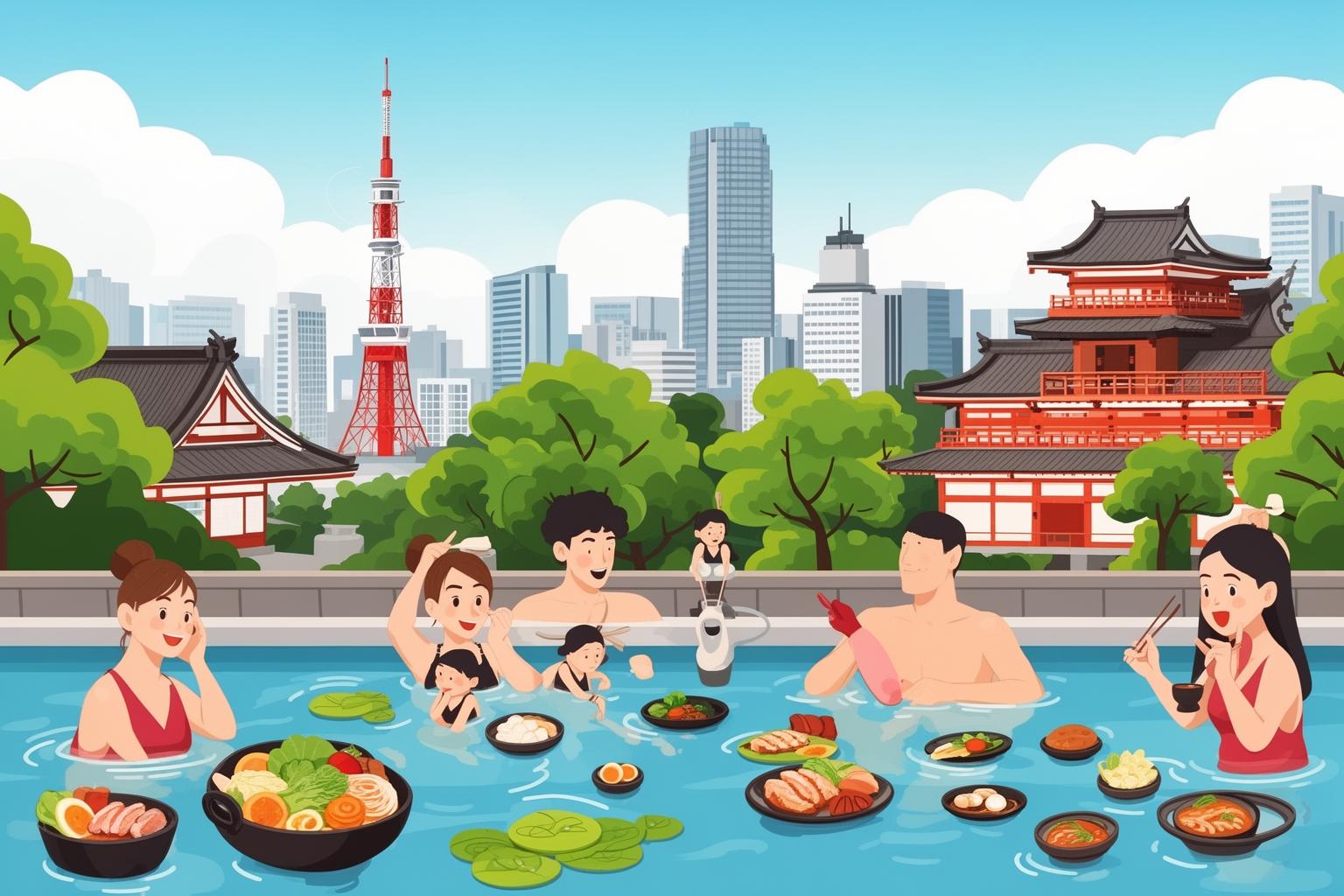
To truly understand what’s going on here, you need to dismantle the Tokyo-centric notion of what a “refresh” means. In the capital, rejuvenation is often a transaction: you pay for a yoga class, buy a museum ticket, or purchase a coffee that costs as much as a full meal elsewhere. These are worthwhile activities, but they’re fundamentally individualistic and consumption-based. You are the customer, receiving a service or experience. If social interaction occurs, it tends to be polite, distant, and limited to the person you arrived with. The Osaka sentō-shokudō ritual completely reverses this dynamic. It’s not about consumption; it’s about participation. It’s not about solitude; it’s about ambient community.
The Psychology of the Reset Button
The magic starts with the profound psychological shift the sentō imposes on you. A Tokyo weekend might involve seeking calm amid the noise, scrolling through your phone while sipping a latte. The sentō offers no such compromise. It draws a firm physical and mental boundary between your workweek and weekend, between your public persona and private self. The moment you slide open that old wooden door and step inside, you enter a different realm. No laptops, no phones, no worries or to-do lists are allowed in the steaming, echoing bathhouse. You are required to disconnect.
This enforced mindfulness is the first layer of the reset. The sensory input is overwhelming in the best sense: the scent of cedar and steam, the splash of water echoing around you, the low murmur of conversations, the tiled floor beneath your feet. It’s a total environmental immersion. Your brain, accustomed to the constant digital alerts of modern life, has no choice but to surrender to the present moment. This isn’t the fragile, curated calm of a minimalist Tokyo cafe; it’s a robust, earthy peace that sinks into your bones. The ritual also involves shedding your identity. This is the true meaning of the Japanese phrase hadaka no tsukiai, or “naked communion.” Though it exists throughout Japan in theory, in Osaka it feels less like a philosophical ideal and more like a practical reality. In the bath, no one knows or cares if you’re a department manager, student, or shop owner. Your suit, uniform, or carefully selected brand clothes lie crumpled in a wicker basket in another room. Freed from these social markers, you’re just another body, another neighbor. This profound equality is deeply relaxing. The social pressures of hierarchy and performance, so strong in Japanese society, dissolve in the steam. You are free simply to exist.
The Sentō: Not a Spa, But a Community Living Room
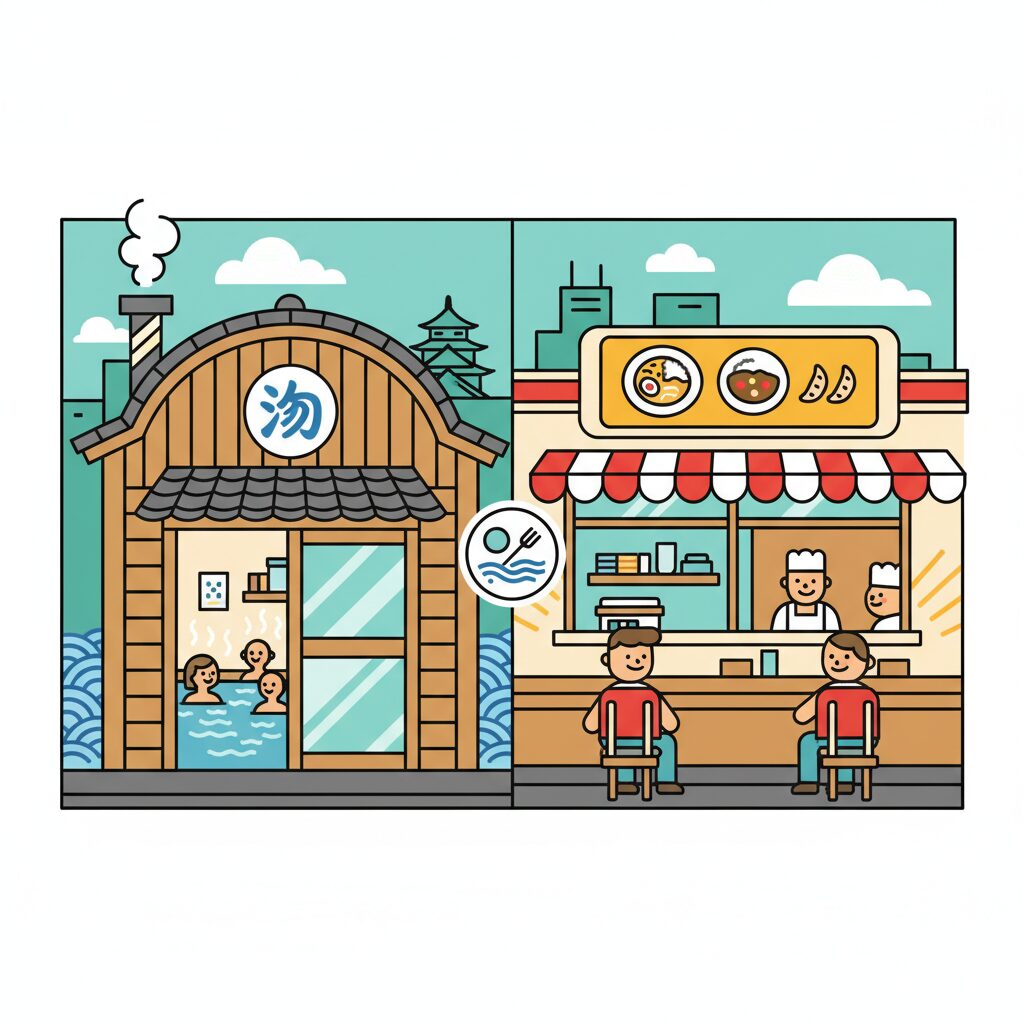
It is important to understand that a neighborhood sentō is not a modern spa. A foreigner might picture something sleek and minimalist, with aromatherapy and meditation rooms. This couldn’t be further from the truth. A classic Osaka sentō is a glorious, often slightly ramshackle monument to a bygone era. Its architecture itself makes a statement. Many feature a grand, temple-like karahafu gabled roof, proudly asserting their importance to the neighborhood. The entrance is marked by a cloth noren curtain, often bearing the character ゆ (yu) for hot water. Pushing it aside feels like stepping back in time.
Inside, the first stop is the getabako, rows of small wooden lockers for your shoes, each secured with a long wooden block key. Then comes the datsuijo, the changing room, the sentō’s social nerve center. Far from a quiet, private space, it’s a lively hub of activity. Elderly men and women (in gender-separated sections, of course) chat and toweling off with practiced ease. There’s usually a large, old-fashioned analog scale that people step on and off, announcing their weight with a grunt of satisfaction or a sigh of mock despair. A vintage massage chair might rattle in a corner, and almost certainly a television is mounted high on the wall, forever tuned to a baseball game (usually the local heroes, the Hanshin Tigers) or a lively comedy show. People shout advice at the screen, groan at bad plays, and share collective laughter. It’s, in every sense, a communal living room.
The bathing area itself is a study in functional bliss. Before even thinking about entering the tubs, you must perform the essential ritual: take a small plastic stool and basin, find a spot at the rows of faucets, and wash yourself thoroughly. This is the cardinal rule. The tubs are for soaking, not cleaning. It’s a powerful, unspoken contract of mutual respect in shared space. Once clean, you can explore the tubs: the main tub, usually blistering hot — the atsuyu; a jet bath or denki buro (electric bath), uniquely jarring but beloved in Osaka, that sends a low-voltage current through the water; and always a cold plunge pool, the mizuburo. The cycle of hot, cold, hot, cold is the physical core of the rejuvenation process, leaving your body loose, warm, and utterly relaxed.
The Social Fabric of Steam and Soy Sauce
The true essence of the sentō-shokudō ritual lies not only in the physical sensations but also in the intricate social fabric woven throughout the entire experience. It is a place where the famously reserved Japanese society becomes unexpectedly and beautifully public. Here, the subtle distinctions between Osaka and other Japanese cities, especially Tokyo, come sharply into focus. In Tokyo, public spaces are often just transit points—moving from place A to place B with minimal interaction—while in Osaka, public spaces serve as stages for daily life to be performed, observed, and shared.
“Maido!”: The Unspoken Language of the Neighborhood
The phrase you’ll hear repeatedly is “Maido!” This classic Osaka greeting is a shortened, informal form of “maido arigatou gozaimasu” (thank you for your continued patronage). But it’s more than a simple hello or thanks; it’s an acknowledgment of belonging. It means “I see you, you’re one of us, welcome.” You’ll hear it from the bandai, often an elderly woman seated on an elevated platform overseeing both the men’s and women’s changing rooms. The bandai is the heart of the sentō, handling your money, selling soap and shampoo, and acting as the neighborhood’s unofficial information hub. She knows who is ill, whose daughter recently had a baby, and who’s been overworking. A quiet nod from the bandai signals acceptance.
The conversations you overhear in the bath are the community’s lifeblood. They’re not profound or intellectual, but the everyday stuff of life. Two elderly men might debate a sumo wrestler’s strengths, while a group of women discuss the rising price of daikon radishes at the market. Someone might good-naturedly complain about their boss. This low-stakes, ongoing exchange binds the neighborhood together. You learn more about local sentiment in twenty minutes of soaking than a week of reading newspapers. For a foreigner, this environment can feel intimidating at first, but the key is understanding that you’re not expected to perform. You’re simply expected to share the space respectfully. Listening is participating. Your quiet presence becomes part of the ambient social hum. Over time, a nod turns into a simple greeting, and a greeting may develop into a brief chat about the weather. This is how you gradually and naturally become woven into the neighborhood’s fabric—a stark contrast to the polite anonymity of a Tokyo apartment building, where you might live for years without ever learning your next-door neighbor’s name.
The Shokudō: The Second Act of the Social Play
The ritual doesn’t end when you leave the sentō. The second act is just as vital. Feeling utterly clean, your skin tingling and muscles limp as noodles, you step out into the cool night air. This transition is a moment of pure bliss. You’re floating, physically and mentally light—and hungry. Not just ordinarily hungry, but experiencing a deep, honest craving for something simple, savory, and satisfying. Just a few doors down, with warmly glowing windows, stands the shokudō.
A shokudō is not a restaurant in the way non-Japanese might imagine. It’s not a place for dates or special occasions. It’s literally a public dining room, an extension of the neighborhood’s collective kitchen. Nearly always family-run and passed down through generations, its decor is unapologetically functional: a well-worn wooden counter, a few simple tables, walls plastered with handwritten menus on yellowing paper, and a calendar from the local sake distributor. The menu is a hall of fame of Japanese comfort food, or washoku. There’s a teishoku (set meal) section offering dishes like grilled mackerel (saba shioyaki), pork cutlet (tonkatsu), or fried chicken (karaage), each served with a bowl of rice, miso soup, and pickled vegetables. Bowls of udon and soba will be available, and in winter, a simmering pot of oden. This is not innovative cuisine—in fact, it’s quite the opposite: culinary bedrock, reliable and deeply comforting. It’s the taste of home, ofukuro no aji (mom’s flavor), designed for those living alone or too tired to cook.
The atmosphere continues the sentō’s communal spirit. A television plays the same baseball game or comedy show. The owner, often a gruff but kind man in an apron, shouts orders to his wife in the kitchen. The air is thick with the scents of dashi, soy sauce, and frying oil. It is a symphony of the everyday, where the social aspect of the ritual reaches its vibrant crescendo.
The Osaka Difference: Practicality, Proximity, and Performance
The sentō-shokudō culture feels so inherently Osakan that it’s difficult to picture it flourishing with the same vigor anywhere else. It’s a perfect blend of the city’s distinctive urban layout, its economic mindset, and its dramatic style of communication. Together, these elements create a ritual that is not only enjoyable but integral to the daily rhythm of life.
Why This Ritual Flourishes in Osaka (and Less So in Tokyo)
First, there’s the straightforward issue of urban design. Much of central Osaka, especially the older, more residential neighborhoods, is a dense, walkable maze of narrow streets and shotengai (shopping arcades). Unlike Tokyo, which often feels like a series of distinct hubs linked by an extensive train network, Osaka’s neighborhoods tend to merge seamlessly. This means your local sentō and a few shokudō are almost always within a five-minute walk from home. This close proximity is crucial. The ritual isn’t a planned outing; it’s a spontaneous extension of daily life. You don’t have to check train times or book in advance. You simply decide to go, grab your small towel, and step outside. This effortless shift from private to public space is much harder to pull off in the vast, train-reliant sprawl of Tokyo.
Second is Osaka’s practical economic mindset. Osakans are famously value-conscious. This is often misinterpreted by outsiders as cheapness or stinginess (kechi), but that’s a serious oversimplification. It’s not about spending as little as possible; it’s about maximizing value for your yen. The sentō-shokudō circuit perfectly embodies this. A sentō visit costs about 500 yen. A satisfying, tasty meal at a shokudō typically runs between 800 and 1,000 yen. For less than the price of a single cocktail in an upscale Tokyo bar, you get two to three hours of relaxation, entertainment, social interaction, and a full, nourishing meal. It’s an incredibly efficient way to enhance your quality of life on a modest budget. This isn’t luxury; it’s a truly democratic form of self-care, accessible to everyone from students to pensioners.
Finally, there’s what I call “Kansai Time.” While Osaka is a huge, bustling city, its pace feels less rushed and less strictly scheduled than Tokyo’s. There is a greater appreciation for the unhurried and the spontaneous. The goal of an evening isn’t always productivity or efficiency; it’s simply satisfaction. The sentō-shokudō ritual defies the clock. You soak until you’re ready to leave. You eat at a leisurely pace. You might chat with the owner awhile after your meal. This embrace of a more fluid, human-centered notion of time allows these rituals to breathe and thrive.
The Performance of Communication
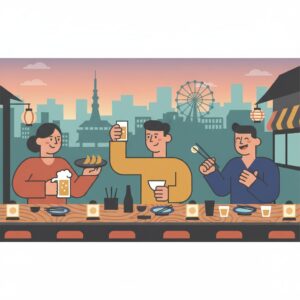
The shokudō is where Osaka’s famous communication style shines brightest. In a typical Tokyo diner, people often eat quietly, focused on their food or phones. Conversations tend to be soft and limited to one’s own group. In an Osaka shokudō, the opposite happens. The space buzzes with lively banter. A customer at the counter might chat with the owner about a news story on TV. Two strangers sitting side by side could end up debating the Hanshin Tigers’ prospects this season. It’s a fluid, free-flowing exchange that might seem confusing or intrusive to outsiders, but it’s central to the experience.
Picture this scene: An elderly regular slurps his udon and points his chopsticks at the TV. “That pitcher is worthless tonight! I could throw better than him!” The owner, wiping the counter, shoots back without missing a beat, “You say that every week, Tanaka-san. Maybe you should be out there instead of warming my counter.” The young woman next to him laughs. “Cut him some slack, master. At least he’s trying!” This isn’t a quarrel. It’s a performance—a way of social bonding and affirming connections through shared experience. Foreigners often misunderstand this. Osaka’s famed “friendliness” isn’t random or boundary-less; it’s a structured, almost theatrical style of public interaction. It’s an invitation to engage, not an intrusion on your private space. Learning to appreciate, and possibly join in, this banter is key to truly understanding the city. It means realizing that the meal isn’t just the food on your plate; it’s the entire atmosphere of the room.
A Foreigner’s Guide to the Sentō-Shokudō Circuit
For a non-Japanese resident, immersing oneself in this world can seem a bit intimidating. These are not tourist destinations but deeply local institutions, each with its own sets of unwritten rules and etiquette. However, the barrier to entry is lower than you might expect. The key is to approach with respectful curiosity and a willingness to observe.
Navigating the Unwritten Rules
Let’s begin with the sentō. Tattoos are a common point of concern. While many larger gyms and modern super-sentō still enforce strict bans, traditional neighborhood sentō tend to be much more lenient, especially toward foreigners. The unspoken rule often is: as long as you are respectful and not causing trouble, people generally don’t mind. If you’re unsure, you can look for signs at the entrance or simply ask. But in most local spots, it’s rarely an issue. The most important etiquette, which cannot be emphasized enough, is hygiene. Wash your entire body with soap before entering the communal tubs. Don’t let your modesty towel touch the bathwater. When leaving the bathing area to return to the changing room, wring out your towel and dry off as much as possible to avoid dripping water onto the floor. These are not mere suggestions—they are the fundamental laws of the sentō world.
Logistics for first-timers are straightforward. You’ll either pay the bandai directly or purchase a ticket from a vending machine near the entrance. If you don’t have your own supplies, don’t worry—you can almost always buy a small “set” including a tiny bar of soap, a small packet of shampoo, and a rental towel for a few hundred yen. And absolutely do not skip the post-bath drink. The classic choice is coffee milk or fruit milk, served in an old-fashioned glass bottle, enjoyed while you’re still warm from the bath. It’s the perfect, sweet finish to the soak.
Shokudō etiquette is much more relaxed. These are casual, no-frills eateries. The main thing is to be a considerate customer. If there’s a line, don’t linger long after finishing your meal. They’re not cafes or libraries. The unspoken agreement is to eat, enjoy, and then free up the space for the next hungry person. Ordering is easy—if you can’t read the handwritten menu, pointing is perfectly fine. Just say “Kore, kudasai” (“This one, please”). Payment is almost always made at the register on your way out. Just signal to the owner when you’re ready, and they’ll tally your bill. It’s a straightforward, honest transaction.
Finding Your Own Circuit: A Neighborhood Sketch
Here’s the most important advice: avoid searching online for “The 10 Best Sentō in Osaka.” That’s a Tokyo mindset. The essence of this ritual is hyper-local. The charm is not in finding the most famous or top-rated spot but in finding your place—the one a five-minute walk from your apartment, where the bandai starts recognizing you with a nod.
So, how do you find it? You walk. Put on your shoes and explore the backstreets of your neighborhood. Look for telltale signs: a grand temple-style roof, a tall chimney, a Noren curtain emblazoned with the ゆ symbol. Peek inside shokudō in the evening to see if they’re filled with locals watching TV and drinking beer. Every neighborhood has its own character. In the gritty, vibrant Nishinari and Shinsekai areas, you’ll find sentō serving the working-class community for generations and shokudō offering incredibly cheap and delicious food. Around Tenma or Nakazakicho, you might discover a beautifully preserved old sentō just around the corner from a trendy craft beer bar. In more residential areas like Juso or the suburbs, these spots are the undeniable heart of the community, anchoring daily life.
The ultimate goal is not to tick boxes or collect experiences but to become a regular. To reach the point where you walk into the shokudō after your bath and the owner says, “Maido! The usual?” without you needing to say a word. That moment—when you shift from being an anonymous customer to a recognized part of the neighborhood—is when you’ll truly know you’ve begun to understand life in Osaka.
Conclusion: More Than a Bath, It’s a Blueprint for Living
Having come from Tokyo, my initial grasp of this ritual was limited. I regarded it as a quaint, retro curiosity. However, I was mistaken. The sentō-shokudō circuit is not a relic of the past; it is a vibrant, evolving blueprint for a more humane and connected style of urban living. It serves as a weekly reminder that we are not isolated individuals rushing through busy lives, but members of a community, sharing space, a meal, and a collective experience.
This simple act captures the very core of the Osaka mindset. It reveals the city’s preference for straightforward practicality over curated aesthetics. It emphasizes a genuine appreciation for community and communication, even among strangers. It stands as proof that a good life need not be expensive or complicated; it can be found in the simple, profound pleasures of a hot bath, a good meal, and the comforting presence of your neighbors. It transcends clichés. The “friendliness” of Osaka is not just a personality trait; it is a social technology, a means to sustain communal bonds in a dense urban setting. The well-known value-consciousness is not stinginess; it is practical wisdom, a way to cultivate a life rich in fulfillment rather than mere possessions.
For me, a Tokyo event planner, embracing this ritual proved transformative. It taught me that recharging doesn’t require an escape, a reservation, or a ticket. Renewal can be found right here—in the steam and the noise, the familiar flavor of grilled fish, and the easy laughter of the elderly man at the counter. It is a rhythm that beats to a different drum, one that values participation over observation, community over solitude, and satisfaction over status. This is the rhythm that makes people truly fall in love with Osaka—not for its famous landmarks, but for its deeply human, wonderfully ordinary, and incredibly nourishing soul.