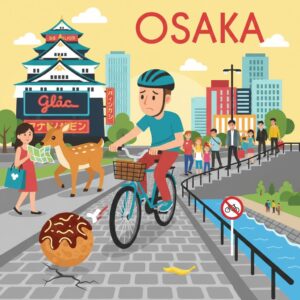
When you picture Osaka, what comes to mind? A riot of neon signs flashing over the Dotonbori canal, probably. The smell of takoyaki and grilled meat hanging thick in the air. A tidal wave of people surging through Umeda Station, moving with a purposeful, almost aggressive speed. Osaka is loud, it’s chaotic, it’s a city that pulses with a relentless, commercial heartbeat. It’s a concrete maze, a vertical world of commerce and consumption. And for the most part, that picture is true. But it’s incomplete. It’s like describing a person by only their public-facing, work-mode personality. You’re missing the other half, the part that gives the first half its meaning and its foundation.
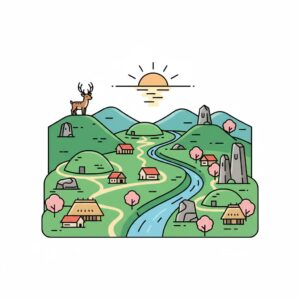
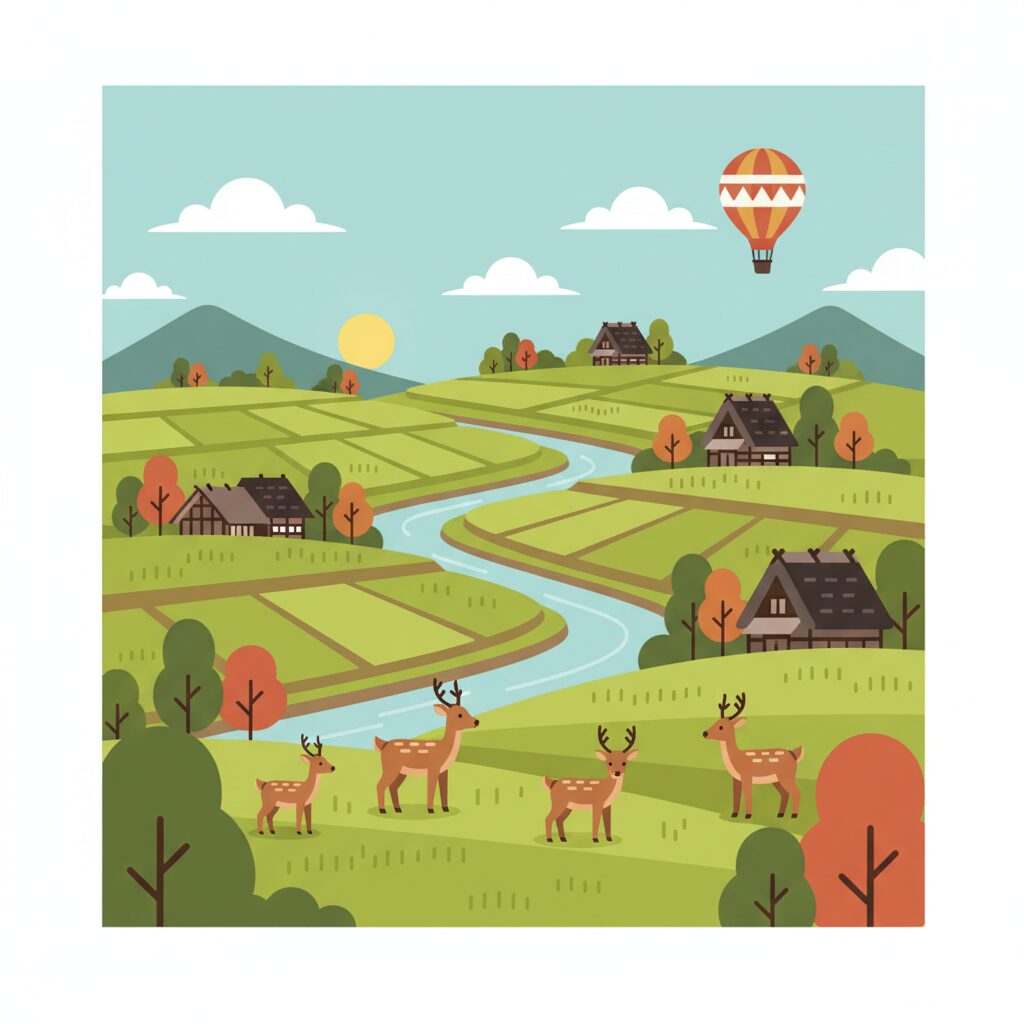
What if I told you there’s an Osaka where the loudest sound at night is a chorus of frogs in flooded rice paddies? An Osaka where time is measured not by train schedules, but by the angle of the sun and the ripening of persimmons? This place exists. It’s not a distant fantasy or a different prefecture. It’s Nose, the northernmost town in Osaka Prefecture, a pocket of deep country nestled in the mountains just an hour’s train ride from the urban core. This is Osaka’s ‘Satoyama’ – a Japanese term that doesn’t just mean ‘countryside’. It refers to a specific landscape, one that exists in the foothills between the mountains and the arable plains, a mosaic of forests, rice fields, streams, and villages that have been managed and shaped by human hands for centuries. It’s not untouched wilderness; it’s a testament to a long, symbiotic relationship between people and nature. A trip to Nose isn’t about escaping Osaka. It’s about discovering the rest of it. It’s about understanding the deep, invisible roots that anchor the glittering skyscraper city to the earth. It’s where you can finally see the whole picture, and begin to understand the soul of this place in a way you never could just by walking through Shinsaibashi.
For another perspective on how a short trip can refresh your connection to the Kansai region, consider exploring a weekend trip to Asuka Village in Nara.
The “Other” Osaka: Why the City Needs its Countryside

One of the first things you notice when comparing Osaka and Tokyo is their connection to geography. Tokyo feels boundless. It’s a man-made horizon extending endlessly in every direction, a sprawling metropolis that seems to have completely replaced the natural landscape. You can ride the train for hours and still remain within a dense urban environment. Osaka, however, feels different. Even from the city center, on a clear day, you can see the mountains: the Ikoma range to the east, the Rokko mountains to the west. They create a natural bowl, a constant visual reminder that the city has limits. This isn’t just an aesthetic distinction; it influences the local mindset.
This visibility of nature reflects a deeper, more practical relationship. For Osaka’s merchants, historically Japan’s commercial powerhouse, the surrounding countryside wasn’t a scenic weekend retreat. It was the source. It was the pantry. The rice that fed the city, the timber that built it, the charcoal that warmed it all came from these nearby satoyama areas like Nose. This fostered a deeply symbiotic, almost familial bond. While Tokyo might seem to regard the countryside as a quaint, rustic subordinate, Osaka has always acknowledged its reliance. The city couldn’t exist without its rural engine room. This nurtures a mindset of pragmatic interdependence rather than urban superiority.
You can observe this mindset in daily life. Visit a local market, even one tucked away in a residential ward of Osaka. You’ll find stalls heaped with muddy daikon radishes and knobbly ginger, sold by weathered men and women who drove in that morning from places like Nose or Kaizuka. The interaction is direct, down-to-earth, and refreshingly sincere. You ask where the spinach is from. The vendor doesn’t mention a brand. They say, “My field. Just over the mountain. Picked it at sunrise.” There’s pride in that statement that isn’t about marketing; it’s about the genuine quality of the product. It’s a distinctly Osakan way of communicating: straightforward, focused on real value, and rooted in a personal connection to the source of that value. The city’s renowned food culture, its reputation as ‘Tenka no Daidokoro’ (The Nation’s Kitchen), wasn’t born in the upscale restaurants of Kitashinchi. It was born in the fertile soil of its own backyard.
Satoyama Time vs. City Time: A Shift in Rhythm
The journey from the city to the satoyama offers a gradual decompression, a slow unwinding from the urban clock. You board the train amid the frantic, multi-layered maze of Umeda Station, where thousands move with synchronized, high-speed intent. As the train departs, the first twenty minutes present a dense tapestry of buildings, wires, and concrete. Then, gradually, gaps begin to emerge. The buildings shrink. You spot patches of green, a small community vegetable garden, a local shrine nestled between apartment blocks. The train line starts to trace a river, and suddenly you’re flanked by bamboo groves and rice fields. The clatter of the train seems to slow, your breathing deepens. By the time you step off at the small Nose station, the air feels different—softer, cleaner, filled with the scent of damp earth and growing green things.
This environmental shift sparks a fundamental change in your perception of time. City time is linear and relentless, measured by minutes and seconds, dictated by train schedules, meetings, and a constant push for efficiency. Osakans excel in this realm. The well-known ‘walk on the right’ escalator rule isn’t rudeness, as outsiders might think; it’s a sign of a city obsessed with optimizing flow, shaving seconds from every transaction and journey. It’s a shared social contract for navigating a high-density space efficiently.
But in Nose, that clock fades away. Time here is cyclical, governed by the seasons. You don’t ask, “What time is it?” Instead, you ask, “Is it time to plant the rice yet?” or “Have the fireflies started appearing by the creek?” This reveals a deeper, more patient side of the Osakan character often hidden beneath their city persona. The same person who hustles through Tennoji Station without missing a beat might spend an entire Sunday patiently weeding a tiny vegetable patch or meticulously turning pickles passed down through generations. This isn’t a contradiction but an adaptation. The city demands one rhythm; the land requires another. Grasping this duality is essential to understanding the people. A conversation with a shopkeeper in Nose won’t be a quick transaction. It will start with the weather, drift to the state of this year’s chestnut harvest, touch on a local festival story, and eventually reach the reason for your visit. It’s a rhythm based on having enough time and valuing relationship-building as much as the exchange itself. It’s worlds apart from the rapid-fire, witty banter at a standing bar in Kyobashi, yet both are equally and authentically Osakan.
The Unspoken Rules of the Countryside Community

There is a widespread misconception among foreigners—and even many city-dwelling Japanese—that the ‘inaka’ (countryside) is merely a quieter, more picturesque version of the city. This is a serious misunderstanding. Moving to the countryside is not just a change of address; it’s akin to relocating to a different country with its own distinct social operating system. The rules differ, the expectations change, and the currency of social capital is completely transformed.
In a city like Osaka, your primary social responsibility is to avoid interference. You keep noise levels down, sort your garbage properly, and don’t block hallways. Your relationship with neighbors is mostly a polite but distant agreement of mutual anonymity. In a satoyama community like Nose, the social contract is reversed. It’s not passive but active; it’s not about what you don’t do, but about what you do. Community is something you practice.
On a weekend morning, you might see a group of elderly residents working together—not just chatting but clearing weeds from a shared irrigation channel or sweeping leaves from the path to the local shrine. No one was assigned the task, nor was there an official meeting. It is an unspoken, deeply embedded understanding that the community’s well-being and the upkeep of shared spaces are everyone’s responsibility. A new resident, perhaps a foreigner, would be evaluated less on their Japanese fluency and more on their willingness to pick up a broom and participate. Your worth is measured by your contribution. This stands in stark contrast to city life, where value is often linked to profession or consumption habits.
This connects to the Osakan ideas of ‘giri’ and ‘ninjo’—a complex blend of duty, social obligation, and human feeling. In the city, these often manifest in commercial interactions. A shop owner gives you a small freebie (‘omake’) because you’re a regular, fostering mutual loyalty. In the satoyama, these concepts are raised to a principle of collective survival. You help your neighbor harvest rice because you know they will support you when a typhoon brings down a tree on your roof. It’s a pragmatic, tightly woven network of mutual aid. This isn’t about being generically “friendly,” a cliché often attached to Osaka. It’s about a pragmatic understanding that everyone’s fortunes are intertwined. It’s community as an essential, functional system—an Osakan value stripped of urban commercialism and returned to its agricultural origins.
Redefining “Wealth” and “Success” – The Nose Perspective
In any major global city, indicators of success are usually visible and measurable. This holds true in Osaka as well. Status can be linked to the company you work for, the floor your apartment occupies, or the designer brands you carry. The city is propelled by commerce, speaking a language often centered on money, profit, and growth. The classic image of the Osaka merchant, fixated on striking a good deal, stems from this environment. However, a visit to Nose compels a profound reconsideration of what terms like ‘wealth,’ ‘value,’ and ‘success’ truly signify.
Here, wealth is not chiefly gauged in yen. Wealth is the clean, cold mountain water that flows into your tap. It’s a basket of perfectly ripe tomatoes, still warm from the sun, harvested from your own garden. It’s the deep, quiet satisfaction of a woodshed filled with winter fuel. It’s the accumulated knowledge passed down through generations about which wild mountain vegetables are safe to eat in spring and which mushrooms are edible in autumn. This represents a wealth of resilience, self-sufficiency, and a direct, unmediated connection to the resources sustaining life.
This outlook doesn’t dismiss the Osakan merchant spirit; it uncovers its roots. The ‘shonin’ mindset is essentially about recognizing and maximizing value. In the city, that value is often abstracted into currency. In the satoyama, value is tangible and immediate. The farmer who carefully observes weather patterns and soil conditions to determine the optimal day for planting rice employs the same strategic, value-oriented thinking as the businessman in Honmachi analyzing market trends to close a deal. The context differs, but the underlying mindset remains identical: a deep, unsentimental respect for resources paired with a drive to optimize them.
This philosophy is evident in local businesses. You might find a small, family-run soba restaurant tucked away on a quiet street. The owners may not be wealthy by urban standards. They might drive an old car and live modestly. But their definition of success differs. Their success lies in a loyal clientele willing to drive an hour just to eat there. It’s the pride in using buckwheat they helped grow and mill themselves. It’s about living in harmony with their environment, raising a family in a healthy setting, and serving as a respected community pillar. This is a quieter, more profound kind of success, one that the relentless pace of the city often obscures.
The Soundscape of Satoyama: What You Hear When the City Pauses
One of the most striking and profound changes experienced when moving from Osaka city to Nose is the shift in soundscape. The city is a symphony of human activity: the persistent rumble of the Midosuji subway deep underground, the competing jingles of pachinko parlors and drugstores, endless chatter in covered shopping arcades, the hiss of hydraulic bus doors, and the constant ring of bicycle bells. It is a dense, layered, almost entirely man-made auditory environment. To cope, your brain builds a filter that blocks out ninety-nine percent of this noise just to focus and function.
In Nose, that filter dissolves. Initially, it may seem like silence, but it is something different. It is a new kind of sound that demands a different mode of listening. Your ears, accustomed to the city’s harsh noises, recalibrate. You begin to notice nuances: the dry rustle of wind through bamboo sounds unlike the soft whisper through pine needles. You learn to tell apart birds’ calls. Evenings during the rainy season bring the rice paddies alive with a deafening, hypnotic chorus of frogs, a sound so ancient it feels like the breath of the land itself. You hear the distant hum of a small ‘kei’ truck traveling a narrow farm road, the sound carrying for miles in the still air. You catch the creak of an old farmhouse’s wooden frame settling at night. These aren’t mere noises; they are information. They reveal weather, the time of day, the season, and ecosystem health. In the city, you learn to ignore your surroundings to survive. In the satoyama, you learn to listen to connect. This deep listening fosters environmental awareness nearly impossible to cultivate in an urban setting. It revives sensory skills dulled by city life and reflects a deeper aspect of Osakan character: a people known for sharpness, observation, and quickness to notice details. Whereas in the city these skills aid in social navigation, here they attune to the natural world.
The Taste of the Land: Food as a Direct Link
Osaka’s nickname as ‘The Nation’s Kitchen’ is often understood through its vibrant street food and numerous restaurants. Dotonbori and Kuromon Market are celebrated as culinary hotspots. Yet this is only the concluding chapter. The true kitchen, the origin of it all, lies in the fields and mountains encircling the city. A visit to Nose offers a behind-the-scenes view from the producer’s perspective rather than the consumer’s.
Dining in Nose is revelatory. Whether at a simple farmhouse inn or a chic, modern café housed in a renovated ‘kominka’ (traditional house), the philosophy is consistent: the ingredient is the star. The food is often simple but bursts with a vitality rarely found in city dishes. A cucumber picked just hours ago has an astonishing crispness and watery sweetness. A bowl of rice grown in a nearby paddy, irrigated with mountain stream water, possesses a fragrance and subtle flavor complexity that makes you realize you’ve never truly tasted rice before. The flavor arises not from intricate techniques or heavy sauces but from the inherent quality of the ingredient itself, its freshness, and the health of the soil and water that nurtured it.
This experience sheds light on the Osakan passion for ‘shun no mono,’ or seasonal ingredients. A true Osaka gourmand respects not only a three-star Michelin chef but is profoundly impressed by a farmer who can produce exceptionally flavorful onions or a forager who knows exactly where to find the best wild sansai vegetables. There is deep respect for the source and an understanding that the chef’s craft is made possible by the farmer’s efforts. That’s why chefs from some of Osaka’s finest restaurants drive themselves out to places like Nose on their days off. They aren’t merely buying ingredients; they are cultivating relationships. They engage with farmers, walk the fields, and learn about that year’s unique conditions. They seek the ultimate ‘value,’ meaning the highest quality flavor. This direct, unpretentious, and deeply respectful bond linking the city’s kitchens to the countryside’s fields forms the true foundation of Osaka’s culinary excellence.
The Return Journey: Seeing the City with New Eyes

The train ride back to Umeda is both strange and enlightening. The morning journey retraces itself in reverse, but now you are a different person observing it unfold. The green fields and forested hills fade away, and the dense city grid reemerges, building by building, until you find yourself once again immersed in the subterranean glow of the station. Yet, it no longer feels like the entire world. The city’s chaos, which once might have felt stressful or overwhelming, now feels different—it feels… contextualized.
You observe the torrent of people, the towering buildings, and the concentrated energy, understanding that it all rests on an unseen foundation. You realize that the water flowing from the tap in a high-rise apartment began its journey in the mountains you just left. You recognize that the perfect bowl of rice served in a back-alley diner has a story rooted in a sun-drenched paddy. The city and the satoyama are not two separate, opposing realms. They are one complex, living organism. The city is the vibrant bloom, and the satoyama is the root system, drawing sustenance from the earth.
A weekend spent in Nose doesn’t make you want to abandon the city. Rather, it deepens your appreciation for its dynamism and convenience. But it also offers a vital sense of balance. It recalibrates your senses and perspective. It reminds you that the fast-talking, deal-making, efficiency-driven urban Osakan is only half the story. The other half is patient, grounded, intimately connected to nature’s cycles, and quietly resilient. To truly know Osaka, to understand its people and culture beyond the clichés, you must experience both. You must navigate the crowded concrete corridors of Namba, but also walk the quiet earthen paths among the rice fields of Nose. Only then do you grasp the whole, beautiful, and complex picture.