You’ve done it. You navigated the labyrinth of Japanese real estate, signed the papers, and finally have the keys to your new apartment in Osaka. The boxes are unpacked, the internet is connected, and a sense of calm settles in. You’re living the dream. Then, one evening, there’s a gentle but insistent knock on your door. You open it to find your neighbor, a middle-aged woman you’ve only exchanged brief nods with, holding a clear plastic clipboard. It’s slightly scuffed, filled with a sheaf of papers, and she extends it to you with a simple, almost ceremonial gravity. “Kairanban,” she says, her eyes flicking towards the apartment next door. “Onegaishimasu.” Please. She wants you to take it, and then pass it on. You take the clipboard, a bit confused. It feels like being handed a strange, low-tech baton in a relay race you didn’t know you were running. This, my friend, is your formal induction into the neighborhood. You’ve just met the Kairanban, the neighborhood circular, and your life in Osaka will never be quite the same. This isn’t just a quaint local custom; it’s a mandatory, deeply ingrained information system, a physical manifestation of the social contract that holds Japanese communities together. In a country famed for its bullet trains and talking toilets, the Kairanban is a stubborn, analog anchor, a paper-and-plastic relic that reveals more about the soul of Osaka than any gleaming skyscraper ever could. It’s a system of shared responsibility, a source of low-grade social anxiety, and an unskippable lesson in what it truly means to be a resident, not just a tourist. Welcome to the chain. Your participation is not optional. Before we dive into the mechanics and mindset behind this neighborhood institution, let’s orient ourselves at the heart of Osaka’s civic life, the very place from which many of these official notices begin their slow, hand-to-hand journey.
To truly understand this social contract, it’s essential to also grasp the unspoken rules of daily life, such as those governing Osaka’s bicycle commute.
What Exactly is This Clipboard of Doom? Decoding the Kairanban
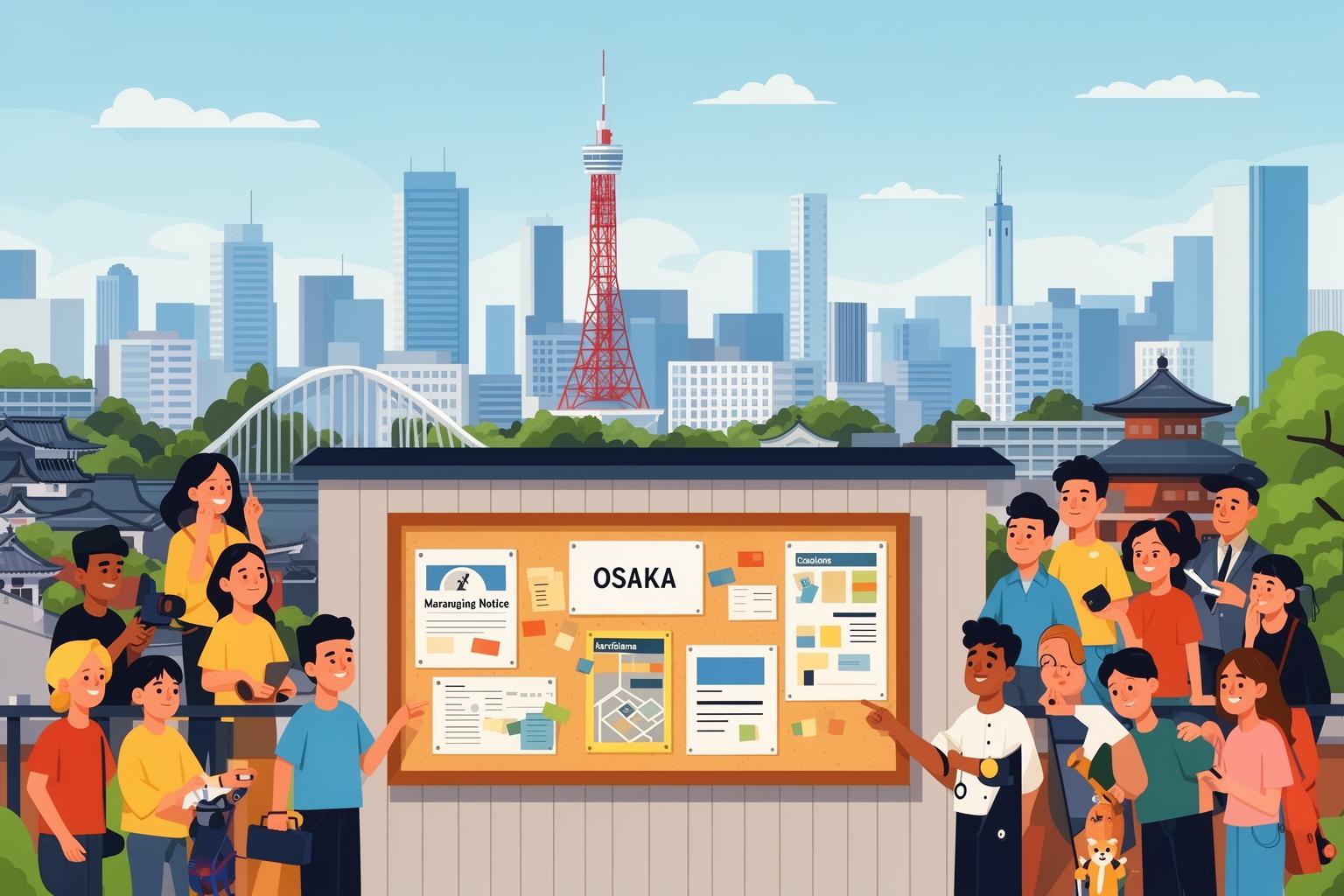
At first glance, the Kairanban appears straightforward. It’s simply a tool for sharing information. Yet, like many things in Japan, its apparent simplicity conceals layers of social rules, obligations, and unspoken expectations. To fully grasp it, you must examine its physical form, its contents, and the invisible network of rules governing its journey from one household to the next. It’s not merely paper; it serves as a symbol of community presence and a test of your reliability as a neighbor.
The Anatomy of a Kairanban
The object itself is ordinary, almost humorously so. Typically, it is a standard A4-sized clipboard made of inexpensive, slightly flexible plastic in inconspicuous colors such as blue, gray, or faded green. More often than not, it is kept in a soft, clear plastic envelope that has seen better days, designed to provide some protection against Osaka’s famously sudden rains. The clip at the top is sturdy, built for practicality rather than style, holding together a collection of documents that reflect various aspects of local life. The papers are a mix of bureaucratic black-and-white print and colorful, almost childlike community flyers. Official notices from the city ward office appear, printed on thin, somewhat rough paper, in dense, formal Japanese—the kind that even native speakers find daunting. These are the critical ones: announcements about changes to the complex garbage and recycling schedules, deadlines for resident tax payments, public health alerts about flu season, or schedules for legally mandated fire extinguisher inspections in your building. These documents are dry, impersonal, and entirely non-negotiable.
Interspersed among these are more vibrant signs of community life. You might receive a brightly colored flyer for the local summer festival, or matsuri, adorned with illustrations of lanterns and smiling faces. Notices for neighborhood cleanup days might appear, encouraging residents to gather on Sunday mornings to weed the local park. There could be sign-up sheets for a children’s softball tournament, announcements about a charity mochi-pounding event in winter, or advertisements for free legal advice sessions for the elderly at the community center. These documents form the lifeblood of the chonaikai, the neighborhood association, fostering a sense of shared involvement. Lastly, there are warnings—often blunt and direct: a notice from the local police box about recent bicycle thefts, alerts about phone scams targeting seniors, or, in suburban areas, bulletins about wild boar sightings. These function as a communal security system, a reminder to look out for each other.
The most important element of the package is the circulation sheet, the kairan-junban-hyo. This first page holds the system together. It is a grid listing every household on the route, in order. Beside each name or apartment number is a small box where you place your personal seal, your hanko, or, if you are a foreigner without one, provide a signature or initials. This small action carries great significance. It serves as your proof of receipt, your acknowledgment of the information, and your commitment to keeping the chain moving. Stamping that box shifts responsibility from your neighbor to you. The Kairanban becomes your responsibility. Your stamp declares, “I have seen this. I am a participating member of this community. I will do my part.” The weight of that small red ink stamp is far heavier than the flimsy plastic clipboard it clings to.
The Unspoken Rules of the Relay
Receiving the Kairanban is simple; mastering the delicate, unspoken etiquette of passing it on is the challenge. This is a subtle social dance, and a misstep can quietly brand you as an inconsiderate or unreliable neighbor. The first rule is speed. The Kairanban is not a magazine to be left on your coffee table for leisurely reading. It’s a hot potato. The unstated expectation is that you will process and pass it on within 24 hours. Letting it linger in your apartment for two or three days is a serious breach of etiquette. The information may be time-sensitive—a deadline for event sign-up, a warning about a road closure happening the next day. Your delay affects everyone down the line; in a small but significant way, this is a selfish act. The entire system relies on prompt, collective action. Holding it up is like causing a traffic jam on a one-lane road. The flow of information stops with you.
Next is the timing of the handoff. You can’t just drop by your neighbor’s door whenever you wish. Knocking too early in the morning is intrusive; too late at night is unsettling. There is a socially accepted window, usually from mid-morning to early evening, when people are likely to be home and not distracted by meals or bedtime routines. You learn this window through observation and subtle social cues. Then there is the classic Kairanban dilemma: what if your neighbor is not home? You knock, wait, knock again—no answer. Anxiety sets in. Do you leave it hanging on their doorknob? Slipping it into the mail slot seems sensible, but what if it jams or gets damaged? Leaving it on the ground is unthinkable. The worst-case scenario is leaving it exposed where wind or rain might ruin it. If the Kairanban goes missing or is damaged while in your care, it’s a serious issue. You bear responsibility for disrupting the neighborhood’s information flow. That may mean coming back later that evening or trying again the next morning as the 24-hour clock ticks down.
The final person on the list carries special responsibility. If you are last, your duty is not only to read and sign but to return the entire clipboard to its starting point—usually the home of the chonaikai-cho, the neighborhood association head, or a collection box at the community center. You close the loop, ensuring the system can reset for the next round of information. This relay, with its ticking clock and social pressures, enforces a minimal yet vital level of interaction. In a world where neighbors may live side-by-side for years without speaking, the Kairanban demands a moment of contact. It is a forced, but functional, means of maintaining community engagement.
The Kairanban and the Osaka Mindset: Efficiency Meets Obligation
If you ask any Osakan under 60 what they think of the Kairanban, you’ll almost certainly hear the word “mendokusai.” It’s a hassle, a pain, an annoying chore in an already busy life. This is a key point to grasp. The people of Osaka, known for their pragmatism, directness, and impatience with pointless formalities, are not fond of this system. They recognize its flaws and understand its inefficiency in a digital age. Yet, they keep participating. This apparent contradiction reveals the Osaka mindset—a unique mix of grumbling pragmatism and a strong sense of communal duty.
“Mendokusai,” the Universal Feeling
The widespread complaint of “mendokusai,” ironically, helps tie the community together. It’s a shared burden, a small, repetitive annoyance everyone in the neighborhood must face. Complaining about the Kairanban to neighbors is a common, low-pressure way to connect. It acknowledges that, yes, the system is outdated, but since everyone’s stuck with it, they might as well get on with it. This attitude challenges the foreign stereotype of Japanese people as blindly obedient to tradition. Osakans, in particular, question, complain, and mock authority and inefficient systems. But pragmatism wins out. They do this not out of blind compliance, but because they fundamentally understand the purpose it serves, even if they wish for an easier method. The system endures because the alternative—a neighborhood where no one knows what’s going on or takes responsibility—is viewed as far worse. So they grumble, sign, and pass it along. It’s a duty, not a pleasure, and that shared understanding acts as social glue.
The Logic of Local Connection (Even When You Don’t Want It)
The Kairanban is the main tool of the chonaikai, the neighborhood association. These hyper-local groups form the foundation of Japanese civil society. They organize festivals, manage local garbage spots, and most importantly, act as first responders in emergencies. Here, the Kairanban’s analog nature shifts from flaw to strength. In a major earthquake, tsunami, or typhoon—real and frequent threats in Japan—power can fail, cell towers go down, and internet access disappears. Digital communication is fragile; a clipboard with paper is sturdy. The Kairanban’s physical route also functions as a pre-set network for wellness checks. Delivering the clipboard to neighbors is, in a small way, a check on their well-being. Is the elderly woman living alone alright? Is mail piling up at a quiet family’s home? The Kairanban enforces a baseline of mutual awareness. This logic is deeply rooted in Osaka’s merchant city history. In the dense, crowded old neighborhoods, neighbors were also business partners, customers, and first responders to fires. Knowing and maintaining functional relationships with neighbors was essential for survival and prosperity, not just social courtesy. That legacy of practical, obligation-driven community continues today, albeit in a new context. The Kairanban is a modern echo of that merchant-class pragmatism.
Osaka vs. Tokyo: The Social Temperature
While Kairanban exist throughout Japan, their role and social significance feel different in Osaka compared to Tokyo. Tokyo—especially its central wards—is marked by greater anonymity. The city’s vast scale and constant influx from across Japan and abroad create a more transient culture. In many modern Tokyo high-rises, the Kairanban has been replaced by digital bulletins or simple lobby notice boards. Expectations for direct, house-to-house interaction are lower. The default social mode is polite, professional distance. Osaka, although a large metropolis, retains a stronger neighborhood identity in many residential areas. There is a slightly higher social expectation to participate or at least not be a hindrance. The Osaka approach favors straightforward, no-nonsense functionality over Tokyo’s formal, surface-level politeness. The attitude isn’t, “Let’s all be best friends,” but rather, “We all live here, we all have responsibilities; let’s not make things difficult for each other.” The Kairanban perfectly embodies this. It’s not elegant, but it works. It’s intrusive, but effective. It reflects an Osaka character that values accomplishing tasks over preserving a flawless, frictionless social appearance. This can be surprising for foreigners used to either complete anonymity or voluntary, friendship-based community, but it is the honest reality in many Osaka neighborhoods.
Navigating the System as a Foreigner: A Practical Guide
For a non-Japanese resident, the first experience with the Kairanban can be genuinely confusing and anxiety-inducing culturally. You’re given a responsibility in a language you might not fully understand, accompanied by rules you haven’t been taught. But don’t worry. Successfully managing the Kairanban is an important milestone in your integration into local life. It serves as a test, and passing it earns you a small but meaningful degree of acceptance.
The Initial Encounter and What to Do
Let’s go back to that initial knock on your door. Your neighbor hands you the clipboard. The key is to grasp the nature of this exchange. This isn’t necessarily a friendly invitation. It’s a functional, procedural interaction. Your best response is simple, polite, and shows you understand your role. A clear “Arigatou gozaimasu” (Thank you) and a slight nod are perfect. You have now accepted the baton. Take the clipboard inside. Don’t try to read it on your doorstep while your neighbor waits. Your first task is to find the circulation sheet. Locate your apartment number or name on the list. Take your hanko (if you have one) and firmly press it in the box. If you don’t have a seal, a clear signature or your initials will do. Marking the sheet is the most important part. Next, look at the name directly below yours—that is your next stop. Now, regarding the content: the stack of papers will be entirely in Japanese, often written in a dense, bureaucratic style. Stay calm and don’t feel compelled to translate every sentence. Use your smartphone. Apps with optical character recognition, like Google Translate’s camera feature, are invaluable here. Hover your phone over the documents and get the main idea. Focus on keywords: dates, times, locations, and topics. Watch for words like “gomi” (trash), “zeikin” (tax), “matsuri” (festival), “chui” (warning/caution), or the name of your local park or community center. In 99% of cases, the information is for general awareness. As long as you don’t miss any critical deadlines for required actions, you’ll be fine.
Common Pitfalls and How to Avoid Them
The biggest mistake in the world of Kairanban is forgetting to pass it on. Life gets busy, and the clipboard can end up buried under your mail on the counter. Two days later, there’s another knock—this time from your neighbor or, worse, the chonaikai-cho—asking for the missing circular. This immediately brands you as unreliable. To avoid this, develop a habit: as soon as you receive the Kairanban, sign it and place it by your front door. Make it a point to deliver it before the day ends. The second common error is losing the clipboard or letting it get damaged. Handle it with reasonable care. Don’t leave it outside your door as a reminder, where a gust of wind might blow it away. The third mistake is handing it to the wrong person. The delivery route is fixed for a reason. Always double-check the circulation sheet and make sure you’re passing it to the next person on the list, not just the household that seems most convenient.
A more complicated question is whether you can opt out. Legally, membership in a chonaikai is voluntary—you can’t be forced to join. However, opting out of the Kairanban sends a strong social message. It’s seen as actively rejecting the community. The repercussions are social rather than legal. You might find yourself excluded from using the designated neighborhood garbage collection point (a significant inconvenience) or simply left out of important local event or emergency notifications. This creates friction that, for most people, is far more troublesome than the minor hassle of passing on the clipboard. The easier path—and the one that shows respect for the local system—is to participate. It’s a small price to pay for harmonious coexistence.
The Kairanban as a Social Barometer
Once you grow accustomed to the routine, you might start to see the Kairanban as more than a mere chore. It becomes a valuable social tool. How your neighbors interact with you when passing the clipboard can reveal much about your relationship. Is it a quick, efficient exchange accompanied by a polite nod? That’s the baseline—a neutral, functional neighborly connection. Does your neighbor add a brief comment about the weather or ask how you’re doing? That indicates a slightly warmer, more open rapport. On rare occasions, the exchange might lead to a longer conversation or even an invitation for tea. The Kairanban provides a regular, low-pressure chance for these small interactions. For a foreigner, these moments are priceless. By diligently participating—passing the clipboard promptly and treating it carefully—you send a clear, non-verbal message. You demonstrate that you are a responsible resident who understands and respects local customs. You show that you aren’t just a temporary visitor but a contributing member of the local community. In a culture where actions often speak louder than words, being a good Kairanban participant is one of the simplest and most effective ways to build quiet, lasting credibility within your Osaka neighborhood.
The Future of the Analog Chain: Is the Kairanban Here to Stay?
In an era defined by instant messaging and constant connectivity, the practice of hand-delivering paper notices from door to door feels hopelessly outdated. Each year, community meetings and online forums throughout Japan debate whether the Kairanban has outlived its purpose. The system is caught in a tug-of-war between the drive for modernization and a strong, deeply rooted resistance to change. Its future remains uncertain, highlighting a fundamental tension within contemporary Japanese society.
The Drive for Digitalization
The case for replacing the Kairanban is logical and compelling. Younger generations, digital natives who manage every aspect of their lives via smartphones, view the physical system as highly inefficient. Why spend hours printing flyers and days handing them out when one email, a post in a dedicated LINE group, or an update on a community app can instantly share the same information with everyone? Going digital would be faster, significantly less expensive by cutting printing and paper costs, and much better for the environment. It would also alleviate logistical challenges for residents with irregular work hours or frequent travel, for whom the physical delivery is a genuine inconvenience. The COVID-19 pandemic served as a strong catalyst for this discussion. The need to minimize physical contact and lower transmission risk led many neighborhood associations to temporarily suspend the Kairanban or try digital alternatives. For a time, it seemed the pandemic might finally usher the system into the 21st century. Some newer, large-scale apartment complexes, particularly in wealthier areas, have already adopted this shift, managing all resident communications through dedicated building portals. For advocates of change, the way forward appears clear and long overdue.
The Resistance to Change
Despite the obvious advantages of digitalization, the Kairanban has shown remarkable resilience, largely due to Japan’s social and demographic context. The biggest barrier to change is the country’s aging population. Many elderly residents are not comfortable with digital technology and often do not own smartphones or use computers. For them, the Kairanban is not a hassle but their only dependable source of essential community information. Eliminating it would essentially exclude them, cutting off access to everything from festival schedules to crucial evacuation instructions. This “digital divide” is a significant social issue, and the Kairanban currently acts as a vital, though imperfect, bridge across it.
Moreover, supporters of the system argue that much would be lost in a digital shift—the human element. The brief, face-to-face interaction that the Kairanban requires serves as an informal welfare check. A digital message offers no certainty that an elderly person living alone has read it or is safe. The physical delivery creates a consistent, predictable touchpoint that a purely virtual system cannot duplicate. Bureaucratic inertia also plays a role. City halls and ward offices are organized around this system, with chonaikai leadership often comprising older, retired individuals who have managed the Kairanban for decades. Overhauling this deeply entrenched process would demand an immense, coordinated effort that many lack the will or energy to pursue. Finally, in Osaka, there is a stubborn, practical attachment to traditions that, despite imperfections, have proven reliable. The Kairanban has endured for generations, surviving wars and natural disasters. There is a cultural mindset of “if it isn’t broken, don’t fix it.” This resistance is less about rejecting technology outright and more about a risk-averse culture that values the stability of a familiar system over uncertain new benefits.
In the end, the Kairanban is so much more than a clipboard piled high with municipal notices and festival flyers. It is a living artifact. It is a physical representation of the intricate, often invisible web of duties, responsibilities, and mutual obligations that constitute life in an Osaka neighborhood. It embodies the constant, fascinating friction between Japan’s hyper-modern surface and its deeply traditional, stubbornly analog core. For the newly arrived foreigner, it can feel like an archaic and frustrating burden, another inexplicable rule in a country full of them. But as you settle in, as you perform the small ritual of stamping the sheet and walking the ten steps to your neighbor’s door, its true meaning begins to emerge. You are participating in a system that values the collective over the individual, reliability over convenience, and human connection—however fleeting—over digital efficiency. Successfully navigating the rules of the Kairanban is a small but powerful rite of passage. It signals your transition from an outsider looking in to an insider who, however grudgingly, is part of the machinery. It’s not about becoming “friends” in the Western sense of the word. It’s about earning a place as a dependable, considerate member of a functioning community. So when that knock comes, and that clipboard is extended to you, don’t see it as a hassle. See it as your official, paper-based invitation into the real, unvarnished, and deeply human daily life of Osaka. You’re in the loop. You’re on the list. You’re part of the chain now. Don’t be the one to break it.
If possible, please make slight modifications to the whole sentence without altering its original meaning.