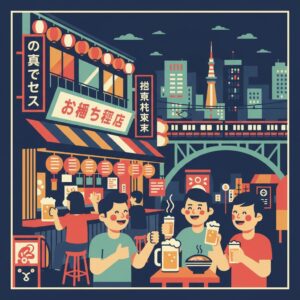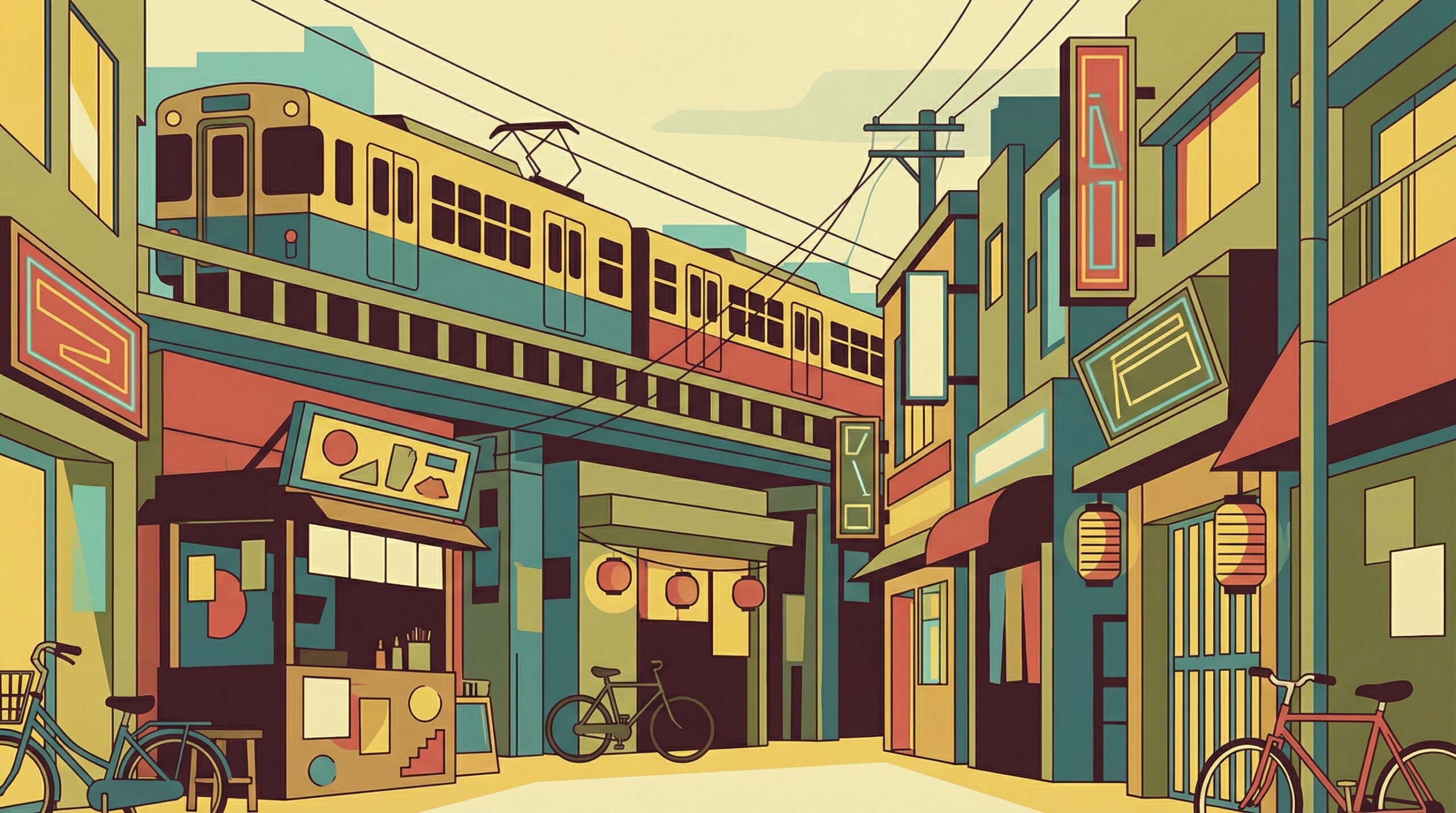
Step off the train at Juso Station, and you don’t just arrive at another Osaka neighborhood. You arrive in another time. Just one stop from the hyper-modern gloss and towering ambition of Umeda, Juso feels like a different dimension entirely, a living, breathing testament to an era that refuses to fade away. This is Osaka’s beating, gritty heart, a place where the neon buzzes with a story, where the air is thick with the savory smoke of yakitori grills, and where the culture of drinking runs deeper than the nearby Yodo River. Forget the curated experiences and polished facades; a night out in Juso is an unfiltered, authentic plunge into the Showa era, that vibrant post-war period of economic miracles and dazzling cultural shifts that defined modern Japan. It’s a labyrinth of friendly-faced shotengai arcades, tiny lantern-lit bars crammed into forgotten alleys, and a symphony of sounds—the rumble of the ever-present Hankyu trains, the sizzle of batter on a hot griddle, the hearty laughter of locals unwinding after a long day. Juso isn’t just a place you visit; it’s a rhythm you feel, a raw energy that gets under your skin and invites you to become part of its ongoing story. For anyone looking to connect with the real, unvarnished spirit of Osaka, the journey begins here, under the crisscrossing train tracks and the warm glow of a thousand red lanterns.
To fully appreciate Juso’s nostalgic contrast, consider exploring the sleek, modern counterpart of Osaka’s Umeda district just one stop away.
The Pulse of the Crossroads: Juso’s Electric Atmosphere
The moment you step through the ticket gates of Juso Station, the neighborhood’s distinctive character immediately makes itself known. It’s an exhilarating sensory overload in the best way possible. Above you, the steel networks of the Hankyu Railway intertwine, with trains rumbling overhead every few minutes, linking Osaka to the major cities of Kobe, Takarazuka, and Kyoto. This constant movement infuses Juso with a kinetic energy, a sense of being at a perpetual crossroads. While it’s undeniably a transit hub, it also stands as a destination in its own right—a place where people from all walks of life converge and coexist. The soundscape forms a rich symphony: the rhythmic clatter of trains sets a steady pace, interrupted by the cheerful jingles of pachinko parlors, the spirited calls of shopkeepers beckoning customers, and the rising hum of conversations drifting from countless doorways. Your eyes take in a dizzying array of visuals. Faded Showa-era signs, with their charming retro fonts and gently worn appearance, vie for attention alongside bright, contemporary advertisements. Glowing red lanterns, or akachochin, hang like ripe fruit outside every izakaya, promising warmth, good food, and flowing sake. The very air seems to tell its own story, scented with the intoxicating aroma of dashi broth, sweet soy glaze caramelizing over charcoal, and the faint, sugary hint of cheap beer. This is no sterile, air-conditioned shopping mall; it’s organic, chaotic, and deeply human. It feels lived-in—a neighborhood with its own laugh lines and endearing scars, proud of its history and utterly at ease with itself. As the sun sets, the energy shifts dramatically. The last daytime shoppers rushing home give way to waves of office workers, their ties loosened, ready to unwind after a long day. Neon lights flicker on, bathing the streets in electric blue, vibrant pink, and warm orange hues, transforming the bustling arcades into glowing tunnels of nocturnal promise. Juso after dark becomes a different creature—bolder, louder, and infused with an irresistible sense of freedom.
A Labyrinth of Delights: Charting Juso’s Iconic Arcades
To truly grasp Juso is to become immersed in its network of shotengai, the covered shopping arcades that form the neighborhood’s lifeblood. These arcades are more than mere clusters of shops; they serve as communal living rooms, sheltered from the weather and alive with local activity. Each arcade extending from the station possesses a unique character, offering a distinct flavor of the Juso experience. Exploring them is the main attraction—a treasure hunt where the reward might be an unforgettable meal, a newfound favorite bar, or simply a moment of connection with the soul of the city.
The Western Front: Juso Honmachi Shotengai
Exiting the station to the west, you immediately encounter the entrance to Juso Honmachi Shotengai. This classic, old-school arcade is a long, straight corridor brimming with commerce and community. By day, it bustles with locals conducting their daily errands. You’ll spot grandmothers selecting vegetables, children stopping for sweets, and the comforting hum of neighborhood life. But as evening falls, it transforms. The metal shutters of daytime shops come down, replaced by the glowing lights of izakayas, tachinomi standing bars, and small specialized eateries. The arcade turns into a lively stage for the night’s celebrations. Its architecture feels like a step back in time, with an arched ceiling and slightly dated fixtures. Strolling through, you pass everything from venerable `kissaten` (traditional coffee shops) serving the same brew for decades to lively yakitori joints where smoke and laughter spill into the street. It’s a microcosm of Juso: a place where past and present not only coexist but engage in a vibrant, ongoing dialogue. Here, you can truly appreciate the seamless blend of the ordinary and the magical that defines the neighborhood.
The Eastern Bloc: Juso Friendly Street and the Deep Dive
Cross over to the east side of the tracks and the atmosphere changes. Here lies Juso Friendly Street, an area devoted even more to the craft of drinking. The density of bars and restaurants is astounding. This is the heart of `tachinomi`, the standing-only bars epitomizing casual, straightforward Japanese nightlife. These spots are often tiny, sometimes fitting no more than a dozen patrons squeezed shoulder-to-shoulder along a worn wooden counter. Yet, what they lack in space they more than compensate for in atmosphere. This is where you drop by for a quick beer and some skewers before heading home, or settle in for an entire night of `hashigo-zake`—the beloved tradition of bar hopping. The energy inside these establishments is tangible. You’ll see groups of salarymen celebrating a successful deal, old friends catching up on neighborhood gossip, and solo drinkers quietly savoring a peaceful moment. Friendly Street’s charm lies in its wide variety. One door might open to a chic, modern sake bar, while the next could be a Showa-era relic unchanged since the 1970s. It’s a playground for the curious drinker, rewarding exploration and a readiness to step into the unknown. The prices remain refreshingly affordable, a legacy of Juso’s working-class roots, making it possible to enjoy a truly memorable night out without overspending.
The Legendary Alleys: Whispers of Shonben Yokocho
Venture further into the maze of streets on the east side, and you’ll inevitably come across the area known colloquially as `Shonben Yokocho`, which colloquially means “Pee Alley.” The name harks back to a rougher era, when public restrooms were scarce and patrons relieved themselves in the narrow alleys. Today, the name endures as a badge of honor, reflecting the area’s unpretentious, slightly roguish past. Far from disreputable, this narrow passage is now one of Juso’s most atmospheric and sought-after spots. Barely wide enough for two people to pass, it is lined with tiny bars and eateries. Red lanterns cast a warm, intimate glow, and the air is thick with fragrant smoke from dozens of yakitori grills. Peering inside these venues feels like glimpsing into a series of miniature worlds: a chef carefully turning skewers over glowing coals, a bartender pouring the perfect draft beer head, a handful of patrons packed into spaces the size of closets, sharing stories and laughter. Securing a seat in one of these legendary spots feels like gaining entry into a secret club. The experience is intimate, immersive, and utterly unforgettable. It embodies the essence of “deep Osaka,” where the food is simple yet exquisite, the drinks are potent, and the human connections are immediate and genuine. This is the Juso that people speak of in whispers—the raw, pulsing heart of its legendary nightlife.
The Flavor of Juso: A Culinary Pilgrimage
While Juso is unquestionably a drinker’s paradise, it would be a serious oversight to ignore its reputation as a powerhouse culinary destination. The food here isn’t focused on Michelin stars or cutting-edge techniques; rather, it centers on soul-satisfying, time-honored dishes crafted with skill and served without any fuss. The local cuisine fuels the neighborhood’s nighttime vibrancy, making it the perfect match for a cold beer or a warm flask of sake. Many visitors come to Juso primarily to eat, embarking on a pilgrimage to savor flavors deeply rooted in Osaka’s identity.
The Green Onion Kingdom: A Tribute to Yamamoto’s Negiyaki
If Juso has a signature dish, it is unquestionably `negiyaki`. And if `negiyaki` claims a monarch, that honor goes to Yamamoto. This iconic restaurant, a staple of Juso’s food scene for decades, is often the main reason newcomers make their first visit to the area. `Negiyaki` is closely related to the more renowned `okonomiyaki`, yet with a key distinction. Instead of being filled with cabbage, it is gloriously, overwhelmingly stuffed with `negi`, or green onions. At Yamamoto, this humble ingredient is elevated to an art form. The experience often begins even before you sit down, with a line of eager diners winding out the door—a sign of its lasting popularity. Inside, you’re greeted by the sight and sound of a massive `teppan` grill dominating the space. Skilled chefs move with practiced ease, pouring thin batter, heaping freshly chopped green onions, adding your choice of fillings like beef tendon (`suji`) or pork, and expertly flipping the savory pancakes until they are perfectly cooked—crispy on the outside, soft and steaming within. The finished dish is brushed with a savory soy sauce rather than the sweet `okonomiyaki` sauce, allowing the sharp, fresh taste of the green onions to shine. Taking the first bite of Yamamoto’s `negiyaki` is a revelatory experience. Simple, hearty, and quintessentially Osaka, it’s a dish worth traveling for and a culinary experience that encapsulates Juso’s honest, delicious soul.
The Skewer Staples: Yakitori and Kushikatsu
Beyond `negiyaki`, Juso’s izakaya culture is fundamentally built on skewers. `Yakitori` (grilled chicken skewers) and `kushikatsu` (deep-fried skewers) are the beloved, ever-present companions to any drinking session. The alleys of Juso are scented with the aroma of chicken fat dripping onto hot charcoal. Step into any `yakitori-ya` and you’ll find a menu celebrating every part of the chicken, from common cuts like thigh (`momo`) and breast (`sasami`) to more adventurous options such as heart (`hatsu`), liver (`rebā`), and crispy skin (`kawa`). Each skewer is seasoned with salt (`shio`) or a sweet-savory glaze (`tare`) and grilled to perfection. The atmosphere is always lively and convivial, filled with the sizzle of grilling and the cheerful calls of orders. Equally popular is `kushikatsu`, Osaka’s famous deep-fried skewered fare. Various meats, seafood, and vegetables are skewered, dipped in a light panko batter, and fried to a golden crisp. Part of the enjoyment comes from the communal pot of thin, savory dipping sauce on the counter. Here, the one inviolable rule of `kushikatsu` must be respected: no double-dipping! Once a skewer has touched your lips, it cannot be returned to the communal pot. This simple etiquette is a crucial part of Osaka’s dining culture, a shared understanding that unites everyone in the room. Savoring a platter of hot, crispy `kushikatsu` alongside a cold draft beer is one of Juso’s most authentic and satisfying pleasures.
Wandering and Wondering: The Joy of Discovery
While `negiyaki` and skewers take center stage, the true charm of Juso’s food scene lies in its remarkable variety and depth. The best advice for any food explorer is to simply wander and follow your senses. You’ll find tiny, specialized ramen shops serving rich, cloudy `tonkotsu` broth simmered for days. Cozy `oden` stalls offer various ingredients like daikon, tofu, and fish cakes gently simmering in a seasoned dashi, providing comforting warmth on a cool evening. Unassuming `shokudo` (local diners) present classic Japanese comfort food—curry rice, ginger pork—in an atmosphere that feels like stepping into someone’s home kitchen. Don’t hesitate to try spots that seem intimidatingly local or lack an English menu; a smile, a point, and a simple “`kore o kudasai`” (This one, please) are often all that’s needed. Juso rewards the adventurous eater. Dropping into a random, unnamed bar for a quick snack and drink can lead to the most memorable moments of the night. It’s in these unexpected discoveries that you truly connect with the spontaneous, delicious spirit of the neighborhood.
Echoes of an Era: Juso’s Enduring Cultural Identity
To truly appreciate Juso, it helps to understand the historical and cultural forces that have shaped the neighborhood. More than just a collection of bars, Juso is a cultural artifact—a living museum of the Showa era (1926–1989). This period, especially the post-war decades, was marked by profound social change and economic growth in Japan. Positioned as a railway hub, Juso developed into a vibrant entertainment and leisure district serving the expanding working and middle classes. The atmosphere it exudes today directly stems from that era.
Showa Nostalgia in Sight and Sound
When people mention the “Showa retro” vibe, Juso stands as the quintessential example. This is evident in the arcades’ architecture, with their curved ceilings and tilework reflecting mid-century design. It shows in the typography on old signs, the faded movie posters, and the neighborhood’s very color palette—a blend of warm oranges, deep reds, and cool blues glowing beneath neon lights. The `kissaten` coffee shops act as perfect time capsules, featuring dark wood interiors, velvet seats, and the lingering aroma of coffee and tobacco—places where time seems to slow. Even the old movie theaters, like Juso Theater, which still screen both new and classic films, contribute to this sense of stepping back in time. This nostalgia is not just an aesthetic; it’s a cultural sentiment. The Showa era is often remembered as a simpler, more optimistic period defined by collective effort and communal relaxation. Juso’s nightlife reflects this spirit—not focused on exclusivity or glamour, but on camaraderie, affordability, and the simple joy of sharing drinks and meals with friends and colleagues after work. It’s a social fabric woven over decades and remarkably preserved.
Understanding the Gritty Underbelly
It is also important to acknowledge, honestly and with context, another aspect of Juso’s identity. The area has a long history as an entertainment district, which has included a notable red-light district, especially in a zone east of the station. For many residents of Osaka, “Juso” has carried this dual meaning: a place known for excellent food and drink, but also for adult entertainment. This history is an undeniable part of what makes Juso such a complex, multifaceted neighborhood today. However, for most visitors, this side is distinctly separate from the primary appeal. The culinary and drinking scenes centered on the shotengai and famous alleys form the heart of the Juso experience. Understanding this background offers a deeper, more nuanced perspective on the area’s development and reputation as a place that has always catered to a wide range of human appetites and desires. It enhances the impression of Juso as a truly “deep,” unfiltered slice of urban Japanese life—a place without pretense that embraces all aspects of its history, both savory and the slightly sordid.
A Practical Blueprint for Your Juso Adventure
Diving into Juso’s vibrant nightlife for the first time may feel a bit overwhelming, but with a few pointers, you can navigate it like an experienced local. The neighborhood is incredibly inviting, and its attractions are open to anyone with an open mind and an empty stomach. Here’s a guide to help you enjoy a smooth, fun, and authentically Juso night out.
Access and Orientation: The Hankyu Hub
Getting to Juso is surprisingly simple, which adds greatly to its appeal. It serves as a major hub on the private Hankyu Railway line. Importantly, it’s the very first stop after the large Osaka-Umeda Station on all three main lines: the Kobe Line, the Takarazuka Line, and the Kyoto Line. This means a train ride from central Umeda takes only about three minutes. Its closeness makes Juso a great alternative to the often crowded and tourist-heavy nightlife areas in Umeda or further south in Namba. Upon arrival, the heart of Juso’s entertainment district is easily reachable on foot. The area is compact and best explored by wandering freely. Let the glowing lanterns and tempting aromas lead you. The station serves as an ideal central point; the tracks split the neighborhood into west and east sides, helping you stay oriented even as you delightfully get lost in the narrow alleys.
Perfect Timing: Catching the Transformation
Timing is key to experiencing Juso at its best. The ideal arrival time is in the late afternoon or early evening, between 5:00 PM and 6:00 PM. This lets you witness the neighborhood’s enchanting transition. You’ll see daytime activities winding down as the `noren` curtains of bars and izakayas are drawn open, signaling they’re ready for business. The streets start filling with the after-work crowd, and the energy noticeably increases. The real buzz builds from 7:00 PM onward, peaking between 8:00 PM and 10:00 PM, especially on Friday or Saturday nights when the atmosphere is at its liveliest. Although many places stay open late, Juso primarily functions as an early-evening spot for locals grabbing a few drinks before catching the last train home. Getting there early means you can secure a seat at popular spots like Yamamoto Negiyaki or a prized spot in a cozy bar in Shonben Yokocho before the crowds arrive.
Navigating Like a Local: Tips for a Smooth Night
Carry Cash: This is perhaps the most practical advice. Juso remains proudly old-fashioned. Many smaller, family-run bars and iconic eateries don’t accept credit cards. Having enough yen on hand is essential to avoid awkward situations and give you the freedom to explore any place that catches your interest.
Embrace `Hashigo-zake` (Bar Hopping): The true essence of a night out in Juso is not settling in one place for hours. It’s about practicing `hashigo-zake`. The idea is to enjoy one or two drinks and a signature dish at one spot before moving on to the next. This way, you get to sample the incredible variety the neighborhood offers. Eat some `negiyaki` at Yamamoto, then head to a `tachinomi` for a beer and some `oden`, finishing your night with a few `yakitori` skewers at a smoky bar down a hidden alley. It’s a journey, not a destination.
Conquer the Small Bars: Don’t be intimidated by the tiny bars that seem locals-only. While your Japanese will be appreciated, it’s often not necessary. A warm smile and a simple, “`Haitte mo ii desu ka?`” (May I come in?) will usually be met with a welcoming response. The owners and patrons of these small spots are often curious and friendly toward foreigners who genuinely appreciate their culture.
Understand the `Otoshi`: Many izakayas and small bars in Japan charge a small table fee called `otoshi` or `sekiryo`. This compulsory charge is added to your bill. It’s not a scam; it’s standard practice. In exchange, you receive a small appetizer such as edamame or pickled vegetables. Think of it as a cover charge that comes with a snack. Knowing this beforehand will help avoid any surprise when the bill arrives.
Be a Good Neighbor: Keep in mind that Juso is not only an entertainment district but also a residential area. People live in apartments above bars and shops. While the atmosphere inside the venues is lively, be considerate about noise levels when outside on the street, especially late at night. Respecting the local community helps keep Juso a wonderful and welcoming place for all.
The Unchanging Soul of Juso
A night in Juso is far more than a simple bar crawl. It’s a journey through time—a full sensory immersion into a side of Osaka that is loud, proud, and unapologetically genuine. In an age where cities grow increasingly alike, Juso remains a stubborn and beautiful stronghold of local character. It’s a place where the flavor of a grilled green onion pancake carries the stories of generations, where the clinking of glasses in a crowded standing bar sparks fleeting yet sincere connections, and where the rumble of the train overhead forms the steady, rhythmic heartbeat of a neighborhood that knows exactly who it is. Walking its streets is like flipping through a living history book of post-war Japan, witnessing dreams and desires from a bygone era still glowing vividly in the neon night. Juso doesn’t just provide a drink; it offers a piece of its soul. It invites you to get a little lost, try something new, and leave with a story to tell and the lingering, savory taste of true Osaka on your tongue. For anyone wanting to truly understand this remarkable city beyond the guidebooks, the answer lies here—just one stop from Umeda, yet a world apart in spirit.