Walk south from the neon-drenched chaos of Namba, keep going past the quiet residential blocks, and you’ll eventually feel a shift in the air. The scent of salt and iron begins to cling to the humidity. The buildings grow wider, lower, their walls corrugated steel instead of polished tile. This is Kitakagaya, a neighborhood tucked away in Suminoe Ward, a place where the hum of machinery is the city’s baseline rhythm. To the uninitiated, it looks like a remnant, a forgotten industrial zone where trucks rumble down empty streets and the ghosts of shipyards linger by the canals. But look closer. Between a metalworking shop and a logistics warehouse, a massive, vibrant mural explodes across a steel wall. An old factory, its windows glowing warmly, isn’t churning out parts anymore; it’s serving single-origin coffee to a crowd of artists and locals. This isn’t just a place of industry. It’s a gallery. A studio. A stage. This is, against all odds, one of Osaka’s most dynamic and important creative hubs.
But the real question isn’t just what is here. It’s why it’s here. Why did Osaka’s avant-garde art scene choose this gritty, unglamorous pocket of the city over a more central, more convenient, more obviously ‘cool’ location? The answer tells you more about the soul of Osaka than any guidebook ever could. Kitakagaya is not an accident; it is the physical manifestation of the Osakan mindset. It’s a testament to a culture that values pragmatism over polish, resourcefulness over refinement, and authenticity over aspiration. While Tokyo builds gleaming new cultural complexes, Osaka looks at a rusty warehouse and says, “This’ll do just fine.” This district is a living case study in how Osaka works, a place where the city’s industrial past and creative future are not in conflict, but in a constant, gritty, and beautiful conversation. It’s here, among the factories and the art, that you can truly begin to understand the unwritten rules of life in Japan’s second city.
For a different perspective on Osaka’s creative urban spaces, consider exploring the art and serene riverside atmosphere of Nakanoshima.
The Ghost of the Shipyards: Understanding Kitakagaya’s Bones
To understand why Kitakagaya is what it is today, you must first grasp what it was in the past. You have to walk its broad, empty streets and sense the history embedded in the asphalt and rust-streaked concrete. This place didn’t emerge from a planner’s design for a cultural district; it was shaped by the fire and noise of Japan’s industrial revolution. Its character is inseparable from the clang of steel and the ambition of a port city determined to build, create, ship, and sell.
A Past Written in Rust and Steel
Throughout most of the 20th century, Kitakagaya and its surrounding waterfront served as the powerhouse of Osaka. This was home to Hitachi Zosen, a giant in shipbuilding. The neighborhood beat to the rhythm of heavy industry. Thousands of workers arrived each morning, dedicating their lives to shaping massive sheets of steel into ship hulls destined to sail the world. The air was thick with the scent of welding and the rhythmic clatter of hammers and rivets. This was more than just a workplace; it was a source of immense civic pride. Osaka, the merchant city, was also a city that made things — real, tangible, and monumental.
But the global economy is a fickle force. Shipbuilding, once the area’s lifeblood, began to decline in the latter half of the century. Production shifted, orders tapered off, and the busy shipyards quieted. The downturn wasn’t a sudden blow but a gradual fading. Factories downsized or shut down one after another. The workforce thinned. The engine room of Osaka began to sputter and cool, leaving behind vast warehouses and skeletal cranes standing guard over the silent canals. Kitakagaya turned into a place defined by its past, a monument to an industrial era now gone.
The Smell of the Sea and the Sound of Silence
In the years that followed, Kitakagaya felt suspended in time, a shadow of its former self. The prevailing feeling was emptiness. Huge factory buildings, once designed for assembling ocean liners, now stood as empty cathedrals of industry. The streets, wide enough for enormous trucks and machinery, felt unsettlingly open and lacked the pedestrian life typical of most urban Japan. The dominant sounds were no longer those of production but the whistle of wind through chain-link fences and the distant calls of gulls from the nearby port.
For many, especially those from the polished commercial centers of Umeda or Shinsaibashi, this area was just a blank spot on the map — somewhere you passed by on the Hanshin Expressway without a second glance. It was viewed as a relic, a case of urban decay. What do you do with tens of thousands of square meters of empty, single-purpose industrial land? Conventional wisdom in a country obsessed with demolition and renewal would be to tear it all down and start fresh: build condos, shopping malls, something new, something lucrative.
More than Decline, a Latent Potential
But that’s not the Osaka way. An Osakan, especially one imbued with the akindo seishin (merchant spirit), doesn’t see a decaying building and think only of demolition costs. Instead, they see an asset. They see space. They see sturdy construction and high ceilings. They see low rents. Where a Tokyo developer might see urban blight demanding a multi-billion-yen redevelopment, an Osakan creative sees a remarkable opportunity. The very qualities that made Kitakagaya unattractive to mainstream commerce — its isolation, industrial aesthetic, and vast open spaces — became a haven for a different kind of pioneer.
The silence and emptiness weren’t a void; they were a blank slate. The warehouses’ vastness wasn’t a drawback; it was a luxury. In a country where space is the ultimate premium, Kitakagaya possessed it in abundance. This latent potential, overlooked by conventional developers, was a quiet invitation. A challenge whispered on the sea breeze: “Here is the space. What will you build in it?” It was an invitation that Osaka’s artistic community was uniquely ready to answer.
The Art of the Practical: Why Creatives Chose Grit Over Glamour
The stage was set: a post-industrial landscape of vast, empty, and affordable spaces. But why did artists, dancers, and creators choose this place in particular? The answer lies in Osaka’s deep-rooted cultural preference for practicality over pretension. The decision to make Kitakagaya a creative hub wasn’t driven by aesthetics; at its core, it was a business decision—a distinctly Osakan approach to art.
The Anti-Umeda Statement
Consider the typical art gallery in a major city. It usually occupies a stylish, high-rent area, a white cube of pristine walls nestled among luxury boutiques and Michelin-starred restaurants. In Osaka, this would be a spot like Umeda, with its towering skyscrapers and department stores, or Horie, known for its trendy cafes and fashionable crowds. Opening a gallery there signals arrival, commercial success, and belonging to the established art world.
Kitakagaya represents the exact opposite. Opening a studio or gallery here is an intentional act of defiance. It declares that the art itself is more important than the prestigious address. It asserts that creativity doesn’t need a polished setting to be valid. This mindset runs deep in Osaka. While Tokyo may prioritize appearances and maintaining a certain image (tatemae), Osaka focuses on the substance of the matter (honne). Does it work? Is it good value? Is it engaging? If so, the rough exterior doesn’t matter—in fact, it can be an asset, filtering out those drawn only to surface-level glamour.
“This’ll Do”: The Osakan Philosophy of Making It Work
A common phrase in Kansai dialect, “ma, ee ka,” roughly means “ah, well, it’s fine” or “this’ll do.” While it can sometimes imply resignation, more often it reflects deep pragmatism. It captures the idea that perfection should not hinder good-enough solutions. When artists or gallery owners looked at a large, drafty warehouse in Kitakagaya, they didn’t see flaws—no proper heating, leaky roofs, industrial grime. Instead, they saw opportunity: four walls, a roof, and abundant space for a fraction of the cost of a tiny central-city room. Ma, ee ka. This’ll do.
This attitude isn’t about laziness or cutting corners. It’s a resourceful, sometimes stubborn insistence on making do with what’s available. It’s the cultural DNA of mottainai (waste-not, want-not) expressed through real estate and commerce. Why spend heavily renovating a space to fit the conventional gallery mold when its raw industrial character is a strength? Why sink all your money into rent and decor when it could be invested in art and artists? This practical mindset comes naturally in Osaka—a city founded by merchants who understood that any venture’s foundation, artistic or otherwise, is a solid balance sheet.
Space to Breathe, Space to Build
Above all, the greatest practical benefit was space. In Tokyo, an artist’s studio is often a cramped nook in a tiny apartment. The city’s density limits what can be created; building a ten-meter-tall sculpture in a six-tatami room is impossible. Kitakagaya offered a fundamentally different option. The old shipyards and factories gave artists what they needed most: room to grow.
This physical freedom directly influences creative output. It allows for large-scale installations, messy, material-heavy processes, and collaborative projects that can’t happen elsewhere. It supports performance art requiring movement, theater companies building sets, and galleries displaying monumental works. The art of Kitakagaya is often big, bold, and unapologetic, reflecting the environment it was born from. It’s a creative scene truly allowed to stretch its legs.
A Community Born from Scrap
Kitakagaya’s art scene wasn’t crafted by government initiatives or corporate sponsorships. It grew organically, a grassroots movement spreading through word-of-mouth and connections. One artist found a cheap, vast warehouse and shared the tip with friends. One small gallery owner took a risk on a forgotten street, then another followed. This network-driven growth is a hallmark of Osaka, which operates on personal relationships and trust far more than on formal institutions.
This fostered a self-selecting, supportive community. Those who came to Kitakagaya shared the same goals: freedom, affordability, and indifference to polished facades. They were pioneers united by practicality and passion for their craft. They built a community from the ruins of a forgotten industrial era, embodying the Osakan belief that the greatest value is often found where no one else looks.
Reading the Walls: Street Art as Public Conversation
One of the first things a visitor to Kitakagaya notices is the art flourishing outside the galleries. The district itself serves as a canvas. Massive murals and detailed street art decorate the metal shutters of factories and the brick fronts of old buildings. This isn’t the random, secretive tagging seen elsewhere; it’s a thoughtfully curated, though unofficial, public exhibition. The presence and vitality of this street art speak volumes about Osaka’s more relaxed and flexible approach to public space and regulations.
More Than Graffiti: The Unspoken Rules Behind Kitakagaya’s Murals
In most Japanese cities, especially Tokyo, unauthorized use of public-facing walls is a significant taboo. A single spray-painted tag can lead to immediate and thorough removal, a swift reassertion of public order. But in Kitakagaya, the scenario is different. Many large murals are part of the “Kitakagaya Wall Art Project,” a loose initiative linking artists with building owners who freely offer their walls. This collaboration exemplifies the Osakan way of doing things: a practical arrangement benefiting all parties. The artist gains a vast, highly visible canvas, the building owner receives a free and often striking piece of art that deters random graffiti, and the neighborhood gains a new landmark.
This is not a top-down, government-funded beautification effort. Instead, it’s a series of individual agreements, handshakes, and mutual understandings among community members. It sidesteps the bureaucracy that might hinder such a project in a more formal city. The property owner, often a small local business, recognizes the practical value. The artist painting a mural is seen not as a vandal but as an asset, someone enhancing the property and the community. This pragmatic perspective of art as a functional element of the urban landscape is characteristic of the area.
The “Don’t Ask, Don’t Tell” Attitude Toward Creative Expression
Beyond officially approved murals, there exists a broader culture of creative expression operating in a distinctly gray zone. While blatant vandalism is still disapproved of, a much greater tolerance exists for art that bends the rules. There’s an unspoken agreement that as long as the work is high-quality, engaging, and doesn’t cause real trouble (meiwaku), people are inclined to overlook it. This reflects a wider Osakan attitude toward rules in general. Although the official rule might be “no graffiti,” the unwritten, more important rule is “don’t be a nuisance.”
This attitude fosters an environment where artists feel greater freedom. They can experiment publicly without constant fear of immediate punishment. This contrasts sharply with Tokyo, where conformity and strict adherence to the law are paramount. In Osaka, the spirit of the law often carries more weight. If that spirit is creative, adds character, and doesn’t harm anyone, residents are more likely to embrace it or, at the very least, tolerate it. This flexibility enables a place like Kitakagaya to become a living, evolving gallery, constantly transformed by each new piece that adorns its walls.
A Visual Dialogue with History
What makes Kitakagaya’s street art so compelling is its dialogue with the industrial setting. This isn’t art imposed on a blank surface; it engages with its environment. A mural might incorporate the texture of a rusted corrugated steel door into its design. A sculpture might be crafted from scrap metal sourced from a nearby workshop. The artists don’t seek to hide or erase the district’s industrial heritage; rather, they interact with it, using it as their primary medium and inspiration.
This act of honoring and repurposing the past resonates deeply in Osaka. It’s a city with a strong memory, one that values the foundations on which it was built. The art of Kitakagaya doesn’t try to convert the neighborhood into something it isn’t. It doesn’t mask the grit and rust with a sleek, modern gloss. Instead, it highlights the beauty that was already present, hidden in plain sight. It celebrates the textures, history, and character of the place, reminding everyone that breathing new life into a space doesn’t require erasing the old — it simply requires a fresh perspective.
The Industrial-Chic Cafe: Sipping Coffee Amongst Ghosts of Industry
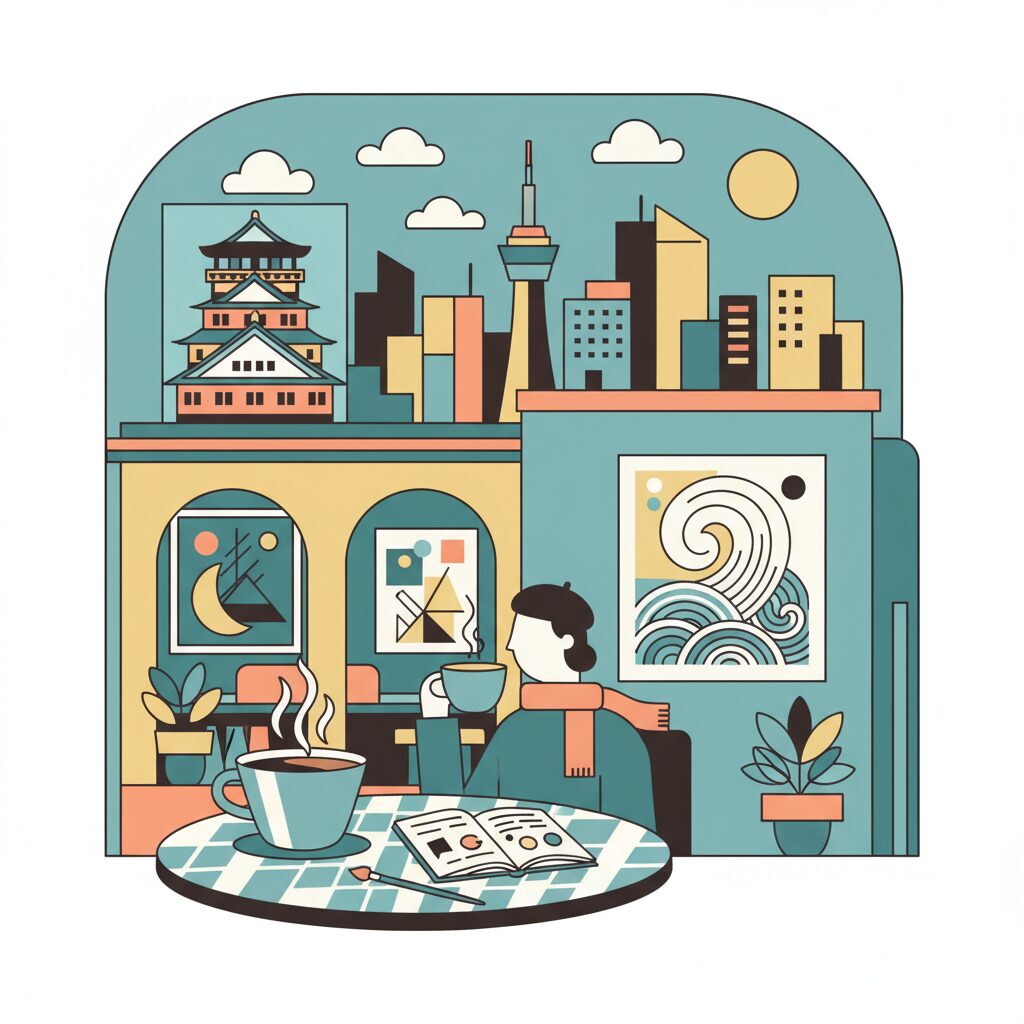
Alongside the emergence of art galleries, another institution has become a hallmark of Kitakagaya: the industrial-chic cafe. These are far from your typical, cookie-cutter chain coffee shops. They serve as destinations in their own right, spaces that perfectly embody the neighborhood’s spirit of resourceful creativity. Sitting in a Kitakagaya cafe means experiencing a blend of past and present, where the scent of freshly ground coffee mingles subtly with the lingering, ghostly aroma of machine oil.
Repurposing with Purpose: The Essence of a Kitakagaya Cafe
Step into a typical cafe here, and you’ll immediately sense a design philosophy focused on revelation rather than renovation. The owners don’t hide the building’s industrial roots; instead, they celebrate them. Concrete floors are polished but left exposed, revealing the cracks and stains accumulated over decades of labor. Steel support beams and electrical conduits remain visible, either painted or raw, becoming key elements of the decor. Furniture is often a brilliant showcase of upcycling: tables crafted from reclaimed wood, chairs formed from scrap metal, light fixtures assembled from old factory parts.
While this aesthetic is trendy worldwide, in Kitakagaya it feels distinct because it arises from necessity and philosophy as much as style. For small business owners in Osaka, this approach is primarily practical. It’s much more affordable than a complete renovation and embraces the mottainai principle by giving old materials a new lease on life. Beyond economics, it’s a deliberate choice reflecting deep respect for the building’s history. It communicates, “This place has a story, and we’re not going to mask it.” This honesty and humility are deeply valued by Osakans. A space that openly shows its character, flaws and all, is considered more genuine and trustworthy than one that adopts a polished, artificial facade.
The “At-Home” Service Style: Less Formality, More Connection
The experience goes beyond the decor. The service style in these independent cafes often mirrors the relaxed, straightforward nature of Osaka communication. You’re less likely to encounter the rigidly polite, almost theatrical customer service common in upscale Tokyo venues. Instead, interactions are more personal and genuine.
The barista might ask where you’re from and naturally strike up a conversation. The owner, often the person taking your order, may offer a recommendation with an honest, unscripted explanation. There’s less of a formal barrier between staff and customer. This can sometimes be misunderstood by foreigners used to a more deferential style of Japanese service. It’s not rudeness or a lack of professionalism; it’s simply a different cultural priority. In Osaka, fostering a genuine, friendly connection is often preferred over executing a flawless yet impersonal service routine. It’s about feeling welcomed into someone’s space, not merely being served as an anonymous patron.
A Menu That Makes Sense
Finally, consider the menu. It rarely features overly complicated, trend-chasing items. The emphasis is on quality and value, or what Japanese call kosupa (cost performance). The coffee is excellent, likely sourced locally and skillfully prepared. The food is satisfying and straightforward: a hearty curry, a well-crafted sandwich on good bread, or a simple yet delicious baked treat. Prices are reasonable.
This approach captures the essence of Osaka’s food culture. Known as kuidaore no machi, the city where you eat until you drop, Osaka’s food culture is not merely about indulgence. It reflects a deep, popular appreciation for food that is both tasty and fairly priced. Osakans have little patience for overpriced, underwhelming fare. A cafe in Kitakagaya survives and flourishes by fulfilling this core promise: honest, quality products in a unique, authentic setting, all at a price that feels fair. It’s the neighborhood’s entire philosophy distilled into a single cup of coffee.
Living in the Juxtaposition: Daily Life in an Art Factory
What truly sets Kitakagaya apart from other “art districts” worldwide is that it hasn’t entirely transformed into one. It is not a fully gentrified area where the original character has been erased in favor of a monoculture of galleries and cafes. Here, the art scene isn’t a replacement but an addition. The factories continue to operate, and the industrial heartbeat of the neighborhood never fully faded. This creates a compelling and sometimes surreal contrast that shapes everyday life here.
The Morning Commute: Welders and Baristas Sharing the Same Train
Stand at Kitakagaya station on the Yotsubashi Line during the morning rush, and you’ll witness the neighborhood’s dual identity in full display. You’ll see young creatives dressed in designer workwear heading to their studios, baristas and gallery staff on their way to open for the day, and alongside them, men clad in grease-stained blue jumpsuits and steel-toed boots, heading to the metalworking shops and small factories that remain the backbone of the local economy. They ride the same trains, buy coffee from the same convenience stores, and acknowledge one another on the street.
This is not a cultural clash but a coexistence. There is a tangible sense of shared space. The artists are not intruders, nor are the factory workers relics. They are simply neighbors, two different industries operating side by side. This integration is essential to understanding Osaka. The city has always been a place of commerce and industry, a working town. Culture in Osaka must find its place within this context; it cannot exist in a sterile, isolated bubble. The presence of active industry keeps the art scene grounded, preventing it from becoming too detached or self-important. It serves as a constant, palpable reminder of the world of work, grit, and practicality from which the neighborhood’s creative energy emerges.
The Soundscape of Kitakagaya: The Rhythm of Machinery and the Murmur of Gallery Openings
To live in or near Kitakagaya is to experience a distinct urban soundscape. The foundation is the persistent hum of industry—the rhythmic clang of a steel press, the high-pitched whine of a cutting tool, the low rumble of delivery trucks. These are the sounds of a neighborhood still engaged in production.
Layered atop this industrial bass are the melodies of the neighborhood’s evolving life. On a weekend afternoon, the industrial hum is often joined by the buzz of conversation and the clinking of glasses spilling out from gallery openings. You might catch the faint strains of a band rehearsing in a converted warehouse or hear the quiet chatter from a cafe patio. The two soundscapes do not drown each other out; instead, they combine into something unique. It’s a symphony of old and new, pragmatic and poetic. This is the reality of living in much of Osaka, a city that rarely tears down its past. Instead, it builds alongside it, on top of it, and within it, creating a complex, layered, and sometimes noisy urban experience worlds away from the curated quiet of many Tokyo neighborhoods.
A Different Neighborhood Dynamic
The relationship between the old-timers—factory owners and longtime residents—and the newcomers is not one of conflict but rather a quiet, practical symbiosis. The artists and gallery owners bring people, attention, and new business to an area that was fading. They occupy empty buildings and breathe life into the streets after the factory whistles blow. In return, the industrial businesses provide an authentic, unchanging backdrop that gives the area its distinct character. They are the anchor preventing Kitakagaya from drifting into the generic sea of global hipster culture.
There is a mutual respect rooted in a shared, unspoken understanding. Both groups are entrepreneurs in their own right—small business owners working to make a living. Factory owners appreciate the gallery owners’ struggles to pay rent and attract visitors, and vice versa. This common foundation in commerce and hard work creates a shared ground that transcends surface-level differences in their professions. It’s a community built not on shared aesthetics but on the distinctly Osakan value of getting things done.
The Kitakagaya Mindset: A Blueprint for Osaka’s Future?
Ultimately, Kitakagaya is more than just a collection of galleries and cafes in an old industrial district. It stands as a symbol—a living, breathing example of a different way to approach cities, culture, and progress. In an era dominated by top-down, hyper-planned urban mega-projects, Kitakagaya exemplifies the power of organic, grassroots development. It offers a counterpoint to the belief that renewal must always involve demolition and that progress must always appear polished.
Organic Growth vs. Top-Down Planning
Osaka is no stranger to mega-projects. The city is investing heavily in the upcoming 2025 World Expo and the development of the Umeda North Yard—initiatives shaped by star architects, large corporations, and meticulous government planning. These efforts aim to showcase a sleek, futuristic, and globally competitive image. Kitakagaya, however, represents the opposite approach.
Its growth was not dictated in boardrooms but driven by the individual choices of hundreds of artists, entrepreneurs, and property owners. It evolved organically, responding to the real needs and aspirations of the local community. This bottom-up method is arguably more resilient and authentic. It created a neighborhood with genuine character, something nearly impossible to replicate through master planning. Kitakagaya serves as a powerful reminder to city planners that sometimes the best way to nurture a vibrant urban space is simply to provide affordable space, reduce bureaucracy, and then step back.
Embracing the “Imperfect”: Osaka’s Answer to Tokyo’s Polish
If one were to distill the core difference in attitude between Tokyo and Osaka, it might be found in their relationship with perfection. Tokyo often pursues a flawless, polished image—a city of impeccable service, pristine public spaces, and a relentless pursuit of the new and perfect. While magnificent and awe-inspiring, it can sometimes feel like there is no room for error, messiness, or the old.
Osaka, as embodied by Kitakagaya, embraces the opposite. It finds strength in imperfection. It sees beauty in rust, character in cracks, and potential in abandonment. It is a city comfortable with its gritty, industrial, and sometimes chaotic identity. It recognizes that a city’s history—even the parts no longer economically productive—is an invaluable asset, offering texture and soul that cannot be recreated.
Kitakagaya is not an anomaly; it is the purest expression of this Osakan spirit. It shows that a world-class creative scene doesn’t require gleaming new buildings. It demonstrates that community can grow from pragmatism and mutual respect. And it proves that the most vibrant future is often fashioned not by erasing the past but by engaging in a creative, ongoing dialogue with it. For those seeking to understand the genuine, living culture of Osaka, skip the tourist traps. Visit Kitakagaya. Walk its wide, quiet streets, and listen to the conversation between the factories and the art. It’s the sound of Osaka’s heart, still beating strong.