Welcome to the electric heart of Osaka, a place where reality feels dialed up to eleven, and the air itself crackles with an energy you can almost taste. This is Dotonbori. It’s not just a street; it’s a sensory explosion, a riotous canal-side theater of life where glowing neon giants dance on the water’s reflection and the scent of sizzling street food becomes the city’s official perfume. For anyone living in or exploring this incredible city, Dotonbori is more than a landmark; it’s a rite of passage. It’s the physical embodiment of Osaka’s soul—loud, unapologetic, and utterly obsessed with good food. Here, a single philosophy reigns supreme, a two-word mantra that defines the local culture: kuidaore. It’s a term famously, and perhaps a little intimidatingly, translated as “to eat until you drop” or “to eat yourself into bankruptcy.” But don’t let that scare you. Kuidaore isn’t about gluttony; it’s a passionate, joyous celebration of life through food. It’s about prioritizing the delight of a perfectly grilled octopus ball, the comfort of a steaming bowl of ramen, the communal joy of sharing a meal over any other earthly possession. In Dotonbori, you don’t just eat to live; you live to eat, and every stall, restaurant, and glowing sign is an invitation to join the feast. This is where Osaka’s vibrant, welcoming spirit is at its most potent, a place to dive in headfirst and discover the delicious chaos that makes this city truly unforgettable. So, loosen your belt, open your mind, and get ready to understand the true meaning of kuidaore in its spectacular, neon-drenched natural habitat.
To truly embrace the kuidaore spirit without worry, it’s wise to plan your culinary adventure with a solid budgeting strategy for Namba.
The Neon River: A Symphony of Sights and Sounds

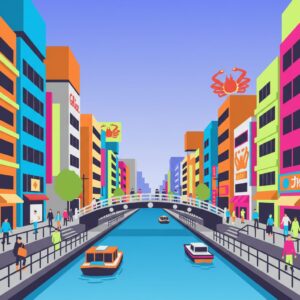
To truly grasp Dotonbori, you must first immerse yourself in its atmosphere, a journey that begins as the sun sets. As dusk cloaks Osaka, Dotonbori ignites in a spectacular display. This is when the district truly awakens, shifting from a busy commercial street to a futuristic, Blade Runner-like spectacle. The abundance of neon lights is astonishing. Massive, three-dimensional sculptures and electronic billboards compete for your attention, their vivid illuminations casting shimmering, kaleidoscopic reflections on the Dotonbori Canal. This is more than just advertising; it’s public art on an extravagant, chaotic scale.
At the heart of this neon jungle stands the unrivaled Glico Running Man. Dominating the skyline above the Ebisu Bridge since 1935, this iconic sign represents more than a confectionery brand; it embodies Osaka itself. Visitors and locals alike pose triumphantly for photos in front of it. The Running Man has endured through wars and witnessed the city’s transformation, his nightly run a steady, reassuring constant. He symbolizes Osaka’s resilience, vitality, and relentless progress. Standing on that bridge, feeling the crowd’s energy and looking up at his familiar figure, you connect deeply with decades of Osaka’s history.
Yet, he’s not alone in this electric panorama. Look around and you’ll encounter a vibrant cast of characters. A gigantic mechanical crab from the Kani Doraku restaurant waves its claws rhythmically, promising delicious, tender crab inside. A huge octopus looms over a takoyaki stand, its tentacles seemingly gripping the building itself. Until recently, a giant pufferfish lantern from the famed Zuboraya floated serenely, a playful reminder of one of Osaka’s most daring delicacies. Though the fugu is gone, its legacy remains, part of Dotonbori’s enduring lore. And then there’s Kuidaore Taro, the beloved red-and-white striped, glasses-wearing drumming clown. He’s been energetically beating his drum since 1950, a cheerful, slightly eccentric mascot for the entire kuidaore spirit. He’s so cherished that when his original restaurant closed, the city couldn’t bear to lose him, and now he proudly serves as Dotonbori’s official greeter.
The soundscape is as vibrant as the sights. There’s the steady, rhythmic beat of Kuidaore Taro’s drum, the sizzle from countless grills, the lively calls of vendors shouting “Irasshaimase!” (Welcome!), the buzz of conversations in numerous languages, and the catchy jingles from nearby stores. It’s a symphony of trade and indulgence, an exhilarating overload that feels more thrilling than overwhelming. Strolling along the canal, with neon lights reflecting on the water and the Tombori River Cruise boats drifting by, you’re not merely a spectator—you become a part of the spectacle.
The Philosophy of Kuidaore: More Than Just a Full Stomach
To truly appreciate Dotonbori, one must understand that kuidaore is a deeply rooted cultural philosophy. This concept emerged from Osaka’s unique history as the “nation’s kitchen” during the Edo period (1603-1868). As the primary center for rice and other goods, Osaka cultivated a powerful merchant class. Though wealthy, these merchants ranked socially below the samurai and were prohibited from displaying their status through extravagant clothing or weaponry. Instead, they poured their wealth and passion into food. They became connoisseurs and patrons of the culinary arts, fostering a culture where the quality and enjoyment of a meal were paramount.
This historical background is essential. Kuidaore isn’t about mindless eating; it’s about a discerning and passionate appreciation of food. It means spending your hard-earned money on an exquisite piece of fatty tuna, a perfectly balanced bowl of dashi, or a carefully crafted skewer, and feeling that every yen was well spent. It reflects the Osakan character—pragmatic, unpretentious, and focused on genuine enjoyment. An old saying distinguishes the great cities of the region: in Kyoto, one indulges in kidaore (ruining oneself on extravagant clothing), in Kobe it’s hakidaore (ruining oneself on fine shoes), and in Osaka, it’s all about kuidaore.
This philosophy is evident in the wide variety and quality of food available at every price point in Dotonbori. You can enjoy a world-class, multi-course meal in an elegant restaurant overlooking the canal or experience an equally satisfying and soul-nourishing time hopping from one street food stall to another. The spirit of kuidaore is democratic; it’s accessible to all. It embodies the communal joy of sharing food, standing shoulder-to-shoulder with strangers around a takoyaki stand, all savoring a moment of simple, delicious pleasure. It encompasses conversations with chefs, the pride they take in their craft, and the honest feedback from their customers. In Dotonbori, food is both the great equalizer and the ultimate form of entertainment.
A Culinary Map: Your Guide to Eating Your Way Through Dotonbori
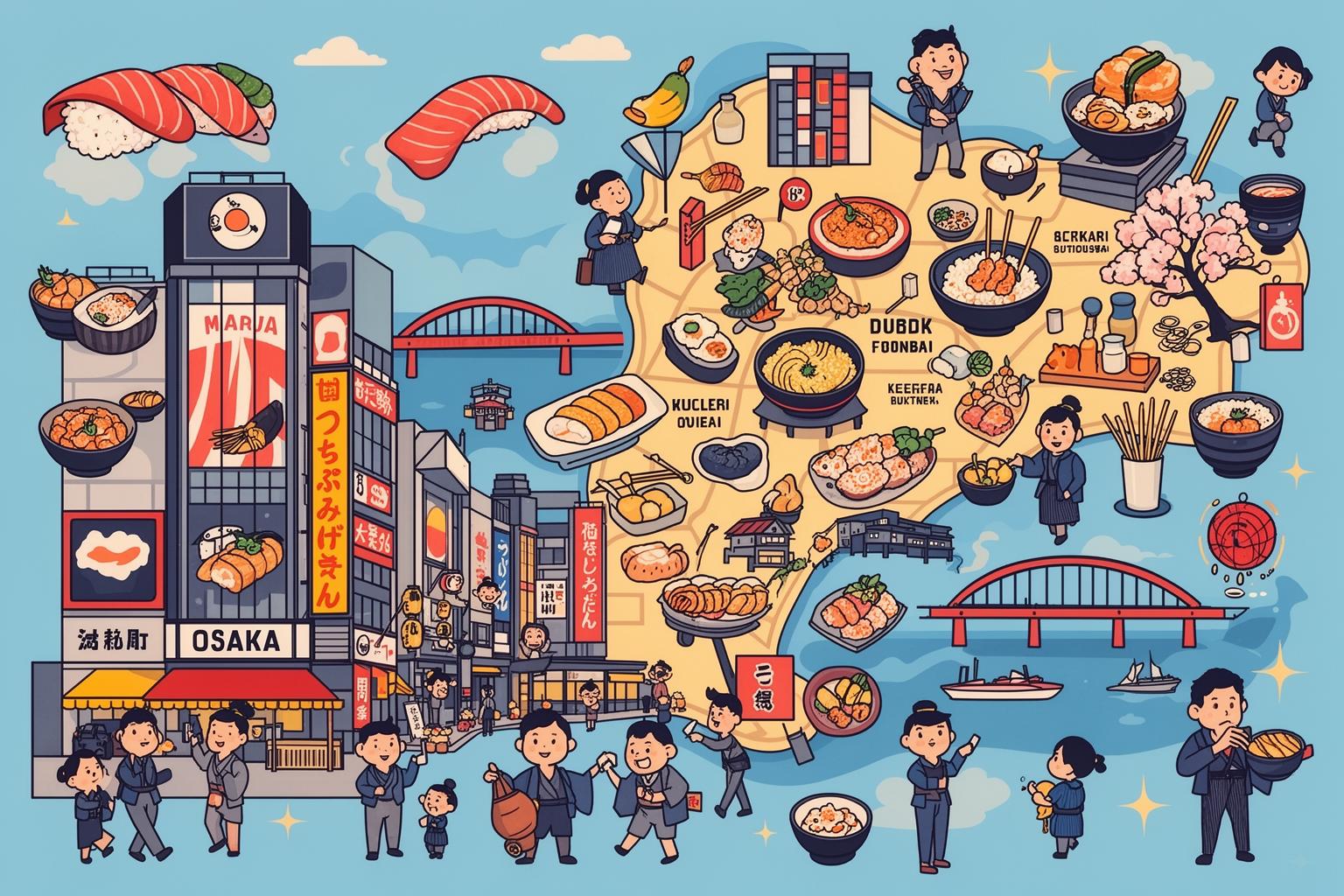
So, where should you start on this epicurean journey? The choices are limitless, but certain quintessential Dotonbori experiences form the foundation of any kuidaore adventure. Consider this your guide to the culinary treasures of Osaka’s kitchen.
The Holy Trinity of Osaka Soul Food
If Osaka has a culinary holy trinity, it’s takoyaki, okonomiyaki, and kushikatsu. These are not just dishes; they are cultural icons, and Dotonbori is the premier place to savor them.
Takoyaki: The Perfect Molten Sphere
First, there’s takoyaki. These are far from ordinary “octopus balls.” Authentic Osakan takoyaki is a masterpiece. A savory batter made from flour, eggs, and dashi is poured into a special cast-iron griddle with hemispherical molds. A tender piece of boiled octopus (tako) is placed in the center of each, followed by pickled red ginger (beni shoga), tempura scraps (tenkasu), and green onion. The magic lies in the cooking technique. With remarkable speed and skill, the vendor uses two long picks to continuously flip the balls, transforming the liquid batter into perfect golden spheres. Ideally, takoyaki has a slightly crisp exterior that gives way to a gooey, molten-hot center. It’s a burst of flavor and texture. In Dotonbori, you’ll find famed shops like Acchichi Honpo by the river and the large Creo-ru, which offers inventive variations. A typical serving comes slathered in tangy, sweet takoyaki sauce, a drizzle of Japanese mayonnaise, a sprinkle of green laver (aonori), and a generous handful of dancing bonito flakes (katsuobushi). Enjoying a fresh-off-the-grill tray of takoyaki while watching neon lights flicker along the canal is perhaps the ultimate Dotonbori experience.
Okonomiyaki: The Savory Pancake You Dream Of
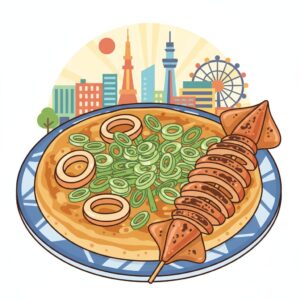
Next up is okonomiyaki, often called a “Japanese savory pancake,” though that hardly does it justice. The name means “grilled as you like it,” emphasizing its customizable nature. The base is a batter mixed with a mound of shredded cabbage and your choice of ingredients—typically pork belly, squid, shrimp, or a mix of all. This glorious stack is cooked on a large flat-top grill called a teppan. In Dotonbori, legendary spots like Mizuno, a Michelin Bib Gourmand recipient often with a line out the door, and Chibo, a larger restaurant with an extensive menu, await. Many places have teppan grills built into your table, allowing you to watch the staff expertly prepare your meal or even try cooking it yourself. When done, it’s brushed with rich okonomiyaki sauce, drizzled with mayonnaise, and topped with aonori and bonito flakes. Each bite delivers a comforting, hearty blend of sweet, savory, and umami flavors, with tender cabbage and your selected fillings offering a deeply satisfying meal. Don’t miss modan-yaki, a popular style featuring a layer of fried noodles inside.
Kushikatsu: The Art of Fried Skewers
Rounding out the trinity is kushikatsu, the pride of Osaka’s Shinsekai district and equally adored in Dotonbori. Kushikatsu features various ingredients—meats, seafood, and vegetables—skewered on bamboo sticks (kushi), coated in a light panko crust, and deep-fried (katsu) to golden perfection. The experience matches the food. Seating at a counter, you order skewers as you go, served piping hot. Before you is a communal container of thin, tangy dipping sauce. Here comes the sacred rule: NO DOUBLE-DIPPING! You dip your skewer once, and only once, then take your first bite. If you need more sauce, use the provided cabbage slice to scoop some up. It’s a matter of hygiene and a respected local custom. The variety is immense, from classic pork loin and shrimp to adventurous choices like quail eggs, lotus root, asparagus, cheese, and even mochi. Paired with a cold beer, a round of kushikatsu at a classic spot like Daruma is a quintessential Osakan social ritual.
Noodle Nirvana and Seafood Spectacles
Beyond the big three, Dotonbori’s culinary scene expands into a realm of noodles, seafood, and countless other delights.
When it comes to ramen, Dotonbori is a battleground of legends. You can’t miss the giant green dragon marking Kinryu Ramen, a 24-hour institution famed for its light, flavorful pork broth ramen, served from street-side stalls where patrons eat standing or on tatami mats. Then there’s Ichiran, renowned for its rich tonkotsu broth and unique “flavor concentration booths,” private cubicles designed to focus solely on your meal, letting you customize everything from noodle firmness to broth richness. For a true Osakan flavor, seek a bowl of kitsune udon. This comforting dish of thick, chewy udon noodles in delicate, umami-rich dashi broth topped with a large piece of sweet and savory deep-fried tofu (aburaage) was invented in Osaka. A place like Imai, just off the main street, has served a legendary version since 1946, offering a refined and historic taste of the city’s noodle culture.
The giant crab at Kani Doraku isn’t just for show—it signals exquisite crab cuisine. Inside, you can enjoy a full kani-kaiseki, a multi-course meal showcasing crab in every form: delicate crab sashimi, grilled crab legs, crab tempura, crab hot pot (kani-suki), and even crab-infused sake. Though a splurge, it perfectly embodies the kuidaore spirit of lavishly indulging in an unforgettable meal. Likewise, while the famous lantern has disappeared, many Dotonbori restaurants still serve fugu (pufferfish). Prepared by licensed chefs who expertly remove toxic parts, fugu is a delicacy prized for its unique, firm texture and subtle flavor. Sampling paper-thin slices of fugu sashimi (tessa) offers a culinary adventure for the daring.
Beyond the Main Drag: Finding Dotonbori’s Hidden Soul
While the main canal walk is an absolute must-see, the true charm of the area emerges when you step just a little off the beaten path. The spirit of old Osaka thrives in the narrow alleyways branching off from the neon-lit main street.
Hozenji Yokocho: A Journey Back in Time
Just a stone’s throw from the dazzling light show of the Glico man lies Hozenji Yokocho, a narrow, stone-paved alley that transports you to another era. The contrast is striking and immediate. The noise of Dotonbori fades away, replaced by the gentle clacking of geta sandals on stone, the warm glow of paper lanterns, and the quiet ambiance of traditional Japan. This alley, running alongside Hozenji Temple, is home to small, intimate restaurants and traditional bars, many of which have been in operation for generations.
At the center of the alley stands the temple itself, housing a renowned statue of Fudo Myoo, a fierce Buddhist deity. Over time, worshippers have poured water over the statue while praying, resulting in the entire figure being covered with a thick, vibrant green moss. Seeing the moss-covered Fudo Myoo, surrounded by incense smoke, offers a calm and spiritual experience that beautifully contrasts with the bustling energy of Dotonbori. Splashing water on the statue yourself is said to bring good luck.
After paying your respects, you can savor the culinary delights of the yokocho. Here, you’ll find Meoto Zenzai, a tiny shop famous for its sweet red bean soup with mochi, a dessert believed to bring happiness to couples. The alley’s eateries specialize in high-quality Japanese cuisine, ranging from exquisite koryori to elegant katsudon. Dining in Hozenji Yokocho offers a different kind of kuidaore—more intimate, refined, and rich in history.
The Theatrical Origins
It’s also important to remember that Dotonbori began in the 1600s as Osaka’s theater district. A local entrepreneur, Yasui Doton, invested his life savings to expand the canal, hoping to create a new entertainment hub. Although he passed away during the Siege of Osaka before the project was finished, his cousins completed the work, and the new lord named the canal “Dotonbori” (Doton’s Canal) in his honor. Theaters featuring kabuki, bunraku puppet shows, and other performances soon lined its banks, accompanied by teahouses and food stalls catering to the crowds. That legacy lives on today. The magnificent Osaka Shochikuza Theatre still stands as a tribute to this history, hosting kabuki and contemporary performances. Nearby, in the broader Namba area, you’ll find the Namba Grand Kagetsu, the headquarters of Yoshimoto Kogyo, Japan’s comedy powerhouse, where you can enjoy manzai (stand-up comedy) and other entertaining shows that highlight Osaka’s renowned sense of humor.
Practical Advice for Your Dotonbori Adventure
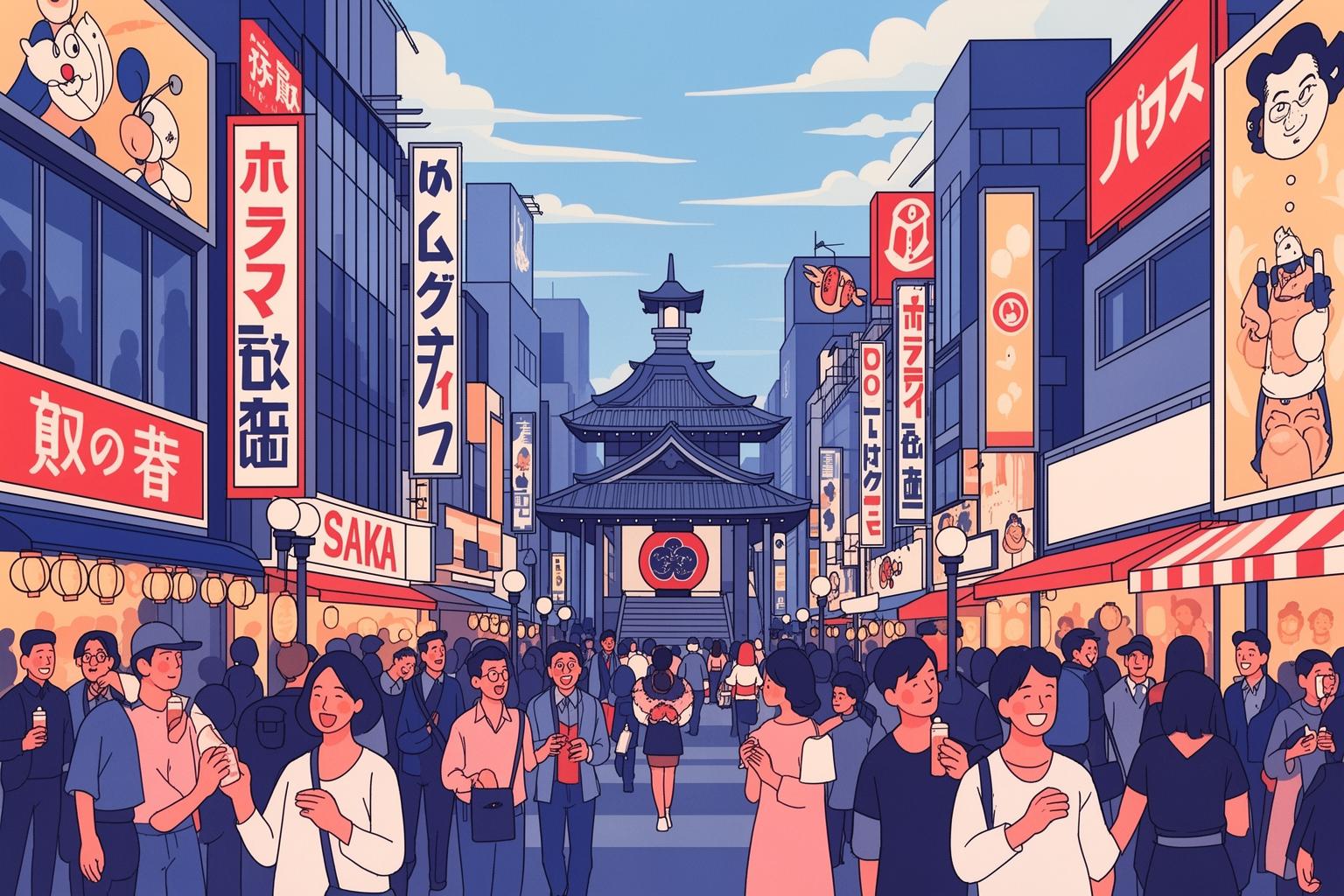
Navigating Dotonbori is part of the enjoyment, but a few tips can help make your visit smoother and even more delightful.
Getting There
Dotonbori is situated in Osaka’s Minami (South) district and is very easy to reach. The nearest and largest station is Namba, a major transportation hub served by several lines: the Midosuji, Yotsubashi, and Sennichimae subway lines, as well as the Nankai, Kintetsu, and JR railways. From any of the Namba stations, it’s just a five- to ten-minute walk to Dotonbori. A helpful landmark to head for is Exit 14 of the subway station, which emerges right near the main Dotonbori bridge.
When to Go
Dotonbori offers two distinct experiences: day and night. Visiting during the daytime provides a slightly quieter, more relaxed atmosphere. The smaller crowds make it easier to explore and appreciate the details of the famous signs and storefronts without the neon lights overpowering them. It’s an ideal time for a calm food tour or shopping in the nearby Shinsaibashi-suji arcade, a large covered street extending north from Dotonbori.
However, to fully experience the iconic charm of Dotonbori, you must visit at night. This is when the district truly comes alive. Neon signs blaze, the energy surges, and the ambiance turns electric. The best time to visit is right after sunset, from around 6 PM onward. Weekend nights tend to be very crowded, so if you prefer a less intense crowd, weekday evenings are a better choice. Regardless of when you go, Dotonbori is always lively and ready for visitors.
Pro-Tips for First-Timers
- Pace Yourself: Enjoy kuidaore as a marathon, not a sprint. Avoid filling up at the first spot you find. Instead, sample small portions from various places. Share a boat of takoyaki, try a couple of kushikatsu skewers, then maybe have some ramen later. This “hashigo-zake” (bar-hopping) style lets you experience the wide variety of food available.
- Bring Cash: While many larger restaurants accept credit cards, smaller street food stalls and ramen shops with ticket machines often only take cash. It’s wise to carry enough yen to avoid any inconveniences.
- Follow the Lines (Sometimes): A long line of locals usually signals delicious, high-quality food. If you spot one, it might be worth the wait. Still, don’t hesitate to be adventurous—some of the best finds are in less crowded places that catch your eye or nose.
- Look Up, Down, and All Around: Dotonbori’s culinary offerings aren’t limited to street level. Many excellent eateries are located upstairs or in basements. Watch for signs and menus directing you to hidden gems above or below.
- Take a River Cruise: For a unique view, try the Tombori River Cruise. This 20-minute boat ride along the canal gives a stunning perspective of the neon signs from the water, providing a relaxing break while still soaking in the vibrant atmosphere.
The Unforgettable Taste of Osaka
Dotonbori is far more than just a collection of restaurants and bright lights. It embodies the living, breathing, sizzling soul of Osaka. It’s a place that perfectly reflects the spirit of its people: warm, lively, genuine, and wholeheartedly dedicated to the enjoyment of good times and great meals. Walking these streets means joining a centuries-old tradition of celebrating life through food. It’s a space to shed your reservations, follow your senses, and immerse yourself in the delicious, beautiful chaos.
So, arrive with an empty stomach and an open heart. Be ready to explore, taste, and experience the pure, unfiltered joy of kuidaore. Stand on the Ebisu Bridge, strike your best Glico Man pose, and then turn your gaze to the endless feast that lies ahead. Whether this is your first visit or your fiftieth, Dotonbori always offers a new flavor to savor, a new sight to admire, and a new memory to create. This is Osaka at its most vibrant, welcoming, and irresistibly delicious.