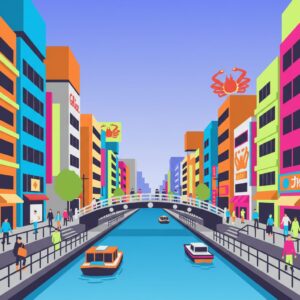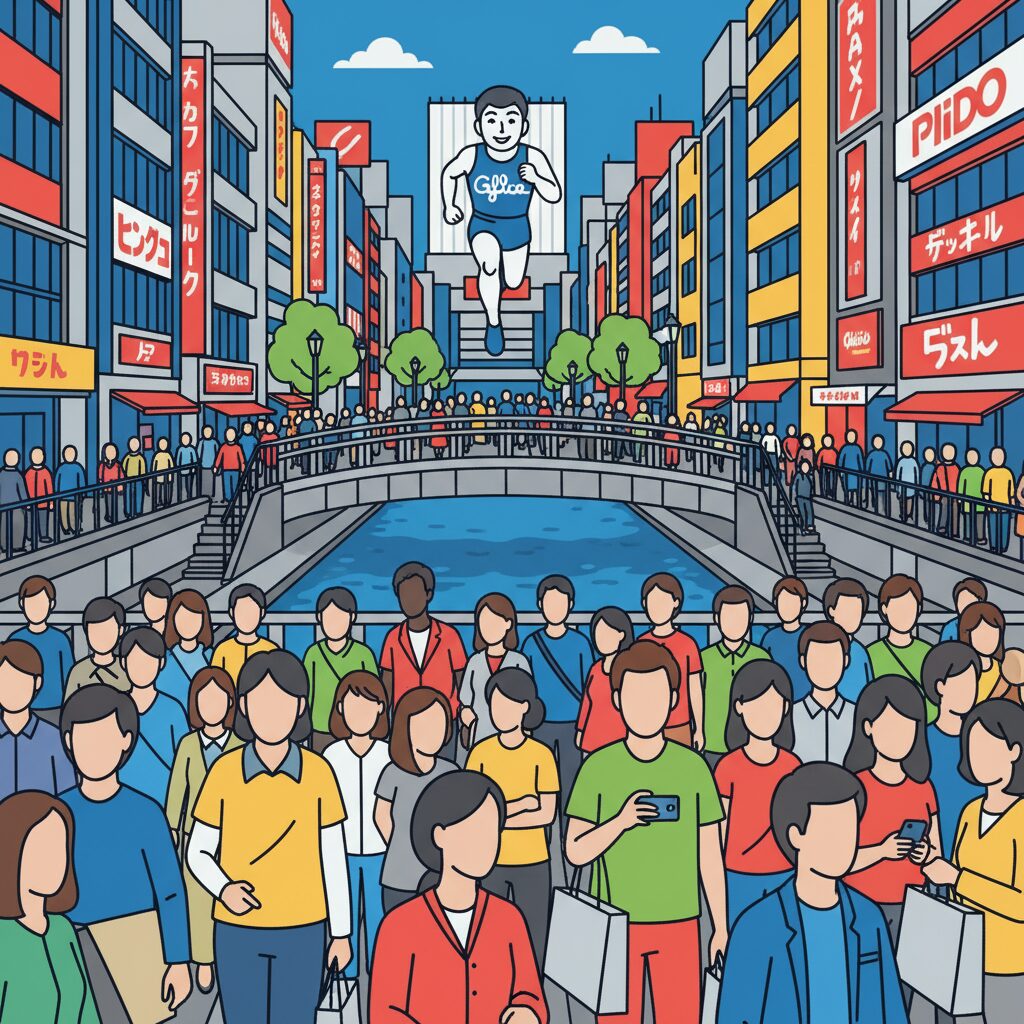
It hits you first as a wave of sound, a chaotic symphony of a thousand different conversations crashing against the tinny jingles of pachinko parlors and the sizzle of hot oil. Then comes the light, a relentless neon assault that paints the night sky in hues of electric blue, screaming magenta, and radioactive green. Giant crabs wave their mechanical claws, a pufferfish lantern glares down with puffy indignation, and a runner, frozen mid-stride for decades, holds his victory pose over the dark, reflective waters of the canal. This is Dotonbori on a Saturday night. It’s not just a place; it’s a sensory overload, a human river flowing with an unstoppable current. For a newcomer, the first instinct is to brace for impact, to fight the tide. But if you’re thinking of living here, of making Osaka your home, you have to learn to swim. Because what looks like pure, unadulterated chaos from the outside is actually a masterclass in the Osakan way of life. It’s a complex, unwritten dance, and understanding its steps is the key to understanding the heart of this city. This isn’t a tourist guide about the best takoyaki stand—it’s a deep dive into the beautiful, baffling, and utterly human machinery that makes Osaka tick, all revealed within the brilliant mess of its most famous street.
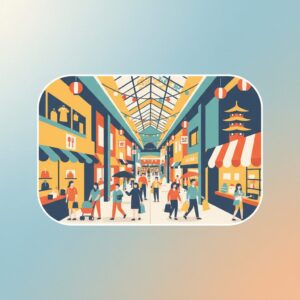
To truly understand this city’s rhythm, you must also explore the quieter, covered arteries of Osaka’s vibrant shotengai.
The Symphony of Chaos: Deconstructing the Dotonbori Crowd
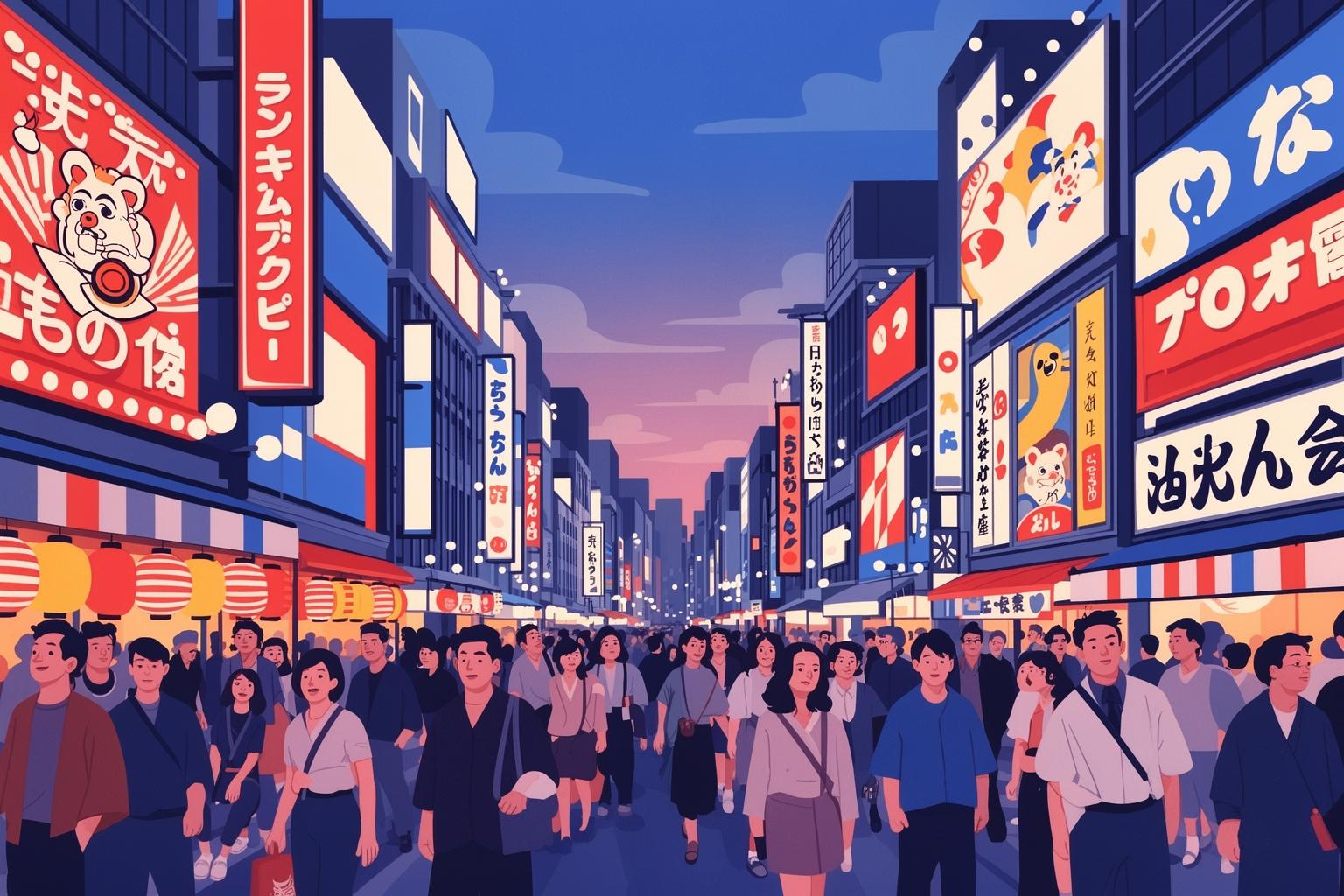
To the untrained eye, the crowd appears as a single, monolithic entity—a formidable mass of humanity. But spend enough time observing, and you begin to discern the individual currents and eddies. You learn to distinguish the various elements that compose this human flood, and in doing so, you start to perceive the city not as an obstacle course, but as a living, breathing organism.
More Than Just Tourists: The Local Presence
A common misconception is to regard Dotonbori as a space solely for tourists. While they certainly comprise a significant portion of the crowd, especially on the main Ebisubashi bridge, look more closely. You’ll notice groups of high school students in their dark gakuran uniforms, laughing and taking selfies, their youthful energy sharply contrasting with the ancient canal beneath them. You’ll see young couples, impeccably dressed for a date night, skillfully navigating the crowds, heading toward a specific restaurant tucked away in a side alley. There are groups of friends, fresh from a day of shopping in nearby Shinsaibashi, planning their next move for the evening. And, naturally, the ever-present salarymen, their ties slightly loosened, their boisterous laughter echoing as they stagger from one izakaya to the next.
This distinction is crucial compared to, for example, Tokyo’s Shibuya Crossing. While Shibuya is an iconic intersection, its primary role is transit. People are moving through it, on their way elsewhere. It feels anonymous, a place of constant motion but little lingering. Dotonbori, despite its busyness, is a destination. It serves as a social hub, a stage where the city’s various communities converge. For many young Osakans, it is the default setting for their social lives. It’s the place where you meet before deciding where you’re really headed. This blend of local social life and international tourism creates a unique dynamic—a space that is simultaneously a global landmark and a neighborhood hangout.
The Unspoken Rules of Movement
So how do tens of thousands of people navigate this narrow space without constant collisions and gridlock? They perform the Osaka Shuffle, an intuitive, fluid style of movement that sharply contrasts with the rigid, lane-based pedestrian traffic typical of Tokyo. In a Tokyo subway station during rush hour, people walk in unspoken but clearly defined lanes. You keep to the left, follow the person ahead, and maintain a steady, predictable pace. It’s efficient, orderly, and deeply rooted in the principle of not inconveniencing the group.
Osaka tosses that rulebook aside. Here, movement is a reactive, improvisational dance. It’s less about adhering to a predetermined path and more about reading the immediate environment. People don’t walk in straight lines; they weave. They anticipate others’ movements several steps ahead. A slight turn of a shoulder, a glance in a particular direction, the way someone shifts their shopping bag—these are all signals. An Osakan moving through Dotonbori processes hundreds of these micro-cues every minute, adjusting their own trajectory through a constant stream of subtle corrections.
There are no sudden stops. If someone needs to pause to check a menu or look at their phone, they don’t freeze in the middle of the flow. They drift toward the edge, like debris settling on the riverbank, allowing the main current to keep moving unimpeded. This physical behavior reflects a broader cultural mindset. It emphasizes situational awareness and adaptability rather than strict adherence to formal rules. The collective good remains paramount, but it is achieved through active, mutual negotiation of space rather than passive conformity.
The Soundscape of the Crowd
Close your eyes for a moment in the heart of Dotonbori. The noise isn’t just a deafening roar; it’s a rich, layered soundscape. You can pick out the distinct staccato rhythm of Kansai-ben, the local dialect, with its rising intonations and vivid affirmations. You’ll hear Mandarin, Korean, English, and a dozen other languages, a testament to the area’s global appeal. Beneath that lies the percussive soundtrack of the district itself: the sizzle and pop of gyoza frying, the rhythmic chopping of cabbage for okonomiyaki, the automated, endlessly looping jingle of a Don Quijote store, and the cheerful, full-throated shouts of “Irasshaimase!” from every shopfront.
Osaka is a city comfortable with noise. In many parts of Japan, especially Tokyo, public spaces often bear a respectful, almost sacred quiet. A crowded Tokyo train can be eerily silent. In Osaka, silence is frequently perceived as a vacuum to be filled with conversation, laughter, or at least ambient commercial sounds. The constant auditory stimulation of Dotonbori isn’t viewed as a nuisance by locals; it’s a sign of life, energy, and commerce. It’s the city’s heartbeat made audible. This tolerance for a higher decibel level in daily life is something newcomers must adjust to. It’s a city that communicates openly, loudly, and with wholehearted expression.
The Osakan Mindset on Display: Reading the Social Cues
The manner in which people move through the physical space of Dotonbori directly mirrors how they navigate their social environment. The principles that keep the crowd from turning into a chaotic crush are the same ones that shape the Osakan character.
“Nantoka Naru”: The Philosophy of “It’ll Work Out”
A phrase commonly heard in Osaka is nantoka naru, which roughly means “it’ll work out somehow” or “we’ll figure it out.” This philosophy embodies pragmatic optimism and a belief in improvisation over strict planning. It sharply contrasts with the Tokyo mindset, which often values careful preparation and strict scheduling. In Tokyo, the plan takes precedence. In Osaka, the outcome matters most, and the route to reach it can be flexible.
Within the Dotonbori crowd, this attitude shows as a collective calm. No one panics about the density. There’s an unspoken confidence that the flow will continue, gaps will form, and everyone will eventually reach their destination. If you accidentally bump someone, their reaction is telling. In Tokyo, it’s usually a sharp intake of breath, a quick, almost mechanical bow, and an immediate withdrawal. The encounter is minimized to avoid further trouble. In Osaka, the same bump might spark a more human response: “Uwa, gomen gomen!” (“Whoa, sorry, sorry!”), often accompanied by a wry smile or shared laugh. The apology is sincere but wrapped in casual camaraderie. This brief moment shifts from a minor social faux pas into a shared human experience. The belief that things will work themselves out cultivates a more relaxed, less tense public atmosphere, even in the densest crowds.
The Art of the Approachable Barrier
In a city as crowded as Osaka, personal space is a rare commodity. In Dotonbori, it’s practically nonexistent. So how do people maintain a sense of self when constantly pressed shoulder-to-shoulder with strangers? They create an “approachable barrier”—a psychological bubble formed through subtle body language. It’s not a cold, exclusionary shield like you might find in other big cities where avoiding eye contact signals unavailability. Instead, it’s a flexible, permeable boundary.
Observe an Osakan waiting for a friend. Their body might be angled slightly away from the main traffic flow. They may be focused on their phone, yet their awareness is clearly outward. Their bag isn’t gripped defensively but held in a way that gently defines their personal space. This bubble communicates, “I’m in my own world, but I’m aware of you.” It’s a barrier that can be instantly removed. If someone needs to pass, a simple “sumimasen” (excuse me) prompts an immediate adjustment—elbows pulled in, body pivoted. The barrier disappears and then quickly reforms. This skill is essential to life in Osaka. It’s about being present and self-contained without shutting others out. It also explains the famous Osakan friendliness: people are open to interaction but won’t intrude. The default mood is friendly neutrality, ready to engage when invited but content to coexist in close quarters.
The Role of Humor and Banter
Humor is the lubricant of Osaka’s social dynamics. It’s a communication tool, a way to build rapport, and a crucial stress-reliever. In the crush of Dotonbori, it’s everywhere. Vendors tease customers over their hesitation, friends loudly rib each other, strangers share laughs over near-misses with bicycles. This is perhaps the most striking difference for those from other parts of Japan. Public humor, especially among strangers, is far more common here.
This tradition is rooted in Osaka’s past as a city of merchants and entertainers. Manzai, the Japanese style of stand-up comedy, has its roots here. The ability to deliver a quick, witty retort (tsukkomi) is a prized social skill. Within the Dotonbori crowds, humor humanizes the experience. It turns potentially stressful moments into shared amusement. It reminds everyone that beneath the anonymity of the crowd, they are individuals engaged in a somewhat absurd collective ritual. It’s a way of saying, “Isn’t this crazy? But we’re all in it together.”
Dotonbori as an Economic and Social Engine
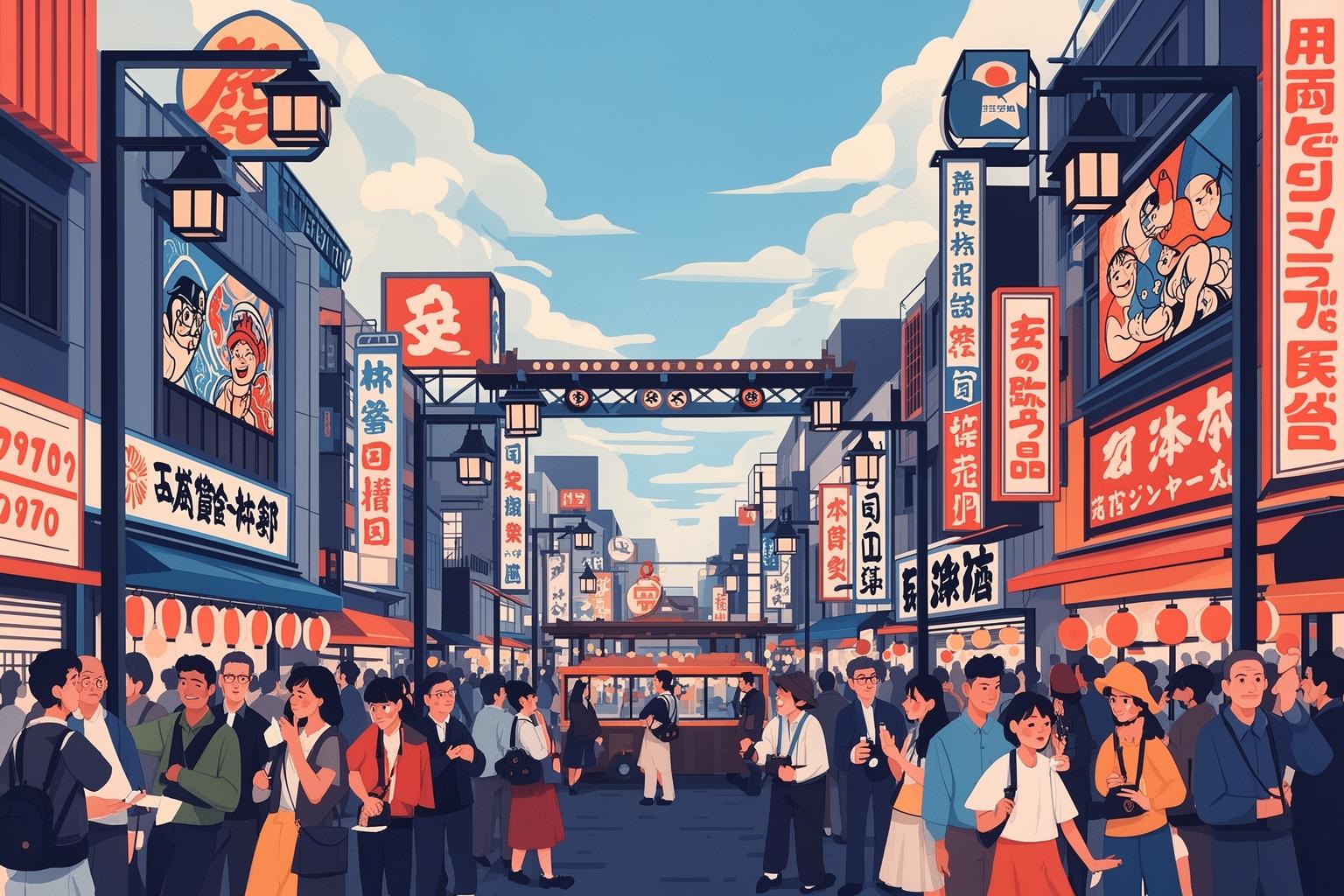
To truly understand Dotonbori, you need to recognize that it’s more than simply an entertainment district; it stands as the most vibrant embodiment of Osaka’s commercial spirit. The city’s identity is deeply intertwined with business, trade, and the art of negotiation.
The Merchant’s Mentality: “Shobai” in the Streets
Shobai is the Osakan term for business, but it holds a richer meaning than its English counterpart. It conveys a certain spirit—a mix of shrewdness, showmanship, and a commitment to offering value for money. Dotonbori serves as a living museum of shobai. The enormous, three-dimensional signs—a cow representing a yakiniku restaurant, a hand holding a piece of sushi, an octopus for takoyaki—are a form of bold, visual advertising with roots stretching back centuries. The aim isn’t subtlety or elegance; it’s to grab attention, be unforgettable, and attract customers.
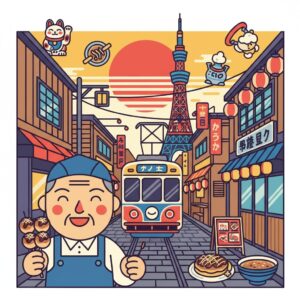
The vendors themselves excel at this performance. Observe a takoyaki chef at work. It’s a whirlwind of movement, a precisely timed routine of pouring batter, dropping in octopus, and flipping the dough balls with two sharp picks at lightning speed. But it’s more than just efficiency. They often maintain a lively commentary, chatting with customers in line, joking, and building anticipation. This is shobai. The product is takoyaki, but the experience is the spectacle.
For locals, this isn’t viewed as tacky or unsophisticated. It’s a point of pride. It connects them to the city’s history as the “nation’s kitchen,” the bustling port that supplied Japan during the Edo period. This direct, unapologetic approach to commerce permeates life in Osaka. People negotiate more frankly, focus more on practicality, and are less concerned with formalities than their Tokyo counterparts. In Osaka, good business is honest, straightforward, and served with a splash of personality.
“Kuidaore”: Eating Until You Drop, a Social Ritual
The famous Osaka phrase kuidaore is often translated as “eat until you drop,” suggesting a kind of indulgent gluttony. While that aspect exists, its deeper meaning is more about community. Food is the primary medium for social interaction in Osaka. Business deals are closed over okonomiyaki, friendships are built over shared plates of kushikatsu, and family outings center on deciding which food stall to try next.
In Dotonbori, this ritual is on full display. You rarely see people eating alone. Food is meant to be shared. Groups gather around small, standing-only tables, passing dishes back and forth. Eating on the street, waiting in long lines together, breaks down usual social barriers. You might start a conversation with the person next to you in line, exchanging tips on what to order. The food vendor temporarily becomes part of your social circle.
This explains why a local living just a few blocks away will still brave the Dotonbori crowds. They aren’t just seeking food; they are engaging in a central ritual of their city’s culture. They reaffirm their identity as an Osakan. The concept of kuidaore is not merely about eating; it’s about connection. It reflects the idea that a shared meal, no matter how simple, forms the foundation of a strong community.
A Foreigner’s Misunderstandings vs. Daily Reality
For anyone thinking about relocating to Osaka, Dotonbori can evoke both fascination and apprehension. It’s easy to jump to conclusions based on its peak-season intensity, but living in and around this landmark presents a more complex reality.
Misconception: “It’s Just a Tourist Trap”
Undoubtedly, Dotonbori is a world-famous tourist hotspot. Yet dismissing it as a “trap” that locals avoid is a fundamental misconception. For residents, Dotonbori serves as an essential urban utility. It’s a key meeting point and the default answer to “Where should we meet in Namba?” It’s also a dependable place to entertain out-of-town guests. For younger Osakans, its bridges are popular spots for nanpa, the Japanese art of flirtatiously approaching strangers.
While locals may not frequent the main street every weekend, they continually orbit around it. The true treasures—the small, specialized bars, hidden ramen shops, and generations-old jazz kissaten—are tucked away in the dense network of streets just beyond the neon lights. Dotonbori acts as the vibrant, noisy gateway to the deeper, more intricate social scene of the Minami district. Locals feel a strong sense of ownership over it, often saying: “Yeah, it’s wild, but it’s our wild.” It’s a chaotic yet cherished part of their urban backyard.
Misconception: “The Crowds Are Unsafe and Aggressive”
In many Western countries, crowds this dense often come with an undercurrent of tension and a risk of aggression or petty crime. However, Dotonbori is remarkably safe due to deeply ingrained social cohesion and unspoken conduct rules. There is an implicit trust that people will act considerately, even in the chaos. Pushing and shoving are exceedingly rare.
What might seem like aggression is often just Osakan directness. The vendor shouting to promote his goods isn’t angry; he’s drawing attention to his products. The person who slips into a narrow gap ahead of you isn’t being rude; they are following local norms of fluid movement. It’s expected you’ll do the same when opportunity arises. The social contract operates differently here. It’s less about strict queuing and more about a dynamic, opportunistic flow. Once you grasp this, you stop seeing these actions as breaches and begin to understand them as part of the local rhythm.
Navigating as a Resident: The Local’s Strategy
So how do those who live or work in the area manage this daily? They develop a different mental map of the neighborhood. Instead of focusing on the main thoroughfare, they see the network of escape routes and side paths.
For example, they avoid the busy Ebisubashi bridge, opting for the less congested Tazaemonbashi bridge just a block away. They know that by passing through the Namba Walk underground shopping center, they can bypass street-level crowds entirely. They’re intimately familiar with the narrow yokocho (side alleys) running parallel to the main canal, which offer quieter, quicker passage. But the most important strategy is timing. Residents understand that Dotonbori at 3 PM on a Tuesday feels completely different from 8 PM on a Saturday. They run errands, do their shopping, and meet friends during these off-peak hours, leaving the weekend chaos to tourists. Living here means learning the city’s rhythms—knowing when to engage with its frenetic energy and when to retreat to its quieter corners.
Dotonbori as a Metaphor for Osaka
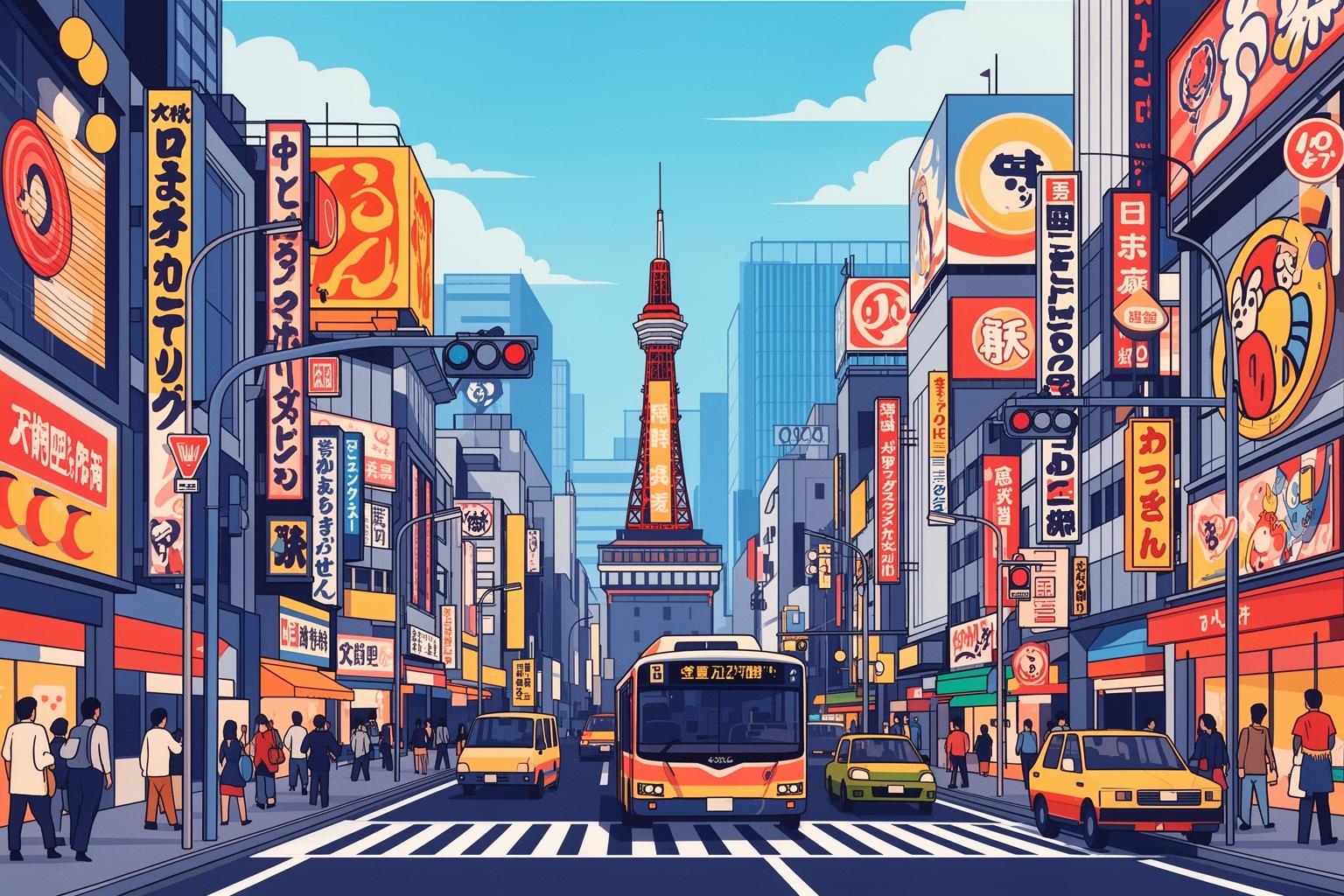
In the end, Dotonbori is more than just a place to visit; it serves as a living metaphor for the city of Osaka itself. If you can come to appreciate and understand the beautiful chaos of this single district, you are well on your way to grasping the soul of the entire city.
Loud, Direct, and Unapologetic
Osaka is not a city of subtlety. Much like the glaring neon lights of Dotonbori, its character is bold, bright, and unapologetically in-your-face. Its people tend to be more emotionally expressive, more direct in their speech, and quicker to laugh than those in other Japanese cities. There is a clear absence of pretense—what you see is generally what you get. While this honesty can be startling at first, it ultimately feels refreshing. The city doesn’t conceal its commercial nature or its rough edges; instead, it showcases and celebrates them. Osaka is unapologetically itself.
A City of Layers, Not Surfaces
Beneath its surface chaos, Osaka is a city of remarkable depth and contrast. Just a two-minute stroll from the sensory overload of the main Dotonbori strip lies Hozenji Yokocho. This narrow, stone-paved alleyway feels like a step back in time. The air is still, filled with the scent of incense and grilled fish. The harsh neon glare gives way to the soft, warm glow of paper lanterns. At its heart stands Hozenji Temple, home to the renowned Fudo Myo-o statue, entirely covered in a thick, green moss grown from countless prayers and splashes of water from worshipers.
This striking contrast captures the essence of life in Osaka. It is a city made up of endless layers. The skill you develop as a resident is learning to navigate between them. You can experience the height of modern, frenetic urban life and, moments later, discover a pocket of deep tranquility and tradition. The city is neither one nor the other; it is both, existing simultaneously. The noise of Dotonbori only makes the quiet of Hozenji Yokocho feel more sacred.
Embracing the Human Mess
Ultimately, Dotonbori’s greatest lesson is about embracing humanity in all its messy, vibrant, and unpredictable glory. Tokyo may aim for sleek perfection, and Kyoto may curate historical beauty, but Osaka is comfortable with the untidiness of real life. It is a city built by merchants, comedians, and hustlers. It values human connection, hearty food, and a good laugh over pristine order and quiet contemplation.
Living in Osaka means learning to find beauty in that mess. It means immersing yourself in the human river, not just watching from the bank, but moving as part of the current. It’s about understanding that the energy of the crowd is the city’s energy—a powerful, creative, and endlessly fascinating force. To live here is to learn that sometimes, the most rewarding path is not the most orderly one, but the one that is most alive.