In the vibrant, pulsating heart of Osaka, a city that famously lives by the creed of kuidaore—to eat oneself into ruin—there lies a street that is the very engine room of this gastronomic paradise. It’s not a place of glittering neon signs promising fleeting culinary thrills, but something far more fundamental, more enduring. This is Sennichimae Doguyasuji Shopping Street, a covered arcade stretching 150 meters, a sacred corridor dedicated entirely to dogu, the tools of the trade. To walk its length is to trace the veins of Japan’s culinary culture, to feel the heft of its history in your hand, and to understand that here, in this city’s kitchen, the craft of the tool is as revered as the art of the meal itself. For the chef, the home cook, or the curious traveler, Doguyasuji is not merely a shopping destination; it is a pilgrimage. It is the place where the functional becomes the philosophical, where a simple knife is a legacy, and a ceramic bowl is a universe. This street is the quiet, humming soul behind Osaka’s roaring appetite, and its story is one of dedication, precision, and the profound beauty found in the implements that bring food to life.
To further explore the culinary artistry that these tools help create, consider the innovative vegan haute cuisine found in nearby Shinsaibashi.
The Pulse of the Arcade: An Atmosphere Forged in Steel and Clay

Entering Sennichimae Doguyasuji feels like stepping into another dimension within Osaka’s already vibrant Namba district. The rowdy energy of nearby Dotonbori, with its giant crabs and running men, fades away. Here, the atmosphere is more concentrated, more inward. The air itself seems different—heavier, infused with the faint, metallic scent of sharpened steel from the knife shops, the earthy smell of unglazed pottery, and the clean, woody aroma of cypress masu boxes and hinoki cutting boards. The sounds compose a distinct symphony. Rather than pop music, you hear the rhythmic shing, shing, shing of a master sharpener drawing a blade across a whetstone, a sound as meditative as a temple bell. You catch the gentle clatter of ceramic bowls being stacked, the rustle of paper as purchases are carefully wrapped, and the soft, respectful murmur of conversation between shopkeepers and professional chefs discussing the nuances of a pan’s heat distribution or a knife’s balance.
The visual scene is one of overwhelming, yet orderly, density. Shops are crammed from floor to ceiling, their goods spilling into the arcade in a cascade of function and form. Mountains of bowls in every imaginable color, glaze, and texture form intricate mosaics. Walls of knives sparkle under fluorescent lights, their polished blades arranged like a metallic tapestry, each with its own purpose and story. You’ll notice towering stacks of ramen spoons, forests of bamboo chopsticks, and rows upon rows of cast-iron takoyaki grills, their hemispherical indentations ready to cradle Osaka’s most famous street food. Lanterns of every size, from grand red chochin hanging outside exclusive ryotei to smaller ones for modest izakayas, add bursts of color and tradition. It is a place best savored at a slow pace. Rushing through Doguyasuji would be like trying to read a library while sprinting past the shelves. You must pause, observe closely, and let the sheer variety and specialization of the objects sink in. This is not a street of souvenirs; it is a living, breathing catalog of Japan’s material food culture, where every object has a purpose and a legacy.
Echoes of the Merchant City: The Historical Roots of a Culinary Artery
To truly appreciate Doguyasuji, one must grasp its place within Osaka’s history. For centuries, Osaka has been Japan’s commercial hub, earning the nickname Tenka no Daidokoro, or “The Nation’s Kitchen,” during the Edo period. It was here that rice and various goods from across the country were collected, stored, and distributed. This heritage as a center of commerce and consumption nurtured a practical, straightforward culture that also gave rise to an exceptionally refined food scene. People in Osaka, from affluent merchants to ordinary laborers, developed a keen palate and a strong appreciation for quality food.
Doguyasuji’s history is closely linked to this development. The street’s origins date back to the Meiji era, around the late 19th and early 20th centuries. It initially served not as a dedicated kitchenware arcade but as a route connecting two important spiritual and commercial sites: Hozenji Temple to the west, known for its famous moss-covered Fudo Myo-o statue, and Shitennoji Temple, one of Japan’s oldest, to the east. Merchants and pilgrims traveled this path, and stalls naturally appeared to serve them. Over time, as the nearby Namba and Sennichimae districts grew into a major entertainment and dining area, the shops along this route began to specialize. They started offering tools needed by the increasing number of restaurants, teahouses, and food stalls. The name Doguyasuji, meaning “Tool Shop Street,” reflects its natural evolution into a professional district.
The covered arcade, or shotengai, was constructed in the post-war period, cementing its identity and providing a sheltered, focused space for sellers and buyers alike. It became the one-stop destination for anyone starting a restaurant in Osaka, and by extension, throughout the Kansai region. This history is tangible. Many shops are family-run businesses passed down through generations. The expertise of a third-generation knife seller or a fourth-generation pottery merchant is vast. They are not mere retailers but custodians of their craft, advisors who can guide a young chef to the precise tools that will shape their career. This strong bond with the city’s culinary professionals gives Doguyasuji its genuine, unpretentious character. It was built by specialists for professionals, and that core identity endures, even as it warmly welcomes curious travelers and passionate home cooks from around the world.
The Soul of the Craft: Exploring the Treasures of Doguyasuji
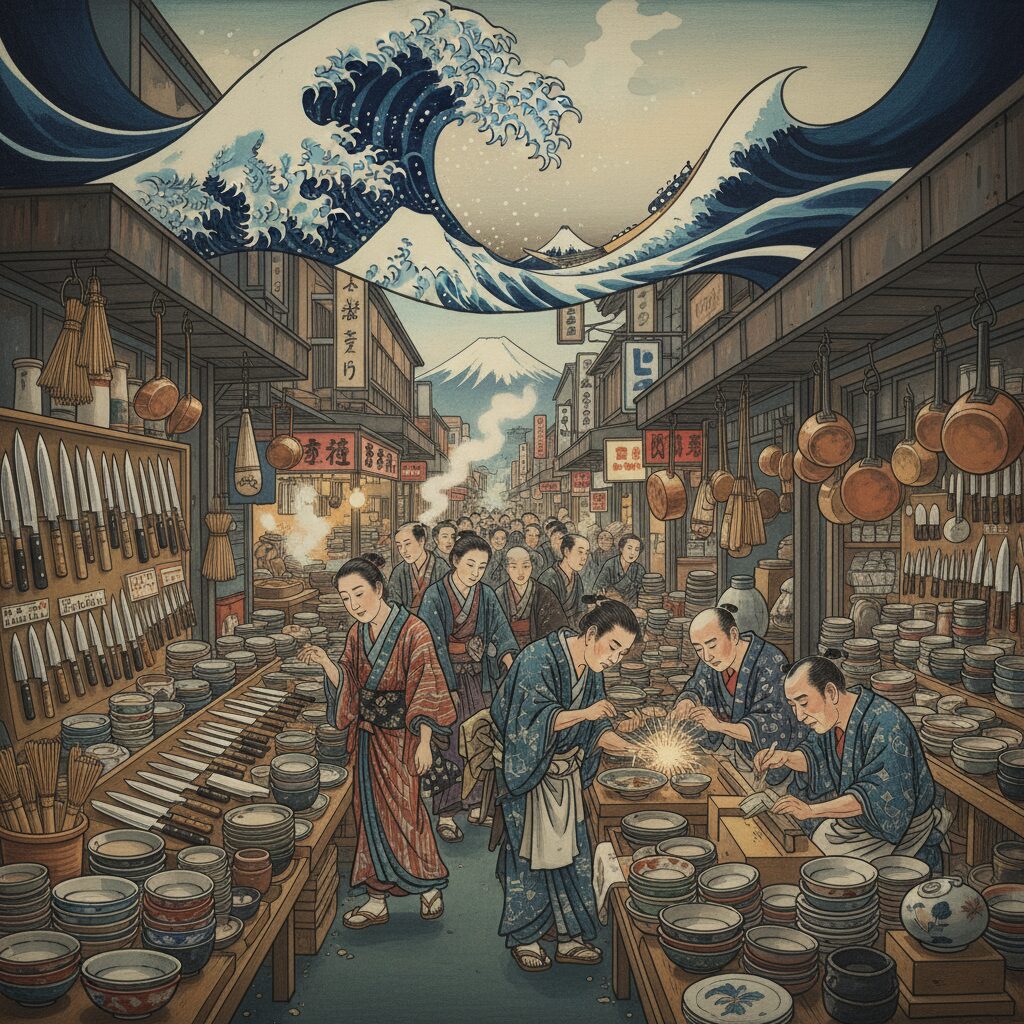
The true enchantment of this street stems from the objects themselves and the remarkable craftsmanship they embody. Each shop—whether focusing on blades, ceramics, or even plastic food replicas—offers a deep immersion into a distinct aspect of Japanese artisan culture. It’s an exploration into a realm where precision, patience, and profound respect for materials hold the highest value.
Hōchō: The Samurai Sword of the Kitchen
The essence of Japanese craftsmanship is most vividly expressed in the knife shops of Doguyasuji. Entering a store such as Ichimonji Chuki or Sakai Tohji feels almost sacred. The range of knives available is astonishing. This isn’t about just a simple chef’s knife; it’s about a comprehensive collection of specialized blades, each perfected over centuries for a particular purpose.
There’s the yanagiba, a long, slender slicer named for its “willow leaf blade” shape. Its single-bevel edge is crafted to slice through raw fish for sashimi with a single pulling stroke, maintaining the integrity of the flesh and producing a glossy, flawless surface. Then comes the deba, a thick, heavy cleaver designed for butchering and filleting whole fish, with enough weight to cut through bones and cartilage effortlessly. The usuba is a rectangular vegetable knife with an ultra-thin edge, ideal for making paper-thin daikon radish sheets (katsuramuki) or performing delicate decorative cuts. More versatile knives include the santoku, the quintessential Japanese all-round kitchen knife, whose name means “three virtues” (slicing, dicing, and mincing), and the gyuto, a Japanese adaptation of the Western chef’s knife, often lighter and crafted from harder steel.
From my perspective, coming from a culture where the Chinese chef’s cleaver is an all-purpose tool, the extreme specialization of Japanese hōchō is fascinating. It reflects a culinary philosophy devoted to excellence in a single task. The craftsmanship shares roots with samurai sword-making traditions. These blades are often forged from laminated steel, featuring a core of extremely hard carbon steel (hagane) clad by softer iron or stainless steel (jigane). This construction yields a blade that retains a razor-sharp edge while offering flexibility and durability. The handles (wa-handles) are typically made of magnolia wood, which is lightweight and water-resistant, often fitted with buffalo horn ferrules. Holding one of these knives feels like an extension of your own hand, perfectly balanced. The shopkeepers are experts in their own right, asking about your cooking style, whether you’re right- or left-handed, and your budget, guiding you toward the ideal knife. They often offer blade engraving, forging a personal bond between user and tool. This is an investment not merely in steel, but in a lifetime of enhanced culinary skill.
Utsuwa: The Canvas for the Meal
Presentation holds immense significance in Japanese cuisine, and the vessel (utsuwa) is valued as highly as the food it carries. The pottery and porcelain shops in Doguyasuji stand as a testament to this philosophy. They are veritable libraries of form, color, and texture, showcasing ceramic traditions from kilns throughout Japan. You’ll encounter the rustic earthy hues of Bizen ware, the delicate blue-and-white patterns of Arita porcelain, and the warm, adaptable glazes of Mino ware.
What stands out is the vast diversity of shapes and sizes, each crafted with a specific dish in mind. Tiny plates for a single piece of tsukemono (pickles), deep, elegant bowls for ramen, small handled cups for chawanmushi (steamed egg custard), and rectangular plates for grilled fish all find their place. The philosophy of wabi-sabi—an appreciation for imperfection and transience—is often evident in the ceramics. Slightly irregular shapes, subtle crackles in the glaze, or asymmetrical designs are not viewed as flaws but as character marks, reminders of the human hand behind the work. Lacquerware, or shikki, offers a contrasting aesthetic. Bowls and boxes coated with refined layers of tree sap are incredibly lightweight, durable, and possess a deep, lustrous shine. Miso soup served in a lacquer bowl offers a wholly different experience from one in ceramic; the lacquer retains heat without becoming hot to the touch, and its smooth finish against the lips enhances the sensory enjoyment.
Selecting utsuwa in Doguyasuji is a creative exercise. You’re not simply buying a bowl; you’re envisioning the food it will showcase, the season it will be used in, and the harmony it will bring to the table. It becomes a deeply personal process, with shopkeepers eager to share their knowledge, explaining the origins of various styles and helping you build a collection that aligns with your aesthetic. Here, you find pieces that elevate home dining from mere nourishment to a thoughtful, beautiful ritual.
The Universe of Specialized Dogu
Beyond knives and bowls, Doguyasuji is a treasure trove of highly specialized culinary tools that highlight the meticulous nature of Japanese cooking. You’ll find rectangular copper pans (tamagoyakiki) designed exclusively for crafting the perfect rolled omelet. Copper’s excellent thermal conductivity allows precise temperature control, resulting in a tender, evenly cooked omelet unattainable with standard round skillets. There are graters tailored for every conceivable use: coarse tin-plated copper ones (oroshigane) for daikon, producing a fluffy, airy texture, and graters with ultra-fine sharkskin teeth for grating wasabi root into a smooth, pungent paste without damaging its delicate cells.
For noodle lovers, there are wooden soba-kiri knives for cutting buckwheat noodles, special pots with inserts for boiling them to perfection, and elegant bamboo zaru trays for serving them cold. Fans of fried foods will find deep copper agemono nabe pots and long metal chopsticks designed to handle tempura with surgical precision. Even the simplest utensils are elevated: wooden drop-lids (otoshibuta) specially designed to circulate liquid evenly over ingredients, and the suribachi and surikogi (a ceramic mortar with a grooved interior and wooden pestle) crafted to grind sesame seeds perfectly, releasing their full flavor and aroma. Each tool represents a relentless pursuit of perfection in a particular culinary technique. Exploring these shops is like taking a masterclass in Japanese culinary arts, one tool at a time.
Shokuhin Sanpuru: The Art of Illusion
Perhaps the most uniquely Japanese and captivating craft in Doguyasuji is the art of shokuhin sanpuru, or fake food samples. What began as a practical aid for restaurants to display menus to customers unable to read Japanese has transformed into a hyper-realistic art form. Shop windows become a feast for the eyes: glistening sushi plates, perfectly marbled steaks, steaming ramen bowls, and delicate, jewel-like desserts—all made from plastic and wax. The attention to detail is astonishing, from condensation on a glass of beer to tiny air bubbles in tempura batter. In some shops, artisans can be seen meticulously painting and assembling these creations by hand. Several also offer workshops where visitors can try crafting their own wax tempura or lettuce leaves. It’s a fun, quirky, and surprisingly intricate experience that provides a delightful contrast to the more serious crafts of bladesmithing and pottery. These food models are not merely curiosities; they embody Japanese omotenashi (hospitality), making the dining experience more accessible and visually engaging for everyone.
Navigating the Nation’s Kitchen: Practical Guidance for Your Visit
Doguyasuji is incredibly easy to access, located right in the vibrant heart of the bustling Namba area, making it a convenient and worthwhile addition to any Osaka itinerary. The street runs in a straight line, so once you find the entrance, getting lost is nearly impossible.
Getting There
The nearest subway station is Namba Station, a major hub served by the Midosuji, Yotsubashi, and Sennichimae subway lines, as well as the Nankai and Kintetsu-Nara railway lines. From any of Namba’s exits, it’s about a 5-10 minute walk. Look for the famous Namba Grand Kagetsu theater, a renowned comedy venue; Doguyasuji is located just behind it. Another convenient nearby option is Nippombashi Station on the Sakaisuji and Sennichimae lines, also within a short walking distance and close to Kuromon Market.
When to Go
Most shops in Doguyasuji follow professional hours, typically opening around 9:00 or 10:00 AM and closing earlier than usual retail stores, often by 5:00 or 6:00 PM. Many are closed on Sundays or public holidays. For the best experience, visit on a weekday morning or early afternoon when the street is bustling with local chefs and restaurant owners shopping. A particularly special time to visit is during the annual Doguyasuji Festival on October 9th, when the street comes alive with special sales, demonstrations, and a lively festive atmosphere, offering amazing bargains on high-quality items.
Tips for a First-Time Visitor
- Take Your Time: Though the street is only about 150 meters long, you can easily spend several hours exploring. Don’t rush—peek into every shop, each offering its own unique selection of specialized goods.
- Bring Cash: While many larger stores accept credit cards, some smaller, family-run shops still prefer cash. It’s wise to carry some yen with you.
- Check Customs Regulations: If you plan to buy knives, be sure to verify the customs rules for your home country regarding bringing them back. Shopkeepers are experienced with tourists and will package items securely for travel, but the ultimate responsibility rests with you.
- Don’t Hesitate to Ask: Shopkeepers are experts and usually happy to assist, even with language barriers. Use gestures, point, or a translation app, and show pictures of what you’re seeking. Their passion for their products goes beyond language.
- Appreciate the Specialization: Instead of looking for a general store, focus on your particular interest. Want a beautiful ramen bowl? Visit the shop with hundreds of them. Searching for a vegetable knife? Head to a bladesmith. The charm of Doguyasuji lies in its depth rather than its breadth.
Weaving a Culinary Tapestry: Integrating Doguyasuji into Your Osaka Exploration
One of the best ways to experience Doguyasuji is by viewing it as a part of the broader culinary ecosystem in the Namba area. This perspective allows you to truly grasp the essence of Osaka’s food culture. A perfect day might begin at Kuromon Ichiba Market, located just a few blocks away, where you can observe the raw ingredients: the freshest seafood, impeccable vegetables, and top-quality meats that form the backbone of Osaka’s cuisine. You can admire the vibrant colors and lively atmosphere of this bustling market.
After immersing yourself in the world of ingredients at Kuromon, head over to Doguyasuji. Suddenly, the tools you see take on new meaning. You’ll recognize the yanagiba knife and recall the tuna you encountered earlier. You’ll spot the charcoal grills and imagine scallops cooking over them. Here is where you find the instruments of transformation—you can purchase the perfect bowl, a set of elegant chopsticks, or a specialized pan that sparks your creativity.
Finally, close the loop in the evening by exploring the culinary delights of Dotonbori or the cozy, lantern-lit alleys of Hozenji Yokocho, both only a short distance away. As you enjoy a meal of takoyaki, okonomiyaki, or exquisite sashimi, you’ll notice the tools in use—the copper grill, the specialized spatula, the carefully selected plate. You gain a newfound respect for the unseen craftsmanship that supports the delicious food before you. You have traced the journey from ingredient to tool to final dish. This comprehensive experience is what makes a visit to Doguyasuji far more than a shopping excursion; it becomes a profound lesson in food culture.
A Final Word from the Kitchen’s Heart
Leaving Sennichimae Doguyasuji, you take with you more than just your purchases. You carry the weight of tradition, the feel of a perfectly balanced tool, and a deeper appreciation for the Japanese dedication to craftsmanship. This narrow street serves as a powerful reminder that the most memorable meals arise not only from fresh ingredients and skilled recipes but also from the respect given to the tools that shape them. It’s a place where the artisan’s spirit is infused into steel, clay, and wood. Whether you are a professional chef seeking the ideal blade or a curious traveler searching for a beautiful bowl to commemorate your journey, Doguyasuji offers a connection to the quiet, steadfast heart of Osaka’s remarkable food culture. It invites you to slow down, appreciate the beauty in function, and understand that in Japan’s kitchen, the hands that create the tools are as vital as the hands that prepare the meal. Come, walk this sacred path, and discover the tools that will help you tell your own culinary story.