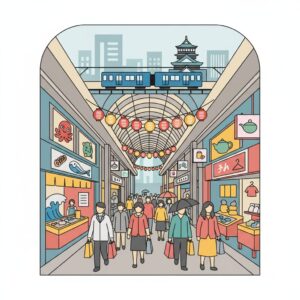
So you’ve landed in Osaka. You’ve found an apartment, you’ve figured out the labyrinthine subway system at Umeda Station without having a full-blown panic attack, and you’re starting to get into the rhythm of daily life. Your next mission, one you’ll face almost every day, is stocking your kitchen. You wander into a local shotengai, one of those long, covered shopping arcades that are the pulsating veins of any Osaka neighborhood. It’s a sensory overload. The rhythmic call of vendors, the smell of freshly fried tempura mingling with grilled eel, the sight of impossibly perfect strawberries next to mountains of daikon radishes. You pick out some vegetables at a family-run stall. The old woman, the obachan, weighs your tomatoes, bags them up, and tells you the price. As you hand her the coins, she smiles, grabs a handful of bean sprouts, and tosses them into your bag. “Kore, omake,” she says with a wink. “This is a little extra.”
Your first reaction might be confusion. Did you pay for those? Is this a special sale? Is she trying to get rid of old stock? In Tokyo, a transaction is a transaction. It’s precise, clean, and predictable. You get exactly what you paid for, no more, no less. But here in Osaka, you’ve just had your first real encounter with omake culture, and it’s a concept that goes far deeper than a free handful of vegetables. This isn’t just a discount. It’s a conversation, a relationship, and a fundamental piece of the city’s economic and social DNA. Understanding omake is understanding Osaka. It’s a key that unlocks not only how to save a bit of money on your groceries but also how to connect with the city on a human level. It reveals why the real cost of living here isn’t just measured in yen, but in the richness of your daily interactions. This culture is a tangible force, something you can feel in the weight of your shopping bag and the warmth of a shopkeeper’s smile. It’s the invisible, un-advertised benefit that subtly, yet significantly, enhances your quality of life and pads your wallet in ways a spreadsheet can never capture.
This culture is a tangible force, something you can feel in the weight of your shopping bag and the warmth of a shopkeeper’s smile, and it’s the same merchant spirit you can experience while bar hopping in the hidden alleys of Ura Namba.
What ‘Omake’ Really Means: Beyond the Free Onion
To outsiders, omake might seem like a simple freebie—a bonus or a promotional gift—and sometimes it is. But within the context of an Osaka shotengai, it carries a deeper, more nuanced significance. It represents the tangible expression of a relationship, a symbol of a social contract that prioritizes human connection over cold, impersonal commerce. This tradition is rooted in Osaka’s history as the “nation’s kitchen,” shaped by merchants who valued long-term loyalty far more than gain from a single transaction. For them, business was personal.
It’s Not a Marketing Tactic, It’s an Invitation to Connect
In most contemporary retail settings, free items are part of deliberate marketing schemes: “Buy one, get one free,” or “Free gift with purchases over 5,000 yen.” These are corporate policies, posted on signs, and offered universally. They are impersonal, aimed solely at boosting sales volume. Osaka omake stands in stark contrast. It’s rarely advertised and there’s no signage declaring, “Free scallions for friendly customers.” It happens spontaneously, personally, decided in the moment by the person right in front of you.
Imagine the scene. You’re at the butcher’s in Komagawa Shotengai. You request 300 grams of thinly sliced pork for shogayaki (ginger pork). A butcher, skilled in his craft for forty years, weighs the meat. The scale shows 315 grams. In a Tokyo department store, he might carefully trim off a small piece to meet the exact weight. But the Osaka butcher? He likely just smiles, shrugs, and says, “Ma, ee ka” (Ah, it’s fine), then charges you for 300 grams. That extra 15 grams is omake. Or perhaps you’re picking up a few korokke (croquettes) from a deli. As a regular, the owner recognizes you and slips an extra one into your bag. “Service, service!” she says, using the Japanese-English term for a free gift. She does this because she knows you, appreciates your patronage, and it’s her way of expressing thanks.
This simple act transforms a routine purchase into a human exchange. It acknowledges your presence. It’s the shopkeeper’s way of saying, “I see you. Thanks for coming back.” This differs fundamentally from a loyalty point card. A point card is an algorithmic device—it doesn’t know who you are, only how much you spend. Omake is authentic analog humanity. It rewards familiarity, small talk, and participation in the local community. The freebie itself isn’t the goal; the connection is.
The Role of Reciprocity in an Osaka Shotengai
Receiving something free triggers a strong psychological effect known as the reciprocity principle. You experience a gentle, positive urge to repay the kindness. This isn’t a burdensome obligation but a warm social bond. The obachan who gave you bean sprouts doesn’t expect anything in return, yet she trusts you’ll think of her stall next time you need vegetables. You’ll remember her kindness and choose her over the brightly lit, mass-produced supermarket aisles.
This dynamic fuels the shotengai economy—a network of personal, small-scale relationships. The fishmonger adds a bit extra tuna to your sashimi because you shop with him every Saturday. In return, you wouldn’t consider visiting his competitor. The tofu maker throws in some free okara (soy pulp great for salads) when you buy fresh silken tofu. You also make a point to buy his soy milk. This isn’t a cynical tactic but a genuinely positive feedback loop. Vendors build loyal customers, and customers feel valued, becoming part of a community.
This sense of belonging offers a powerful remedy to the isolation that many foreigners can experience living abroad. In a city of millions, a local shotengai becomes your neighborhood. Vendors become familiar faces who notice your small milestones—they see you just moved in, observe your improving Japanese, and inquire about your adjustment to humid summers. The omake is the handshake affirming your unspoken membership in this community. It’s a small, edible reminder that you are not just an anonymous consumer in a sprawling metropolis; you are a neighbor.
The Economic Reality: How Omake Impacts Your Monthly Budget
While the philosophical and social dimensions of omake are intriguing, let’s focus on the practical aspect. Does this culture of “a little extra” genuinely impact your cost of living? The answer is a definite yes, although it appears in both tangible and intangible forms. It won’t make you wealthy, but it can provide a noticeable cushion in your monthly budget and, more importantly, shift your entire perception of value.
The Tangible Savings: Small Extras, Big Impact
Let’s consider a hypothetical weekly grocery trip to a traditional shotengai. Each individual omake might seem minor, but when practiced consistently week after week, the savings add up significantly.
Picture this shopping trip:
- The Vegetable Stall: You purchase carrots, onions, and potatoes, totaling 650 yen. The vendor includes a free green pepper since she has a surplus, worth about 50 yen.
- The Butcher: You buy 300 grams of chicken but receive 330 grams for the same price—a 10% bonus, saving you about 40 yen.
- The Fishmonger: You buy two salmon filets. When asked if you’re making soup with the bones and you say yes, he gives you a fish head and skeleton for free, ideal for a rich dashi broth—something supermarkets would charge for, saving you at least 100-200 yen.
- The Tofu Shop: You buy a block of firm tofu for 150 yen, and the owner throws in a small, fried tofu puff (aburaage) at no extra cost, valued at 30 yen.
- The Fruit Stand: You buy a bag of mikan oranges. The owner notices one has a small blemish and adds it to your bag for free, assuring you it’s still delicious inside—and it is. You save 60 yen.
On this single trip, you receive roughly 300 yen worth of free items. It may not seem like much, but multiplied by four weeks in a month, it amounts to 1,200 yen. Over a year, that’s nearly 15,000 yen—a nice dinner out, a new pair of shoes, or a Shinkansen round trip to Kyoto. This is a conservative estimate. If most of your daily shopping happens in these places, the savings multiply even more.
This effect is reinforced by the pricing in the shotengai, which is often already lower than major supermarkets for fresh produce. The omake acts as a bonus on top of an already good deal. It’s essential advice for anyone living on a budget in Osaka: build relationships with your local vendors. Your wallet will thank you.
The Intangible Value: Quality of Life and Community
However, the true worth of the omake culture extends far beyond financial calculations. It profoundly enhances your quality of life. The daily stress of managing a budget in a foreign country can be exhausting. The omake system offers a small but steady psychological lift. Receiving something extra feels rewarding—it feels like a win. That sense of getting a fair, honest deal from someone you trust eases financial worries and transforms an ordinary chore like grocery shopping into a genuinely pleasant experience.
Moreover, this culture fosters a more mindful way of consuming. The free fish head encourages you to learn how to make dashi from scratch rather than using instant powder. The extra bean sprouts inspire you to add them to your miso soup. The slightly bruised but still good apple gets eaten promptly instead of forgotten in the fridge. This connection to your food helps reduce waste, aligning with the Japanese idea of mottainai—a feeling of regret over wastefulness.
This starkly contrasts with shopping in a large, impersonal supermarket, where you are a passive consumer who pushes a cart, scans items, and pays a machine. There’s no conversation, no bargaining, no surprise. While efficient, it is sterile and can feel profoundly lonely. The shotengai, energized by the spirit of omake, is quite the opposite. It is an active, social experience that encourages you to use your Japanese, interact with others, and be part of the neighborhood rhythm. The real “extra” you gain isn’t just the food; it’s the community spirit that comes with it. And when it comes to what makes a place feel like home, that value is priceless.
Osaka vs. Tokyo: A Tale of Two Shopping Carts
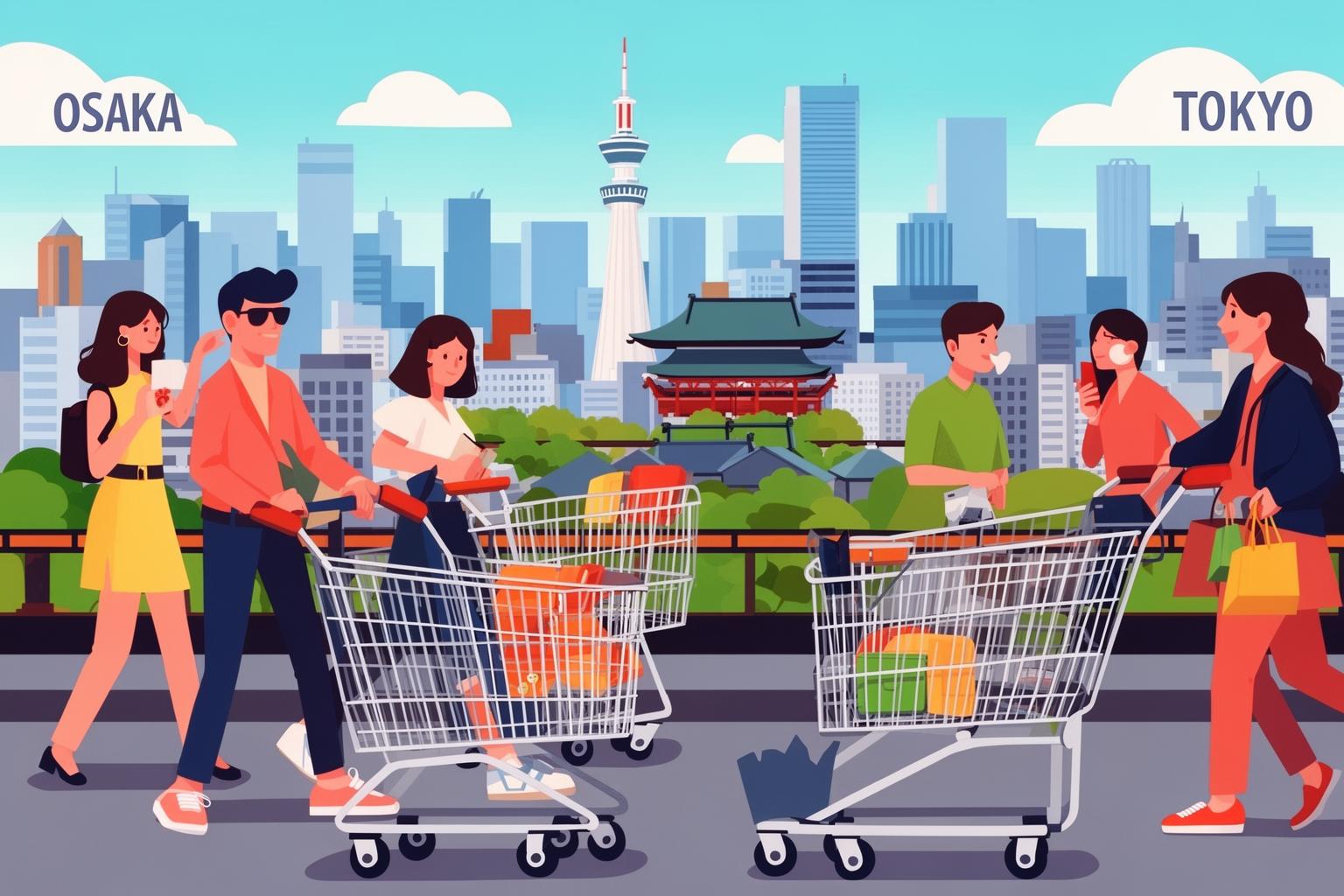
To truly understand the uniqueness of Osaka’s omake culture, the best comparison is with its perennial rival, Tokyo. The contrast in a simple shopping experience reveals nearly everything about the deep-rooted cultural differences between Japan’s two largest metropolitan areas. It’s a tale of precision versus pragmatism, presentation versus personality.
The “Kitchiri” (Precise) Tokyo Transaction
Grocery shopping in Tokyo, particularly in the central wards, is an exercise in precision and perfection. The experience is often encapsulated by the word kitchiri—meaning exact, neat, and without deviation. Enter a high-end supermarket or a depachika (department store food hall), and you’ll witness this principle firsthand. Fruits are individually wrapped and arranged with geometric care. Vegetables are meticulously cleaned and sorted by size. Fish is sliced into perfectly uniform fillets.
The transaction itself is equally meticulous. Ask for 200 grams of beef, and the butcher will use tweezers to add or remove tiny pieces until the digital scale reads precisely 200.0 grams. The cashier handles your money with practiced efficiency, and your items are bagged with an almost artistic sense of order. The service is flawless—polite, professional, and impeccable. What you won’t encounter, however, is any surprise. The cashier won’t toss in a free candy bar. The butcher won’t slip an extra slice of ham just because. The system prioritizes predictability over spontaneity; it’s designed for perfection. The value in Tokyo lies in the quality of the product and the flawlessness of the service. You pay for perfection and receive exactly that.
This mindset mirrors a broader Tokyo ethos that prizes order, form, and strict adherence to rules. It’s a city famed for its impeccable efficiency. While admirable and often very convenient, this can sometimes feel impersonal. The relationship between customer and vendor remains strictly professional—a clean exchange of goods for money.
The “Ma, Ee ka” (Ah, Whatever) Osaka Exchange
Now, step into an Osaka shotengai. The vibe changes completely. It’s louder, a bit messier, and much more flexible. Instead of kitchiri, the prevailing philosophy is ma, ee ka—a charmingly pragmatic phrase meaning “ah, whatever” or “close enough is good enough.”
This attitude infuses the shopping experience. The butcher who hands you 315 grams of pork instead of 300 perfectly embodies ma, ee ka in practice. Why bother trimming off a tiny piece when you can make a customer happy? The vegetable vendor won’t toss out a perfectly edible tomato with a minor bruise; instead, she’ll give it to a regular customer as an omake. This philosophy springs from a merchant’s mindset: don’t waste anything, and keep customers happy so they keep returning. In Osaka, value lies not in sterile perfection but in scoring a great deal and nurturing human connections.
This often includes a touch of performance and good-natured haggling. While hard bargaining is rare across most of Japan, playful back-and-forth is part of Osaka’s shopping ritual. A customer might say, “Chotto takai naa!” (“A little expensive!”), and the vendor might laugh in reply, “Honma ka? Shoganai naa, kore omake!” (“Really? Can’t be helped, here’s a little extra!”). This isn’t serious price negotiation but a form of social communication, a friendly dance. The omake serves as the punctuation at the end of a warm exchange.
This core contrast reveals the essence of each city. Tokyo is Japan’s political and administrative capital, a place where rules and order prevail. Osaka, historically a city of merchants, traders, and entrepreneurs, values pragmatism, flexibility, and relationship-building as keys to success. In Tokyo, you buy a product. In Osaka, you buy from a person. That simple difference changes everything.
How to Navigate the Omake Culture: An Unwritten Guide for Newcomers
The omake culture is a charming aspect of life in Osaka, but for newcomers, it can be somewhat perplexing. It follows a set of unwritten rules, and navigating them correctly can be the difference between being viewed as a clueless tourist or a savvy local. Here’s a practical guide to smoothly integrating into this system.
Don’t Ask, Just Receive (Gracefully)
This is the golden rule, the absolute top principle: You must never, ever ask for an omake. Doing so is extremely rude. It’s like requesting a gift. An omake is not a right; it’s a spontaneous gesture of goodwill from the vendor. Asking for one turns a kind act into a demand and completely breaks the spirit of the exchange. It marks you as someone unfamiliar with the culture.
So, what should you do when you receive one? The key is to respond with a bit of surprise and a lot of gratitude. A common and polite reaction is to say, “Eh, ii desu ka?” (“Oh, is that really okay?”). This shows you weren’t expecting it and that you appreciate the gesture. Follow this immediately with a big smile and a warm thank you. In standard Japanese, you’d say “Arigatou gozaimasu!” In Osaka, you’ll earn bonus points for using the local dialect: “Ookini!” A simple, heartfelt ookini combined with a slight bow is the perfect response. It expresses your appreciation and strengthens the social bond, making it more likely you’ll receive an omake again in the future.
Building Relationships: The Key to the Kingdom
If you can’t ask for an omake, how do you get one? The answer is simple: you earn it by building a relationship. The way to do that is by becoming a regular. This is the single most important step to unlock the full benefits of shopping in a shotengai.
- Choose Your Spots: Instead of visiting a different shop each time, pick one vegetable stall, one butcher, one fishmonger, and one tofu shop. Make them your places.
- Go Consistently: Shop there once or twice a week. Let them see your face. Soon, they’ll recognize you as “the foreigner who lives down the street.”
- Engage in Small Talk: Here’s where your Japanese practice pays off. It doesn’t have to be a deep conversation. Start simple. Greet them with a cheerful “Konnichiwa!” Ask about the weather. A killer phrase is, “Kyou no osusume wa nan desu ka?” (“What’s your recommendation today?”). This shows you trust their expertise and value their opinion. They’ll love it. They might point you toward the freshest fish that just arrived or the sweetest corn of the season.
- Be a Good Customer: Be patient if they’re busy. Have your money ready. Be polite and cheerful. In short, be the kind of customer they are happy to see.
By doing these things, you stop being an anonymous transaction. You become a person, a neighbor. The omake will start coming naturally from this relationship. It becomes the vendor’s way of acknowledging your loyalty and friendship.
Where to Find the Omake Goldmines: A Neighborhood Guide
While this culture exists throughout Osaka, it thrives most vibrantly in the city’s traditional shotengai. These are the best places to experience it firsthand. You won’t find this happening at large corporate chains like AEON, Life, or Mandai. You need to go where the owner is the one bagging your groceries.
- Tenjinbashisuji Shotengai: Stretching over 2.6 kilometers, this is the longest shopping arcade in Japan. It’s a world unto itself. Due to its size and the number of old, family-run shops, it’s a fantastic place to see omake culture in action. The delis selling tempura and croquettes are especially famous for it.
- Kuromon Ichiba Market: Though very popular with tourists, Kuromon remains a working market where locals shop. Go early in the morning to catch the real action. The fishmongers here are legendary, and if you become a familiar face, they are known to be generous.
- Komagawa Shotengai: Situated in southern Osaka (Higashisumiyoshi-ku), this is a truly local arcade. It’s less polished than some central ones but incredibly authentic. The prices are great, and the vendors embody the classic, friendly Osaka spirit. This is an excellent place to build those crucial relationships.
- Sembayashi Shotengai: Another sprawling, energetic arcade, a bit off the main tourist track. It’s famous for its “100 yen” shops (not the chain store, but individual shops selling items for just 100 yen) and its general atmosphere of bargain-hunting. The vendors here are masters of friendly sales pitches and thank-you omake.
Visiting these arcades isn’t just about shopping; it’s about taking part in a living culture. It’s where the heart of Osaka truly beats.
The Misunderstandings: What Foreigners Get Wrong About Omake
Like any deeply rooted cultural practice, omake can be easily misunderstood by outsiders. Cynicism, cultural differences, or simply lacking context can lead to misconceptions that prevent foreigners from fully appreciating—and enjoying—this unique aspect of Osaka life. Clearing up these common misunderstandings is essential to grasping the true spirit behind the “little extra.”
“They’re Just Trying to Get Rid of Old Stock.”
This is perhaps the most frequent and cynical interpretation. A foreigner receives a slightly bruised apple or a day-old bread roll as an omake and immediately assumes, “Ah, they’re just giving me their leftovers.” While it’s sometimes true that an omake might be an item that is cosmetically imperfect or close to its sell-by date, seeing this as an attempt to dump trash fundamentally misreads the culture.
First, this is closely tied to the concept of mottainai, the Buddhist-rooted Japanese philosophy that regrets waste. A piece of fruit with a small blemish is still perfectly tasty. A fish head can make a rich, flavorful soup stock. In a culture that abhors waste, offering these items to a valued customer is considered a sign of respect for the food itself. It’s a way to ensure that something valuable doesn’t go to waste. The vendor isn’t handing over garbage; they are entrusting you with something still worthwhile, assuming you recognize and appreciate it.
Second, and more importantly, a large portion of omake aren’t old stock at all. The extra handful of fresh bean sprouts, the bonus slice of top-quality pork, the additional freshly fried croquette—these are premium items. The vendor takes a small loss on the product to earn long-term loyalty and goodwill from customers. Approaching every omake with suspicion means missing the genuine warmth and generosity motivating most of these offerings.
“Osaka People Are Cheap.”
This is a persistent and unfortunate stereotype about Osakans. They are often portrayed, especially by people from Tokyo, as being money-obsessed and stingy (kechi). Their love of a good bargain and the culture of playful haggling are frequently cited as “proof.” Misunderstood, the omake culture can be twisted into supporting this idea—that it’s all just a scheme to save every last yen.
This completely overlooks the real point. It’s important to distinguish between being “cheap” and being “value-conscious.” Osakans are deeply value-conscious. They work hard for their money and excel at making sure they get the absolute most out of it. This isn’t about stinginess; it’s about being smart, practical, and efficient—the very qualities that made Osaka Japan’s commercial powerhouse for centuries.
Omake culture perfectly embodies this. It isn’t about being cheap; it’s about a more nuanced understanding of value. An Osakan merchant knows that the worth of a loyal customer who returns week after week far outweighs the 50 yen they may lose by giving away a free green pepper. It’s a long-term investment in relationships. In fact, giving an omake is an act of generosity, the exact opposite of stinginess. It forms a key pillar of a community-oriented economic system that prioritizes people over profit margins.
So, when you see an Osakan happily celebrating a discount or an omake, don’t interpret it as cheapness. See it as an appreciation for value and a joy in a successful, friendly transaction. They’re not just pleased about saving money; they’re happy because the exchange was personal, fair, and mutually rewarding. It’s a win-win, and in Osaka, that’s the best kind of business there is.