Long before the neon lights of Dotonbori flicker to life, while the subways are still slumbering, a different part of Osaka is already roaring with energy. This is the raw, beating heart of the city known as “Tenka no Daidokoro,” the Nation’s Kitchen. It’s a place where the air is thick with the scent of the sea, where the rhythmic calls of vendors echo through sprawling halls, and where breakfast isn’t just a meal—it’s a revelation. Welcome to the Osaka Kizu Wholesale Market, a culinary institution over three centuries in the making. This isn’t just a market; it’s a living museum of Osaka’s insatiable appetite, a place where the city’s top chefs and discerning locals come to source the ingredients that define its world-class cuisine. For the traveler willing to rise with the sun, Kizu offers an experience that is profoundly authentic, a chance to taste seafood so fresh it still whispers of the ocean, and to witness the unfiltered commerce that fuels a food-obsessed metropolis. Forget your hotel buffet; your most unforgettable Osaka meal awaits in the humble, bustling corridors of this legendary market.
After exploring the bustling energy of the market, consider discovering a quieter, spiritual side of the city by visiting the moss-covered Fudō Myō-ō statue in Hozenji Yokocho.
The Heartbeat of Naniwa: A Market Awakens

Entering the Osaka Kizu Wholesale Market at dawn feels like plugging straight into the city’s lifeblood. The atmosphere buzzes with a symphony of organized chaos that is both daunting and exhilarating. This isn’t the polished, tourist-friendly experience of some well-known markets; Kizu is unapologetically a place of work. The ground is damp, the air cool and salty, filled with the sounds of whirring turret trucks, the slap of fish on cutting boards, and the gravelly calls of auctioneers and vendors sealing deals with handshakes and nods. It’s a place driven by purpose. Everyone moving through these aisles has a mission—whether a Michelin-starred chef scrutinizing a flounder, a local grandmother negotiating for the best daikon radish, or a delivery driver skillfully maneuvering a cart stacked high with styrofoam boxes.
There’s a raw authenticity to Kizu that’s deeply captivating. You won’t find cute souvenirs or trendy snacks made for social media here. Instead, you’ll discover a stunning variety of top-quality ingredients presented without fuss. It’s worlds apart from the bright lights of nearby Namba, yet it feels unmistakably Osakan. The city’s spirit is rooted in the idea of ‘kuidaore’—to eat oneself into ruin—and this market is where the arsenal for that delicious battle is assembled. The energy is contagious. You sense it in the workers’ brisk movements, the buyers’ intense focus, and the overwhelming abundance of nature’s bounty. Walking these aisles makes it clear that in Osaka, food isn’t just a pastime; it’s the very fabric of life, and this market is where the threads are sorted, sold, and sent out to weave the city’s culinary tapestry.
A Dawn Ritual: The Sublime Experience of Market Sushi
For any food lover visiting Kizu, the ultimate pilgrimage is to one of the small, unassuming eateries nestled within the market complex. This is where the idea of breakfast is transformed. Here, sushi is not a delicate evening meal but a robust, energizing way to start the day. The experience is both intimate and immediate. You may find yourself seated at a tiny wooden counter alongside just a few other diners, often market workers themselves, fueling up before their shift ends. The atmosphere hums with the quiet reverence of people savoring something truly special.
The magic lies in the closeness. The fish, or ‘neta,’ on your plate was likely swimming in the ocean less than a day ago and was auctioned just meters from where you sit only an hour earlier. This is the height of freshness, turning the familiar into something extraordinary. The tuna, or ‘maguro,’ is not merely red; it’s a deep, translucent crimson that melts on your tongue, its flavor clean and rich with the oils of the cold sea. The sea urchin, ‘uni,’ is not simply briny; it’s a creamy, sweet custard of the ocean, glowing with the color of a brilliant sunset. Even the modest mackerel, ‘saba,’ often lightly cured, sheds its fishy image to become a complex, savory delight.
The sushi masters here are artisans of the highest caliber, but without any pretense. Their movements are swift, economical, and precise, shaped by decades of repetition. They form the ‘shari,’ the vinegared rice, with practiced care, ensuring it’s at the ideal body temperature to complement the cool fish. They may apply a whisper-thin layer of soy sauce or a dab of wasabi themselves, presenting each piece as a complete, perfectly balanced creation. This is ‘Edomae’ style at its purest, where the chef’s role is to enhance, not overshadow, the pristine quality of the main ingredient.
While sushi takes center stage, don’t overlook the ‘kaisendon,’ a jewel-like bowl of rice topped with a stunning mosaic of assorted sashimi. It offers a more rustic yet equally satisfying way to enjoy the day’s catch. You’ll find glistening salmon roe (‘ikura’) that bursts in your mouth with a wave of salty goodness, sweet raw shrimp (‘amaebi’), and slices of whatever whitefish was freshest that morning. Paired with a steaming bowl of miso soup, rich with dashi crafted from ingredients sourced directly from the market, it is a meal that nourishes both body and soul. It’s a moment of pure, unfiltered pleasure that will forever change your perception of breakfast.
Beyond the Counter: Exploring the Market’s Labyrinth
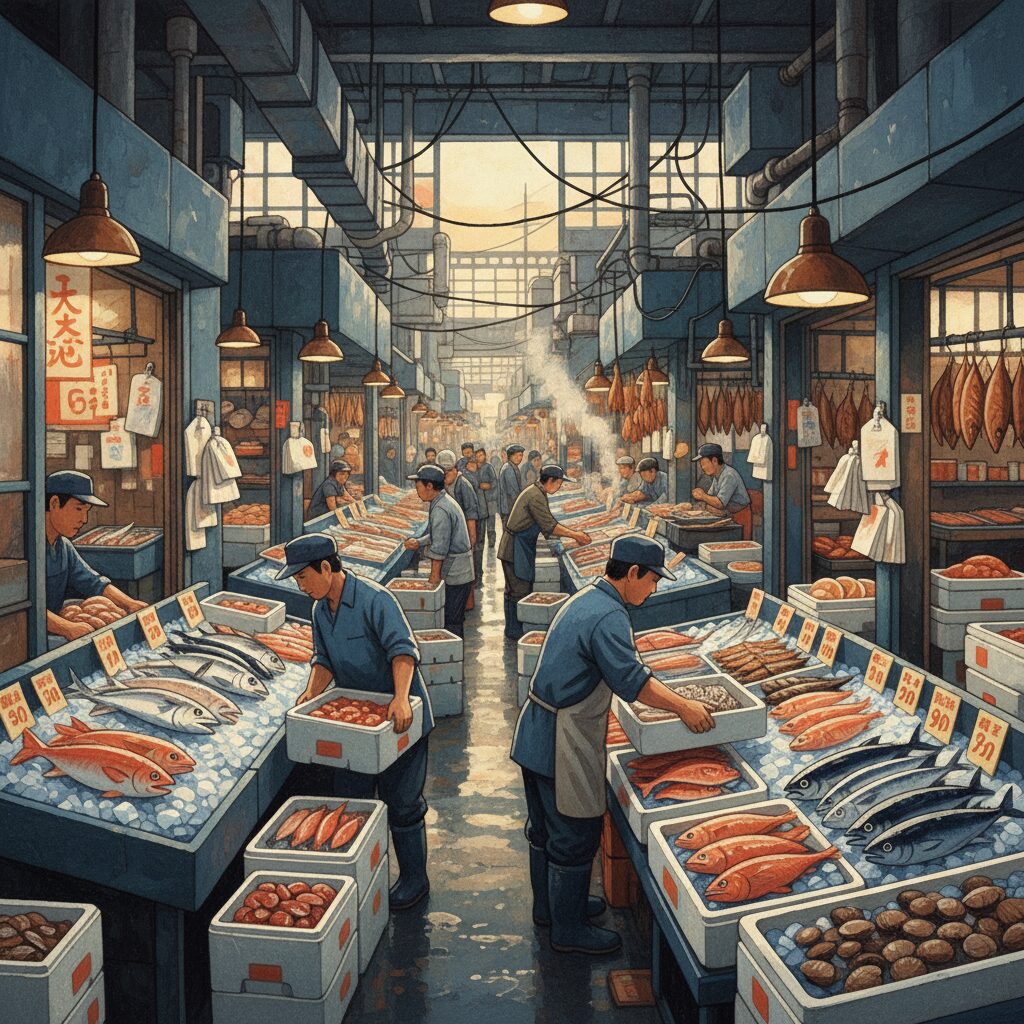
Once you’ve eaten your fill, the true adventure begins. To fully appreciate Kizu, you need to roam its maze-like corridors and let your senses lead the way. The market is largely divided into distinct sections, each a world of its own.
The Realm of the Sea
The seafood area is the heart of Kizu, offering a stunning display of marine biodiversity. You’ll find enormous tuna lying on pallets, their powerful bodies ready for skilled mongers to break down with long, sword-like knives. Tanks teem with live crabs, their claws bound, alongside baskets of writhing shrimp and prawns. Look for boxes of uni, their spiny shells cracked open to reveal the golden treasure inside. You’ll also see silvery horse mackerel (‘aji’), glistening squid (‘ika’), and plump scallops (‘hotate’) still nestled in their fan-shaped shells. The variety is astounding and shifts with the seasons. In winter, fatty yellowtail (‘buri’) and deep-sea anglerfish (‘ankō’) may appear, while spring brings sparkling sea bream (‘tai’) and tiny firefly squid (‘hotaruika’). This is a living classroom for anyone passionate about Japanese seafood, a visual delight that precedes the culinary one.
The Bounty of the Land
The produce section is equally remarkable. Osaka is surrounded by a fertile plain, and the vegetables and fruits here are of exceptional quality. You’ll spot perfectly shaped strawberries, each a glossy red gem, and piles of daikon radishes, ranging from the common white variety to purple and green heirlooms. Be sure to seek out unique ‘Naniwa yasai,’ traditional vegetables native to the Osaka area, such as the slender ‘Moriguchi daikon’ or the leafy ‘Tenma-na.’ The air is filled with the earthy aroma of mushrooms, sharp spring onions, and sweet citrus fruits. The vendors are specialists, their stalls artfully arranged to showcase the vibrant colors and shapes of the earth’s bounty. It’s a tribute to the Japanese reverence for seasonality, a fundamental principle of the nation’s cuisine.
The Pantry of Japan
Venture further and you’ll discover stalls selling the essential elements of Japanese flavor. Shops specializing in ‘tsukemono,’ or pickles, offer barrels in every hue and variety, from bright pink pickled ginger (‘gari’) to salty, pungent umeboshi plums. Vendors sell ‘katsuobushi,’ dried, fermented, and smoked skipjack tuna shaved into paper-thin flakes for dashi stock—the woody, smoky aroma unforgettable. Other stalls feature a wide assortment of tofu, from silky ‘kinugoshi’ to firm ‘momen,’ along with sheets of ‘yuba’ (tofu skin), ‘nori’ seaweed of various grades, and countless types of miso paste. You can even find professional-grade kitchen tools, from razor-sharp knives to sturdy cypress cutting boards. Here lies the secret to the unique and profound depth of flavor in Japanese cooking.
Practical Guidance for a Perfect Morning
A trip to Kizu is incredibly rewarding, and a bit of preparation can make the experience smooth. Knowing the pace and customs of a working market is essential for a respectful and enjoyable visit.
Timing is Everything
The market’s energy is at its highest early in the morning. To get the most out of your visit, plan to arrive between 6:00 AM and 9:00 AM. This is when the restaurants are lively, vendors are busy, and the market is fully active. Although the market officially opens around 5:00 AM, this initial hour mainly serves wholesale transactions. By 10:00 AM, many vendors start packing up, and by noon, the market becomes much quieter. It is closed on Sundays and some Wednesdays, so checking the official market calendar online before your visit is always a good idea.
Getting There
Getting there is exceptionally easy. The nearest subway station is Daikokucho Station, served by both the Midosuji and Yotsubashi lines. From exit 1 or 2, it’s a short, well-marked walk of just a few minutes. The market’s location is a major convenience; it’s only one stop south of Namba on the Midosuji Line, making for a quick and straightforward trip from one of Osaka’s central transport and accommodation areas. You can enjoy breakfast at Kizu and be back in Namba, ready to explore, before most city shops have opened.
Market Etiquette: A Visitor’s Guide
Keep in mind, Kizu is primarily a place of business. Being a considerate visitor will earn you friendly smiles and help your visit go smoothly.
- Stay Alert: The aisles are narrow and busy. Mind your surroundings. Small turret trucks and workers with heavy carts have the right of way. Step aside promptly to let them pass. Avoid blocking pathways, especially if you are in a group.
- Look, Don’t Touch: The produce and seafood are top quality and intended for sale. Refrain from touching items unless you plan to buy them. Vendors take great pride in their displays.
- Respectful Photography: The market is highly photogenic, but always be courteous. Avoid using flash as it can be disruptive. If you want close-up shots of stalls or vendors, it’s polite to ask first. Simply gesturing with your camera and making eye contact usually suffices, and most vendors will gladly allow it.
- Bring Cash: Despite modern payment methods, cash remains the preferred—and often only—way to pay, especially at smaller food stalls and vendors. Be sure to carry enough Japanese Yen to cover your meal and any purchases.
Three Centuries of Commerce: A Taste of History
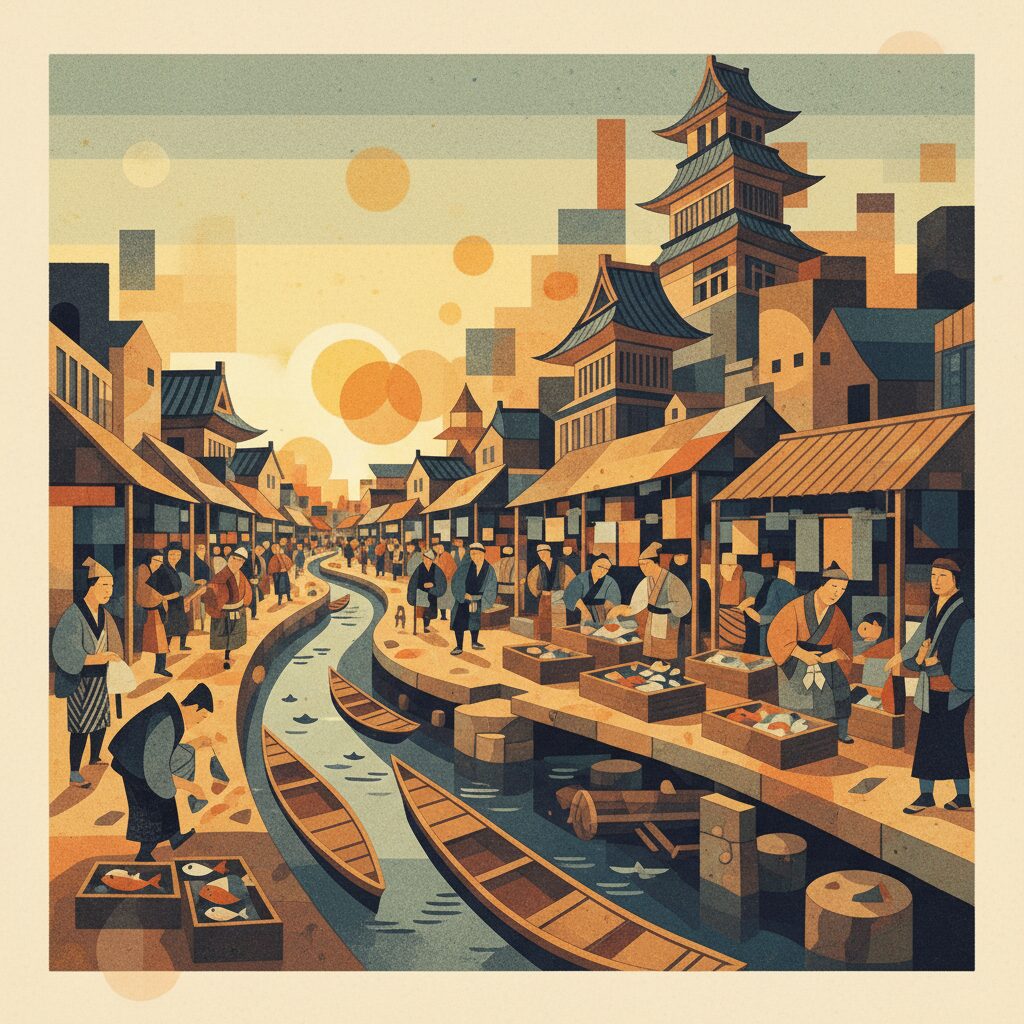
The Osaka Kizu Wholesale Market is far from a recent development. Its origins trace back over 300 years to the Edo Period. Founded in 1710, it has functioned as a crucial hub for distributing goods in a city rapidly establishing itself as Japan’s commercial center. Osaka’s extensive canal network and strategic location positioned it as the main repository for rice and other products from across the nation, earning the nickname ‘The Nation’s Kitchen.’ The market has always embodied this title physically.
Throughout the centuries, it has endured fires, reconstructions, and Japan’s sweeping modernization. Yet, its essential mission remains the same: to link producers of Japan’s finest ingredients with Osaka’s chefs and residents. This profound history is evident throughout the market. You sense it in the multi-generational family businesses where expertise is handed down from parent to child. You observe it in the traditional tools still used alongside modern machinery. A visit to Kizu is more than a culinary trip; it is a passage into living history, an opportunity to engage with a commercial tradition that has shaped Osaka’s very identity. The market stands as a symbol of the city’s resilience, its enduring passion for food, and its practical, hardworking nature.
Making a Day of It: What’s Near the Kizu Market?
Starting early at Kizu Market places you in an ideal position to explore the surrounding neighborhoods of southern Osaka before the crowds arrive. The market serves as a perfect launching point for a day of discovery.
- Namba: Just a short walk or one subway stop north brings you to the vibrant heart of Osaka’s Minami (South) district. Here, you’ll encounter a fascinating blend of old and new. Discover Namba Parks, an architectural marvel that combines a shopping mall with a terraced rooftop garden. Nearby is Den Den Town, Osaka’s version of Tokyo’s Akihabara, a paradise for anime, manga, and electronics fans. For a more traditional feel, visit Hozenji Yokocho, a narrow, stone-paved alley lined with traditional restaurants and featuring an iconic moss-covered statue.
- Shinsekai: A bit further south is Shinsekai, or “New World,” a district that feels like a mid-20th-century time capsule. Centered around the iconic Tsutenkaku Tower, this area is known for its retro atmosphere and its fondness for ‘kushikatsu’—deep-fried skewers of meat, seafood, and vegetables. Following a light seafood breakfast, a filling lunch of kushikatsu (remember the golden rule: no double-dipping in the communal sauce!) makes for the perfect contrast.
- Imamiya Ebisu Shrine: Situated right next to Kizu Market, this shrine is one of Osaka’s most important Shinto sites, dedicated to Ebisu, the god of fishermen and commerce. It becomes especially lively during the Toka Ebisu festival in January, when millions visit to pray for business prosperity. A quick, quiet visit after the market offers a moment of cultural reflection and a peaceful counterbalance to the commercial bustle you just experienced.
The Lingering Flavor of Osaka
Leaving Kizu Market, you carry more than just a full stomach. You take with you the lingering taste of incredibly fresh tuna, the scent of saltwater and shaved bonito, and the memory of a place alive with energy. It’s an experience that connects you directly to the source, peeling back layers of packaging and marketing to reveal the simple, profound truth of good food. You’ve witnessed where the finest ingredients in Osaka originate. You’ve shared a meal with the people who work with them every day. You have, in a small way, participated in the daily ritual that defines the Nation’s Kitchen. This is the essence of travel: not merely to see a place, but to taste it, to feel its rhythm, and to understand what drives it. A morning at the Osaka Kizu Wholesale Market is one of the most authentic and flavorful ways to do just that, leaving you with a taste and a feeling that linger long after you’ve returned home.