Step off the roaring, neon-pulsing streets of modern Osaka and into a time capsule. The air shifts, growing thick with the rich, earthy scent of dark-roast coffee, a hint of toasted bread, and the faint, sweet ghost of cigarette smoke from decades past. You’ve just crossed the threshold into a kissaten, one of Japan’s beloved retro coffee shops, and you’re about to partake in a ritual as ingrained in the city’s daily rhythm as the morning commute: the “Morning Service.” This isn’t just breakfast; it’s a cultural institution, a warm, affordable embrace that kicks off the day for students, salarymen, and neighborhood grandmothers alike. Forget the sterile efficiency of a global coffee chain. Here, in the hushed, wood-paneled world of a Showa-era cafe, you’re not just getting a meal. You’re getting a slice of Osaka’s history, its heart, and its unhurried soul, all for the price of a single cup of coffee.
For a similarly immersive and traditional experience that defines the city’s daily life, consider exploring the local culture of Osaka’s neighborhood sentō.
The Anatomy of a Perfect Morning
So what exactly is this legendary “Morning Service,” or mōningu sābisu as you might hear it called? The concept is wonderfully simple and incredibly generous. Sometime between the shop’s opening and around 11 a.m., if you order a drink—usually coffee or tea—you receive a complimentary breakfast plate. This tradition emerged in the post-war boom as a clever marketing strategy and has since evolved into a beloved daily ritual. The classic, iconic set is a humble delight: a cup of richly dark, expertly brewed coffee, a thick slice of fluffy white toast (shokupan) spread with butter, a perfectly hard-boiled egg still warm in its shell, and occasionally a small, crisp side salad dressed with bright sesame dressing. The cost for all this? Typically between 400 and 600 yen—the price of the coffee alone. It’s a deal that seems almost too good to be true, a small daily economic miracle that has sustained the city for generations.
But the charm of Osaka’s morning scene lies in its variety. Step into another kissaten and the toast might be a luscious “pizza toast,” topped with melted cheese, bell peppers, and onions. The egg might come scrambled, or as a delicate tamagoyaki-style omelet. Some places offer a dollop of sweet red bean paste (ogura) to spread on your toast, a specialty from Nagoya that has happily migrated west. You might also find a small serving of yogurt, a piece of fruit, or a tiny sausage link sharing the plate. Each kissaten has its own unique version, a signature touch that keeps regulars coming back. This isn’t a standardized, cookie-cutter experience; it’s a deeply personal offering from the shop’s “Master” to their community.
Stepping Into a Living Museum
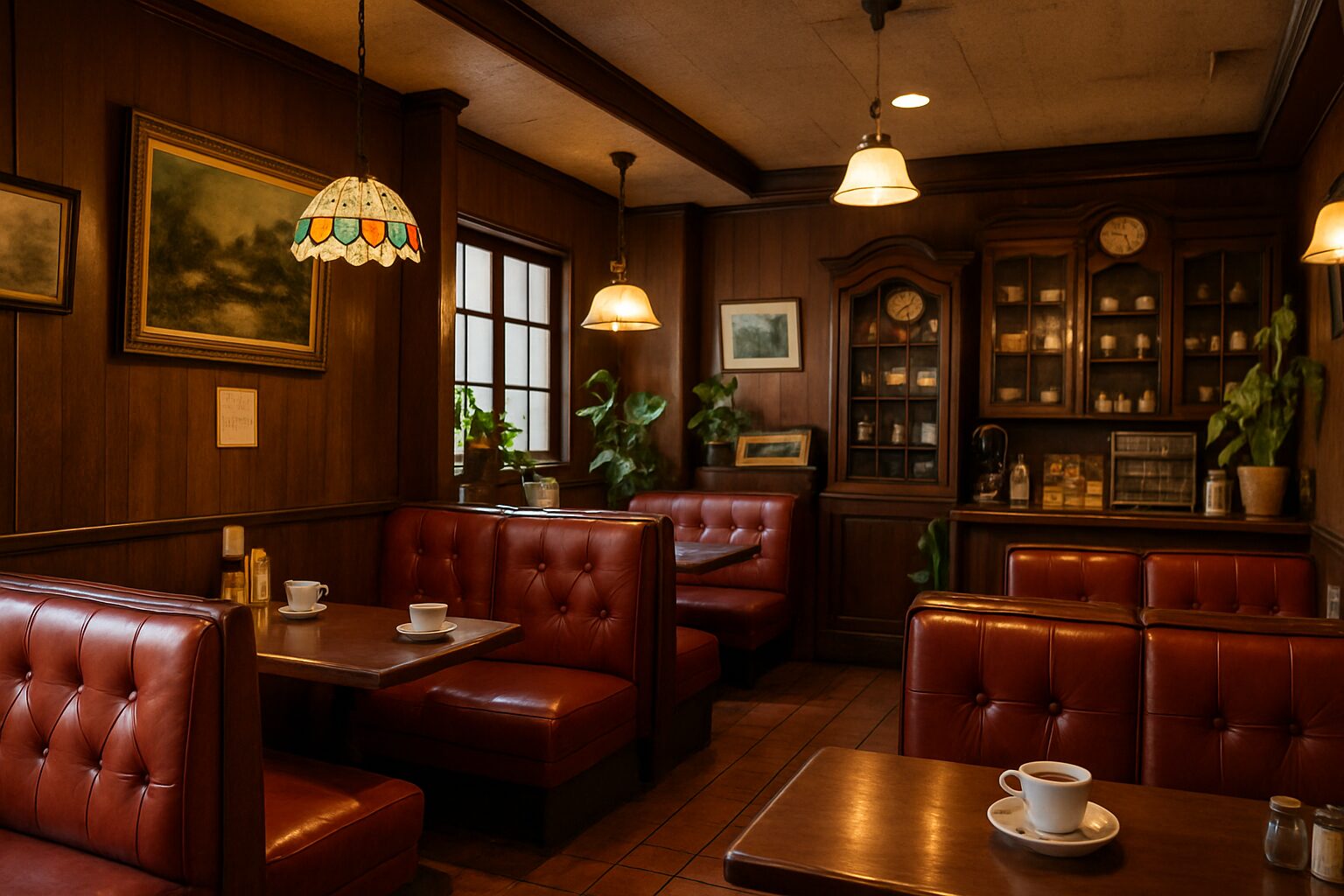
Before you even sip the coffee, the ambiance of a genuine kissaten surrounds you. These spots aren’t merely old; they are carefully preserved. They serve as sanctuaries of the Showa Period (1926-1989), clinging to an aesthetic that resists modern trends. Imagine plush velvet chairs in deep burgundy or forest green, perhaps marked by a few elegant cigarette burns from a past era. Dark, polished wood paneling graces the walls, decorated with landscape paintings or vintage posters. Intricate stained-glass lamps cast a warm, amber light across the room. The soft hum of a ceiling fan, the subtle rustle of a folded newspaper, the gentle clink of porcelain cups against saucers—these sounds compose the morning’s soundtrack.
This sharply contrasts with the bright, noisy, and fast-paced cafes we often know. A kissaten invites you to slow down. There’s no rush to finish your coffee and leave; quite the opposite. These places were created as a “third space” long before that phrase existed—a soothing refuge between the formality of work and the demands of home. They are spots for reflection, quiet chats, and reading the morning paper from start to finish. The sense of nostalgia is tangible; you can almost sense the echoes of countless conversations, business deals, and peaceful moments shared in these booths over the past fifty years. For newcomers, it might feel like stepping onto a film set, but you soon understand this is no act. It is the genuine, living heart of neighborhood life.
The Master and the Method
At the heart of this universe stands the “Master,” the proprietor who frequently serves as both owner and sole employee behind the counter. The Master is the calm conductor of this quiet orchestra. Clad in a crisp shirt and apron, they move with a practiced economy of motion refined over decades. They know the regulars by name and their usual orders by heart, greeting them with a subtle nod of recognition upon their arrival.
The coffee itself is an art form. Many kissaten specialize in siphon coffee, a brewing method resembling a science experiment that yields a uniquely clean, smooth cup. Watching the Master handle the glass bulbs, the open flame, and the precise timing is a captivating performance. The beans tend to be a dark, robust roast, offering a flavor profile that boldly contrasts with the lighter, more acidic notes of third-wave coffee. This is coffee meant to be savored slowly, a warm, grounding presence to start your morning. It is served in a delicate, often ornate porcelain cup that feels special to hold. Every element, from the brewing technique to the choice of ceramic, contributes to the deliberate, thoughtful experience.
An Osaka Morning Safari: Finding Your Kissaten
Osaka is an expansive metropolis, and its kissaten culture showcases the distinctive character of its diverse neighborhoods. Discovering the ideal spot for your morning service is a charming urban adventure.
Umeda’s Business Rhythm
In the vibrant commercial district of Umeda, amidst towering skyscrapers and complex train stations, the kissaten acts as a vital outlet for relief. Here, classic, old-fashioned establishments can be found tucked into basement offices or along quiet side streets, mere steps from the hectic flow of commuters. The patrons are a blend of office workers grabbing a quick, energizing breakfast before their workday, and seasoned salesmen conducting discreet meetings over coffee and toast. The ambiance is slightly more formal and focused, yet equally welcoming. These spots serve a purpose, offering a moment of tranquility before the workday’s rush begins. Look for hand-painted signs and plastic food models in the windows—the universal signals of a delicious, affordable meal awaiting inside.
Namba and the Electric Dream
Travel south to Namba, the city’s lively entertainment district, and the atmosphere changes. The kissaten here feel like sanctuaries from the sensory overload of Dotonbori’s flashing neon lights and crowded arcades. They are quiet retreats where you can recharge. You might discover a shop that has been serving patrons for over seventy years, its interior unchanged, its morning service a comforting constant in a neighborhood defined by endless motion. These are excellent spots for people-watching, observing the diverse cast that forms Osaka’s southern heartland as you leisurely butter your toast.
Tennoji and Shinsekai’s Nostalgic Heart
For the purest, most authentic Showa experience, journey further south to the neighborhoods around Tennoji and Shinsekai. This is Osaka’s working-class soul on full display—a district steeped in gritty, beautiful nostalgia. The kissaten here are genuine time capsules. They are not retro-themed; they simply are retro. The furniture is original, coffee pots have been brewing for decades, and regulars have occupied the same seats since youth. The air is dense with stories. Here, the morning service feels less transactional and more like joining the community’s living room. Don’t be surprised if the elderly gentleman beside you strikes up a conversation. This is where the essence of old Osaka resides, tasting of strong coffee and perfectly toasted bread.
Nakazakicho’s Bohemian Retreats
Just a short stroll from Umeda’s modernity sits Nakazakicho, a quaint maze of narrow alleys and preserved pre-war wooden houses. This artistic, bohemian district is home to a wealth of unique and quirky kissaten. Many occupy refurbished old homes, combining traditional architecture with eclectic, artistic interiors. Morning service here might include homemade jam or distinctively brewed herbal teas. Finding a cafe in Nakazakicho is part of the adventure; it means wandering winding lanes, peering into hidden courtyards, and letting chance guide you. It’s a completely different style of kissaten experience—more laid-back, more inventive, and utterly delightful.
Practical Pointers for the First-Timer

Navigating your first morning service is simple, but a few tips can make the experience even smoother. Most kissaten will display a sign or menu board outside promoting their mōningu setto (モーニングセット). This offering usually runs from opening time (typically around 7 or 8 a.m.) until 10 or 11 a.m. Once inside, you can just point to the menu or say, “Mōningu, kudasai” (“Morning set, please”). You’ll probably be asked about your drink choice. Saying “Hotto kōhī” for hot coffee or “Aisu kōhī” for iced coffee will suffice.
One important cultural note: many of these traditional establishments still allow smoking. Although it’s becoming less common in Japan, classic kissaten are often among the last places where indoor smoking is permitted. If you’re sensitive to smoke, it’s a good idea to glance inside before settling down. Yet for many, that faint, nostalgic scent of tobacco adds to the authentic atmosphere.
Feel free to stay awhile. Unlike many Western cafes, there’s no unspoken pressure to leave as soon as you finish. Bring a book, your journal, or simply enjoy watching the world go by. The kissaten is a place for being, not just for consuming.
Beyond the Morning: The All-Day Allure
While the morning service remains the main attraction, the charm of the kissaten endures throughout the day. Their menus often serve as a collection of nostalgic comfort foods known as yōshoku—Western-style dishes adapted to suit the Japanese palate. Imagine a rich, ketchup-based Napolitan spaghetti, a hearty curry rice, or a perfectly crafted egg sandwich on soft white bread. And then there are the beverages. The iconic Melon Soda Float, a bright green soda crowned with a scoop of vanilla ice cream and a vivid red maraschino cherry, offers an unfiltered taste of childhood delight. Another Osaka specialty is the mikkusu jūsu (mixed juice), a creamy, frothy blend of banana, milk, and canned fruits that is both surprisingly tasty and thoroughly refreshing.
Don’t overlook dessert. A classic coffee jelly, presented in a parfait glass with cream, is an elegant and enjoyable sweet treat. These dishes are all part of the same cultural fabric as the morning service. They reflect a distinct era in Japan’s history, a time of optimism and cultural exchange, and continue to be served with pride and dedication by the Masters who have honed them over many years.
A Ritual Worth Waking Up For
In a city that constantly moves forward, the kissaten stands as a subtle act of resistance. It provides a place to unplug from the digital world and reconnect with the simple, tactile joys of a good cup of coffee, a warm slice of toast, and a moment of calm. Taking part in the morning service is more than just enjoying an affordable and delicious breakfast. It is an experience of cultural immersion. It offers a chance to sit alongside Osaka’s residents as they start their day, to witness the quiet rhythms of neighborhood life, and to value a tradition rooted in generosity and community. So, set your alarm a little earlier tomorrow. Skip the convenience store breakfast. Stroll down a side street, push open a heavy wooden door, and let the warm, coffee-scented air of a kissaten greet you. Find a cozy seat, order the morning set, and savor a taste of Osaka’s true spirit.