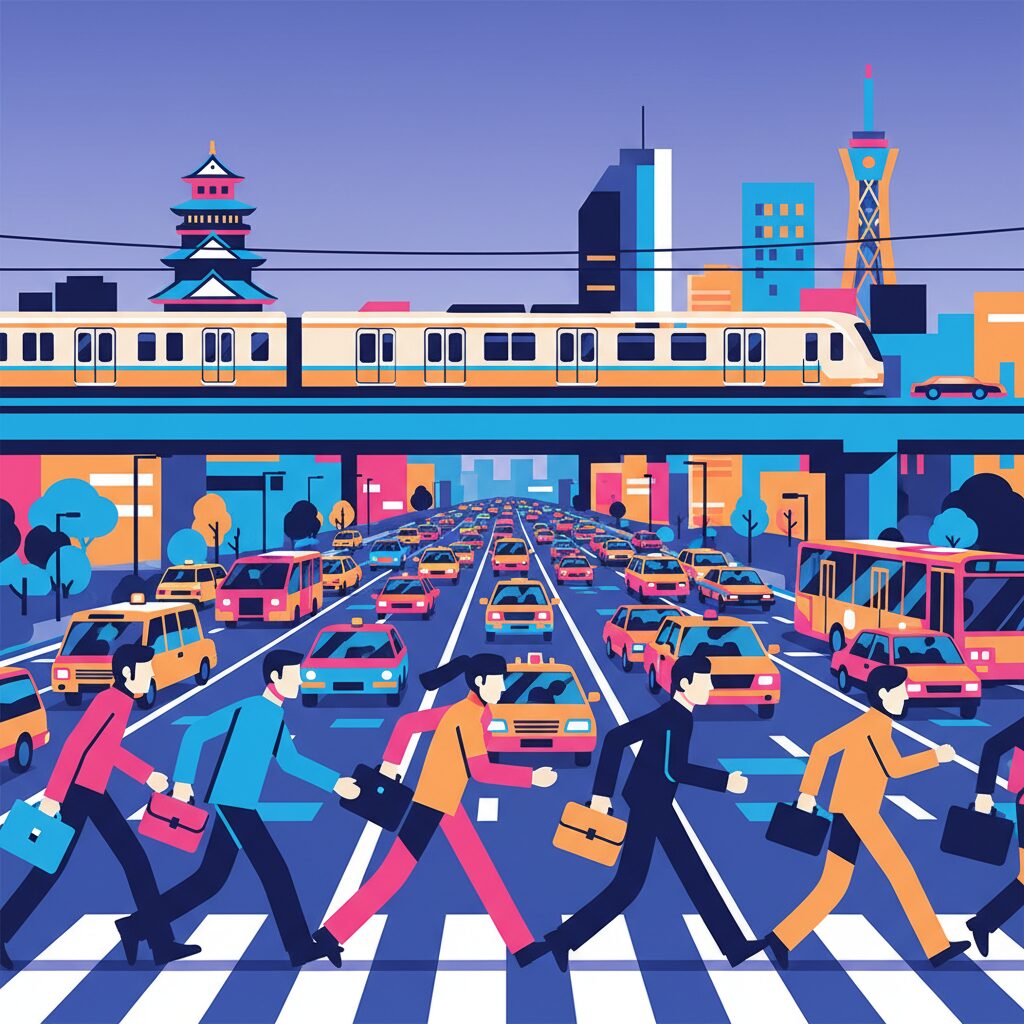
Before you ever see the neon glow of Dotonbori, before you taste your first takoyaki, before you stand in the shadow of Osaka Castle, you’ll likely experience the city’s true rite of passage. It doesn’t happen at a tourist spot. It happens at 8:15 AM on a Tuesday, deep within the concrete labyrinth of Umeda Station. It’s the morning rush hour. You’ve seen pictures, you’ve heard stories—videos of white-gloved station staff pushing people into impossibly full train cars. But that’s a highlight reel, a caricature that misses the point. The reality is something more intimate, more systematic, and far more revealing about the soul of Osaka than any guidebook could ever tell you. It’s a silent, synchronized ballet of millions, a daily test of patience and social cohesion. Forget the travel brochures for a moment. If you truly want to understand how Osaka works, how its people think, and what it feels like to actually live here, you need to understand the commute. This is the city’s heartbeat, rhythmic and relentless, and your first real lesson in the unwritten rules of Osaka life.
To truly settle into the rhythm of Osaka life, mastering the city’s unique social codes, such as the intricate rules of garbage disposal, is just as crucial as navigating its crowded trains.
The Unspoken Rules of the Platform Ballet
Long before the train’s headlights cut through the tunnel’s darkness, the performance is already underway. The station platform serves as a stage, with every commuter acting as a dancer who knows their role by heart. There is no choreographer, no director shouting commands. Only a shared, unspoken understanding exists about how to move a vast number of people from one place to another with minimal friction. This goes beyond mere politeness; it is a masterpiece of social engineering shaped by decades of necessity. For a newcomer, it can be confusing. It appears too orderly, too quiet for the sheer number of people involved. But watch closely, and you’ll begin to notice the intricate patterns and subtle signals guiding this daily migration. It’s the first and most fundamental lesson in negotiating public space in urban Japan, and specifically, how Osaka runs its own brand of organized chaos.
The Art of the Queue
Your first instinct might be to stand wherever there is space. That would be a mistake. Glance down at the platform floor. You’ll find painted lines, often yellow or white, indicating exactly where the train doors will open. On either side of these marks, two neat lines of people have already formed, facing each other like an honor guard awaiting a dignitary. This is not a suggestion; it’s an ironclad rule. You choose a line and stick to it. There is no weaving between lines or trying to find a shorter one. The system is engineered for maximum efficiency. When the train arrives, the space between the two lines becomes a clear passage for disembarking passengers. By queuing to the sides, commuters create an exit route, ensuring the flow remains unblocked. This simple act reveals a core principle in Japanese society: the group’s efficiency takes precedence over an individual’s desire to be first. It’s a silent agreement everyone accepts the moment they step onto the platform. Breaking it is not only rude; it signals a lack of understanding about functioning as part of the collective. You won’t be met with anger but with quiet, withering stares conveying a world of disapproval.
The Doorway Dance
As the train glides to a stop and the doors slide open with a hiss, the next scene of the ballet begins. The two queues on the platform hold perfectly still. No one rushes forward. The space directly in front of the doors is sacred, reserved exclusively for those exiting. A stream of people flows out, and only after the last passenger has crossed the threshold does boarding start. The two lines simultaneously fold inward, merging into one steady stream entering the carriage. It’s a smooth, seamless motion occurring almost in silence. This is more than just courtesy. It is a deeply logical system. Boarding while others are still disembarking causes a bottleneck, slowing everyone down. The “exit first” rule is the foundation of the entire commuting system. It physically embodies a shared understanding that your turn will come, but only after you help others move forward. You’ll notice people subtly turning their bodies to become narrower, holding their bags close, and making small adjustments to let others pass. This is the “doorway dance,” a silent negotiation for space happening thousands of times every second throughout the city. It’s a beautiful, humbling sight, a reminder that harmony in a crowd is an active, ongoing process of mutual accommodation.
Inside the Can: Surviving the Squeeze
Once you step onto the train, the laws of physics and social interaction shift entirely. The carefully structured order of the platform dissolves into a new reality ruled by a single principle: density. The doors close behind you with a soft pneumatic sigh, trapping you in a space defined by intimate, unavoidable closeness. This aspect of the commute surprises foreigners the most. It’s not the external pushing that shapes the experience, but the collective, internal compression. The air grows warmer, infused with faint hints of laundry detergent, coffee, and the scents of a dozen strangers’ perfumes or colognes. At this moment, the Western notion of personal space is not merely ignored; it is utterly erased. Yet, within this intense physical proximity, a different set of social rules arises, crafted to make the overwhelming bearable.
Personal Space: A New Definition
In the West, brushing against someone without apologizing is a breach of etiquette. On a rush hour train in Osaka, you are in constant, full-body contact with multiple people. Your shoulder presses against one person’s back, your hip against another’s, your arm against someone else’s. The key is to realize that this contact is impersonal. It does not invade your space because, in this context, individual space doesn’t exist. There is only shared space. The aim is to become as small and unobtrusive as possible. People stand almost motionless, their bodies swaying gently with the train’s movement. They adopt a kind of “human Tetris” approach, instinctively shifting and adjusting to fill every cubic centimeter of air. There’s a technique to it: keep your arms close to your body, hold your bag in front of you or place it on the overhead rack. You learn to support yourself using your core muscles rather than leaning on others. It’s a curious paradox: you are physically closer to strangers than you might be to your own family, yet you are expected to behave as if you are entirely alone.
The Symphony of Silence
This is often the most striking part of the experience for newcomers. Despite the train being packed to a density that would violate fire codes elsewhere, it remains remarkably quiet. You won’t hear loud conversations or people talking on their phones—an important social taboo. The only sounds are the rhythmic clatter of the train on the tracks, the automated voice announcing the next station, and the faint whisper of music leaking from thousands of headphones. This silence is not empty; it carries meaning. It is a profound act of collective respect. The commute is already a stressful sensory overload. Adding noise to that environment is considered deeply selfish. By staying quiet, each passenger contributes to a shared atmosphere of calm, or at least managed stress. It’s a form of non-verbal communication that says, “I understand this is difficult. We are all in this together. Let’s not make it harder for each other.” This deep-rooted desire to avoid causing trouble, or meiwaku, is a cornerstone of Japanese culture, nowhere more vividly displayed than in the profound silence of a rush hour train.
The “Sumimasen” Shuffle
Exiting a packed train carriage is an art in itself. Your stop is approaching, but you’re ten people away from the door. Panic sets in. How do you get out? The Western instinct is to push or to raise your voice with “Excuse me!” But here, the approach is more subtle and cooperative. Moments before your station, you quietly express your intention with a soft, nearly whispered “sumimasen” (excuse me). There’s no need to shout. The word acts as a cue, a signal to the collective consciousness. The people ahead, without turning, subtly shift, compress, and turn their bodies, creating a narrow path for you to slip through. It feels almost magical. The crowd parts before you like the Red Sea. You continue murmuring “sumimasen” as you move, a continuous flow of apology and thanks. It’s not an apology for existing, but an acknowledgment of the small inconvenience you cause by passing through shared space. This ritual perfectly exemplifies how Japanese society uses verbal and non-verbal cues to accomplish complex, cooperative tasks without conflict or aggression.
Osaka vs. Tokyo: The Commute as a Cultural Barometer
To the casual observer, a crowded train is simply a crowded train. However, for those who have experienced both of Japan’s megacities, the daily commute acts as a fascinating and precise gauge of the profound cultural distinctions between Osaka and Tokyo. While the basic experience is the same—a large number of people packed into a small space—the overall feeling, energy, and subtle social interactions differ greatly. These contrasts reveal much about how each city views itself and its residents. The journey from Umeda to Namba feels markedly different from the trip from Shinjuku to Shibuya, and understanding the reasons behind this is essential to grasping Osaka’s unique character.
The Myth of the “Oshiya” (Pushers)
Let’s begin with the most iconic image of the Japanese commute: the white-gloved station attendants, or oshiya, who physically push passengers into trains. This scene is almost exclusively associated with Tokyo, especially on renowned lines like the Yamanote or Chuo lines during rush hour. Although it still occurs, it’s less frequent than before. In Osaka, such official “pushers” are nearly nonexistent. The task of packing the train to full capacity is left to the commuters themselves, relying on a system of self-regulation and collective effort. Just before the doors close, you’ll sense a final, gentle yet firm push from those behind you, an unspoken pact to create that last bit of space. This subtle difference reflects a significant cultural divide. Tokyo’s approach feels more top-down, an official method addressing the problem of scale, while Osaka’s method is more grassroots, depending on the pragmatism and cooperation of individuals. This small detail hints at Osaka’s slightly less formal and more independent spirit.
The Energy of the Crowd: A Tale of Two Cities
The inside atmosphere of the train further highlights the differences. A Tokyo rush hour train can feel intensely tense. Silence dominates, almost oppressively so. Passengers seem to withdraw into themselves, their faces set in stoic masks of endurance. The train feels like an extension of the office—a place of quiet focus and immense pressure. The energy is one of disciplined uniformity. In contrast, while Osaka’s trains remain quiet and crowded, the ambiance is subtly distinct. The pressure feels less crushing. You might catch fleeting glances or wry, shared looks of resignation with fellow riders. Postures are somewhat more relaxed. There’s an undercurrent of gritty pragmatism rather than silent suffering. People endure the commute, yes, but it feels like just another part of the day—not the overwhelming, soul-crushing ordeal it can seem in Tokyo. Outside, on the platform, the difference is even more striking. Conversations are louder, laughter more frequent, and the air hums with the melodic cadence of the Kansai dialect. This vibrant energy permeates the commuting experience, painting it with a distinctly Osakan character.
The Midosuji Line: Osaka’s Red Artery
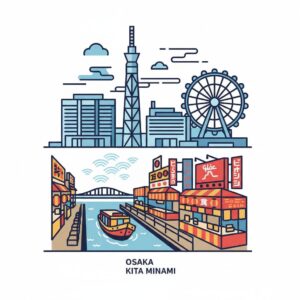
To truly understand the Osaka commute, one must ride the Midosuji Line. This main subway line, marked bright red on maps, connects the city’s two major hubs: Kita (North), centered on Umeda, and Minami (South), anchored by Namba. Traveling it end-to-end during rush hour offers a cross-section of Osaka society. Boarding at Umeda, the sprawling business and transport center, you’ll find the train immediately filling with office workers in dark suits, the city’s economic backbone. As the train heads south, more corporate workers enter and exit at Yodoyabashi and Honmachi, the financial and administrative districts. At Shinsaibashi, the demographic shifts—more retail employees and young people in fashionable attire, heading to the city’s premier shopping area. Finally, arriving at Namba, the core of Osaka’s entertainment and culinary scene, the crowd becomes a lively, diverse mix. The Midosuji Line is more than just transport; it’s a living story of the city’s everyday life, a moving portrait of its varied neighborhoods and people. The immense, unrelenting flow of humanity coursing through this red artery each morning stands as a testament to Osaka’s vitality as a commercial and cultural powerhouse.
A Foreigner’s Guide to Not Messing It Up
Understanding the theory behind the Osaka commute is one thing; managing to survive it while maintaining your dignity and social standing is quite another. As a foreigner, you naturally stand out. Minor mistakes that locals might easily overlook can be significantly magnified. However, by mastering a few key etiquette rules, you can blend in effortlessly, earn the quiet respect of your fellow commuters, and make your daily journey much more enjoyable. These are not just tips—they are signals to those around you that you recognize the unspoken contract of shared space and are willing to respect it. This is how you transform from a bewildered outsider into a seasoned resident.
Backpack Etiquette 101
This is the biggest mistake foreigners and tourists make, instantly marking you as inexperienced. Never, under any circumstances, wear a backpack on your back inside a crowded train. Consider this: a backpack effectively doubles your physical space, occupying the area of another passenger. Even worse, you have limited control over it. When you turn, you risk hitting someone in the face or knocking items from their hands. It is the ultimate commuting faux pas. The correct approach is simple: before boarding, swing your backpack around to the front and hold it against your chest. Alternatively, if space allows, place it on the overhead rack (though these fill up quickly). Holding your bag in front saves a significant amount of space and signals to everyone that you are mindful of your impact on the shared environment. This small gesture carries great weight—a silent “I understand”—that will smooth your journey.
The Smartphone Stare
Look around a crowded train car, and you’ll see nearly every passenger absorbed in their smartphone. It serves as a modern defense against the discomfort of close strangers, creating a private digital bubble within a busy public space. But even this refuge has its etiquette. First and foremost, keep your phone on silent. All notifications, keyboard clicks, and game sounds must be muted. Taking a phone call is simply unacceptable. Second, be discreet about what’s on your screen. While there’s an unspoken rule not to glance at others’ phones, it’s wise to keep your screen brightness at a reasonable level so you don’t light up the entire carriage. Finally, be conscious of your posture—don’t hold your phone where your neighbor must strain to avoid it. The smartphone is a tool for carving out a personal sanctuary, but that sanctuary should never intrude on anyone else’s.
Reading the Room (or the Carriage)
Every train carriage features designated priority seats, often marked in a different color, reserved for the elderly, passengers with disabilities, pregnant women, and those with small children. While anyone may sit there if the seats are empty, it is a strong social expectation that you will give up your seat immediately if someone who needs it boards. This is not optional. Pretending to be asleep or burying yourself in your phone will bring severe social disapproval. Beyond priority seats, there is the women-only car to consider. On many lines, during peak morning rush hours, one carriage (clearly marked on the platform and train) is reserved exclusively for women. This can be a sensitive topic, but understanding it is vital. These cars were introduced to address the very serious problem of groping (chikan) on crowded trains. As a male, entering one of these cars during designated times is a major social blunder. Respect the signs—it’s a system designed for safety and comfort, and abiding by it is non-negotiable.
Beyond the Grind: What the Rush Hour Reveals
It’s easy to write off the morning commute as a necessary nuisance, a daily trial to be endured and soon forgotten. Yet, upon closer examination, this routine embodies the essence of Osaka itself. It offers insight into the city’s character, values, and the mindset of its people. The way millions manage this shared challenge each day without chaos reveals a deep-rooted pragmatism, a strong sense of community, and remarkable resilience. Rush hour is not a blemish on the city’s face; it is the sinew and muscle beneath, the force that gives Osaka its strength and propels it forward. It is where the city’s abstract cultural values take shape as tangible, lived experiences.
Pragmatism Over Polish
The Osaka commute isn’t graceful or comfortable. It is, however, astonishingly efficient. Every element—from the orderly platform lines to the quiet shuffle inside the train—is designed for one goal: moving the greatest number of people in the shortest time with minimal conflict. This emphasis on function rather than form is quintessential Osaka. The city is known for being straightforward, practical, and unpretentious, in contrast to Tokyo’s focus on appearance and formalities. Osaka residents appreciate things that simply work, and despite its discomforts, the rush hour system functions exceptionally well. It exemplifies a collective mindset that values results and common sense. There’s no time wasted on unnecessary pleasantries or strict formalities; just a shared, silent goal and an efficient system to accomplish it.
A Community of Strangers
During those thirty or forty minutes on the train, you become part of a temporary, anonymous community. Bound by shared experience and unspoken rules, you cooperate to maintain balance, create space, and ensure a bearable journey for all. This sheds new light on the famed “Osaka friendliness.” It’s less about being outgoing or chatty with strangers and more about an implicit social contract—a readiness to accommodate and help others because everyone is part of the same urban ecosystem. If you drop your wallet in a crowded train, hands will reach out to help, not out of friendship but because sustaining the group’s smooth functioning is instinctive. In the dense anonymity of the city, this silent cooperation is the adhesive that holds society together.
The Resilience of the Daily Grind
Witnessing the morning rush hour is to see the city at its most raw and determined. This is Osaka’s powerhouse, where immense human energy fuels its economy and culture. It reflects millions of personal ambitions, duties, and routines combined. Enduring this daily builds a unique resilience, a mental toughness forged in one of the busiest urban settings on earth. It is a shared struggle that links the high-rise CEO to the arcade shopkeeper. All stand on the same platform, ride the same crowded train, and follow the same rules. Rush hour is not a flaw in Osaka’s system; it’s a defining feature. It’s not an obstacle to understanding the city; it is the very key. To survive it is to learn how to live here. To understand it is to begin to understand Osaka itself.