Welcome to Osaka, the city that beats with a heart of neon and steel, a place where the scent of takoyaki drifts through ancient temple grounds and the laughter from a thousand izakayas spills into the warm night air. You’ve made it. You’ve chosen Japan’s kitchen, its vibrant, unapologetic, and endlessly fascinating metropolis, as your new stage. But before you can lose yourself in the controlled chaos of Dotonbori’s glowing Glico Man or find your zen in the quiet corners of Shitennoji Temple, there’s a fundamental question you must answer, a choice that will define the rhythm of your new life more than any other. It’s the foundational decision upon which your entire Osaka story will be built: Where will you call home? This isn’t just about a place to sleep; it’s about the very fabric of your daily existence. Will you opt for the quiet sovereignty of a private apartment, a personal sanctuary where you are the sole ruler of your domain? Or will you dive into the vibrant, communal current of a share house, a place of instant connection and shared experience? This choice is a crossroads between two profoundly different ways of living, each with its own unique set of financial realities, social dynamics, and logistical challenges. It’s a decision between forging a path alone, with all the freedom and isolation that entails, and joining a collective, with all its support and compromises. For a foreigner navigating the intricate dance of life in Japan for the first time, this isn’t a trivial matter. It will shape your budget, your social circle, your Japanese language skills, and even your understanding of the local culture. It’s the first, and perhaps most important, key you’ll forge to unlock your own personal Osaka. Let’s explore the landscape together, mapping out the costs, the benefits, and the soul of these two distinct paths. Your adventure starts here, with the simple, yet monumental, choice of a door to open at the end of the day.
To fully immerse yourself in the local lifestyle, consider exploring the unique culture of Osaka’s public baths.
The Financial Frontier: Decoding Osaka’s Rental Riddles

Before you even begin to consider the vibe, the atmosphere, or the lifestyle, you must first face the numbers. Money talks, and in the realm of Japanese real estate, it speaks a language that can be perplexing to newcomers. The financial divide between renting a private apartment and moving into a share house isn’t just a gap; it’s a chasm—filled with unique cultural customs and a terminology of fees found almost nowhere else in the world. Understanding this financial terrain is your initial and most crucial task. It’s the difference between a smooth, exciting start to your life in Osaka and a frustrating, budget-draining experience that leaves you overwhelmed before you’ve even had a chance to explore your local train station. Let’s break down the yen, step by step, to reveal the true cost of securing a roof over your head in this vibrant city.
The Apartment Gauntlet: Navigating the Upfront Financial Barrage
Picture finding the perfect small 1K apartment—a single room with a compact kitchen, just a ten-minute walk from a station on the Midosuji Line. The rent seems reasonable at 70,000 yen per month. A fantastic deal, you think. But that 70,000-yen figure is just the tip of a massive financial iceberg. In Japan, renting an apartment isn’t simply paying the first month’s rent and a security deposit. It’s a complex, multi-layered process called the “initial costs,” an upfront payment that can easily total five, six, or even seven times the monthly rent. Before receiving the keys, you’ll be expected to hand over an amount that could reach 350,000 to 500,000 yen—or more. This initial shock is a rite of passage for renters in Japan, made up of a dizzying array of fees, each with its own name and purpose, all of which must be paid before you can move a single box into your new home. This is the apartment gauntlet, a financial trial by fire demanding substantial savings and mental readiness.
Key Money, Deposits, and Other Complexities: A Glossary for the Unfamiliar
Let’s unpack this mountain of initial costs—a vocabulary lesson you can’t afford to miss. The first and most uniquely Japanese concept is `reikin` (礼金), or “key money.” This is literally a non-refundable gift paid to the landlord as gratitude for allowing you to rent their property. It’s a tradition rooted in post-war housing shortages that still persists today. `Reikin` typically equals one or two months’ rent. For our 70,000-yen apartment, that means an immediate 70,000 to 140,000 yen that you will never get back. It simply disappears. Next, there is the `shikikin` (敷金), the security deposit. This is somewhat familiar to Westerners. It’s usually one to two months’ rent, held by the landlord to cover damages or unpaid rent. In theory, it’s refundable, but in practice, landlords often deduct a significant “cleaning fee” when you leave, regardless of how spotless you leave the place. Expect to receive only part of your `shikikin` back unless the apartment is left in pristine condition. Then there’s the `chukai tesuryo` (仲介手数料), the real estate agent’s commission. This fee is legally capped at one month’s rent plus tax and is typically charged at the maximum. It covers the agent’s service in showing you properties and managing paperwork. It is non-negotiable. But there’s more. You’ll also face a guarantor company fee, or `hoshonin-gaisha` (保証人会社). Since most foreigners don’t have a Japanese family member to co-sign the lease, you’ll be required to use a guarantor company that insures the landlord against rent default. The fee is usually 50% to 100% of one month’s rent for the first year, with an annual renewal fee after that. Add a lock-changing fee, `kagi koukan-dai` (鍵交換代), typically around 15,000 to 25,000 yen, plus mandatory fire insurance, `kasai hoken` (火災保険), costing another 15,000 to 20,000 yen for a two-year policy. Don’t forget the first month’s rent, also due upfront. When you total one month’s rent, one month `reikin`, one month `shikikin`, one month agent fee, and one month guarantor fee, you’re already at five times the rent before smaller fees are counted. This is the stark financial reality of renting an apartment in Osaka—a massive upfront cost that demands a solid savings cushion.
The Monthly Expenses: Beyond Just Rent
The financial burden doesn’t end once you survive the initial onslaught. That 70,000 yen rent is just the baseline. On top of that, you’re responsible for every utility bill: electricity (`denki`), gas (`gasu`), and water (`suido`). These are separate contracts you need to set up yourself, often requiring phone calls in Japanese. Depending on usage—especially in Osaka’s scorching, humid summers or surprisingly cold winters—these utilities can easily add 10,000 to 15,000 yen to your monthly expenses. Then there’s the internet. Signing a contract with a provider can be confusing, with multiple plans and companies to choose from. Many contracts last two years, with steep penalties for early cancellation, costing another 4,000 to 6,000 yen each month. Finally, consider the biggest hidden cost: furnishing your apartment. It will be completely empty. Not just a bed and table, but also a refrigerator, washing machine, microwave, curtains, lighting fixtures (sometimes even those aren’t included), cooking utensils, and everything else needed to make the space livable. You’ll have to buy all these items from scratch—a monumental task and a major expense, easily running into hundreds of thousands of yen even if shopping at budget stores like Nitori or hunting for second-hand bargains. The freedom to choose your furniture comes at a literal price. And remember the `koushinryo` (更新料), the contract renewal fee. Most leases in Japan last two years; if you want to stay longer, you’re likely to be charged a renewal fee, typically equal to one month’s rent, just for the privilege of continuing to live there. It’s a recurring cost that often takes newcomers by surprise.
The Share House Shortcut: A Simpler Route to a Place to Sleep
Now, let’s shift to share houses and watch that mountain of financial complexity shrink to a gentle hill. The share house model is designed for simplicity and a low entry barrier, making it an incredibly appealing option for newcomers to Japan, students, or anyone on a tighter budget. The idea is simple: rent a private bedroom and share common spaces like the kitchen, living room, and bathrooms with other residents. The financial setup reflects this simplicity. The daunting array of `reikin`, agent fees, and guarantor company charges almost never apply in most share houses. The initial cost is much lower and more transparent. Usually, you only pay a deposit and the first month’s rent. Deposits tend to be a manageable flat fee, often between 30,000 and 50,000 yen—much less than the one-to-two months’ rent typical for an apartment `shikikin`. This deposit is often fully or partly refundable, depending on the condition of your room when you move out. Some share houses might charge a one-time “contract fee” or “move-in fee,” but even this is a fraction of apartment initial costs. This means that instead of needing 500,000 yen upfront, you might only require 100,000 yen or less. This difference alone can be a game-changer, enabling you to move to Osaka with less financial strain and freeing up savings for exploring, language classes, or just enjoying your new life.
One Bill to Cover It All
The simplicity extends to monthly payments. A share house usually advertises one all-inclusive monthly price. This rent typically covers not only your room but also all utilities—electricity, gas, and water. High-speed Wi-Fi is almost always included. Many share houses also provide basic household supplies such as toilet paper, dish soap, and cleaning products for shared areas. This bundled approach removes the hassle of setting up multiple contracts and the uncertainty of varying utility bills. You know exactly what you’ll pay each month, making budgeting straightforward and stress-free. No surprising gas bills in the cold or shocking electricity bills in the summer. Moreover, the rooms are almost always furnished. You’ll step into a room equipped with a bed, desk, chair, and closet. The kitchen is fully stocked with a refrigerator, microwave, stove, rice cooker, and often pots, pans, and dishes. The living room includes a sofa and television. All you need to bring is your suitcase and personal items. You can move in and start your new life instantly, without the overwhelming and costly task of furnishing a whole home from scratch. This convenience cannot be overstated—it saves you not only a significant amount of money but also time and effort, allowing you to better focus on settling in and immersing yourself in Osaka’s culture.
The Rhythm of Daily Life: Solitude vs. Symphony
Beyond the cold, hard figures lies the essence of your decision. How do you want to live? What kind of daily rhythm do you envision for your life in Osaka? At this point, the choice goes beyond finances and becomes a deeply personal reflection of your character, your ambitions, and your vision for your time in Japan. An apartment and a share house offer two fundamentally distinct answers to what “home” feels like. One is a silent canvas waiting for you to paint your life on it, a private kingdom of one. The other is a living, breathing community of shared moments, a symphony of various lives playing out in harmony and occasional discord. Neither one is inherently superior, but one will almost certainly suit you better.
Your Private Empire: The Four Walls of Freedom
There is an undeniable magic in closing your own front door at the end of a long day. The click of the lock signals absolute privacy, a mark that you have entered your personal sanctuary, a space governed entirely by your own rules. This is the promise of the private apartment. It is your empire. You can decorate it however you please, paint the walls (with permission), choose every piece of furniture, and create an environment that perfectly reflects you. You can play your music as loud as you like (within reason—Japanese walls can be thin), walk around in pajamas all day, and leave your dishes in the sink overnight without a disapproving glance. There is no one to answer to but yourself. For introverts, creatives, or anyone who treasures personal space and quiet time, this freedom is priceless. After navigating the crowded trains of the Osaka Loop Line and the sensory overload of Umeda’s underground, coming home to perfect silence can be a vital act of mental and spiritual renewal. You control the social thermostat. If you want friends over, you can host a dinner party, a movie night, or simply enjoy a quiet conversation without worrying about disturbing housemates. Your home is your castle, and you are the ruler. This autonomy touches every facet of your life. You decide when to clean, what to cook, and how to live. This fosters a strong sense of independence and self-reliance, which can be incredibly empowering, especially when living abroad.
The Joy of Silence, The Challenge of Solitude
However, this kingdom of one has its downside. The glorious silence can sometimes turn into loneliness. The freedom from social obligations can become a deep sense of isolation. When you’re new to a city, much less a new country, building a social network from scratch is a formidable task. In an apartment, there is no built-in safety net. If you have a tough day at work or feel homesick, there’s no one waiting in the living room to offer a sympathetic ear or share a cup of tea. You are entirely responsible for creating your own social life, which means actively joining clubs, attending events, and making connections. This can be especially hard if you’re still struggling with a language barrier. The privacy you cherish can become a barrier that separates you from the very connections you need to flourish. Simple problems can also become major obstacles. If you can’t figure out how to operate your new washing machine with all-Japanese buttons or need help deciphering official mail from the city office, there’s no housemate nearby to ask for a quick favor. You must navigate these challenges alone. The independence fostered by apartment living is a double-edged sword; it grants complete freedom but also places full responsibility on your shoulders.
The Communal Heartbeat: Life in the Shared Lane
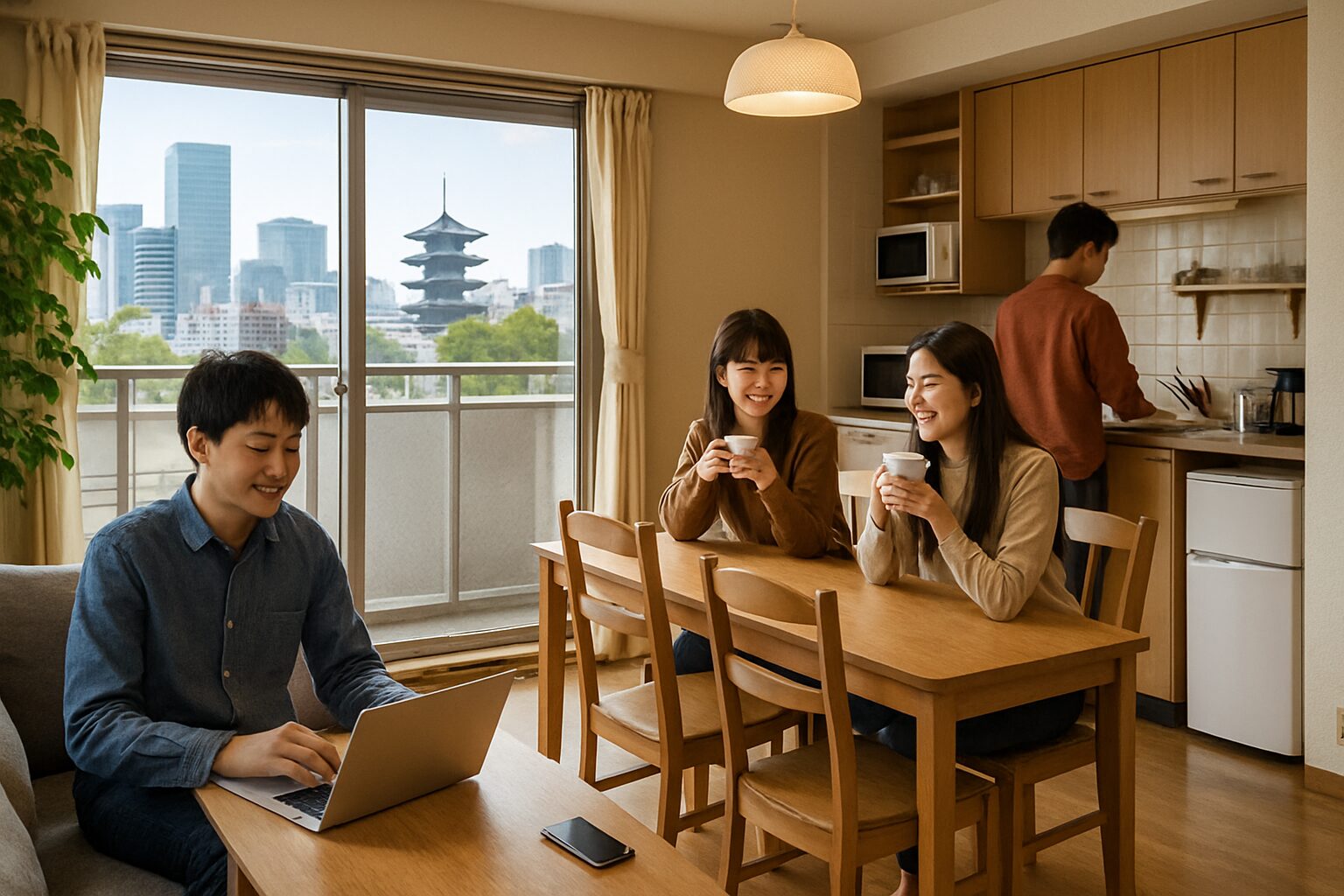
Now, picture a different scenario. You come home after that same long day. As you walk through the door, you’re greeted by the aroma of someone cooking dinner and the sound of laughter from the living room. A housemate from Brazil asks about your day while another from Japan offers you a taste of the curry they’re preparing. This is the reality of a share house. It is a home with a built-in heartbeat, a place of constant, low-level social interaction that can be an incredible remedy for the loneliness of expatriate life. From the moment you move in, you become part of a community. You have an instant network of people—both Japanese and international—who are on the same adventure as you. This creates an immediate support system. Questions about where to find the best groceries, how to open a bank account, or what that puzzling kanji means are answered around the dinner table. Homesickness is eased by shared movie nights and spontaneous weekend trips to Kyoto or Nara organized by the residents. For those aiming to practice their Japanese, a share house is an immersive, round-the-clock language school. You pick up conversational, natural Japanese in a low-pressure setting, absorbing slang and cultural nuances you won’t find in textbooks. Living with Japanese housemates offers an invaluable window into the culture, from grasping social etiquette to learning how to prepare traditional dishes. It’s a cultural exchange that unfolds organically every day.
A Built-in Family: Navigating the Social Landscape
This instant community is the share house’s greatest strength, but it also requires a particular mindset. You trade absolute privacy for continual companionship. You can’t simply retreat into your own world the same way. The kitchen is shared, so you might have to wait your turn to use the stove or navigate around someone else’s cooking. The bathroom has a schedule, especially during mornings. There will be rules—about cleaning duties (`toban`), noise levels, and having guests over. You are part of a collective, which demands compromise, communication, and tolerance for others’ quirks and habits. There will be messy housemates and neat freaks. Social butterflies and quiet introverts. Successfully living in this environment requires social flexibility. You might come home exhausted, craving silence, only to find a lively party in the living room. For some, this is energizing and welcome; for others, it can be draining. Being honest with yourself about the social environment you thrive in is crucial. A share house is more than an affordable place to live; it’s a commitment to a communal lifestyle. If embraced, it can become one of the most rewarding, fun, and transformative experiences of your time in Japan, leaving you with lifelong friends from all over the world.
The Great Hunt: Securing Your Slice of Osaka
The process of actually finding and signing a contract for your new home is another area where apartments and share houses differ significantly. One route is a complex journey filled with linguistic and bureaucratic obstacles, while the other is usually a streamlined, digital-friendly system designed with foreigners in mind. Your experience during “the hunt” will provide a strong initial insight into the realities of navigating Japanese systems.
The Apartment Quest: A Heroic Journey Through Real Estate
Searching for a private apartment in Osaka as a foreigner is a true adventure that requires preparation, patience, and a bit of courage. The journey usually begins at a local real estate agency, or `fudosan-ya` (不動産屋). Their storefronts cluster around nearly every train station, with property listings plastered on the windows. Entering one can feel intimidating. The entire process is likely to be conducted in Japanese. While some agents in central Osaka might speak some English, this should not be expected. If your Japanese skills are limited, bringing a Japanese-speaking friend or hiring a translator is strongly recommended. You will meet with an agent, explain your needs—budget, preferred location, size—and they will show you listings. However, many landlords in Japan are hesitant to rent to foreigners due to concerns about language barriers, cultural differences, or the possibility of tenants breaking a lease and leaving the country. Consequently, some of the best properties may suddenly become “unavailable” once the agent knows you are not Japanese. This frustrating reality is common. Although there are foreigner-friendly agencies, they often have a more limited selection of properties. Once you find a suitable place and the landlord agrees to consider you, the real challenge begins: the paperwork.
Wielding the Sword of Language and the Shield of Paperwork
You’ll need to provide a mountain of documentation, including your Residence Card (`zairyu card`), passport, proof of employment or student status, and proof of income. The application form itself will be a multi-page document entirely in Japanese. The lease agreement, or `chintai keiyaku` (賃貸契約), is a dense, legally binding contract filled with complex terminology that you’ll be expected to sign. This is where the risk is greatest; you must fully understand every clause, from rules about pets and musical instruments to conditions for getting your deposit back. But the single biggest obstacle for most foreigners is the guarantor requirement.
The Guarantor Ghost: A Very Real Obstacle
Nearly every apartment lease in Japan requires a `rentai hoshonin` (連帯保証人), a joint guarantor. This person must be a Japanese national with a stable income and is legally responsible for your rent if you fail to pay. For newcomers without family or strong connections in Japan, finding such a guarantor is nearly impossible. This is why guarantor companies (`hoshonin-gaisha`) have become a standard solution for foreigners. You pay a significant fee, and they act as your financial guarantor for the landlord. It is mandatory and unavoidable. Passing the guarantor company’s screening is yet another step in this lengthy and challenging process. From entering the agency to finally receiving the keys, the entire procedure can take several weeks of back-and-forth communication, document submissions, and waiting. It is a real test of endurance.
Clicking Your Way Home: The Share House Application
In sharp contrast, securing a room in a share house is often as easy as booking a hotel online. Major share house companies like Oakhouse, Borderless House, and Sakura House offer multilingual websites where you can browse available rooms throughout Osaka with detailed photos, descriptions, and virtual tours. The process is designed for an international audience. You can filter by location, price, and even the type of atmosphere you prefer (e.g., social and lively, quiet and studious, female-only). The application is a simple online form that can be completed in English. You’ll submit digital copies of your passport and visa, and communication is typically conducted via email or messaging platforms with multilingual staff. There is no need for a `rentai hoshonin`. The share house company itself is your landlord, operating a business model built around accommodating short- to long-term foreign residents. The screening process is straightforward, often just verifying your visa status and ability to pay rent. You can often reserve a room from your home country before you even arrive, giving you the huge peace of mind of having a place ready upon arrival. The entire process can be completed in a matter of days, sometimes even hours. It is a system designed for convenience, accessibility, and speed, removing nearly all the bureaucratic and language barriers that make the apartment search so intimidating.
Location, Vibe, and Your Urban Identity
Your housing choice will also determine where in Osaka you can reside and, consequently, the type of urban identity you develop. The city is a vast mosaic of distinct neighborhoods, each with its own character, and your address will become a fundamental part of your experience.
Central Energy or Suburban Calm?
Private apartments are available throughout the city, from the dazzling high-rises of Umeda in the north (Kita) to the lively, electric streets of Namba and Shinsaibashi in the south (Minami). However, finding an affordable, modern, and suitably sized apartment in these central areas can be extremely challenging and costly. The most sought-after apartments are often quickly taken by locals. As a foreigner navigating the rental market, you may have better luck finding a place in quieter, more residential neighborhoods a few stops from the city center, such as those along the Hankyu lines in the north (like Toyonaka or Ikeda) or along the Keihan line towards Kyoto. These neighborhoods offer a more relaxed, local atmosphere and often better value, but they come with a daily commute into the city’s core. Share houses, by contrast, are often strategically located in popular, convenient, and trendy neighborhoods. Share house companies understand that their target demographic—young professionals, students, and travelers—prefer to be close to the action. You’ll find many share houses in areas like Tennoji, which combines old-world charm with modern shopping; Nakazakicho, known for its bohemian vibe and cozy cafes; or the fashionable Horie district, famous for its boutiques and art galleries. By pooling resources, a share house can secure prime real estate that would be unaffordable for an individual renting a private apartment. This option can often place you directly in the vibrant, walkable, and exciting neighborhoods you’ve dreamed of living in.
Aligning Your Home with Your Osaka Vision
In the end, consider what you want from your time in Osaka. If your vision is a quiet, reflective life, exploring local shotengai (shopping arcades) in a peaceful residential area and crafting a personalized sanctuary, then seeking a private apartment in a suburb like Senri-Chuo might be the perfect choice. You’ll experience a deeply authentic and serene side of Japanese life. However, if you dream of being in the midst of the activity, enjoying a dynamic social life, meeting people from across the globe, and walking to the best bars and restaurants, then a share house in a vibrant neighborhood like Fukushima or near Osaka Castle could be your ideal starting point. Your housing decision is more than just practical; it’s a lifestyle choice that will place you in a unique part of Osaka’s vast urban landscape and shape the tone of your entire journey. Choose the option that suits not only your budget but also your spirit.
The Final Choice is Yours
We’ve explored both paths. We’ve considered the significant upfront costs and bureaucratic challenges of an apartment alongside the straightforward, all-inclusive convenience of a share house. We’ve balanced the deep, quiet freedom of a private retreat against the lively, supportive community of a shared home. There is no single right answer, no universally better choice. The right path reflects who you are. Are you an independent pioneer with the financial means and resilience to build a life from the ground up, seeking a personal space to call your own kingdom? The apartment awaits. Or are you a social connector, someone who thrives in community, values convenience, and desires an instant family to share both the highs and lows of this incredible journey? The share house door is open. Look within. Reflect on your budget, personality, tolerance for solitude, and need for connection. Whichever you choose, you are beginning an unforgettable chapter in one of the world’s most exciting cities. Your home in Osaka is more than just an address; it is the foundation for every memory you will create. Choose thoughtfully, embrace the adventure, and welcome home.